

Mold Inspection Sarasota: Accurate Local Inspection
A musty smell near the air handler, staining around a window, or a family member dealing with persistent irritation can make any Sarasota homeowner wonder whether mold is hiding somewhere inside the property. Wiping the visible spot may improve the appearance, but it won’t explain where the moisture came from or whether damp materials remain behind the wall.
That’s why mold inspection Sarasota homeowners can rely on should begin with building science, not an automatic order for laboratory testing. A proper inspection finds moisture, maps affected materials, evaluates indoor conditions, and determines what action makes sense. Sampling can help in selected situations, but it isn’t a substitute for correcting the water source.
Why Professional Mold Diagnosis Matters in Florida
A homeowner may notice a dark mark beneath a bathroom cabinet and assume the problem is limited to that surface. Another may smell mildew whenever the air conditioner starts, yet see no visible growth at all. In both situations, appearance offers only part of the answer.
Mold can develop behind drywall, beneath flooring, around supply lines, inside cabinets, and near HVAC components. A musty odor can point toward damp organic materials that aren’t visible from the room. Conversely, a small area of surface growth may reflect a larger leak that has continued inside the wall cavity.
Sight and smell are useful clues
Visual inspection and odor recognition help an experienced technician decide where to investigate, but neither one measures moisture or establishes the full extent of a problem. A cleaning product may remove discoloration while leaving wet insulation, drywall paper, wood framing, or subflooring in place.
That distinction matters in Sarasota because the surrounding environment can keep buildings damp for long periods. Mold is a moisture problem first and a cleaning problem second. If a technician removes growth without identifying the source, the same area can return.
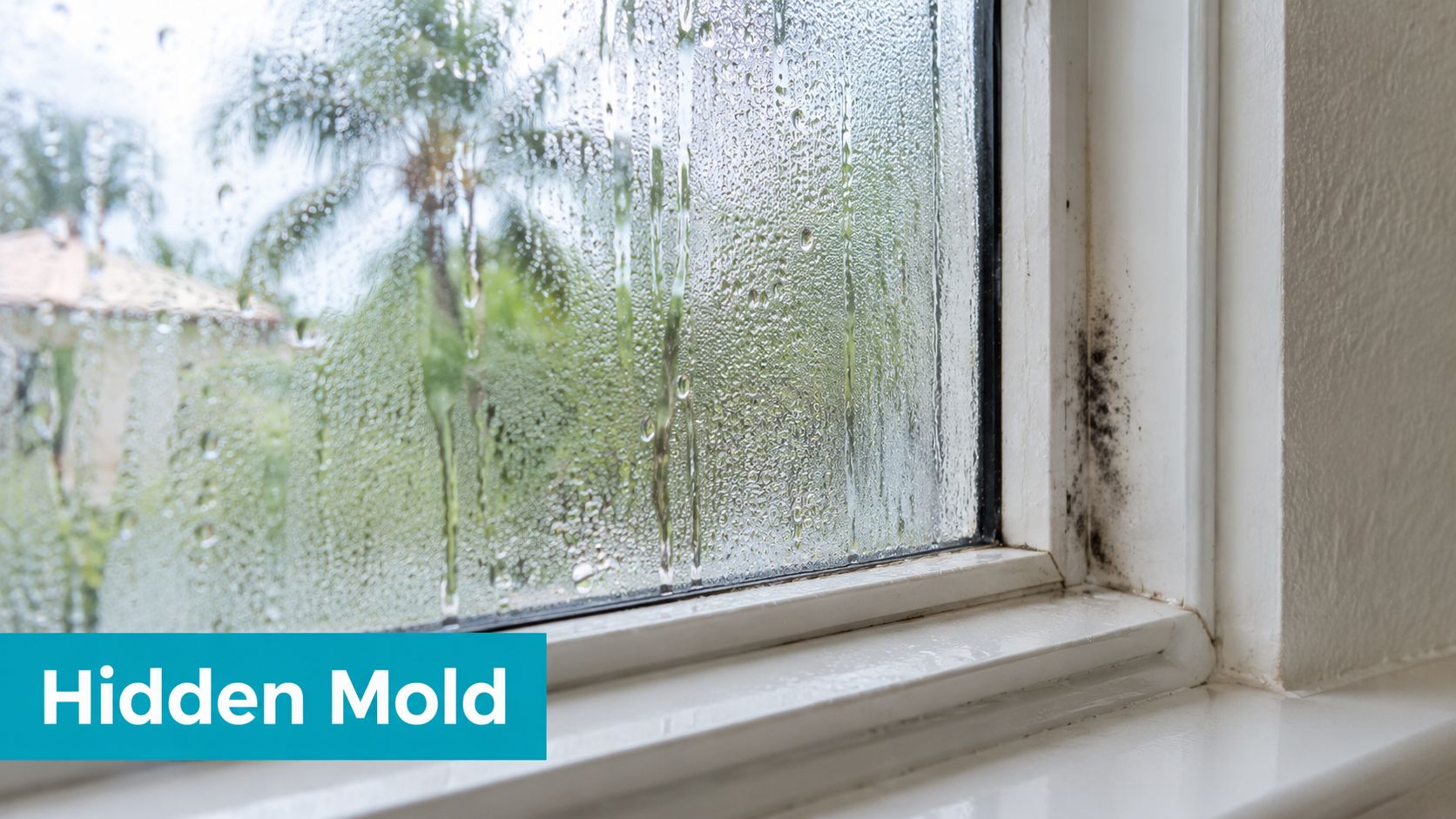
A professional mold inspection service brings together visual observations, moisture readings, humidity measurements, temperature information, and, when justified, sampling. The technician is not just looking for something that looks black or smells unpleasant. The technician is trying to answer practical questions:
- Where did the water come from?
- Is the source active, intermittent, or already corrected?
- Which materials are wet or damaged?
- Could contamination extend beyond the visible area?
- What should be removed, dried, cleaned, or monitored?
- Is laboratory analysis needed for a specific decision?
Why DIY cleaning often fails
Homeowners can sometimes clean a small, isolated area on a hard, nonporous surface when the moisture source has been corrected. That approach becomes risky when the affected material is porous, the odor persists, the area returns, or the suspected growth is near an HVAC system.
The most reliable diagnosis also protects the property. A written record of observed conditions, moisture locations, affected materials, and recommended corrective work can help a homeowner communicate with a property manager, contractor, or insurer. It replaces assumptions with evidence.
Practical rule: If you can see mold but can’t explain why the material became wet, the inspection is incomplete.
Understanding the Persistent Mold Risk in Sarasota
A Sarasota home can feel cool while hidden materials remain damp. Outdoor relative humidity stays above 70% for much of the year, and July and August dewpoints commonly reach 74°F to 76°F. Indoor relative humidity should stay below 60% to slow mold growth, with 45% to 55% offering a more comfortable Florida range.
That difference between outdoor and indoor conditions requires constant control. Air conditioning, dehumidification, sound window assemblies, roof maintenance, plumbing repairs, and controlled ventilation all help keep humid coastal air from affecting building materials.
The thresholds that change the risk
Mold growth accelerates when indoor relative humidity rises above 60%. If humidity stays above 70% for more than a few days, growth on paper-faced drywall becomes highly likely within days. A wall can therefore be deteriorating even when the room still looks usable and feels comfortable.
The figures in the table below come from the same Florida humidity guidance cited above. Their value is practical: each threshold points toward a different inspection or maintenance decision.
| Condition | What it means for the home |
|---|---|
| Outdoor humidity above 70% for much of the year | Keep indoor humidity under control rather than relying on outdoor ventilation alone. |
| Summer dewpoint of 74°F to 76°F | Check whether the air conditioner is removing moisture, not only lowering temperature. |
| Indoor humidity above 60% | Measure the room and investigate HVAC operation, drainage, air leakage, or moisture entry. |
| Indoor humidity in the 45% to 55% range | Maintain this range when practical, especially in bedrooms, closets, and seldom-used rooms. |
| Humidity above 70% for more than a few days | Inspect paper-faced drywall, closets, and other porous materials for elevated moisture and early growth. |
These thresholds do not mean every humid property has the same damage. They explain why a Sarasota inspection must connect humidity readings with material type, temperature, airflow, and the location of any visible staining or odor. Building-science findings often answer the homeowner's first question more effectively than a laboratory result: where moisture is entering and why it has not dried.
Why HVAC performance matters
An air conditioner can cool a room without removing enough moisture. Short cycling, blocked filters, poor condensate drainage, inadequate duct insulation, and an oversized system can leave a property cool but humid. A vacant vacation home presents another risk because small leaks and rising humidity may go unnoticed between visits.
The building envelope also deserves attention. Failed window seals, roof penetrations, plumbing connections, shower assemblies, and exterior drainage can introduce moisture that normal HVAC operation cannot overcome. Checking only the visible stain may miss the assembly or source that keeps the material wet.
For homeowners, landlords, and commercial operators, mold inspection Sarasota work is therefore an ongoing moisture-management discipline. The useful result is not just a label for suspected contamination. It identifies the building condition that allowed growth to develop and the maintenance decision that can reduce the chance of recurrence.
Inspection vs. Testing and What You Actually Need
A mold inspection and mold testing answer different questions. Confusing them can lead a homeowner to pay for laboratory analysis while the leaking pipe, wet drywall, or poorly controlled humidity remains unresolved.
An inspection is a building-science investigation. It typically includes a visual review, moisture mapping, humidity and temperature observations, evaluation of likely sources, and an assessment of affected materials. The inspector uses those findings to determine the probable scope of the problem and the next practical step.
Testing involves collecting air or surface samples for laboratory analysis. Depending on the situation, the analysis may help characterize spores or compare indoor conditions with an outdoor baseline. Testing can provide useful information, but it doesn't dry a wall, repair a roof, remove contaminated materials, or stop a plumbing leak.
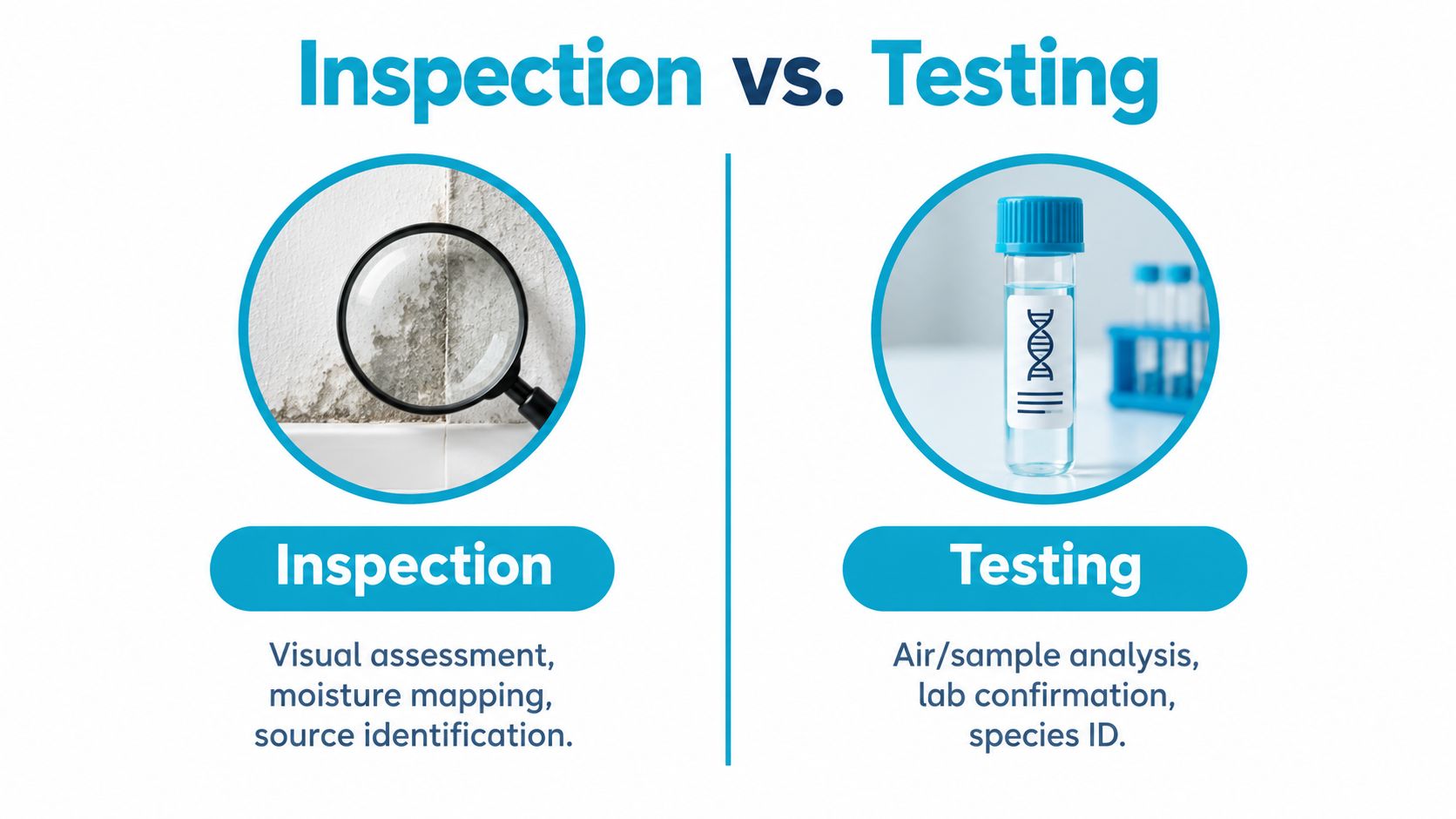
Compare the purpose before choosing the service
| Question | Inspection | Testing |
|---|---|---|
| What does it primarily find? | Moisture sources, affected materials, and likely extent | Air or surface conditions submitted for laboratory analysis |
| Does it identify the cause? | It can investigate leaks, condensation, humidity, and building conditions | A lab result alone doesn’t identify the building source |
| Is it always necessary? | Appropriate when moisture, odor, staining, or suspected hidden damage exists | Useful when a specific decision requires analytical information |
| What happens after the result? | The findings support drying, repair, removal, or remediation planning | The result may add context, but corrective work still addresses moisture and materials |
Florida’s public-health guidance says mold assessors and remediators are licensed under Florida Statutes sections 468.84 through 468.8424, with licensing handled by the Department of Business and Professional Regulation. The same state guidance says Florida doesn’t recommend mold testing just to confirm that a mold problem exists or to identify the species present. That position puts the emphasis on source control and moisture remediation, rather than treating species identification as the primary objective. The regulatory and public-health framework is summarized in the Florida mold licensing and assessment guidance.
When sampling makes sense
Sampling may be reasonable when visible findings are uncertain, when occupants or stakeholders need documented analytical information, or when a professional needs to compare indoor air with outdoor background conditions. EPA guidance also points readers toward analytical methods recommended by professional organizations, including the American Industrial Hygiene Association and the American Conference of Governmental Industrial Hygienists. Those recommendations are discussed in the EPA mold course guidance.
The practical trade-off is straightforward. A visual and moisture inspection usually provides the information needed to locate and correct a known water problem. Testing can add evidence when the decision is unclear, but a clean-looking laboratory report doesn’t prove that a building is dry or that hidden materials are unaffected.
Homeowners comparing a mold kit with a professional mold inspection should ask what question the test will answer. If no one can explain how the result will change the repair plan, the money may be better spent locating the moisture source.
The Step-by-Step Mold Inspection Process
A credible inspection follows a logical sequence. The technician starts with the property’s history, then narrows the search using observations and instruments. The process should make the diagnosis more accurate, not merely produce a stack of sample labels.
Start with the history
The initial conversation should cover recent leaks, roof or storm damage, plumbing failures, HVAC concerns, renovations, recurring odors, visible staining, and areas where occupants noticed discomfort. Property managers should provide maintenance records when available. A timeline helps distinguish an active leak from old staining and can reveal whether a repair solved the issue.
The technician then reviews the building layout and looks for conditions that commonly concentrate moisture. Bathrooms, kitchens, laundry rooms, exterior walls, closets, air handlers, window openings, and areas below plumbing deserve careful attention, but the investigation shouldn’t stop at the room where the odor is strongest.
Scan surfaces and concealed assemblies
A moisture meter helps identify high moisture content in materials and compare suspect areas with apparently dry locations. Infrared imaging can reveal temperature patterns associated with damp materials, missing insulation, air leakage, or concealed water movement. Infrared works best when there’s enough temperature contrast to make the pattern visible, so it isn’t a magic camera that directly photographs mold.
Moisture meters and thermal imaging complement each other. The thermal image can point to an abnormal area, while the meter helps confirm whether the material contains excess moisture. Building-science guidance also recognizes that wet materials can support microbial growth quickly, with some coastal-humidity sources citing initiation in roughly 48 hours. That timing is discussed in technical guidance on infrared inspection and wet materials.
Homeowners who want to learn the warning signs before an appointment can review this resource on spotting home water damage. It won’t replace an inspection, but it can help residents document stains, swollen materials, peeling finishes, and odor locations.

Sample only when the findings justify it
A technically sound mold inspection in Sarasota pairs visual observations with moisture, temperature, and humidity measurements. Inspector workflows in the local market commonly include one outdoor baseline sample plus at least two indoor air samples when air sampling is part of the assignment, allowing indoor spore loads to be compared with background conditions. This approach is described in Sarasota mold testing and sampling guidance.
Sampling should have a defined purpose. The technician should explain where samples will be collected, what they can and can’t show, and how the findings will affect the recommendations. Surface samples may help characterize a particular area, while air samples provide a snapshot of airborne conditions. Neither one independently maps every contaminated material.
The final stage is documentation. A useful report identifies observed moisture sources, locations tested or inspected, affected materials, limitations, photographs when appropriate, and recommended corrective actions. For questions about detecting concealed conditions, homeowners can review how mold inspections detect hidden mold behind walls.
Reading the Report and Certifications to Trust
A report should help you make a decision, not leave you with unexplained laboratory language. Look for a clear connection between observations, moisture findings, suspected source, affected materials, and the recommended response.
A strong report distinguishes confirmed conditions from areas that need further investigation. It should identify whether moisture is active, whether materials are porous or cleanable, and whether the inspector recommends drying, repair, removal, containment, cleaning, testing, or continued monitoring. Photos and a floor plan can make the findings easier to communicate to an insurer or another contractor.
What standards add
ANSI/IICRC S520-2024 is the current professional mold remediation standard. It covers procedures and precautions for remediation in residential, commercial, and institutional buildings, including related systems and personal property contents. The standard organizes mold work around inspection, containment, removal, cleaning, treatment, and restoration, giving contractors a practical framework instead of a vague promise to “spray and wipe.” Details about its scope appear in the ANSI overview of S520-2024.
The IICRC describes S520 as a procedural standard. Its companion R520 reference guide restates and expands on the procedures and methodologies, including inspection and preliminary determination, building science, safety, documentation, post-remediation verification, and the role of an indoor environmental professional. The distinction is explained in the IICRC R520 reference guide information.
Questions worth asking before hiring
Credentials don’t replace careful work, but they help you screen providers. Ask:
- License status: Is the company or professional properly licensed for the work being performed in Florida?
- Scope: Does the estimate cover assessment, remediation, reconstruction, or only one of those services?
- Tools: Will the technician use moisture meters and thermal imaging where conditions justify them?
- Sampling logic: If testing is proposed, what decision will the results support?
- Documentation: Will you receive readings, photographs, affected-area descriptions, and recommendations?
- Independence: Who will perform post-remediation verification if verification is needed?
You can also review guidance on understanding a mold inspection report before signing a contract. Be cautious with a provider who promises certainty from a single sample, refuses to discuss moisture sources, or recommends demolition without explaining the evidence.
A trustworthy report tells you what was found, what remains uncertain, and what action will resolve the uncertainty.
Navigating Insurance Claims and Remediation
Mold claims often become difficult because the visible growth is not always the original loss. A burst supply line, roof intrusion, storm event, appliance failure, or long-term seepage may receive different treatment under a policy. The inspection can’t guarantee coverage, but it can document the physical facts that an adjuster needs to evaluate the cause.
Photographs, moisture readings, affected-material descriptions, drying records, repair invoices, and a clear timeline can support the claim file. Keep damaged materials available for documentation when it’s safe to do so, and avoid making unnecessary cosmetic changes before the carrier or its representative has had an opportunity to inspect.
Licensing exemptions require care
Florida law in Chapter 468, Section 468.8419 creates specific exemptions from mold-assessment and mold-remediation licensing rules for certain owners and employees working on property they own, lease, operate, or manage. The statute also says the exemption doesn’t apply when the person, employer, or affiliated entity is in the business of performing mold remediation for the public. It separately addresses work by an employee of a mold remediator under direct supervision. The statutory language is available in Florida’s mold licensing law.
That doesn’t mean every property owner should open walls or remove contaminated materials. Legal permission, safe work practices, insurance requirements, and the actual scope of contamination are separate questions. Commercial landlords and managers should be particularly careful because occupied buildings involve tenants, employees, visitors, contents, and operational disruption.
Weather-related losses can also involve more than mold. Property owners reviewing coverage questions may find this Florida windstorm insurance guide useful when considering how storm damage and subsequent moisture intrusion fit into a broader claim.
Professional documentation helps reduce disputes over what happened and when. It also gives the restoration team and carrier a common record for deciding whether drying, containment, removal, reconstruction, or additional investigation is appropriate. For a practical discussion of policy questions, see whether mold remediation is covered by insurance.
Prevention Strategies for Coastal Homes
Prevention starts with the conditions found during the inspection. Sarasota homeowners should treat moisture control as routine property maintenance, not a response reserved for visible mold.
Keep HVAC equipment serviced and make sure condensate drainage works correctly. A cooling system that runs but doesn’t control humidity can leave the home vulnerable. Use dehumidification when the indoor environment remains damp, and monitor indoor relative humidity rather than relying only on how cool the room feels.
Check window frames, exterior doors, roof penetrations, plumbing connections, shower surrounds, and cabinet bases for recurring moisture. Improve drainage around the building so rainwater moves away from walls and foundations. After a storm or plumbing failure, inspect concealed areas instead of assuming that a dry-looking finish means the assembly is dry.
A practical maintenance list includes:
- Track humidity: Use a reliable hygrometer in rooms with past odor, condensation, or water damage.
- Inspect HVAC drainage: Look for overflow, blockage, staining, or persistent dampness near the air handler.
- Watch window and wall edges: Condensation, bubbling paint, swollen trim, and soft drywall deserve investigation.
- Respond to leaks quickly: Dry affected materials and identify the source before closing walls or replacing finishes.
- Review vacant properties: Arrange periodic checks for rentals, seasonal homes, and commercial spaces with limited occupancy.
A professional inspection is most valuable when it leads to a lasting change, such as repairing a leak, improving dehumidification, correcting drainage, or replacing materials that can’t be effectively dried and cleaned.
Secure Your Home with a Free Professional Inspection
The right response to a suspected mold problem isn’t panic, and it isn’t an automatic laboratory order. Start by identifying the moisture source, assessing the affected materials, and deciding whether sampling adds useful information. That approach protects both the property and the household from spending money on answers that don’t change the repair plan.
A qualified provider should explain the findings in plain language, document the conditions, distinguish inspection from testing, and coordinate the next step with the owner, property manager, or insurance carrier. AMPM Restoration Services provides mold inspection, water damage restoration, mold removal, fire and smoke restoration, storm and flood cleanup, commercial restoration, and reconstruction for communities across the Gulf Coast, including Sarasota, Bradenton, Tampa Bay, Saint Petersburg, and Lakewood Ranch.
Property owners who also need pest-related support can review Pestless Inc.’s Miami-Dade solutions as a separate resource. Mold and pest concerns can overlap around damp building materials, but each requires its own qualified evaluation.
Frequently asked questions about mold inspection Sarasota
What does a mold inspection in Sarasota look for?
A professional inspection looks for visible growth, musty odors, active or historical water intrusion, high moisture, humidity problems, damaged porous materials, and conditions that could support hidden contamination. The technician may use moisture meters and infrared imaging to investigate areas that can’t be evaluated by sight alone.
Is mold testing required after visible mold is found?
Not necessarily. Florida Department of Health guidance doesn’t recommend testing just to confirm that mold exists or identify its species. Testing may be useful when a defined question requires laboratory analysis, but source control and moisture correction remain central to the response.
Can a moisture meter find mold behind a wall?
A moisture meter can identify high moisture levels in accessible materials and help locate suspicious areas. It doesn’t directly identify every mold colony behind a wall. Infrared imaging can reveal temperature patterns that guide further investigation, while selective openings or sampling may be considered when the evidence justifies them.
Should I use a home mold test kit?
A kit may produce a laboratory result, but it usually won’t identify the leak, map the affected materials, or determine what needs to be removed. If you have persistent odor, staining, recurring growth, or known water damage, a building-focused inspection generally provides more actionable information than a standalone test.
Does homeowners insurance cover mold remediation in Florida?
Coverage depends on the policy and the cause of the damage. Mold connected to a covered sudden water event may be treated differently from mold associated with long-term maintenance issues, excluded causes, or unrepaired leaks. Document the loss and ask the carrier how it wants the inspection and mitigation handled.
How quickly should I arrange an inspection after water damage?
Arrange an evaluation promptly, especially when materials remain damp, the affected area is concealed, or drying equipment hasn’t been used. Building-science guidance cited earlier describes microbial growth initiation in roughly 48 hours under favorable wet conditions, so delaying can make the scope harder to control.
AMPM Restoration is available 24/7 for emergency restoration and offers free inspections and estimates, insurance claim assistance, and financing options. Call 941-946-7807 when you need a professional evaluation for suspected mold, hidden moisture, or water damage in Sarasota and surrounding Gulf Coast communities.
AMPM Restoration Services provides professional mold inspection, moisture assessment, water damage restoration, mold removal, and reconstruction support for homes and businesses across Florida’s Suncoast. Visit AMPM Restoration Services to request a free inspection and estimate, discuss insurance claim assistance and financing options, and take the next step toward a dry, safe property.
