


What Are the Signs of Water Damage Behind Drywall?
If you’re standing in your home after a hard Florida rain and noticing a faint musty smell, a tiny bubble in the paint, or a stain that seems too small to matter, you’re asking the right question: what are the signs of water damage behind drywall? On the Gulf Coast, hidden moisture is common because leaks don’t always show up where they start, and our humidity makes early damage harder to read.
In Bradenton, Sarasota, Lakewood Ranch, Tampa Bay, and Saint Petersburg, homeowners often wait because the wall still looks mostly normal. That’s the mistake. Water can move along framing, pipes, and trusses before it shows itself, which means the visible clue is often only the last stop, not the source.
AMPM Restoration is a 24/7 emergency restoration company based at 4301 32nd St W b18, Bradenton, FL 34205, serving Bradenton, Sarasota, Tampa Bay, Saint Petersburg, Lakewood Ranch and surrounding Gulf Coast communities with professional water damage restoration, mold inspection and mold removal, fire and smoke damage restoration, storm and flood damage restoration, commercial restoration services, and full reconstruction solutions. If you’re worried about hidden moisture, the most useful first step is learning which clues matter, which DIY tests can mislead you in Florida, and when a professional inspection becomes urgent.
That Unexplained Spot Your First Clue to Hidden Water Damage
Many wall leaks don’t announce themselves prominently. You walk past the same hallway corner every day, then one morning the paint looks slightly raised. Or the guest room smells earthy after a storm, even though you don’t see a wet wall. Those small changes are often the first real warning that moisture is trapped behind drywall.
On Florida’s Suncoast, hidden wall damage is easy to underestimate because surfaces can dry faster than the cavity behind them. The front of the wall may look fine while insulation, backing paper, wood framing, or trim stays damp. That’s why what are the signs of water damage behind drywall isn’t just a cosmetic question. It’s a structural and indoor air quality question too.
Start with what changed
Use a simple rule. If a wall smells different, looks different, or feels different than it did last week, treat that as a clue, not a coincidence.
Practical rule: A small symptom on the surface can point to a much larger moisture problem inside the wall cavity.
Homeowners who want to understand mold control after water intrusion sometimes benefit from broader technical reading on selecting industrial anti-mould solutions, especially when trying to distinguish cleanup from true remediation. But before thinking about products, confirm whether water is present.
A smart local next step is scheduling free water leak detection when the source isn’t obvious. That’s especially important after roof leaks, AC issues, plumbing failures, or storm-driven rain, because the stain you see may be far from where the water entered.
Don’t wait for a dramatic stain
Homeowners often expect a soaked wall or obvious drip. Hidden wall damage rarely starts that way. It starts with a subtle smell, a faint discoloration, or trim that looks slightly off.
If something seems off in your house, trust that instinct and investigate it quickly. Early action gives you more options and usually means less invasive repairs.
Visual Clues The Earliest Visible Signs of Trouble
A wall can look only slightly off and still have active moisture behind it. In Bradenton homes, that matters because our heat and humidity can soften paint, swell trim, and create surface changes that look like a leak when the actual issue is condensation, or make a real leak look less serious than it is.
The first visible clues are usually modest. A pale yellow ring near the ceiling. A brown stain above a baseboard. Paint that starts to blister at a window return or outside wall. The U.S. Environmental Protection Agency notes that moisture problems often show up as discoloration, peeling paint, or warped materials, especially after a leak or prolonged dampness in the building assembly.
https://www.epa.gov/mold/brief-guide-mold-moisture-and-your-home
What to check before the stain gets worse
Inspect the areas that fail first. Around windows, under roof lines, below second-floor bathrooms, behind washing machine walls, near tubs and showers, and anywhere an AC line runs through or above the wall.
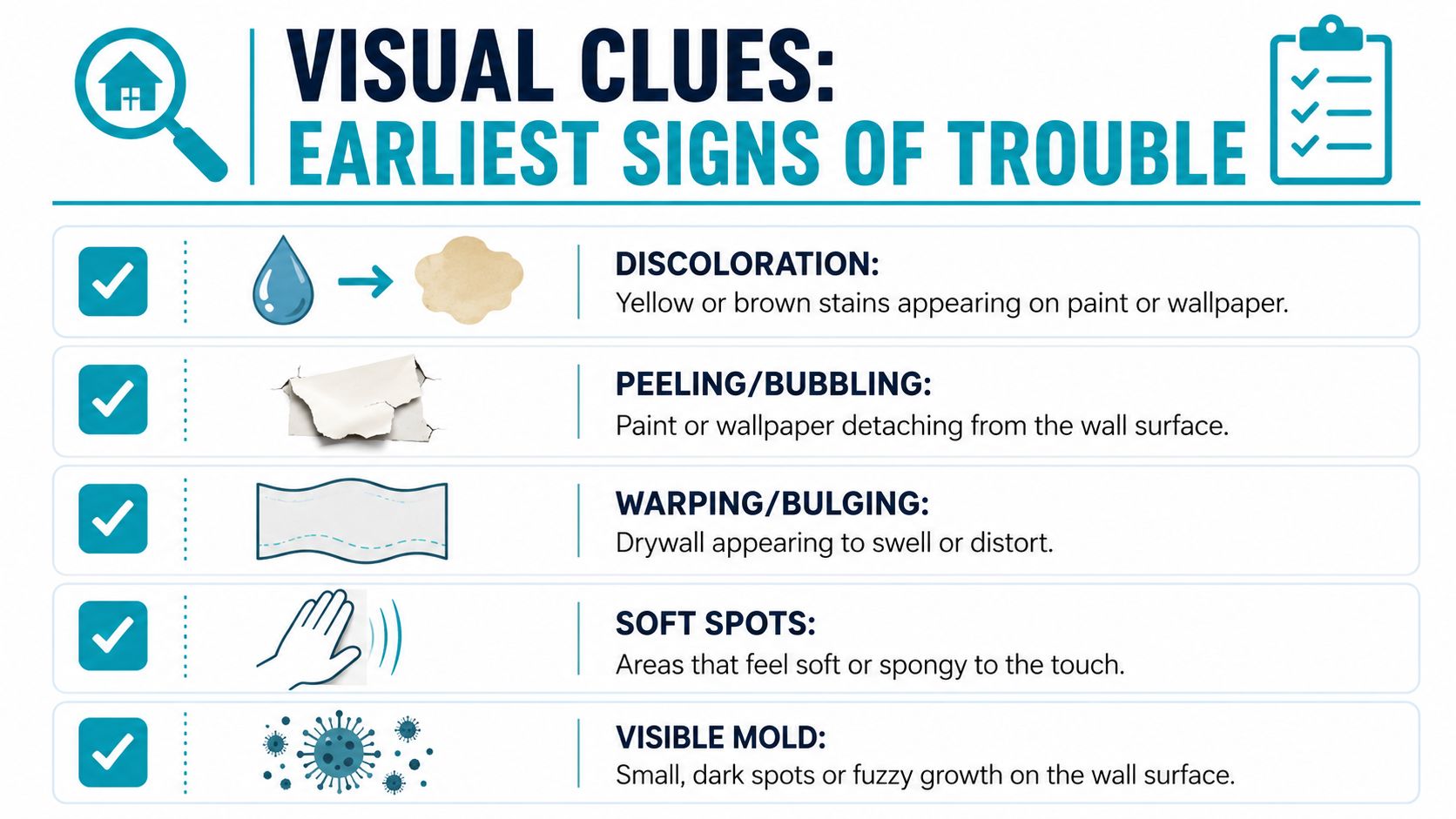
Look for these surface changes:
- Yellow or brown staining: Water pulls tannins, rust, and other residues through drywall and paint, leaving a tea-colored mark.
- Bubbling or peeling paint: Moisture breaks the bond between the wall surface and the paint film.
- Slight swelling or waviness: Drywall tape lines may start telegraphing through, or the wall may lose its flat look in one small area.
- A stain that slowly expands: That usually points to an ongoing source, not an old one that already dried.
- Small dark specks on painted drywall: They may be early microbial growth, especially on cooler exterior walls or around AC-related moisture.
Florida homeowners need to be careful with DIY checks here. A wall that feels cool to the touch is not proof of a hidden leak in our climate. Air conditioning, shaded exterior walls, and high indoor humidity can all create false positives. Good inspections rely on moisture meters, thermal imaging, and a reading pattern across the wall, not one hand test in one spot. If you want a practical comparison guide, this page on signs of water damage in walls helps show what deserves a closer look.
Why the mark you see is rarely the full problem
Water follows framing, plumbing, and gravity in unpredictable ways. I see this often after roof leaks and wind-driven rain on the Gulf Coast. The stain appears in one place, but the entry point is several feet away. A plumbing leak can also stay hidden in a stud bay and surface low on the wall long after the pipe started dripping.
That is why surface appearance has limits. It gives you a target area, not a full map of the damage.
For readers comparing hidden wall moisture with other concealed growth patterns in a home, Vanish Canada’s guide to attic mold is useful because it shows how secondary symptoms often appear before the full extent of the problem is obvious.
Trusting Your Senses When You Smell or Hear Damage
You walk past the same hallway wall every day, and one evening the house smells a little off. Not a strong sewage smell. More like damp cardboard, old towels, or an AC closet that never fully dries out. In Bradenton homes, that change matters, especially during long humid stretches when hidden moisture can sit behind drywall without leaving an obvious stain.
A musty odor in one specific area often points to moisture trapped in the wall cavity. The EPA explains that mold commonly produces a musty smell, even when growth is hidden from view, which is why odor can be one of the first clues a homeowner notices in a concealed-damage situation. See the EPA’s guidance on mold and moisture from the U.S. Environmental Protection Agency.

What a musty smell usually means
Drywall alone is not the usual source of that odor. The smell typically comes from damp paper facing, insulation, wood framing, dust, or microbial growth inside the wall. If the odor stays strongest near one closet, vanity, exterior wall, or AC-adjacent room, treat it as a location clue.
Florida homes add a complication. High humidity can make a room smell stale even when there is no active leak, and cool air from the AC can make a wall feel suspicious when it is merely being chilled from the other side. That is why I do not put much weight on the old DIY advice to smell the room, touch the wall, and call it confirmed. In Gulf Coast conditions, those checks can point you in the right direction, but they do not give a reliable diagnosis.
Watch for patterns instead. A smell that gets stronger after rain, after a shower on the other side of the wall, or when the AC has been running hard usually deserves a closer inspection.
If hidden growth is part of your concern, this guide on how to tell if mold is in your walls can help connect odor, room history, and moisture exposure.
Sounds that often mean water is still active
Noise matters too. If the house is quiet and you hear light dripping, a faint hiss, or a soft rushing sound inside the wall when no fixture is running, there may be an active plumbing leak. The Insurance Institute for Business & Home Safety advises homeowners to investigate unexplained sounds of running water because they can signal concealed leaks before visible damage appears. Their home plumbing loss guidance is a good reference from IBHS.
Listen for:
- Intermittent dripping: Common after fixture use if water is escaping slowly inside the wall.
- A steady hiss: Often associated with a pressurized supply line leak.
- Sound in one repeat location: Especially near kitchens, bathrooms, laundry walls, or water heater connections.
Use common sense around nearby wiring. If you hear water in a wall that also has outlets, switches, or flickering circuits, stop probing and treat it as a safety issue first. If that overlap is happening, this resource on troubleshooting home electrical problems is worth reviewing while you wait for the right contractor.
If you smell moisture but cannot see damage, or hear water but cannot trace it, do not assume Florida humidity is the whole story. A professional inspection with moisture mapping and thermal imaging can sort out the difference between damp indoor air and a real leak behind the drywall.
Physical Signs of Advanced Drywall Water Damage
Once hidden water has been sitting in a wall for a while, the drywall starts to lose shape and strength. This is the stage where I tell Bradenton homeowners to stop treating it like a paint problem and start treating it like a building problem.
The wall may swell outward, look slightly crooked in certain light, or feel different from the drywall beside it. Trim can pull away at the edges. Baseboards may puff up, split at the joints, or lose their tight line against the wall. The U.S. Environmental Protection Agency notes that building materials affected by moisture can warp, stain, and deteriorate as water damage continues, which is why distortion around trim and floor lines deserves attention. See the EPA’s moisture control guidance here: EPA on moisture control and building materials.
What to feel for carefully
Drywall should feel firm and dry. If it feels soft under light pressure, water has usually been there longer than the surface suggests.
According to Disaster Kleen, when drywall feels spongy, soft, or depressed upon manual pressure, it confirms internal moisture saturation even if the exterior paint appears normal, which points to serious water damage affecting the wall’s integrity.
Use a light touch only. Do not press around outlets, switches, or any area where wiring may be present.
Here are the changes that concern me most:
- Sponginess: The surface gives when it should stay solid.
- Soft lower corners: Common near tubs, showers, windows, and exterior walls after repeated moisture exposure.
- A damp or chalky feel: The finish may seem slightly tacky, softened, or degraded.
- Shallow depressions: The face of the drywall no longer feels flat because the gypsum core has started to break down.
Other physical clues around the wall
Advanced wall damage often shows up at the bottom first. Gravity pulls water down inside the cavity, and in Florida homes that often means the earliest serious distortion appears at the baseboard, door casing, or flooring edge.
A quick field check helps:
| Area to inspect | What you may notice | What it often suggests |
|---|---|---|
| Baseboards | Swelling, separation, warping | Water moved downward inside the wall cavity |
| Flooring edge | Cupping, staining, softness near wall | Moisture collected at the base |
| Wall plane | Bulging or bowing | Drywall absorbed enough moisture to deform |
| Exterior wall sections | Uneven finish or swelling | Ongoing intrusion from the outside envelope |
One trade-off matters here. Florida humidity can make surfaces feel damp or look slightly uneven, but humidity alone does not usually make trim pull loose or drywall turn soft. When materials are changing shape, the odds of hidden water go up fast.
If water may be near wiring, outlets, switches, or electrical devices, stop touching the area and bring in qualified help. If you’re also concerned about related hazards, troubleshooting home electrical problems is worth reviewing so you know when a moisture issue may overlap with electrical risk.
When the condition has already escalated
Visible mold on drywall usually means the problem extends beyond the painted surface. In Gulf Coast homes, colonies often spread farther inside the wall than homeowners expect because warm air and trapped moisture give growth a head start.
When soft drywall, warped trim, staining near the floor, and a distorted wall face show up together, the repair usually gets larger with delay. If you want a clearer sense of timing, this page on how fast water damage spreads in walls explains how quickly a hidden leak can turn into structural and microbial damage.
Why DIY Detection in Florida Is a Gamble
You run your hand across a bedroom wall in Bradenton, feel a slightly cool patch, and assume water is trapped behind the drywall. In our climate, that quick test misleads homeowners all the time.
Heat, air conditioning, shade, and indoor humidity all affect wall temperature. On Gulf Coast homes, an exterior wall can feel cooler for perfectly normal reasons. That is why the common advice to “feel for a cool spot” creates false alarms here, and it can also miss a real moisture problem hiding a few feet away.
What doesn’t work well in our climate?
Touch tests are inconsistent in Florida. So are many DIY moisture checks sold as simple answers online.
A wall may feel cool because the room is heavily air-conditioned, the wall faces west and recently came out of shade, or the insulation pattern is uneven. Condensation near vents can confuse the picture even more. Homeowners often read those conditions as hidden water damage when the wall is dry, or they dismiss a damp wall because it feels no different from the rest of the room.
That is the gamble. DIY checks can help you notice that something is off, but they do not tell you whether moisture is active, how far it traveled, or whether the source is plumbing, roof leakage, window failure, or humid air condensing inside the cavity.
What professionals use instead?
Accurate wall diagnosis comes from combining tools, not relying on one clue. The Institute of Inspection Cleaning and Restoration Certification explains in its water damage restoration standards that moisture inspection should be based on measurement and mapping, not surface guesswork alone. See the IICRC S500 standard overview.
In practice, that means checking the wall with a moisture meter, comparing readings to dry control areas in the same home, and using infrared imaging to look for temperature anomalies that need confirmation. Infrared is useful, but in Florida it is only a starting point. A cool image on a camera can reflect air movement, missing insulation, or HVAC influence. The meter confirms whether that pattern is wet.
For gypsum wallboard, readings need context. Meter manufacturers such as Protimeter note that drywall should be evaluated against a known dry baseline because material type, coatings, and room conditions affect the number. Their guidance on using moisture meters to inspect building materials lines up with what we see in the field.
Where DIY usually falls short?
Homeowners are often good at spotting symptoms early. Confirming extent is the hard part.
I have seen small stains turn out to be localized and dryable. I have also seen a wall that looked almost normal test wet across a much wider area because moisture had moved through insulation and settled at the bottom plate. Without the right tools, those two situations can look similar from the outside and lead to the wrong decision.
If you are debating whether to monitor it yourself, read why you shouldn’t DIY water damage restoration before trusting a hand test or a hardware-store gadget. In Florida homes, the margin for error is small, and waiting to get a real inspection often makes a simple dry-out turn into drywall removal, odor control, and mold remediation.

Your Next Steps Call AMPM Restoration 24/7
A small wall stain at 9 p.m. can turn into a much bigger cleanup by the next afternoon in a Bradenton home. In our climate, moisture does not stay neatly in one spot. It moves into insulation, trim, baseboards, and the wall cavity, and high humidity gives mold and odor problems a head start.
The main goal now is speed and accuracy. The IICRC explains in its ANSI/IICRC S500 Standard for Professional Water Damage Restoration that fast inspection and drying are part of limiting secondary damage. That matters even more on the Gulf Coast, where humid air can keep materials from drying the way homeowners expect.

What to do right away
If hidden wall moisture is suspected, do this first:
- Stop the water source if you can do it safely. Shut off the fixture, appliance, or supply line if the leak source is obvious.
- Do not trust a hand test or a cool patch on the wall. In Florida, AC influence and indoor humidity can create false positives. A wall can feel cool and be dry, or feel normal and still be wet inside.
- Leave the wall closed until it is assessed. Opening drywall in the wrong place can spread contamination, miss the wettest area, and add unnecessary repair work.
- Photograph the warning signs. Get clear pictures of stains, bubbling paint, warped baseboards, damp flooring edges, or anything that changed after rain or plumbing use.
- Book a professional inspection quickly. Moisture mapping, meter readings, and thermal imaging used together give a much more reliable answer than DIY guessing in Gulf Coast conditions.
Why local response matters
Florida homes dry differently than homes in drier states. I see this often after roof leaks, AC line clogs, wind-driven rain, and slow plumbing leaks inside exterior walls. By the time the drywall shows a mark, the wet area is often larger than the stain.
That is why local response time matters. A restoration crew familiar with Bradenton, Sarasota, Tampa Bay, Saint Petersburg, and Lakewood Ranch knows how to check for hidden spread, account for ambient humidity, and determine whether the wall can be dried in place or needs removal.
AMPM Restoration provides 24/7 emergency help from 4301 32nd St W b18, Bradenton, FL 34205, serving surrounding Gulf Coast communities with water damage restoration, mold inspection and mold removal, fire and smoke damage restoration, storm and flood damage restoration, commercial restoration services, and reconstruction. If you see, smell, or hear any of the warning signs above, call 941-946-7807 for a free inspection and estimate. Insurance claim assistance and financing options are available, which makes it easier to act quickly instead of waiting on a problem that usually gets more expensive.
Frequently Asked Questions About Hidden Water Damage
Can drywall look normal and still have water damage behind it
Yes. I see this often in Bradenton homes after a slow plumbing leak, an AC drain issue, or rain pushed into an exterior wall during a storm. The paint can still look decent while the drywall core, insulation, or framing inside the wall stays damp.
That is one reason hidden water damage gets missed.
Is a musty smell enough reason to schedule an inspection
Yes, especially when the odor keeps returning in the same room, closet, or wall area. A musty smell usually means moisture has been there long enough to affect materials inside the cavity. In Florida, high indoor humidity can make a room smell stale, but a localized earthy odor that does not go away after normal cleaning or air conditioning use deserves a closer look.
Can I press on the wall to test it myself
Light pressure can help you spot obvious soft areas, but it is a limited check. If the wall feels spongy, fragile, or slightly sunken, there is a good chance moisture has already affected the drywall. Keep your hands away from outlets, switches, and any area that could hide wiring.
A firm wall also does not clear the area. Wet drywall can still feel normal early on.
Are moisture meters actually useful for hidden wall damage
Yes, but the reading is only as good as the person using the tool. In Gulf Coast homes, humidity can skew simple DIY checks, especially when homeowners rely on cool-to-the-touch spots or a single surface reading. Professional inspectors compare meter readings across dry and suspect areas, account for indoor humidity, and pair that information with thermal imaging and moisture mapping.
The Institute of Inspection Cleaning and Restoration Certification explains these procedures in its water damage restoration standard overview. That matters in Florida, where outside moisture and air conditioning can create false positives if the wall is tested without context.
Will insurance cover water damage behind drywall
It depends on what caused it and how long it has been going on. Sudden losses are often handled differently than a leak that has been active for weeks or months. Good photos, prompt reporting, and a clear inspection record all help.
AMPM Restoration helps homeowners document damage and work through the insurance claim process with less confusion.
How much does it cost to have hidden water damage inspected
Pricing varies by company and by how much testing is needed. AMPM Restoration offers a free inspection and estimate, which gives you a practical next step if you have a stain, odor, bubbling paint, or a wall that just does not seem right.
If you are seeing the signs of water damage behind drywall, do not wait for the wall to fail or mold to spread. AMPM Restoration Services is available 24/7 for homeowners and property managers across Bradenton, Sarasota, Tampa Bay, Saint Petersburg, Lakewood Ranch, and nearby Gulf Coast communities. Call 941-946-7807 now for your free inspection and estimate. We provide fast response, insurance claim assistance, financing options, and clear guidance that helps restore both your property and your peace of mind.