

Water Damage Removal: Fast 24/7 Response
You walk into the kitchen in Bradenton before sunrise, and your socks hit water. The supply line under the sink let go overnight, or the washing machine pan overflowed, or yesterday’s Gulf Coast storm pushed water where it had no business going. Cabinets are swollen. Drywall feels soft. The air already has that damp, heavy Florida smell. In that moment, most homeowners think the job is just getting the standing water out.
It isn’t. Water damage removal is the first visible step, but safe recovery is bigger than extraction. In Florida, the primary risk is what stays behind in wall cavities, under baseboards, inside insulation, below vinyl plank, and inside the documentation your insurance carrier will ask for later. If the work stops at “dry enough to look okay,” the property can keep deteriorating long after the floor appears dry.
That’s why speed matters. Water damage accounts for nearly 24% of all insurance claims in the United States, with the average claim payout reaching $13,954. This makes it the primary cause of interior property damage, highlighting the critical importance of rapid, professional water damage removal to mitigate costs. For homeowners across Bradenton, Sarasota, Tampa Bay, Saint Petersburg, Lakewood Ranch, and nearby Suncoast communities, fast action protects both the structure and the claim.
AMPM Restoration is a 24/7 emergency restoration company based at 4301 32nd St W b18, Bradenton, FL 34205, serving Bradenton, Sarasota, Tampa Bay, Saint Petersburg, Lakewood Ranch and surrounding Gulf Coast communities with professional water damage restoration, mold inspection and mold removal, fire and smoke damage restoration, storm and flood damage restoration, commercial restoration services, and full reconstruction solutions.
The Moment Disaster Strikes Your Florida Home
A lot of water losses start small. A refrigerator line drips behind the cabinet toe-kick. An AC drain backs up into a closet. A roof leak during a Sarasota downpour stains the ceiling, then suddenly drops through drywall into the living room. By the time the homeowner notices, the damage has usually moved beyond the obvious wet spot.
That’s where water damage removal has to become a structured response, not a panic response. Shut off the source if it’s safe. Keep people away from wet areas if there’s any chance of electrical exposure. Take photos before moving too much. Then get a qualified restoration team involved before the moisture spreads farther into framing, insulation, and finish materials.
Practical rule: If water touched drywall, cabinets, flooring, or insulation, assume the visible area is smaller than the actual affected area until moisture mapping proves otherwise.
One of the biggest mistakes I see in Florida homes is confusing emergency cleanup with complete recovery. A shop vac, box fan, and open windows may remove surface water, but they don’t document the class of loss, they don’t verify hidden moisture, and they don’t create a record that supports an insurance file. Homeowners dealing with the first day of a loss should also understand what happens during the first 24 hours of emergency water damage repair so they can judge whether the response is thorough or superficial.
What usually goes wrong first
- Delayed extraction: Standing water keeps wicking into baseboards, drywall edges, cabinetry, and flooring layers.
- Missed hidden moisture: Water travels under flooring and behind wall finishes even when the room looks mostly dry.
- Poor documentation: If the initial source, category, and affected materials aren’t recorded early, the claim can get harder to support later.
In a Florida home, the first call should be about more than pumping water. It should be about protecting the structure, the indoor environment, and your paperwork from the start.
Cleaning Sanitizing and Disinfecting Explained
Homeowners hear these words constantly after a water loss, and many contractors use them loosely. They are not interchangeable. If you don’t understand the difference, it’s easy to approve the wrong scope of work or assume a home is safe when it isn’t.

Think of a kitchen counter
Cleaning is wiping off visible grime, food residue, and dirt. The surface looks better, but that doesn’t mean harmful organisms are gone.
Sanitizing lowers microbial load to a safer level. That may be enough in a limited clean-water loss where the affected area hasn’t been exposed to sewage or gross contamination.
Disinfecting is a much higher bar. It’s what you need when the water source includes pathogens or hazardous contamination.
That distinction matters because the Water Category system is critical. Category 3 water (from sewage or ground flooding) contains pathogenic agents and requires all affected porous materials to be removed and surfaces treated with an antimicrobial solution under strict containment to prevent cross-contamination, a step not required for Category 1 water.
How treatment changes by water category
| Water category | What it means in practice | Typical hygiene response |
|---|---|---|
| Category 1 | Starts as clean water from a sanitary source | Cleaning and, where appropriate, sanitizing of salvageable materials |
| Category 2 | Contains a higher contamination risk | Targeted cleaning, controlled drying, and selective antimicrobial treatment depending on exposure |
| Category 3 | Sewage or grossly contaminated water | Removal of porous materials, antimicrobial treatment, and strict containment |
The mistake is assuming every wet room gets the same treatment. It doesn’t. If a toilet overflow involved sewage backup, or floodwater entered from outside, the protocol changes immediately. Carpet pad, insulation, certain upholstered contents, and other porous materials often can’t stay in place safely.
Cleaning makes a surface look better. Disinfecting is what makes a contaminated hard surface safer to occupy. Those are different outcomes.
Why this matters beyond the floor
Florida homeowners often focus on the room they can see and forget the HVAC system that may be pulling damp air through the home. If moisture and organic debris reach ductwork or nearby components, indoor air quality issues can linger after the visible cleanup ends. For that reason, it’s worth understanding practical steps for preventing mold in your ducts when a loss affects areas near vents or air returns.
For commercial properties, schools, offices, and multi-unit spaces, sanitation standards become even more critical because occupancy risk affects more people. In those settings, a dedicated service like commercial sanitization services may need to be part of the recovery scope, especially when contamination extends beyond a simple clean-water leak.
The Professional Water Damage Removal Process
A proper water damage removal job follows a sequence. Not because contractors like process charts, but because each stage affects the next one. Skip a stage and the whole project gets weaker.
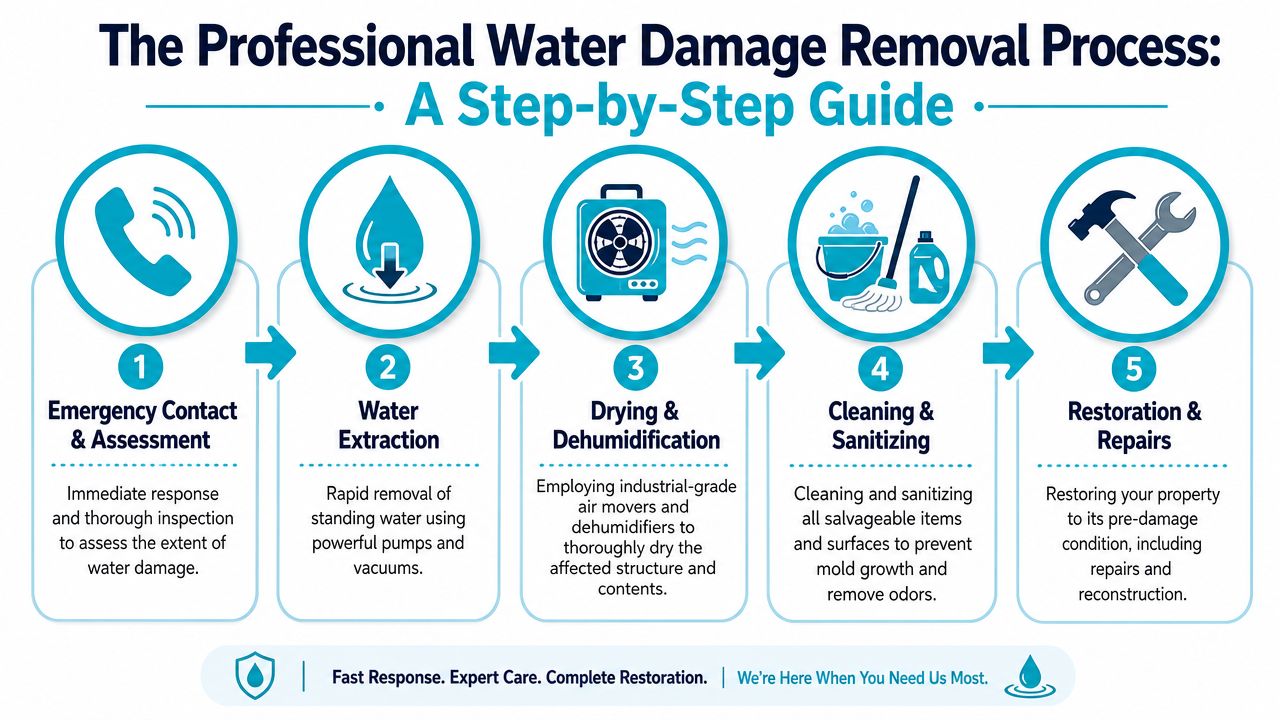
Emergency contact and inspection
The first visit should answer four questions quickly. What’s the source? What category of water are we dealing with? How far did it travel? What materials are affected?
Technicians use moisture meters, hygrometers, and often thermal imaging cameras to map where water migrated beyond the visible loss. That initial inspection also creates the job file: photos, notes, moisture readings, affected-room list, and a drying plan. If a contractor starts tearing into the house without documenting the condition first, that’s a red flag.
Water extraction
Extraction is where most homeowners think the job begins and ends. It doesn’t. Still, it’s a critical phase because every gallon removed reduces how much moisture must evaporate later.
Crews use extraction units, weighted extractors for carpeted areas when appropriate, portable pumps, and wet vac systems to pull out standing water. Good extraction limits secondary swelling in wood components, cabinet bases, and drywall bottoms. But extraction alone does not dry the structure.
Drying and dehumidification
Real restoration discipline is evident in these steps. Air movers push evaporation. Commercial dehumidifiers remove moisture from the air. Hygrometers track ambient conditions. Moisture meters confirm whether the materials are drying.
Structural drying is a multi-day process. It typically requires 3 to 5 days of continuous operation with professional air movers and dehumidifiers to meet the IICRC S500 standard, ensuring all hidden moisture is removed from materials like wood framing and drywall.
That timeline matters because many homeowners expect a crew to “finish” in one day. The extraction may happen that day. The drying does not. Equipment often runs continuously while technicians return to monitor readings, adjust placement, and verify progress.
If no one is taking repeat moisture readings, no one can honestly tell you the structure is dry.
Cleaning and controlled demolition
After extraction and during drying, the team evaluates what can be saved. Baseboards may come off for access. Wet drywall may need a flood cut. Cabinet toe-kicks may be opened. In contaminated losses, porous materials may have to be removed rather than treated in place.
This stage is also where odor control, surface treatment, and content cleaning happen. What works in one house may be wrong in the next. A clean-water appliance leak and a storm-driven flood do not get the same material-salvage decisions.
Final restoration and repairs
The last phase returns the property to pre-loss condition. That may include drywall replacement, insulation, trim, flooring repair, cabinet work, texture, and paint. The best mitigation jobs make the rebuild cleaner because the affected area was documented and dried correctly from the beginning.
Homeowners worried about framing, subfloors, and hidden structural effects should read how flood damage restoration preserves your home’s structural integrity, because the true value of good mitigation is what it prevents later.
Why IICRC Certification and Standards Are Non-Negotiable
Plenty of companies say they handle water losses. That phrase by itself doesn’t tell you much. The useful question is whether they follow ANSI/IICRC S500, because that standard separates cosmetic dry-out from technical restoration.
What the standard changes on a real job
An IICRC-based approach classifies the loss, maps moisture migration, and sets drying goals based on affected materials and environmental conditions. It doesn’t rely on guesswork, and it doesn’t stop because the surface feels dry to the hand.
That matters most when water gets into assemblies that homeowners can’t inspect themselves. The ANSI/IICRC S500 standard is not a suggestion; it’s a technical protocol. For Class 3 water damage where water comes from overhead, it mandates the removal of wet insulation from wall and ceiling cavities because it cannot be dried effectively, a critical step to prevent hidden mold and structural issues.
What to listen for when a contractor explains the scope
A qualified firm should be able to explain:
- Why materials stay or go: Not every wet material is salvageable, and not every demolition cut is arbitrary.
- How drying is verified: Moisture readings, psychrometric conditions, and monitoring notes should guide the job.
- What’s being documented: Source, category, affected rooms, equipment placement, and progress logs matter for both quality control and insurance.
Here’s the practical trade-off. A cut-rate response may look cheaper because it avoids demolition and shortens equipment time. But if wet insulation remains overhead, or wall cavities stay damp, you haven’t saved money. You’ve pushed the damage out of sight.
Certification protects the homeowner
IICRC certification isn’t a marketing badge. It’s one of the few reliable signals that the company understands water categories, classes, drying science, and contamination control well enough to build a defensible scope. In a Florida property, where hidden moisture gets punished fast, that difference shows up later in odor complaints, repeated leaks, microbial growth, and disputed insurance files.
The Florida Suncoast Climate Risk Factor
Water losses in Bradenton, Sarasota, Lakewood Ranch, Saint Petersburg, and the wider Gulf Coast don’t behave like the same losses in a drier climate. Heat and humidity change the timeline, the odor profile, and the likelihood of secondary damage.

Why Florida losses escalate so fast
In this region, moisture doesn’t just sit where it landed. It migrates, gets absorbed, and stays active in enclosed spaces. Cabinets trap it. Vinyl flooring can trap it. Wall cavities and insulation can hold it. The air itself slows amateur drying because the home is already fighting a high moisture load.
That’s why this number matters so much here: in Florida’s high humidity, toxic mold can begin to colonize within just 24 to 48 hours after a water intrusion, making the first two days absolutely critical for professional intervention to prevent a much larger and more costly mold remediation project.
On the Suncoast, “we’ll deal with it tomorrow” is often the decision that turns a straightforward dry-out into a mold and reconstruction project.
The extraction gap most homeowners miss
The visible water may be gone while the risk is still increasing. That’s the gap between simple extraction and full restoration. Drywall paper, tack strip zones, cabinet backs, insulation facings, and subfloor seams can still hold enough moisture to support damage even after the room looks normal.
Three Florida-specific patterns show up often:
- Storm intrusion: Wind-driven rain enters from rooflines, window assemblies, or soffit failures and spreads across ceilings and wall cavities.
- HVAC-related moisture: Condensate issues and hidden line leaks create slow, broad wetting that homeowners notice late.
- Flooding and groundwater: These losses often involve contamination concerns and broader demolition requirements.
For hurricane-related losses, homeowners in Tampa Bay should understand what goes into emergency water cleanup after a hurricane in Tampa, because post-storm projects often involve both water migration and contamination control, not just pumping out rooms.
Local urgency is different
Florida’s climate punishes delay. It also punishes incomplete drying. The companies that perform well here are the ones that respond quickly, monitor aggressively, and understand what hidden moisture does in Gulf Coast buildings. Out-of-area crews can still help after major storms, but they need to work to Florida conditions, not to assumptions from drier markets.
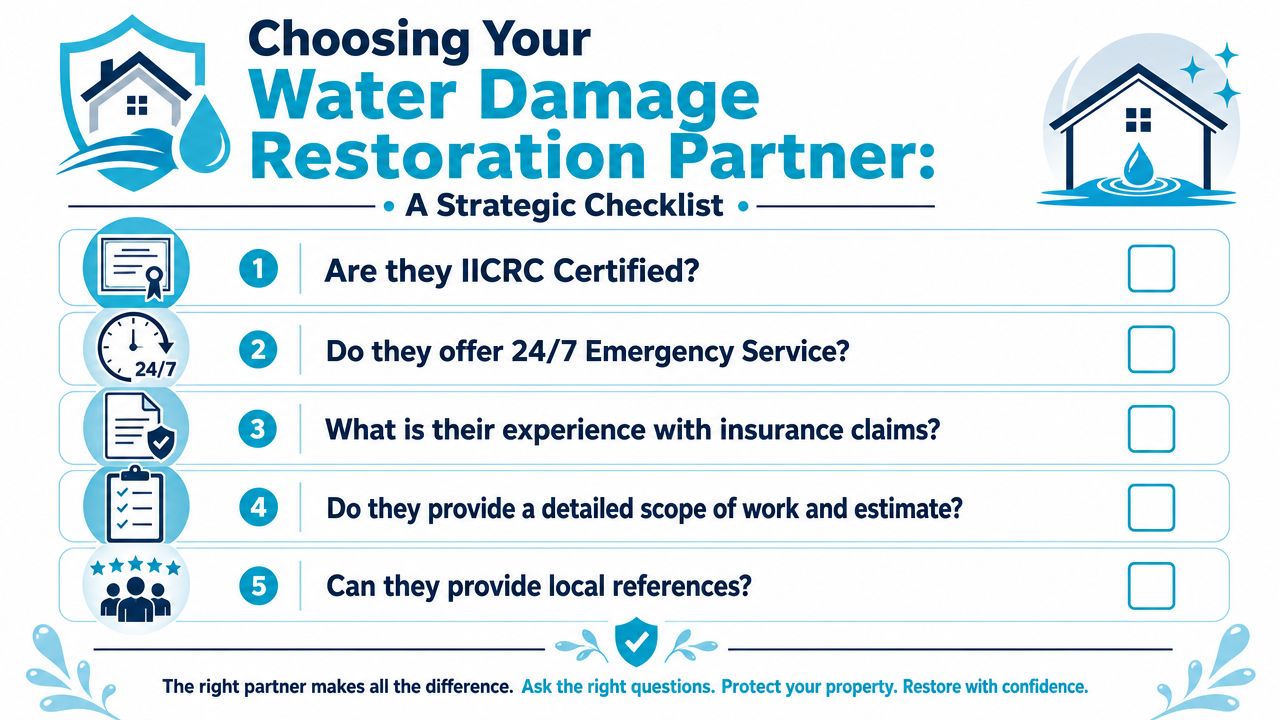
How to Choose Your Restoration Partner
When you’re under stress, every company sounds convincing on the phone. The fastest way to sort them is to ask questions that reveal whether they understand insurance compliance, contamination, and drying verification.
Ask about water category documentation first
Many claims face complications. A shocking 28% of Florida homeowners incorrectly classify Category 3 floods as clean water, leading to immediate insurance claim denials. Asking a provider how they document water classification from the start is essential to ensure your claim is approved.
If the company can’t explain how it documents source, category, moisture readings, and affected materials, keep looking.
The questions that actually matter
Ask these in plain language:
-
Are your technicians IICRC-certified?
You want a yes, not a vague answer about “years of experience.” -
How do you determine the water category and record it?
The right answer includes photos, source identification, room-by-room notes, and initial moisture readings. -
What equipment will you use, and how will you know when drying is complete?
Good answers mention air movers, dehumidifiers, hygrometers, moisture meters, and follow-up monitoring. -
What materials might need removal instead of drying?
This tests whether they understand contaminated porous materials and trapped moisture. -
Will you provide a written scope and help with claim documentation?
The answer should include estimates, photos, logs, and communication with the carrier.
What a trustworthy answer sounds like
A strong contractor doesn’t promise that everything will be saved. They explain trade-offs. They tell you what they know now, what they need to test, and what may change once moisture mapping and demolition expose the full extent of the loss.
One local option homeowners may consider is AMPM Restoration Services, particularly if they need help understanding how insurance documentation fits into emergency mitigation and rebuild planning. What matters most is that whichever company you hire can connect field work to claim support without gaps.
If a company talks only about extraction speed and not about classification, readings, and documentation, you’re hearing half a restoration plan.
Water Damage Removal FAQ and Your Next Steps
Can I stay in my house during water damage removal?
Sometimes yes, sometimes no. It depends on the affected area, the water category, the amount of demolition needed, noise from drying equipment, and whether contaminated materials are present. If sewage, gross contamination, or major ceiling or wall demolition is involved, temporary relocation may be the safer call.
How do I know the structure is actually dry?
You know because the contractor shows you moisture readings, not because the floor feels dry. A complete answer includes readings from affected materials, comparison to unaffected areas when appropriate, and documentation that drying goals were met before equipment was removed.
Should I throw away wet furniture and belongings immediately?
Not always. Some contents can be cleaned, dried, and restored depending on the water category and material type. Upholstered items, pressed wood furniture, paper goods, and porous belongings exposed to contaminated water are much harder to salvage safely than hard, non-porous items.
Is removing baseboards and drywall always necessary?
No. It depends on where the water went, how long materials were wet, and whether contamination is involved. But if moisture is trapped behind finishes, selective demolition may be the only way to dry the assembly correctly and prevent later odor, mold, or material failure.
What should I save for my insurance claim?
Keep photos, videos, invoices, communication records, a list of damaged contents, and any emergency mitigation paperwork. Don’t rely on memory after the loss. A clean claim file starts with organized documentation from day one.
Will water damage removal also fix the room completely?
Not by itself. Water damage removal is part of restoration, not the whole job. Complete recovery may include drying, sanitizing, demolition, odor treatment, insulation replacement, drywall work, flooring repair, trim, paint, and sometimes reconstruction.
For homeowners on the Florida Suncoast, the biggest takeaway is simple. Water damage removal should never stop at pumping out water and setting a few fans. The job has to account for hidden moisture, contamination level, material salvageability, and insurance-ready documentation from the first visit. That’s how you reduce the chance of secondary damage and avoid preventable claim problems.
If your home or commercial property in Bradenton, Sarasota, Tampa Bay, Saint Petersburg, Lakewood Ranch, or nearby Gulf Coast communities has a leak, overflow, storm intrusion, flood issue, or mold concern, act while the damage is still manageable.
Call AMPM Restoration Services at 941-946-7807 for a free inspection and estimate. AMPM Restoration provides 24/7 emergency response from Bradenton for water damage restoration, mold inspection and mold removal, fire and smoke damage restoration, storm and flood damage restoration, commercial restoration services, and full reconstruction. The team also offers insurance claim assistance and financing options, so you can move quickly, document the loss properly, and start restoring both your property and your peace of mind.