


Water Damage Restoration Companies Near Me
Water on the floor changes the mood of a house fast. You step into the hallway in Bradenton or Sarasota, feel that damp spot underfoot, and suddenly you’re thinking about drywall, flooring, baseboards, and whether that smell means mold has already started. In Florida, that reaction is justified. Heat, humidity, storms, and concealed leaks give water damage a head start if nobody intervenes quickly.
If you’re searching for water damage restoration companies near me, you probably don’t need broad theory. You need to know who to call, what to do in the next few minutes, and why speed matters so much on the Suncoast.
Your Search for Water Damage Restoration Companies Near Me Ends Here
Most water losses start subtly. An ice maker line leaks behind the kitchen cabinets. An air handler drain backs up in the attic. Rain pushes through a roof detail you didn’t know was vulnerable. By the time you notice stained drywall, cupping floorboards, or water wicking into base trim, the problem is already larger than the visible wet spot.
That’s why people search for water damage restoration companies near me in a hurry. They’re not shopping for a future remodel. They’re trying to stop active damage, protect contents, and keep a manageable loss from turning into drywall removal, flooring replacement, and mold remediation.
For homes and buildings around Bradenton, Sarasota, Lakewood Ranch, St. Petersburg, and the wider Tampa Bay area, the practical first move is to get a local emergency crew moving while you secure the property. AMPM’s water damage restoration service handles emergency mitigation, extraction, drying, and the steps that come right after the initial loss.
Why fast response matters
Water damage is a major driver of property loss, accounting for 23% of all property damage claims in the U.S. from 2017 to 2021, and emergencies can affect 14,000 people per day, according to industry statistics compiled from insurance data. That’s one reason restoration companies are built around emergency dispatch, water removal, drying, and mold prevention instead of delayed repair scheduling.
Practical rule: The first job isn’t making the room look dry. The first job is stopping the water, removing as much as possible, and starting controlled drying before moisture migrates deeper into the structure.
What a good local response should look like
When a homeowner calls from the Florida Suncoast, the priorities are straightforward:
- Stop the source if possible by shutting off a valve, isolating an appliance, or addressing roof or plumbing intrusion.
- Extract standing water quickly so it doesn’t keep soaking trim, framing, cabinets, and floor assemblies.
- Identify hidden moisture in wall cavities, under flooring, and behind finishes.
- Start structural drying with the right mix of air movement and dehumidification.
- Document the loss clearly for insurance and repair planning.
If the company you’re considering can’t talk clearly about those steps, keep looking. In this line of work, calm process beats flashy promises every time.
Why Florida Homes Are a Breeding Ground for Mold and Water Damage
Florida buildings fight moisture from more than one direction. Rain comes from outside, humidity loads the air, cooled surfaces create condensation, and porous materials hold moisture longer than most owners realize. That combination is why a small leak in a Suncoast home can behave very differently than the same leak in a drier climate.
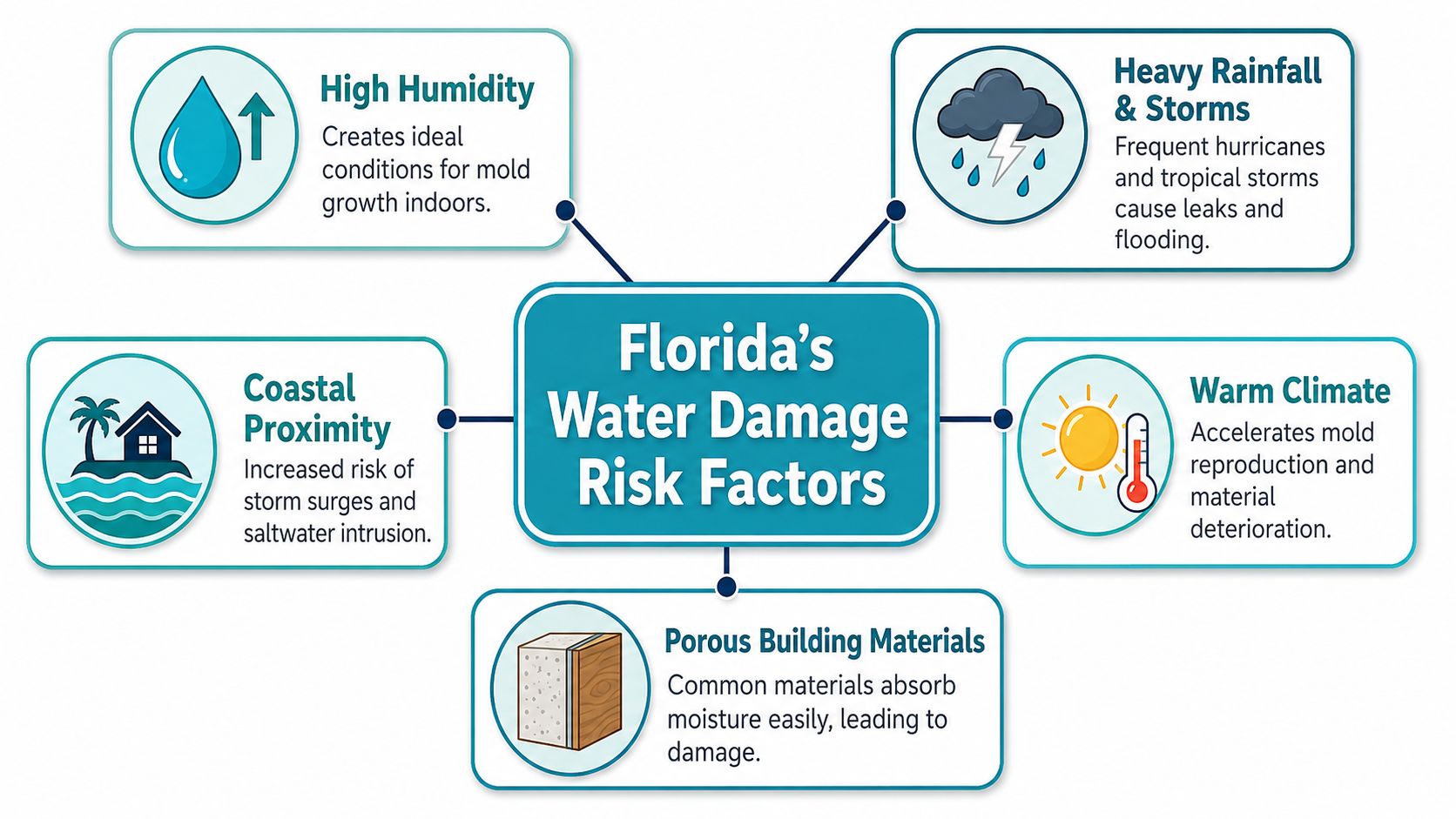
Moisture behaves differently here
Air in coastal Florida often carries enough moisture that drying takes more than opening a window or running a box fan. If outside air is already humid, bringing more of it indoors can slow the drying process or feed microbial conditions in closed rooms, closets, and wall cavities.
Homes across Bradenton, Palmetto, Sarasota, and St. Petersburg also deal with weather swings that stress the building envelope. Wind-driven rain, storm events, clogged gutters, flashing failures, and slab or grading issues all create different intrusion patterns. Some are obvious. Others stay hidden behind paint, trim, or insulation until odor or staining appears.
For homeowners trying to understand how indoor moisture turns into a recurring problem, this guide on how humidity causes mold in Florida homes is worth reviewing. It explains why the air itself can become part of the problem even after the original leak stops.
Materials hold moisture longer than people think
Drywall, baseboards, wood framing, insulation, laminate underlayment, and subfloors can all trap moisture. Visible surface drying doesn’t mean those materials are back to a safe condition. That’s why professionals use moisture meters and thermal imaging instead of relying on touch or appearance alone.
A few common Florida trouble spots show up again and again:
- Air conditioning areas where condensate drain problems wet ceilings, closets, and utility spaces.
- Window and door perimeters where seal failure lets repeated rain intrusion soak framing.
- Bathrooms and kitchens where supply line leaks feed cabinets, toe kicks, and adjacent walls.
- Garage transitions and slab edges where water enters after heavy weather.
- Attics and insulation where roof leaks can stay unnoticed until staining appears below.
If insulation has been exposed to prolonged moisture, replacement is often part of the discussion. These insulation mold protection tips are useful for understanding why some insulation can’t be left in place after a water event.
In Florida, the leak you see is often only part of the wet area. Moisture moves by gravity, absorption, and air movement, so the inspection has to go beyond the obvious stain.
The Hidden Dangers of Unaddressed Water Intrusion
A homeowner notices a faint wall stain after a summer storm, wipes it down, and assumes the problem is minor. Two weeks later, the baseboard is swollen, the room smells musty, and the flooring near the wall starts to cup. That progression is common on the Florida Suncoast because water keeps moving after the visible leak stops.
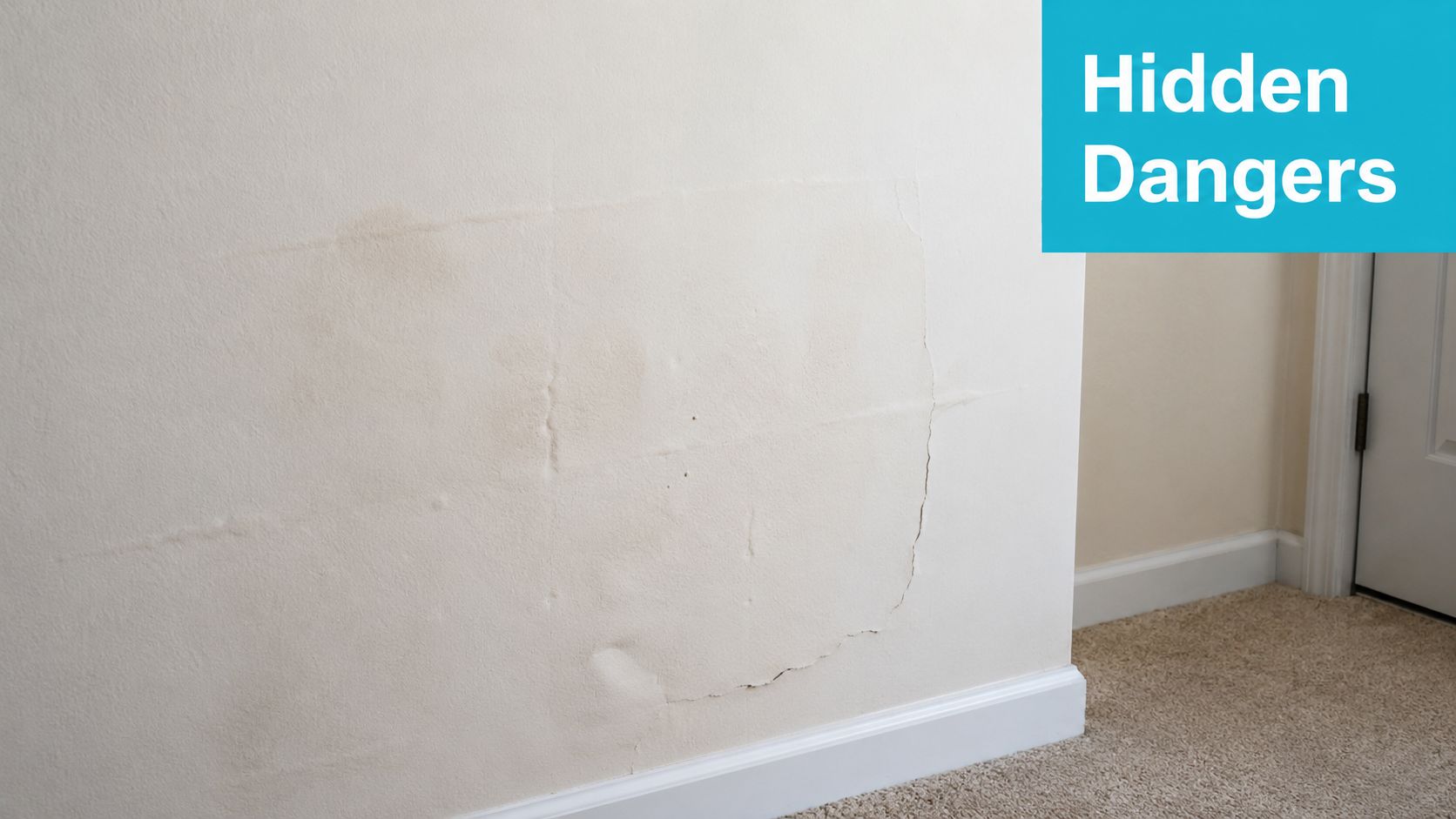
Structural damage rarely stays isolated
Water intrusion affects more than the stained spot you can see. It travels into drywall, trim, cabinet boxes, subfloors, and framing, then changes how those materials perform. Wood swells. Drywall softens and loses strength. Adhesives release. Engineered flooring and laminate often trap moisture below the surface, which is why a floor can look only slightly affected while the underlayment or subfloor is already deteriorating.
Flooring losses are a good example of why early inspection matters. Surface drying does not confirm that the assembly underneath is dry enough to save. If flooring is part of the concern, this Flacks Flooring water damage guide explains how different floor types respond once water gets below the finish layer.
Health concerns start with lingering moisture
In our trade, we treat wet materials as time-sensitive because mold can begin developing quickly if drying is delayed. The Institute of Inspection, Cleaning and Restoration Certification (IICRC) and standard restoration practice both treat the first 24 to 48 hours as the window where proper drying helps prevent microbial growth from taking hold. Once moisture remains in a wall cavity, under flooring, or inside insulation past that point, the job often shifts from straightforward drying to contamination control and selective demolition.
That is one reason musty odor matters. It is not just an inconvenience. It often signals that porous materials stayed wet long enough for biological growth to start.
Homeowners also ask about mycotoxins. In plain terms, they are compounds associated with certain mold conditions. The practical point is simple. If there is persistent dampness, visible growth, or a stale, earthy odor after a leak, the problem should be inspected and dried correctly instead of covered, painted, or left to air out on its own. For homeowners who want to reduce future risk, this full home guide to preventing mold gives a solid overview of the conditions that let growth return.
On the Suncoast, hidden moisture often does more damage than standing water because it stays out of sight long enough to affect materials, air quality, and cleanup cost all at once.
Simple Home Maintenance to Prevent Costly Water Damage
Not every water loss is preventable, but many of the expensive ones begin with small maintenance issues that were easy to miss. On the Florida Suncoast, prevention means watching both the plumbing inside the home and the way water moves around the outside.
Focus on the usual failure points
Walk your property with moisture in mind, not just appearance.
- Check appliance lines and shutoffs. Look behind the washer, refrigerator, dishwasher, and water heater for corrosion, drips, or damp drywall.
- Inspect the air handler and drain line. In Florida, condensate issues are one of the most common causes of interior moisture damage.
- Look at ceilings after storms. A faint stain after rain is an early warning, not a minor cosmetic issue.
- Know your main water shutoff. In an active plumbing leak, that knowledge can save flooring, cabinets, and wall assemblies.
- Manage indoor humidity. Air conditioning helps, but some homes and enclosed spaces also need dedicated dehumidification.
Don’t ignore the exterior drainage pattern
A home can have perfectly sound plumbing and still take on water because exterior grading sends runoff toward the structure. Gutters, downspouts, hardscapes, and low spots all matter.
For broader prevention inside the house, this full home guide to preventing mold covers the habits that help reduce long-term moisture risk.
One more point from the field. If you’ve had a prior leak in the same location, treat recurrence as a sign that the original issue wasn’t fully corrected. Repainting over a stain doesn’t fix moisture.
DIY Cleanup vs Calling a Professional Restoration Company
At 2 a.m., a bathroom supply line bursts, the hallway carpet is wet, and water has already slipped under the baseboards. In that moment, the main question is not whether you can grab towels and a fan. It is whether water has entered materials that hold moisture long after the surface looks dry.
That distinction matters in Florida homes. Tile may survive the initial event, but drywall, cabinet toe-kicks, laminate, tack strip, insulation, and wall cavities often do not. Once water reaches those assemblies, cleanup becomes restoration.
The line between cleanup and restoration
A true restoration response starts with finding where the water traveled, not just where it is visible. Reputable restoration scopes consistently include water removal, moisture detection, and controlled drying because hidden moisture is what leads to swelling, odor, microbial growth, and delayed repair costs. This overview of water damage response and structural drying gives a good plain-language explanation of that process.
The tools matter too. Technicians use moisture meters, infrared cameras, air movers, dehumidifiers, and extraction equipment together because one tool alone does not confirm a structure is dry. This explanation of equipment used in restoration work covers why professional drying is a measured process, not just a matter of blowing air across a wet room.
Water Damage Response DIY vs Professional
| Situation | DIY Action | Professional Action |
|---|---|---|
| Small, clean spill on sealed tile or another non-porous surface | Wipe up immediately, dry the area, and watch for any moisture reaching grout lines or adjacent materials | Usually not required if water stayed on the surface and was removed right away |
| Water under baseboards, laminate, carpet, drywall, cabinets, or insulation | Towels and fans may help with surface moisture, but they will not verify what remains inside materials | Required to inspect hidden moisture, extract water, and dry the affected assembly correctly |
| Leak discovered after sitting for a day or more | Surface cleanup alone is not enough once materials have stayed wet | Required because delayed drying raises the chance of mold and material breakdown, as noted earlier |
| Ceiling leak from roof or plumbing | Catch active dripping if safe, protect contents, and stay clear of light fixtures or sagging areas | Required to check the ceiling cavity, insulation, and connected wall areas for trapped moisture |
| Sewage, stormwater, or uncertain water source | Do not treat it like a standard household spill | Required because contaminated water calls for proper containment, removal, and sanitation |
| Repeat leak in the same area | Do not assume a stain is only cosmetic | Required to find what remained wet, what was missed, and whether materials now need removal |
What works and what doesn't
Box fans can help dry a countertop or a small wet patch on a hard surface. They do very little for water trapped under flooring, behind cabinets, or inside a wall cavity. A shop vac can remove some standing water. It cannot replace professional extraction, humidity control, and moisture mapping.
I tell Suncoast property owners to use a simple rule. If water touched porous materials, sat for more than a short period, came from an unsafe source, or spread farther than one small, contained area, call a restoration company. If you want a fuller breakdown of where homeowners can help and where the risks start, AMPM's guide on DIY water damage restoration risks and limitations is a useful reference.
A room can look dry and still be holding moisture where you cannot see it. That is the gap between panic and a solid plan, and it is exactly where a professional drying response saves money, materials, and time.
Choose AMPM for Your Suncoast Water Damage Restoration Needs
When people compare water damage restoration companies near me, they usually focus on three things. Can the company arrive quickly. Can the team explain the drying process clearly. Will they help reduce the insurance and repair stress that follows the emergency.
In local restoration markets, trust signals such as IICRC certification, decades of local experience, and 24/7 emergency availability are foundational buying criteria for customers comparing firms that need to arrive fast and mitigate damage correctly, according to this discussion of local restoration trust factors. That lines up with what property owners on the Suncoast ask every day. They want qualified people, a clear plan, and no confusion about next steps.
What local owners need during a real loss
For Bradenton, Sarasota, Tampa Bay, Lakewood Ranch, and surrounding Gulf Coast communities, the practical checklist usually looks like this:
- Emergency availability around the clock so the job starts when the damage starts, not the next business day
- IICRC-certified technicians who understand extraction, moisture detection, drying goals, and contamination concerns
- Insurance claim assistance because documentation matters as much as cleanup
- Reconstruction capability when mitigation is only the first half of the project
- Financing options for owners who need to move quickly while sorting out the claim
AMPM Restoration, based in Bradenton and serving the Florida Suncoast, is one provider that handles emergency water damage restoration, mold-related work, fire and smoke damage, storm and flood cleanup, commercial restoration, and reconstruction. For homeowners and property managers, that means one team can manage the move from emergency mitigation to final restoration instead of leaving the handoff to multiple vendors.
Local response matters. The company that can reach the property quickly and start the right drying plan often helps prevent the second round of damage that appears days later.
Frequently Asked Questions About Water Damage
What should I do while waiting for help
If it's safe, stop the water source first. Shut off the local valve or main line if a plumbing leak is active. Then protect the property from further damage, document what you see, and keep records, which matches consumer guidance summarized by the BBB page discussing insurance documentation and loss records.
Move lightweight items out of the wet area if you can do it safely. Avoid entering rooms with sagging ceilings, contaminated water, or electrical risk.
Should I take photos before anything is moved
Yes. Photograph standing water, damaged materials, affected contents, and the source area if visible. Keep receipts for anything you buy to protect the property, such as temporary supplies or lodging related to the loss.
How does the insurance part usually work
Most owners benefit from early documentation, a clear scope of affected areas, and direct communication between the restoration contractor and the carrier. The smoother claims tend to be the ones with organized notes, photos, and a documented timeline of what happened.
How long does structural drying take
It depends on the source of water, the materials affected, how long the area stayed wet, and whether moisture spread into hidden cavities. Drying is measured by conditions in the materials, not by whether the floor looks dry.
How can I tell if water is hiding behind the wall
Watch for bubbling paint, swollen baseboards, staining, musty odor, warped flooring edges, or a room that still feels damp after cleanup. Those are signs the visible area may be only part of the moisture footprint.
When should I ask about mold inspection or remediation
Ask that question any time the water sat longer than expected, there's visible growth, or the area smells musty after the leak was addressed. If you want more detailed homeowner guidance, AMPM also has a dedicated page for water damage frequently asked questions.
If you're dealing with an active leak, storm intrusion, flooding, or the first signs of mold after a water loss, contact AMPM Restoration Services for help now. We serve Bradenton, Sarasota, Tampa Bay, Saint Petersburg, Lakewood Ranch, and nearby Gulf Coast communities with 24/7 emergency response, free inspections and estimates, insurance claim assistance, and financing options. Call 941-946-7807 to get a fast, professional plan for your water damage restoration needs and restore both your property and your peace of mind.