

Expert Mold Removal In St. Petersburg
A slow leak under the kitchen sink is easy to ignore in St. Petersburg, especially after a summer storm when the house already feels damp. The cabinet may look fine for a day or two, the smell may seem minor, and then the first soft spot in the baseboard or dark patch behind the trash pullout tells the story. In this city, mold removal St Petersburg isn’t about scrubbing a stain. It’s about stopping moisture fast enough to keep a small leak from becoming a building problem.
That’s the part most homeowners don’t get until they’re already dealing with drywall, insulation, or an HVAC system that now smells off every time the AC kicks on. In a humid coastal market, the difference between a cleanup and a remediation job is often time, not drama. Once materials stay wet too long, mold has a head start, and the job stops being simple.
Why St. Petersburg Homes Are Prone to Mold
A kitchen leak in St. Petersburg can turn into a mold problem fast because the weather works against drying from the start. Summer storms push extra moisture into the house, and the coastal air already carries the kind of humidity that lets damp materials stay wet longer than they should. In practice, that means a small plumbing issue can sit in the dark long enough to become a bigger remediation job, especially when walls, cabinets, or flooring trap moisture.
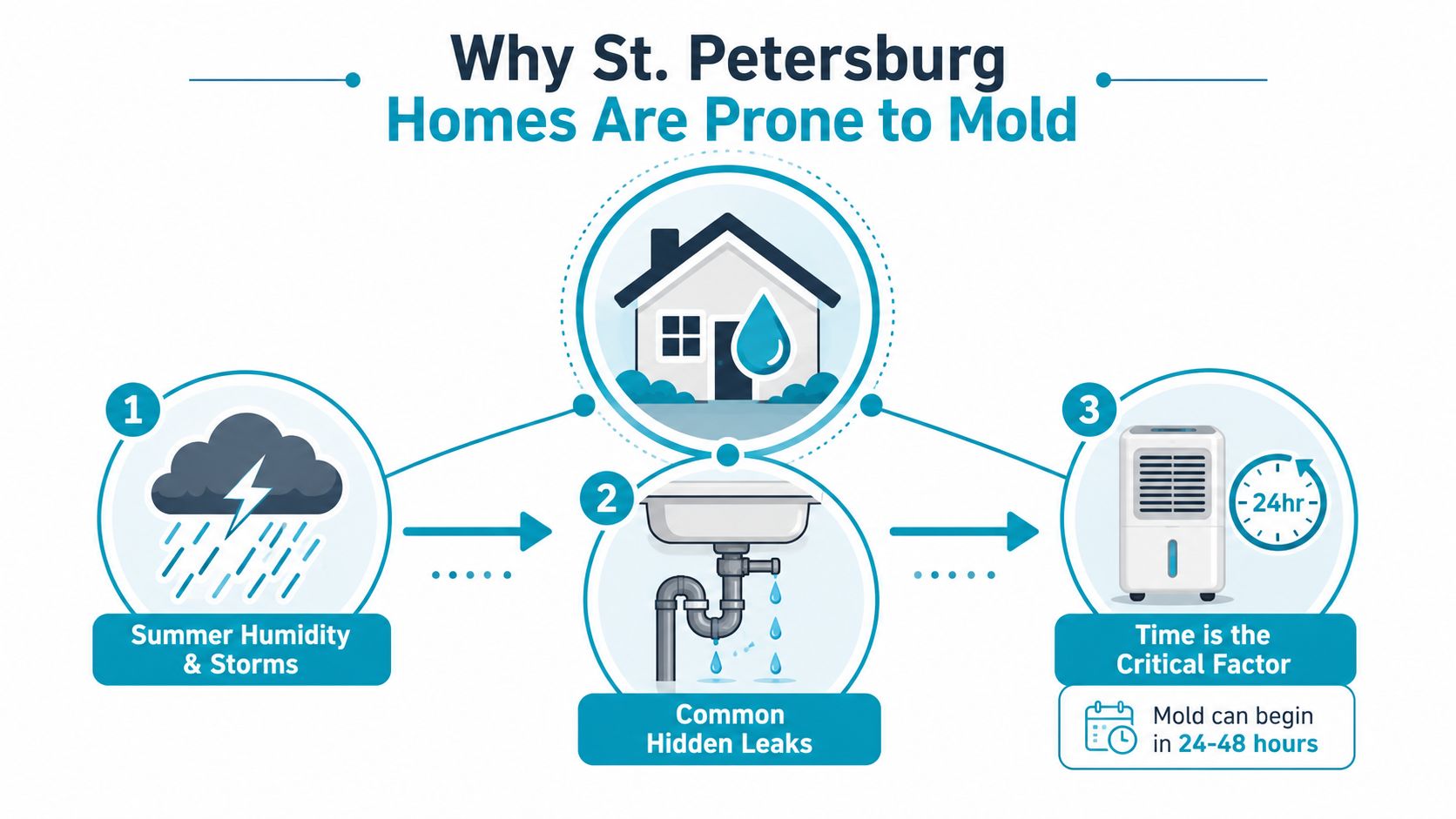
A leak becomes a mold job fast
I see the same pattern in older Pinellas County homes. A drip starts under the sink, water wicks into particleboard, and the cabinet back stays damp after the visible puddle is gone. By the time the homeowner notices a musty odor, the moisture has usually already moved into nearby materials.
Florida’s Department of Health says indoor mold should be removed promptly, and that small areas under about 10 square feet may be handled with detergent and thorough drying. That lines up with what I see on real jobs, because drying is the point where a cleanup stays small or turns into something more involved. Florida’s mold and air quality guidance
Geography and housing stock work against you
St. Petersburg’s humid coastal setting makes lingering moisture a normal risk, not an outlier. Older houses add another layer because plumbing, window seals, and crawl spaces often create more chances for hidden leaks and slow evaporation. One wet area behind a vanity can spread into framing, flooring, or the next room if nobody finds the source early.
I’d rather have a homeowner check a damp spot early than wait for the smell to spread through the house. If you want a clearer look at how local humidity drives indoor growth, this explainer on how humidity causes mold in Florida homes breaks down the mechanism without the fluff. A separate, practical issue is how a home problem affects the rest of the household, so even something like find affordable coverage St. Petersburg can become part of the conversation when repairs, missed work, or temporary displacement start adding pressure.
How to Recognize Mold Before It Spreads
The first clue is usually visible, but not always where people expect it. In a St. Petersburg home, I look for dark spotting near window AC units, staining around a bathroom ceiling corner, or fuzzy growth on the back of a cabinet after a plumbing leak. The second clue is smell. A closet that smells stale after AC season often tells you more than the wall paint does.
Read the room like a tech would
Visible growth is obvious when it’s there, but hidden moisture is the bigger trap. Peeling paint, warped laminate, soft baseboards, and condensation on ductwork usually show up before anyone sees fungus. That’s why a ten-minute walkthrough of your own house can be enough to decide whether you need help.
Practical rule: if the material stayed wet beyond that 24 to 48 hour drying window, stop treating it like a cosmetic issue.
The third clue is location. Mold that appears behind furniture, under flooring, or inside a closet with poor airflow usually means the source hasn’t been fixed yet. A bathroom patch that keeps returning after every shower points to a moisture problem, not a surface problem.
For homeowners who want a tighter field guide, this local overview of five signs of mold damage in homes gives a good side-by-side with what I check on site. The important part is not guessing which stain is “bad enough.” It’s recognizing when a stain says the structure got wet.
The Health and Property Risks of Waiting Too Long
A small patch can stay easy to ignore right up until the room starts smelling damp or the drywall begins to soften. That delay is what turns a local cleanup into a broader repair. In a St. Petersburg home, humid air keeps wet materials wet longer than many owners expect, so the problem keeps feeding itself until someone stops the moisture source and removes the damaged material.
What delay does to a home
Mold does not stay on the surface for long. It can break down drywall, stain insulation, and spread into subfloors or HVAC insulation if the leak, condensation, or intrusion is still active. A job that looked like a simple wall patch on Friday can turn into a much larger rebuild once the cavity is opened and the damage is mapped out. In this market, remediation often lands in the middle of the restoration budget rather than the cheap cleanup category, which is one reason homeowners are usually surprised by the final scope. Florida remediation pricing guide
The health side matters too. Homeowners commonly report sinus irritation, headaches, fatigue, or asthma flare-ups when a damp area keeps cycling moisture into the air. I’m careful about saying mold is the only cause, because bodies react differently, but I’ve seen enough jobs in poorly ventilated homes to know that lingering moisture and weak air handling are a bad combination.
Moisture control is the fix. Bleach is not the fix.
Why St. Petersburg raises the stakes
St. Petersburg’s climate keeps pressure on any weak point in the building shell. Coastal humidity and frequent rain make it easier for indoor moisture to drift upward if the AC is not pulling water out of the air the way it should, or if a small leak goes unnoticed. Mold Compass’s St. Petersburg climate guidance recommends keeping indoor humidity between 30% and 50%, and that is the range I want homeowners to keep in mind before they start wiping at stains. Mold Compass’s St. Petersburg climate guidance
Waiting only gives the mold more time. The stain gets darker, the odor gets stronger, and the material behind the finish keeps breaking down. If a homeowner reaches the point where they are wondering whether to tear out a wall section or keep scrubbing, this comparison of whether to remove mold yourself or hire a professional is the right next question.
DIY Cleanup or a Certified Professional
A small patch on a bathroom ceiling is one decision. Mold that keeps coming back is another. The cleanest way to sort the two is by the 10 square foot line. Florida health guidance says small areas under about 10 square feet can often be handled with detergent and thorough drying, which makes some DIY cleanup reasonable when the moisture source is obvious and already fixed. Once the area gets larger, hidden, or tied to HVAC, the job changes quickly. Florida’s mold and air quality guidance
A simple comparison
| Factor | DIY Cleanup | Certified Professional |
|---|---|---|
| Visible size | Small area under about 10 square feet | Larger area or spreading contamination |
| Moisture source | Already fixed and easy to verify | Hidden, recurring, or not yet identified |
| Location | Bathroom ceiling patch or shower caulk line | HVAC, crawl space, behind drywall, or insulation |
| Documentation | Usually informal | Written scope, photos, and moisture records |
| Risk | Lower when the problem is small | Better control of containment and recurrence |
If you're dealing with a single shower caulk line or a tiny ceiling spot after a known drip, careful DIY can make sense. If the odor is coming from a wall cavity, the AC handler, or a crawl space, I'd treat that as a professional call. Once air movement is involved, a small-looking job can spread faster than people expect.
Cost is only part of the equation
DIY looks cheaper at first, but it can miss the moisture source and leave the core issue active. Professional remediation costs more, yet it creates a documented process that can help with an insurance claim if the loss qualifies. That documentation matters when an adjuster wants proof that the source was identified, the area was contained, and the materials were handled correctly.
For homeowners who want a blunt rule of thumb, this guide on whether you can remove mold yourself or should hire a professional is the right place to pressure-test the decision. A free inspection is often the fastest way to find out which bucket you're in before you spend a dime.
What Professional Mold Remediation Actually Looks Like
A real remediation job starts with moisture, not chemicals. A technician walks the affected area with moisture meters, hygrometers, and visual checks to find where the water entered and how far it spread. If the numbers or conditions suggest hidden impact, the scope grows from a simple cleanup to a controlled demolition and drying project.
Containment comes before demolition
On larger jobs, EPA guidance calls for full containment when the contaminated surface area is greater than 100 ft² or when there's a risk of spreading spores into adjacent occupied spaces. That usually means double layers of polyethylene sheeting, controlled removal of contaminated material, and PPE so the crew doesn't spread the problem while they're fixing it. In a humid market like St. Petersburg, containment quality matters because moisture can keep the contamination active if the structure isn't isolated correctly. EPA mold remediation guidance for schools and commercial buildings
The next stage is removal. Drywall, insulation, or other porous material that's clearly contaminated comes out under containment, then the area gets cleaned and dried with industrial equipment. I've seen crews skip the drying discipline and end up revisiting the same home a month later, and that's usually a sign the original moisture source never got fully controlled.
If the wall cavity is still wet, the mold job is not finished.
Drying and verification close the loop
The drying phase often takes several days because the structure needs time, not just airflow. Technicians use air movers and dehumidification to pull moisture out of the space, then check the readings again before signing off. Antimicrobial treatment can be part of the process, but it only works when the contaminated materials have been removed and the area is dry enough to stay stable.
For homeowners comparing options, this breakdown of mold assessment versus mold remediation helps separate inspection from actual cleanup work. I also want homeowners to know that AMPM Restoration Services is one option for this kind of work in the area, because their process includes emergency response, drying, and reconstruction when the damage is bigger than surface level.
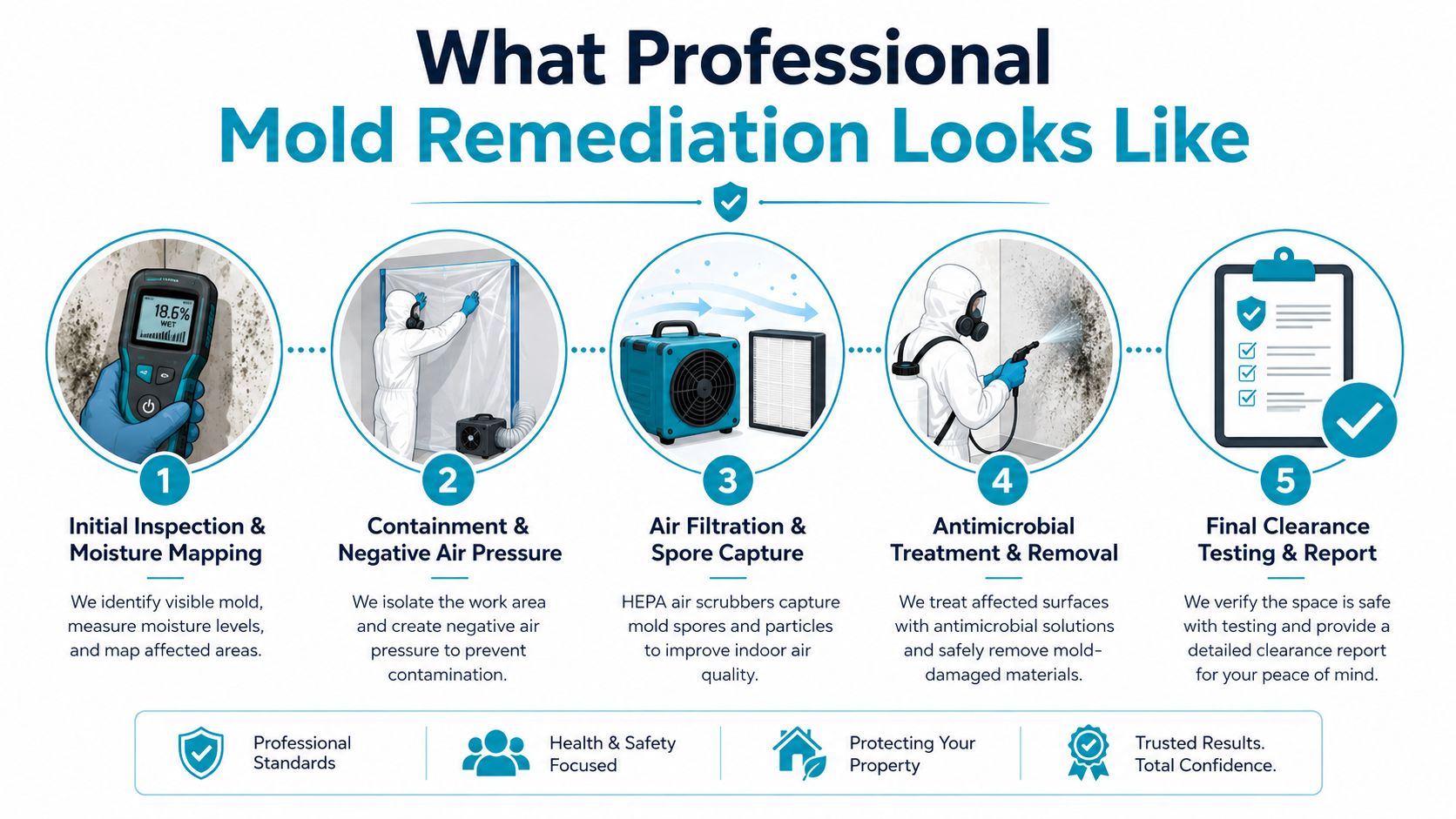
The final piece is clearance. A homeowner should expect a closing check that confirms the area is dry, the contaminated materials are gone, and the job didn't just move the problem somewhere else. That's what gives both the homeowner and the insurer a clean record.
What Mold Removal Costs in the Tampa Bay Area
A homeowner calls after spotting growth in a closet wall, and the first question is usually the same, what is this going to cost? In Tampa and St. Petersburg, pricing moves with the size of the contamination, the amount of demolition needed, and how much drying and rebuild work follows. One Florida pricing guide places mold remediation around $3,000 to $10,000, while another says typical professional mold remediation in Florida averages about $2,350 and commonly runs $1,200 to $3,750, with per-square-foot costs of $10 to $25. Those ranges make sense once you account for what may be hidden behind the finished surface. Florida mold remediation cost guide

What pushes a job higher
A surface-level issue with a fixed moisture source usually stays lower in the range. Once the mold is behind drywall, inside ductwork, or in a crawl space, the crew has to contain the work, remove more material, and keep drying the structure longer. That is where costs climb, because the visible patch is rarely the full job once the cavity opens up.
Early inspection and fixing the moisture source control cost better than anything else. If the problem is obvious and easy to reach, the scope stays tighter. If the source is still unknown, each day of delay can spread the repair area and make the quote harder to keep down.
Insurance and financing matter here
Insurance coverage depends on the cause and the documentation, so photos, moisture logs, and a clear scope can change how a claim moves once it is opened. When the bill is urgent and cash is tight, financing can let a homeowner start remediation before the problem spreads further. Waiting for a better month rarely helps, because mold keeps growing while the budget catches up.
A free inspection turns the guesswork into a written number, which is usually where the decision gets easier. For homeowners who want a local starting point, the St. Petersburg mold removal page at AMPM Restoration's St. Petersburg service area can help show what a quote would cover. For tenants and landlords sorting out responsibility before a job starts, the Pestless Inc. Florida compliance guide is a useful reference point for the contractor side of the conversation.
Florida Rules Every St. Petersburg Homeowner Should Know
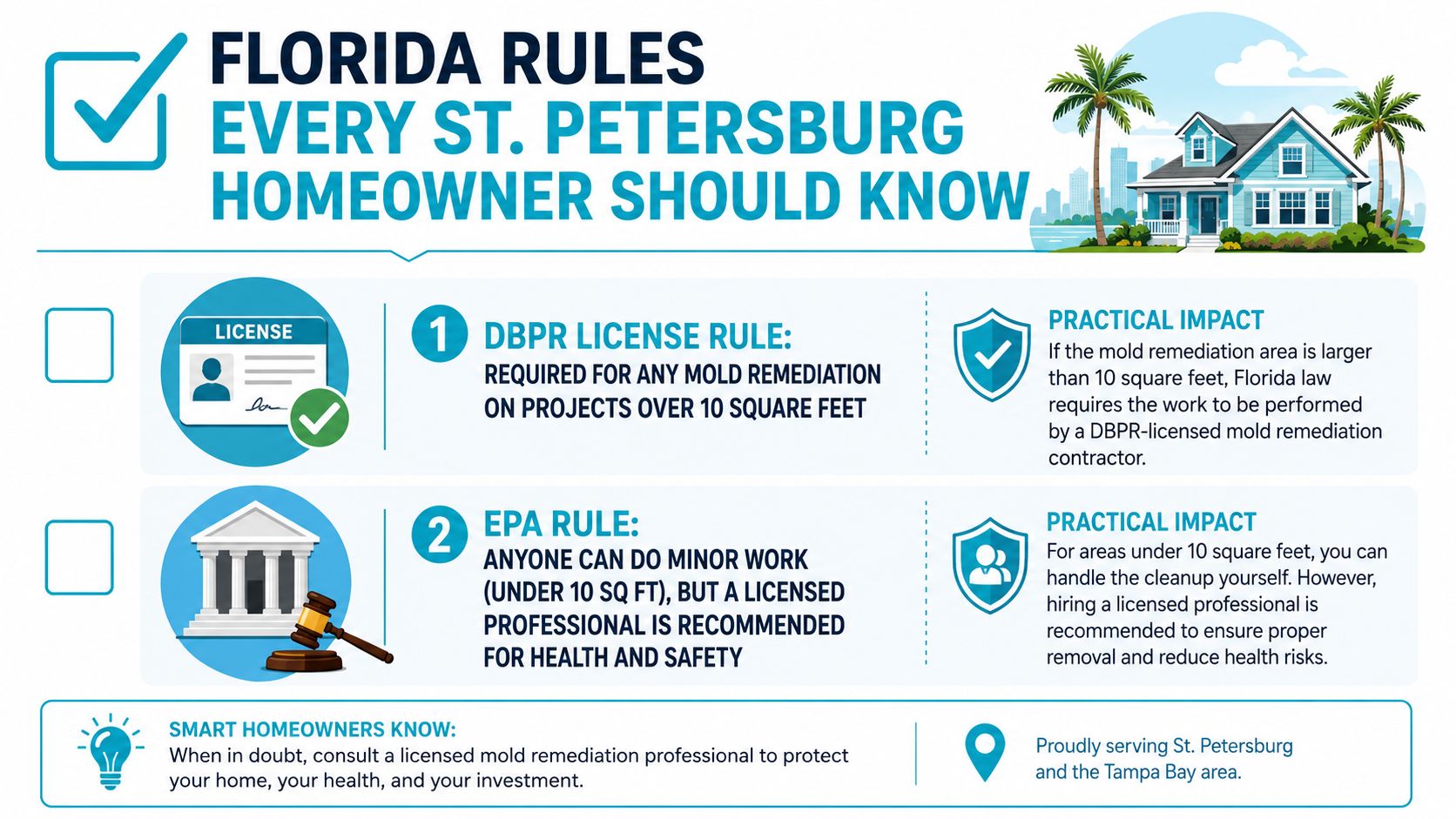
Florida doesn't leave mold work to vague judgment calls. Under state law, any mold-related service on areas greater than 10 square feet requires an active DBPR license, and the statute defines mold remediation broadly enough to include removal, cleaning, sanitizing, demolition, or other treatment of mold-contaminated material over that threshold. A first violation is a second-degree misdemeanor, and a second violation is a first-degree misdemeanor. Florida Statute 468.8419
Why the license check matters
That legal cutoff is the line homeowners should use when vetting contractors in Pinellas County. If a company is taking on larger remediation without the right license, the homeowner is taking on legal and quality risk at the same time. The conflict-of-interest rule matters too, because the statute bars a mold remediator from having a financial interest in a company employing a mold remediator.
For landlord and condominium-related work, another layer applies. Outside contractors hired to inspect or remediate mold must carry a specialty license and an insurance policy with at least $1,000,000 in liability coverage, which protects the property owner if something goes wrong on site. Florida mold law and tenant-rights overview
How to vet in minutes
Check the state license, confirm the insurance, and ask who is doing the work. If the answer is vague, keep looking.
For property managers, a compliance-focused resource like Pestless Inc. Florida compliance guide is useful because it reinforces the broader point that legal responsibilities don't disappear just because a contractor is hired. Mold work is no different. The right paperwork matters before anyone opens a wall.
Your Next Step With AMPM Restoration
A musty smell that keeps coming back, staining that returns after a leak, or a wall that stayed damp after a storm all point to the same next move. Get the moisture source identified, have the affected area scoped, and confirm the contractor is legally qualified to do the work. In St. Petersburg, climate, cost, and Florida law all need to line up before the job is fully under control.
AMPM Restoration handles emergency response, mold removal, drying, and reconstruction with IICRC-certified technicians. The company says it responds 24/7 with a one-hour arrival window across Pinellas and Manatee counties. It also coordinates insurance claims directly and offers financing options for homeowners who need to move now but cannot absorb the full bill all at once. For a local service overview, see AMPM Restoration mold removal in St. Petersburg.
How to decide today
If the affected area is small and clearly dry now, guidance may be enough. If the area is larger, hidden, or connected to HVAC or recurring moisture, the safer move is to have it inspected before you start pulling materials apart yourself. That protects the house, and it gives you a real scope instead of a guess.
Florida Statute 468.8419, the DBPR license threshold, and the state insurance rules shape who should be on the job, so price alone should never be the only filter. A contractor can sound confident and still be the wrong fit if the paperwork is thin or the role is unclear. Ask who is doing the work, who is carrying the insurance, and whether the company is set up to handle the job it is quoting.
The important thing is not to wait for the smell to get stronger or the stain to spread. Mold problems get more expensive when the source stays active, and delay usually helps the damage, not the homeowner. Call 941-946-7807 for a free inspection and estimate, mention your insurance claim questions or financing needs, and let the team handle the rest.
A CTA for AMPM Restoration Services.