

Mold Remediation Clearwater: Fast Local Services
Medium mold remediation projects in Clearwater typically range from about $1,450 to $4,500, while small jobs start near $500 and large structural work can reach $5,000 to over $30,000 depending on hidden moisture and material replacement needs. Cost depends less on the visible spot than on what caused it, how far contamination traveled, and whether affected building materials can be saved.
You may be dealing with that problem right now. You wake up in your Clearwater home with a stuffy nose and heavy-headed feeling, notice a musty smell near a closet, and then find a damp mark behind furniture. A quick wipe seems tempting, especially when you’re worried about disruption, cost, and whether insurance will help.
The right response is to identify and stop the moisture source before treating the mold. Mold remediation in Clearwater isn’t just a cleaning job. It’s a controlled process that addresses moisture, contaminated materials, air movement, drying, and final verification.
Why Clearwater Homes Face Unique Mold Challenges
A closet wall can look dry while the space behind it stays damp. In a Clearwater bedroom, warm outdoor air, storm moisture, air-conditioning condensation, plumbing leaks, and aging construction may keep a small wet area active after the original cause is no longer obvious. That hidden moisture is often the core issue, while the visible mold is only the warning sign.
According to the Clearwater market summary at Local Clearwater mold conditions and remediation costs, average relative humidity runs about 78%, annual rainfall is roughly 55 inches, and the median home build year is around 1977. These figures do not mean every home will develop mold. They do explain why a leak or condensation problem may dry slowly, especially in older walls, roofs, plumbing systems, insulation, or other building assemblies.

How a small problem becomes a larger one
Consider a bedroom closet along an exterior wall. Clothing and stored boxes can restrict airflow, while humid air meets a cooler wall surface and forms condensation. A slow roof leak or plumbing issue can add moisture from another direction. By the time staining appears on drywall, baseboards, or the back of the closet, the affected area may already extend beyond what you can see.
Waiting for a larger stain can increase the work required. Mold can enter porous drywall, insulation, wood, flooring materials, and wall cavities. A return vent or other air movement may also spread particles beyond the original room if the area is not isolated.
Local reality: Clearwater homes do not need a dramatic flood to develop a serious mold problem. Persistent humidity and a small, unresolved moisture source may be enough.
Indoor conditions deserve the same attention as outdoor weather. Bathrooms with weak exhaust, kitchens that send steam into adjoining rooms, crowded closets, and air-conditioning systems with condensation problems can create separate moisture zones inside one home. This guide to how humidity causes mold in Florida homes explains how those conditions support mold growth.
Timing affects the response. Early discovery may allow targeted drying and limited removal. Delayed action can involve demolition, reconstruction, HVAC cleaning, and independent verification. Cleaning a surface may improve its appearance, but mold remediation in Clearwater must address the moisture source, affected materials, airflow, drying, and confirmation that the area is ready to use again.
Signs of Mold and the Moisture First Principle
Mold doesn’t always announce itself with a large black patch. A musty odor in a closed room, dark staining near a ceiling or baseboard, peeling paint, warped flooring, or recurring condensation can indicate a moisture problem. Some residents also notice allergy-like irritation that improves after leaving the property, although symptoms alone can’t identify mold or prove that mold caused them.
A useful first check is to ask three questions:
- What changed: Did the room recently experience a leak, overflow, roof issue, storm intrusion, or HVAC condensation?
- Where is moisture collecting: Look around plumbing connections, exterior walls, closets, bathrooms, windows, ceilings, and flooring transitions.
- What remains damp: A surface can look clean while drywall, padding, insulation, or wood underneath still holds moisture.
The moisture-first principle comes from the basic requirement mold has for growth. The U.S. EPA says controlling moisture is the best way to control mold growth, while Florida guidance emphasizes cleaning mold promptly, repairing leaks first, and removing heavily contaminated drywall, carpet padding, or insulation when those materials can’t be adequately cleaned. Florida mold guidance and moisture-control recommendations explain why spraying a surface without correcting the source is an incomplete response.
What to do before professional help arrives
Stop the leak if you can do so safely. Move undamaged belongings away from the affected area, but don’t carry visibly contaminated porous items through clean rooms. Use ventilation carefully, because blowing air across a contaminated area can spread particles. If the home has a water event, document the condition before disturbing materials when possible.
Bathrooms and kitchens deserve special attention because steam and condensation can repeatedly wet surfaces. Use exhaust ventilation that discharges outdoors, keep air moving through enclosed spaces, and use a dehumidifier where needed. CDC guidance recommends keeping indoor humidity at no higher than 50% and fixing roof, wall, or plumbing leaks because mold needs moisture to grow. CDC guidance on indoor mold and moisture provides the practical benchmark.
A small, isolated area on a cleanable surface may be manageable with appropriate precautions. Larger contamination, recurring growth, hidden dampness, HVAC involvement, or affected porous materials call for an assessment. You can review common warning signs in this resource on five signs of mold damage in homes, but don’t use a checklist as a substitute for finding the water source.
Cleaning Versus True Mold Remediation
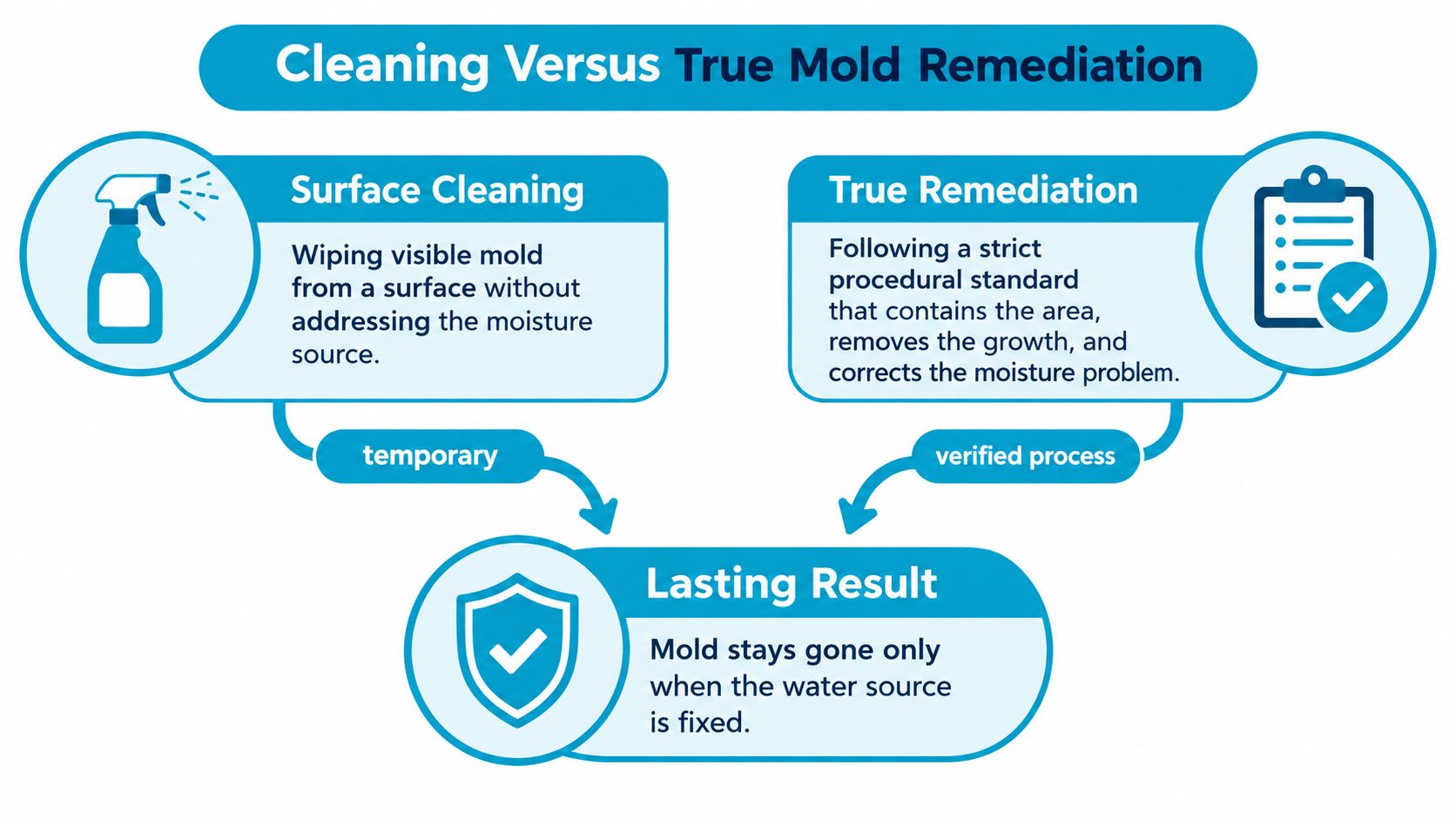
Wiping visible discoloration and completing professional remediation are different tasks. Surface cleaning may improve the appearance of a wall, floor, or cabinet, but it doesn’t establish whether moisture remains behind the finish or whether contaminated porous materials are still present.
| Surface cleaning | True mold remediation |
|---|---|
| Focuses on visible material | Investigates visible and hidden moisture |
| May remove staining from a cleanable surface | Removes or treats affected materials according to their condition |
| Usually lacks containment | Uses isolation and controlled air movement when needed |
| Doesn’t prove the source was corrected | Includes drying and documentation of the result |
| Can leave hidden contamination unaddressed | Uses a defined process and appropriate verification |
Drywall, insulation, carpet padding, and other porous materials can absorb water and support growth below the surface. If those materials can't be cleaned effectively, professionals may remove them rather than spread contamination by aggressive handling. Carpet requires particular care because moisture can reach the backing and padding. For practical background on the limits of household treatment, see how to clean mold from carpet from Flacks Flooring.
What professional controls accomplish
The IICRC S520 Standard for Professional Mold Remediation applies to residential, commercial, and institutional buildings, including building systems and personal property contents. The 2024 Fourth Edition is available and sets out procedures and precautions for remediation work. The IICRC S520 standard gives professionals a procedural framework rather than a cosmetic cleaning recipe.
A controlled project may use plastic barriers, negative pressure, HEPA air filtration, sealed waste removal, and careful cleaning methods. Negative pressure helps keep air from moving out of the work zone into unaffected rooms. HEPA filtration captures fine particles from the air, while containment limits the area workers and equipment disturb.
The process also separates the questions “Does it look clean?” and “Has the moisture problem been resolved?” A room can look better while a wet wall cavity continues feeding growth. Conversely, a stained but dry material may need a different decision than a damp, porous material with active contamination.
Homeowners should ask what will be removed, how the work area will be contained, how HVAC registers will be protected, how drying will be measured, and who will verify completion. This explanation of the difference between mold removal and remediation can help you evaluate proposals that use those terms interchangeably.
The Professional Remediation Process Explained
A competent remediation project should make the work understandable before demolition begins. The crew should identify the likely source, define the affected area, protect occupants and unaffected rooms, and explain what evidence will show that the space is dry and ready for normal use.
Inspection and moisture mapping
The first step is a detailed inspection. Technicians may use moisture meters to compare affected materials with dry areas and infrared cameras to identify temperature patterns that suggest hidden moisture. These tools don't replace judgment, but they help locate damp materials behind finishes, around plumbing, under flooring, or near HVAC components.
The inspection should also consider the building system. Affected supply or return registers, wall cavities, and adjacent rooms can change the scope. The goal is to understand the path moisture took, not to photograph the most obvious stain.
Containment and removal
Once the work area is defined, the crew can isolate it with plastic sheeting and controlled air pressure. Air scrubbers with HEPA filtration help reduce airborne particles within the work zone. Workers should use protective equipment and remove contaminated materials in a way that limits exposure to occupants and clean sections of the building.
Materials that can't be salvaged are removed. Materials that can be cleaned are treated according to their type and condition. NIOSH and CDC guidance says wetted materials should be dried within 48 hours to help prevent mold growth, and mold-damaged materials should be removed and cleaned with appropriate containment to minimize exposure. NIOSH and CDC recommendations for wet and mold-damaged materials provide further context.
Cleaning, drying, and verification
After removal, technicians clean remaining structural surfaces using methods suited to the material. HEPA vacuuming, damp wiping, and other controlled techniques may be used. Antimicrobial products can have a role, but chemicals don't replace source correction, physical removal, or drying.
The final stage is verification. Depending on the project, that may involve visual inspection, moisture confirmation, or an independent clearance assessment. Florida's distinction between mold assessment and remediation matters here. The company performing the work shouldn't be the party grading its own completion, so homeowners should ask whether the assessor is independent and what written documentation they'll receive.

A written scope, photographs, moisture readings, disposal records when relevant, and final findings give you something more useful than a verbal assurance. This mold remediation timeline can help you understand why inspection, containment, removal, drying, and verification happen in sequence.
Clearwater Mold Remediation Costs and Timelines
A homeowner may see a small dark patch and expect a simple cleaning bill. In Clearwater, the visible growth may be only the surface of a larger moisture problem inside drywall, under flooring, or around an HVAC system. A local summary places smaller projects at $500 to $1,500 and medium projects at $1,450 to $4,500, depending on access, materials, moisture control, and repairs. See these Clearwater remediation cost ranges as planning guidance, not as a fixed quote.
- Small areas under 10 square feet: About $500 to $1,500, when access is straightforward and the moisture source is limited.
- Medium remediation projects: About $1,450 to $4,500, especially when the work includes demolition, drying, cleaning, and repairs.
Large structural or HVAC-related projects can exceed $30,000 once reconstruction and system cleaning are included. That possibility explains why a phone estimate can change after technicians open a wall or inspect materials that were hidden from view. A written scope matters more than a low starting figure.
What changes the price
The affected area is only one part of the calculation. Contractors also consider access, material type, contamination location, containment, disposal, drying equipment, HVAC involvement, and reconstruction. An active leak or ongoing humidity problem can turn a one-time cleanup into repeated work, much like mopping a floor while the faucet is still running.
Florida guidance uses an area threshold when determining whether professional remediation is recommended. Smaller growth may still require professional help if it is hidden, recurring, connected to HVAC, or located in a vulnerable building system. The square footage alone does not describe the risk or the work required.
Insurance can also affect the final out-of-pocket cost. A proposal should separate remediation from repairs and clearly identify which work addresses the moisture source. That distinction gives you better documentation for an adjuster and helps prevent confusion between covered water damage and excluded maintenance.
Timelines follow the same pattern. A limited project may progress quickly, while structural work takes longer because materials must be removed, the source corrected, affected areas dried, and repairs completed. Clearwater's warm, humid conditions can make drying more demanding. Ask for the work sequence in writing rather than accepting a vague promise about the completion date.
For a broader explanation of estimate variables, review this guide to mold removal cost in 2026. Compare proposals by checking whether they include moisture correction, containment, cleaning, disposal, drying, repairs, and verification, rather than just choosing the lowest number.
Navigating Insurance Claims for Mold Damage
Many homeowners assume that a mold policy question starts with the mold itself. Insurers usually focus first on what caused the water.
Standard homeowners policies commonly cover mold when it results from a sudden, accidental covered event, such as a burst pipe or storm-related roof damage. Mold connected to long-term humidity, poor ventilation, condensation, or an unresolved gradual leak is generally treated as maintenance and may be excluded. In a humid state, the cause and timing of the moisture event can matter more than the amount of visible growth. Guidance on mold insurance claims explains this sudden-versus-gradual distinction.
Build the evidence before cleanup
If a pipe breaks or a storm damages the roof, photograph the source and the affected rooms before removing materials, provided doing so is safe. Record when you discovered the problem, when the water event occurred, what was damaged, and which emergency steps you took. Keep invoices, plumber or roofer reports, moisture documentation, and communications with your insurer.
A claim file becomes harder to evaluate when the homeowner can't connect the mold to a specific covered event. That doesn't mean you should leave wet materials in place while waiting for an adjuster. Prompt mitigation can prevent further damage, but document conditions and notify the carrier as quickly as possible.
Ask your insurer about policy-specific limitations, deductibles, mold sublimits, preferred vendors, and requirements for testing or documentation. Don't assume a restoration company can determine coverage. The carrier makes that decision under the policy.
Why maintenance issues create disputes
Humidity-driven mold can develop without one obvious incident. Condensation around an air-conditioning system, poor bathroom ventilation, or a slow leak behind a cabinet may continue for a long period. The result can be real and expensive, yet the policy may treat the cause as preventable maintenance.
A clear inspection report should separate observed conditions from conclusions. It can identify wet materials, likely moisture pathways, visible growth, and recommended corrective work without promising that the insurer will approve payment. That honest separation protects you from relying on an unsupported coverage assumption.
Choosing a Licensed Local Remediation Company
The right company should be able to explain both the visible work and the evidence behind its conclusions. Look for state licensing, bonding, insurance, relevant IICRC training or certification, a written scope, and a clear answer about independent post-remediation verification.
Ask these questions before signing:
- Who performs the assessment: Is the person evaluating the damage separate from the crew performing remediation?
- How will the area be contained: Will the proposal address negative pressure, HEPA filtration, HVAC protection, and sealed disposal?
- What happens to porous materials: Does the company explain why drywall, insulation, carpet padding, or other materials will be cleaned or removed?
- How is drying confirmed: Will you receive moisture readings or other documentation?
- What does the estimate include: Are repairs, reconstruction, testing, and possible hidden conditions identified separately?
Local availability matters during a water or storm event because delays can increase the amount of material that needs removal. AMPM Restoration is a 24/7 emergency restoration company based at 4301 32nd St W b18, Bradenton, FL 34205, serving Bradenton, Sarasota, Tampa Bay, Saint Petersburg, Lakewood Ranch, Clearwater, and surrounding Gulf Coast communities. Its services include water damage restoration, mold inspection and removal, fire and smoke damage restoration, storm and flood damage restoration, commercial restoration, and reconstruction solutions.
The company describes its team as locally owned, licensed, bonded, insured, and IICRC-certified, with direct insurance coordination, free inspections and estimates, financing options, and a satisfaction guarantee. Those offerings can simplify the process, but you should still compare the written scope with the actual conditions in your property.
A responsible contractor won't promise that every claim will be covered or that every stain requires full demolition. They'll explain the evidence, identify uncertainty, and tell you what needs to happen before the space is considered complete.
Your Next Steps Toward a Healthy Home
Start with the source, not the stain. If you find damp drywall, recurring condensation, a musty odor, or suspected growth behind a closet, stop adding moisture to the area and arrange an inspection. Don't paint over the mark, move contaminated belongings through clean rooms, or run a fan across visible growth without understanding where the air is going.
If flooding or a significant indoor water event has left the home wet for more than 24 to 48 hours, CDC guidance says occupants should assume mold may be present, completely dry the property, clean up the mold, and eliminate the moisture problem before reoccupying the space. CDC guidance for flooded or wet homes supports acting quickly while separating emergency drying from later remediation decisions.
Six questions Clearwater homeowners often ask
Is mold remediation different from mold removal?
Yes. Removal may describe taking out visibly affected materials. Remediation is the broader process of finding and correcting moisture, containing the area, removing or cleaning affected materials, drying the structure, and verifying the result.
How much does mold remediation cost in Clearwater?
Small areas under 10 square feet may start around $500 to $1,500, medium projects commonly range from $1,450 to $4,500, and large structural or HVAC-related work can reach $5,000 to $30,000 or more. The scope, hidden moisture, material replacement, and reconstruction needs determine the final estimate.
Can I clean a small mold spot myself?
A small, isolated area on a suitable cleanable surface may be manageable with proper precautions. Professional help is more appropriate when growth is recurring, hidden, connected to HVAC, involves porous materials, follows a water loss, or exceeds 10 square feet.
Is mold always covered by homeowners insurance?
No. Coverage often depends on the cause. Mold connected to a sudden, accidental covered event may qualify, while mold caused by gradual humidity, condensation, poor ventilation, or long-term leaks is commonly treated as maintenance.
Do I need independent clearance after remediation?
Independent verification is a meaningful safeguard, especially after larger, hidden, or complex contamination. Florida guidance distinguishes assessment from remediation, so ask who will inspect the completed work and what documentation you'll receive before final payment.
What should I do if mold returns after cleaning?
Treat recurrence as evidence that the moisture source may still be active. Arrange another moisture inspection, check nearby plumbing, roofing, HVAC, and ventilation conditions, and avoid repeating surface cleaning without identifying why the area became damp.

A homeowner who acts early has more options than one who waits for a wall to soften or an odor to spread through the home. A professional inspection can separate a localized cleanable condition from hidden moisture that needs containment, removal, drying, and documentation.
You don't have to decide the entire repair plan before making the first call. Gather photos, note when you found the issue, protect unaffected areas, and ask for a written inspection and estimate that addresses both mold and the moisture source.
AMPM Restoration Services offers 24/7 water damage response, mold inspection and remediation, drying, cleanup, reconstruction, insurance claim assistance, and financing options for Clearwater and Gulf Coast properties. Call 941-946-7807 for a free inspection and estimate, or visit AMPM Restoration Services to start with a local team that can help you address the moisture problem before it becomes a larger repair.