

Emergency Water Cleanup After a Hurricane in Tampa
When you walk back into a Tampa home after a hurricane and hear water under the floor, smell wet drywall, or see a brown line climbing the wall, the first feeling is usually overload. You’re trying to protect your family, keep the property from getting worse, and make decisions fast without creating a bigger problem.
That’s why emergency water cleanup after a hurricane in Tampa has to follow a strict order. Tampa has a long history of hurricane-related storm surge and rainfall flooding, documented in NOAA’s Tampa Bay significant weather records, so this isn’t a rare one-off event. It’s a recurring local hazard. In this climate, delay turns a wet house into a contaminated, mold-prone, much more expensive project.
Your Guide to Emergency Water Cleanup in Tampa
The hard part after a hurricane isn’t just removing water. It’s knowing what to do first, what can wait, and what absolutely should not be handled casually.
In Tampa, post-storm water damage often isn’t simple rainwater. It can involve storm surge, wind-driven intrusion, roof leaks, overflowing drainage systems, and inland flooding at the same time. That mix changes the cleanup strategy. Saltwater can corrode metal and damage electrical components. High outdoor humidity slows drying. Floodwater can soak insulation, wall cavities, trim, cabinets, and contents long after the visible puddles are gone.
Why speed matters in Tampa
A lot of homeowners lose time on the wrong tasks. They start pulling out rugs, wiping surfaces, or running box fans before the house is even safe or documented. That feels productive, but it often creates problems for both health and insurance.
The right mindset is simpler than commonly believed:
- Protect people first
- Document before disturbing the loss
- Remove bulk water fast
- Dry the structure, not just the surface
- Treat flood-affected materials as potentially contaminated
Practical rule: If the water came in from outside during a hurricane, don’t assume it’s clean just because it looks clear.
The significance of a real emergency response plan is critical. If you need local help with emergency flood cleanup in Tampa Bay, the goal should be immediate mitigation, not cosmetic cleanup.
What works and what usually fails
What works is a disciplined sequence. What fails is guessing.
Homeowners can safely do some early mitigation if conditions are stable. They can’t safely replace proper extraction, moisture mapping, controlled drying, and contamination handling with a wet/dry vac from the garage and a few fans. In Tampa’s post-hurricane conditions, hidden moisture is where significant damage keeps developing.
Safety First Your First Hour Post-Hurricane
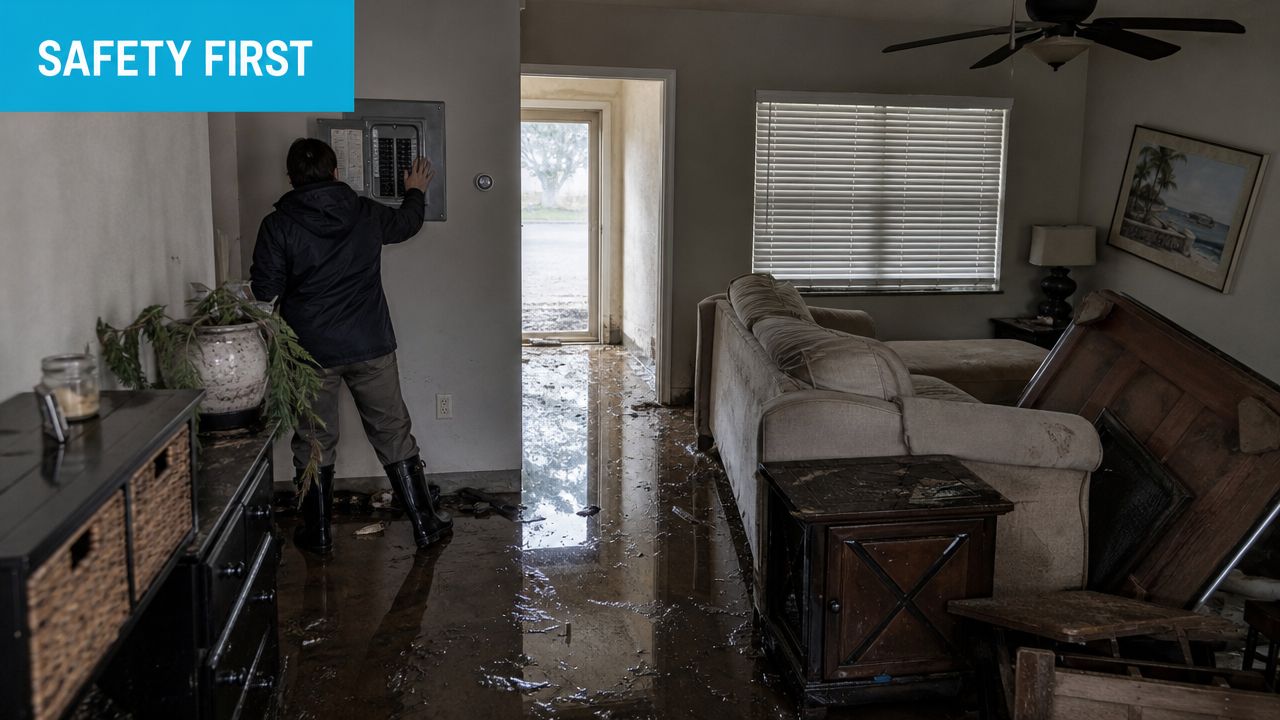
Before any emergency water cleanup after a hurricane in Tampa begins, the property has to be safe enough to enter. The technically correct order starts with electrical safety, then stopping the water source if possible, then extraction, then drying and dehumidification, as outlined in this Tampa water damage cleanup guidance.
Treat the house like a hazard scene
After a hurricane, standing water may overlap with damaged wiring, compromised outlets, shifted flooring, broken glass, and unstable ceilings. If utility lines are down outside, treat them as live. If water reached outlets, appliances, or your electrical panel, don’t step into flooded areas until power has been isolated safely.
Start with these checks:
- Look before entering. Check for sagging ceilings, leaning walls, broken windows, displaced doors, and warped floors.
- Assume floodwater is unsafe. Wear boots and gloves before contact.
- Don’t drive through floodwater. If streets are still flooded, wait until access is safe.
- Keep away from downed lines. They should be treated as energized until utility crews confirm otherwise.
If the building smells like gas, don’t go inside. Leave immediately and contact the utility provider or emergency services from a safe location.
What you can do in the first hour
The first hour is about control, not cleanup.
- Shut off electricity if it’s safe to access the panel from a dry area.
- Stop active intrusion if possible. That might mean shutting off a broken supply line or placing a temporary cover over an opening once conditions allow.
- Keep family members and pets out of affected rooms.
- Create one clean path in and out. That limits tracking contamination through the house.
Wet flooring near outlets, extension cords, or appliances is not a DIY situation.
If you’re unsure whether the house is safe enough for re-entry, wait for qualified help. If you need a clear checklist for the immediate response window, this guide on emergency water damage repair in the first 24 hours is useful.
What not to do
A lot of avoidable injuries happen because people rush inside to save belongings.
Don’t do these things in the first hour:
- Don’t switch breakers while standing on wet flooring
- Don’t lift soaked carpet without checking for tack strips, nails, or contamination
- Don’t use household fans in visibly contaminated flood areas
- Don’t let children help with cleanup
Your property can be repaired. A bad re-entry decision can’t be undone.
Document Damage and Mitigate Further Loss
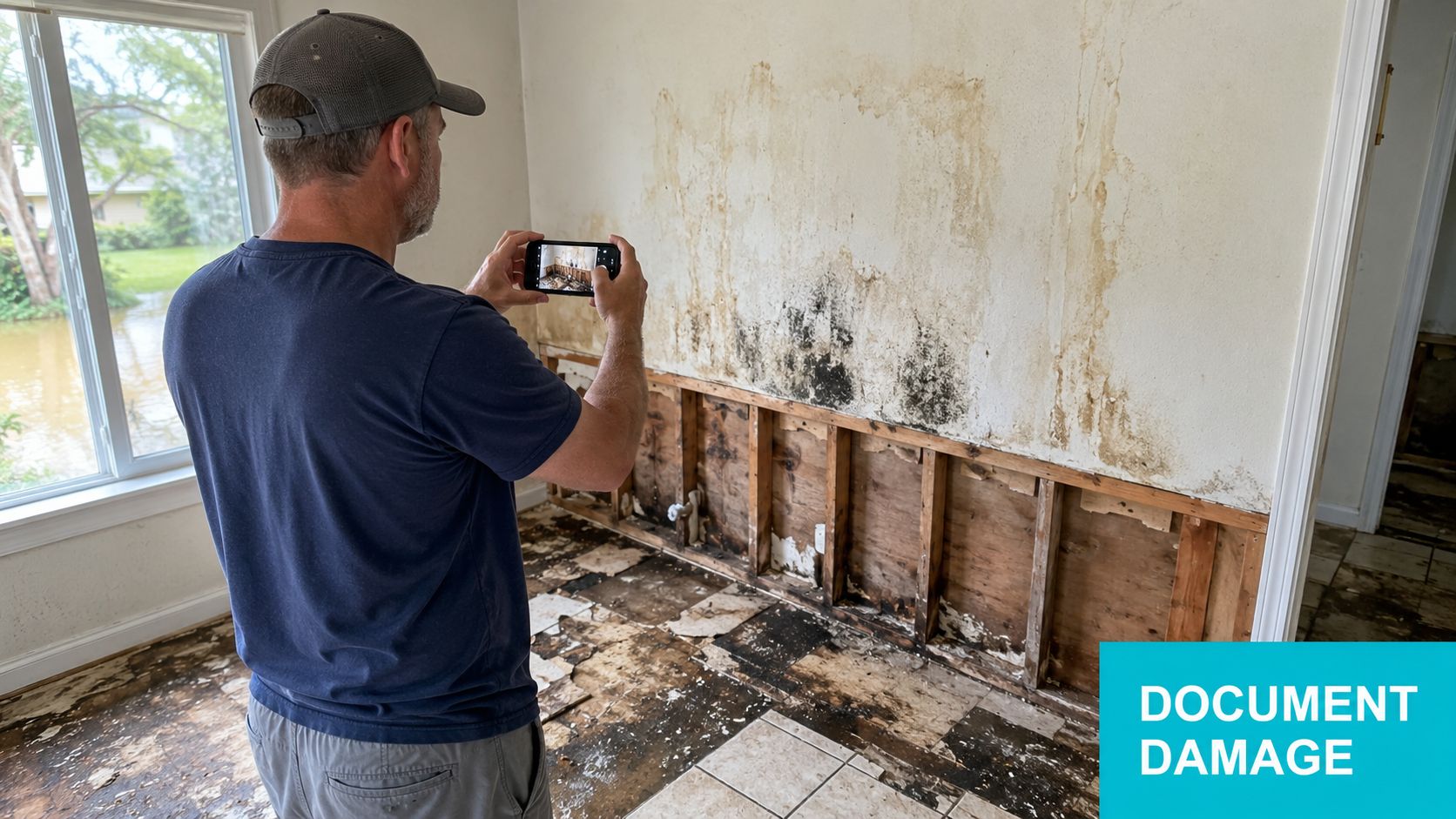
Once the property is safe to enter, stop and document it before you start moving things around. This step protects your claim and gives the restoration team a clean record of what was affected before materials were removed.
What to photograph before cleanup
Use your phone and move methodically. Take wide shots first, then close-ups.
Photograph these items before disturbing them:
- High-water marks on drywall, doors, cabinets, and furniture
- Every affected room from multiple corners
- Damaged contents such as rugs, mattresses, upholstered furniture, electronics, and boxes
- Visible staining or swelling on baseboards, trim, cabinets, and flooring
- Exterior entry points where water likely entered
- Appliances and electrical areas if they were exposed, but only from a safe position
A short video walkthrough helps too. Open cabinet doors and closet doors as you record if it’s safe to do so.
What to save and what to move
After documentation, your next job is reducing further damage without spreading contamination.
Low-risk mitigation can include:
- Moving dry items away from wet zones
- Lifting furniture legs onto blocks or foil
- Removing loose rugs if they were not hit by contaminated water
- Placing towels or mops on small clean-water puddles in unaffected areas
- Opening interior doors to improve visibility and access
If you need temporary supplies to separate salvageable belongings, sturdy moving boxes in house can help organize contents before pack-out or relocation to a dry room.
Photograph first. Move second. Discard last. Once materials are gone, it’s harder to prove the original extent of the loss.
DIY mitigation that makes sense
A homeowner can help stabilize the situation if the water exposure is limited and safe to handle. That usually means simple tasks in areas that are not electrically hazardous and not obviously contaminated by floodwater.
Reasonable temporary actions include:
| Task | Safe for homeowner | Notes |
|---|---|---|
| Moving undamaged contents | Yes | Keep items in a dry, separate room |
| Blotting small surface water in safe areas | Yes | Don't use this as a substitute for extraction |
| Opening cabinets for inspection | Yes | Only if structure is stable |
| Pulling out soaked drywall | Usually no | Better after documentation and professional review |
| Lifting wet flooring | No | Hidden moisture and contamination often spread farther than visible damage |
Mitigation mistakes that create bigger losses
The biggest mistake is overhandling. People often start tearing out materials too soon, especially after floodwater enters from outside. That can spread debris, contamination, and insurance confusion all at once.
The second mistake is assuming a room is dry because the surface looks dry. In Tampa conditions, wall cavities, insulation, subfloors, and cabinet toe-kicks hold moisture long after the visible water is gone.
The Professional Water Cleanup and Drying Process
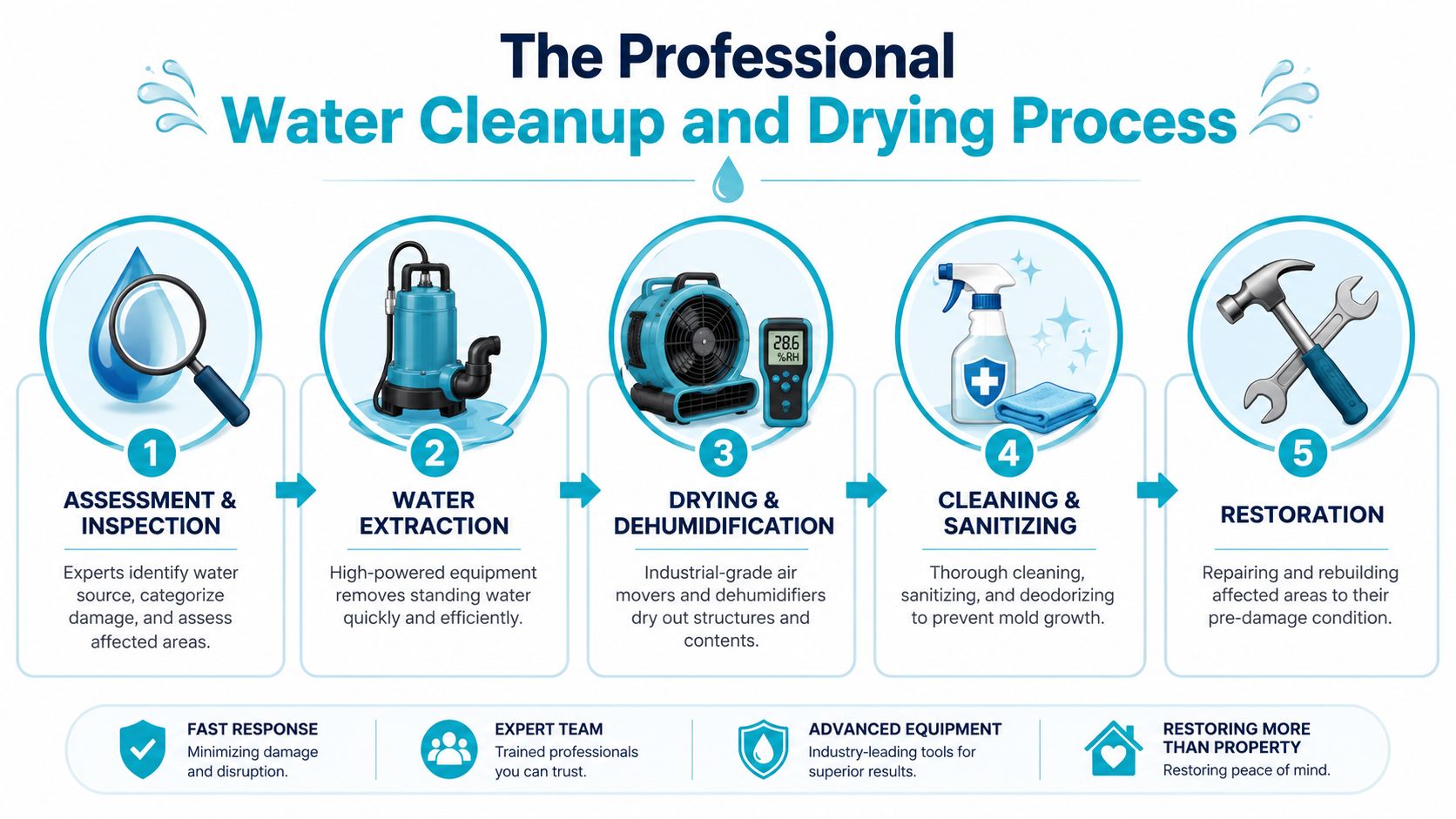
Professional emergency water cleanup after a hurricane in Tampa isn't just a bigger version of DIY cleanup. It's a different process entirely. The accepted workflow is inspection and hazard triage, high-capacity extraction, structural drying with air movers, dehumidifiers and moisture meters, cleaning and sanitization, then repairs and rebuild, as described in this Tampa restoration process overview.
Step one is inspection, not demolition
A trained crew doesn't walk in and start cutting walls at random. The first move is to identify where the water came from, what materials it reached, and where hidden moisture likely traveled.
In a Tampa hurricane loss, that inspection should account for:
- Storm surge or rising water exposure
- Wind-driven rain entry through roofs, windows, or doors
- Saltwater contact
- Moisture migration into insulation, framing, and subfloors
- Content contamination
Saltwater changes the conversation. It doesn't just wet materials. It leaves residue behind, accelerates corrosion, and complicates what can be cleaned versus what should be removed.
Extraction has to be fast and aggressive
Professional extraction uses commercial-grade pumps and vacuums to remove standing water quickly. That matters because the longer water sits, the farther it wicks into drywall, trim, engineered flooring, cabinets, and contents.
A household wet vac can help with a tiny, clean spill. It does not replace high-capacity extraction after a hurricane. Large losses need the kind of removal rate you get from truck-mounted or commercial systems.
What works:
- Fast bulk water removal
- Repeated passes in low spots
- Extraction from carpet and pad where salvage is still possible
- Removal before swelling and contamination spread further
What doesn't:
- Waiting for water to “drain out”
- Mopping without extraction
- Leaving saturated padding in place
- Assuming tile means the room is unaffected
Drying is where most DIY efforts fail
Drying a structure is not the same as circulating air. Good restoration crews use air movers, dehumidifiers, and moisture meters together. The air movers promote evaporation. The dehumidifiers remove moisture from the air. The meters confirm whether wood, drywall, and other materials are drying.
That last part is critical. You can't judge a wall cavity by touch.
If you need help understanding that stage, these structural drying services in Tampa Bay show what controlled drying is supposed to include.
Dry surfaces can fool people. Moisture trapped behind baseboards, under flooring, and inside insulation is what leads to callbacks, odor, and mold.
Why fans can make things worse
In clean-water losses, air movement has a place. In hurricane flood losses, generic fan use can be a serious mistake. Tampa Bay reporting after Hurricane Helene warned that when water comes from rising floodwaters, “everything the water touched is contaminated” and may need removal, with a “flood cut” often required about four feet above the floor. It also warned that fans can spread contaminated air and worsen conditions, as reported in this Tampa Bay cleanup resource.
That's the trade-off many homeowners don't hear clearly enough. A fan feels like drying. In a contaminated environment, it may be spreading what you don't want airborne.
Cleaning and rebuild depend on the material
Not every wet material gets the same treatment.
A professional crew typically sorts materials into three groups:
| Material type | Usually salvageable | Often not salvageable after floodwater |
|---|---|---|
| Non-porous surfaces | Often, after proper cleaning | Depends on damage severity |
| Semi-porous finishes | Sometimes | Depends on saturation and contamination |
| Porous materials like drywall, insulation, some upholstered items | Limited | Commonly removed |
One practical example is a company like AMPM Restoration Services, which handles emergency extraction, drying, sanitization, and rebuild under one roof for Gulf Coast properties. That kind of full-service scope helps when the same loss affects flooring, drywall, contents, and air quality at once.
Navigating Insurance and Hiring a Restoration Pro
Insurance stress usually starts the moment cleanup begins. People worry that if they act fast, they'll hurt the claim. They worry that if they wait, the house will get worse. Both concerns are real, and the answer is to document thoroughly, report promptly, and choose a restoration company that works in a way insurers can follow.
Tampa's broader emergency response system is built around 24/7 access and fast reporting. The City of Tampa lists emergency utility contacts, including Water Department Emergency Services at 813-274-7400, Wastewater Emergency Repair / Sewer Backup at 813-247-3451, and TECO outage or safety concerns at 1-877-588-1010, and local restoration providers commonly state 24/7 availability, as noted in the South Tampa Chamber hurricane prep resources. That tells you something important. In this kind of loss, speed is not optional. It's part of the system.
How to make the claim smoother
Start with your carrier, but don't stop there. You still need mitigation underway.
These practices usually make the process cleaner:
- Open the claim early. Get the claim number as soon as you can.
- Keep every photo and video. Don't delete failed or duplicate shots until the claim is settled.
- Save receipts for emergency purchases. That includes temporary supplies and protective measures.
- Ask for written scope notes. You want a clear record of what was wet, what was removed, and why.
For a practical walkthrough, this guide on how to file an insurance claim for water damage can help you stay organized.
Your right to choose the contractor
Many homeowners think they have to use whoever gets suggested first. They don't. You can choose your own restoration company.
When comparing firms, ask direct questions:
| Question | Why it matters |
|---|---|
| Are you licensed, bonded, and insured? | It protects you if the job goes sideways |
| Do you document moisture and drying progress? | Insurers often want support for the scope |
| Do you handle mitigation and rebuild? | Fewer handoffs usually means fewer delays |
| Have you worked on hurricane flood losses in Tampa Bay? | Local conditions matter |
If you own a manufactured or mobile home, flood coverage questions can be even more specific. This overview of flood insurance for mobile homes is a useful reference when you're sorting out what policy may apply.
The wrong contractor can turn a hard claim into a messy one. Poor documentation, rushed demolition, and incomplete drying are what usually create disputes.
What a qualified local pro should understand
A qualified restoration team in Tampa should understand local flood patterns, humidity behavior, utility coordination, contaminated water handling, and the difference between mitigation and repair. They should also be able to explain what they're doing in plain language.
That matters because after a hurricane, you don't need vague reassurance. You need a dry building, a documented scope, and a crew that knows which materials can stay and which have to go.
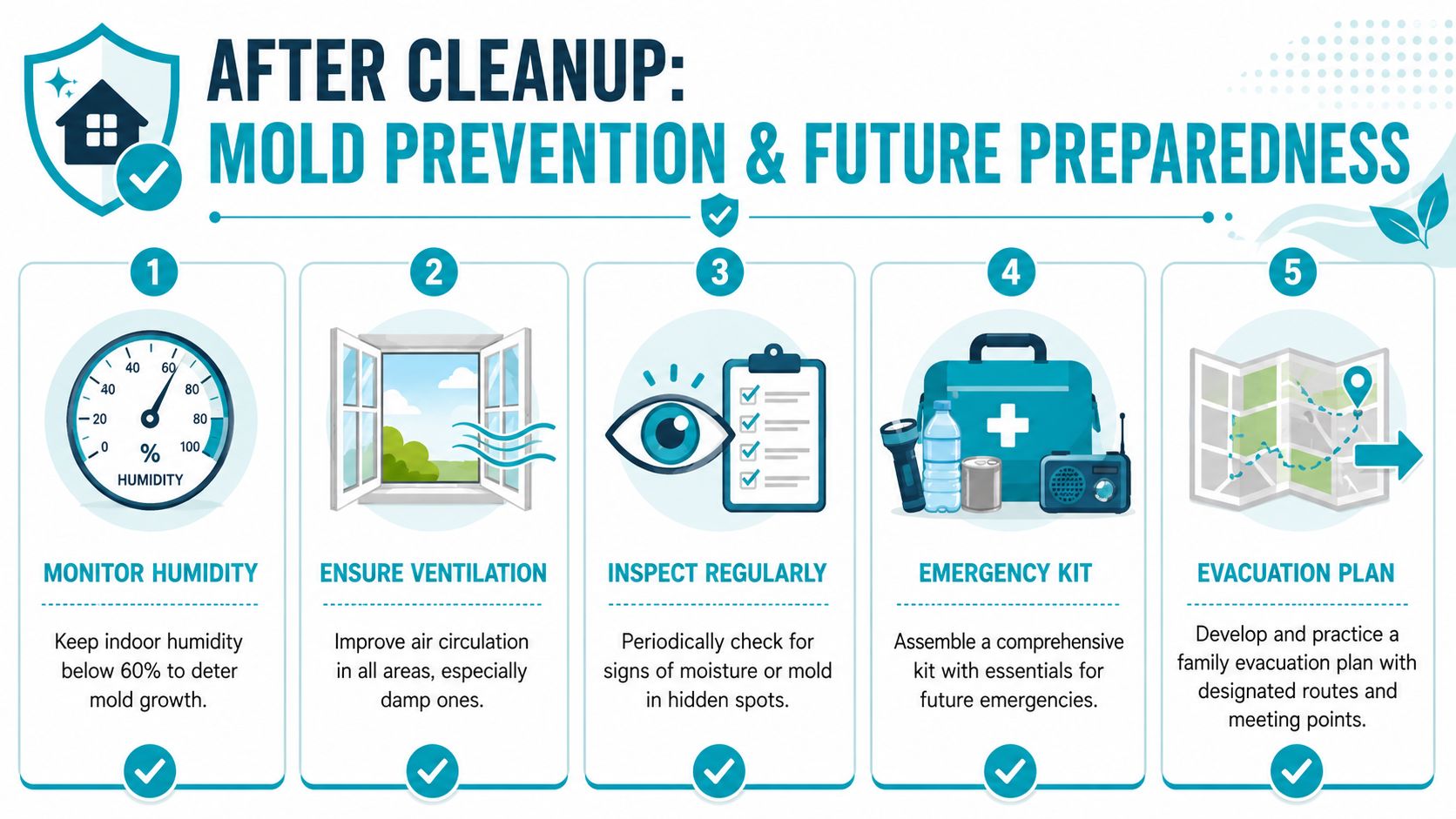
After Cleanup Mold Prevention and Future Preparedness
Once the visible cleanup is done, many homeowners relax too early. That's when secondary moisture problems get missed.
What to watch in the next few weeks
Pay attention to subtle warning signs:
- A musty smell that wasn't there before
- Baseboards or trim separating from the wall
- Paint bubbling or drywall softening
- Flooring that starts cupping, lifting, or feeling spongy
- Recurring condensation in one room
Those clues often point to hidden moisture, not a new event.
If you want a practical post-flood checklist, this guide on how to prevent mold after a flood is worth reviewing.
Make the next storm easier to manage
Preparedness doesn't eliminate risk, but it does shorten decision time.
Focus on these upgrades:
- Seal vulnerable openings. Check windows, doors, roof penetrations, and garage seals.
- Improve drainage. Keep gutters, downspouts, and ground grading moving water away from the house.
- Store contents smarter. Keep irreplaceable items and documents raised and sealed.
- Build a storm response kit. Gloves, boots, contractor bags, lighting, chargers, and document sleeves help immediately after re-entry.
- Plan utility shutoff access. Everyone in the household should know where key shutoffs are.
The goal after emergency water cleanup after a hurricane in Tampa isn't just to dry the house once. It's to reduce how much damage the next storm can do.
Tampa Hurricane Water Cleanup FAQs
| Question | Answer |
|---|---|
| How quickly should cleanup start after hurricane water enters the home? | As soon as the property is safe to enter. In practice, electrical safety and hazard checks come first, then documentation, then extraction and drying. Waiting allows water to keep moving into structural materials. |
| Can I use household fans to dry floodwater damage? | Be careful. In floodwater situations, fans can spread contaminated air and worsen conditions. That's one reason flood losses need a more controlled drying plan. |
| What has to be thrown away after rising floodwater enters the home? | The clearest rule is this: when water comes from rising floodwaters, “everything the water touched is contaminated” and may need removal. That can include porous materials and contents. |
| What is a flood cut? | A flood cut is removal of damaged wall material above the water line. Tampa Bay reporting after Hurricane Helene noted that a flood cut is often required about four feet above the floor in affected areas. |
| Can I stay in the home during cleanup? | Sometimes, but it depends on safety, contamination, electrical conditions, and how much demolition or drying equipment is required. If multiple rooms were affected or floodwater entered from outside, many families are better off staying elsewhere temporarily. |
| How do I choose a restoration contractor after a hurricane? | Look for a local, insured, restoration-focused company that documents the job well, responds fast, and can explain its drying and material-removal decisions clearly. Avoid anyone who pushes major demolition before proper documentation and hazard review. |
If you need emergency water cleanup after a hurricane in Tampa, contact AMPM Restoration Services for 24/7 help. Call 941-946-7807 for a free inspection and estimate. We can assist with insurance claim coordination, explain the mitigation scope clearly, and discuss financing options so you can move quickly without guessing.