

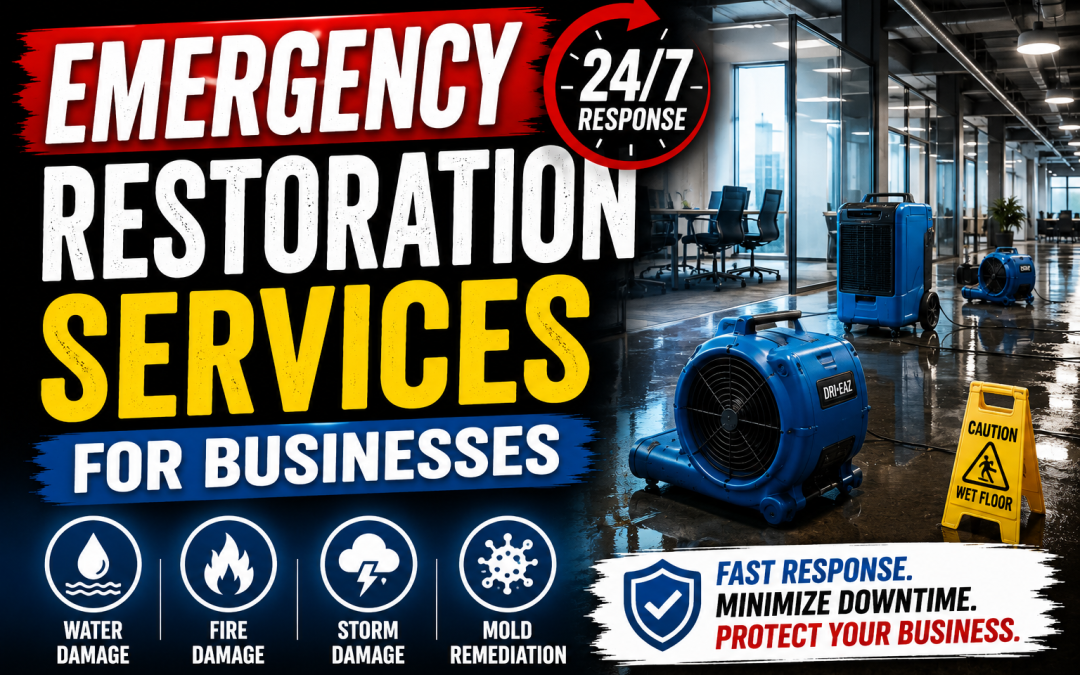
Water is on the floor. Ceiling tiles are sagging. A burnt smell is moving through the HVAC system. Staff are texting you before sunrise asking whether they should even come in.
That’s the moment when emergency restoration services for businesses in Tampa stop being a line item and become an operations decision, a safety decision, and a cash flow decision all at once. The first hours after a loss shape whether you reopen quickly or spend weeks fighting secondary damage, tenant issues, customer disruption, and insurance delays.
Tampa businesses deal with a hard mix of risks. Storm intrusion, plumbing failures, roof leaks, electrical fires, smoke contamination, and the mold that follows moisture exposure all hit differently. What works in a house often doesn’t work in an office, restaurant, retail suite, warehouse, medical space, or hotel. Commercial losses require faster triage, better documentation, and a cleaner chain of communication between ownership, facilities, insurance, and the restoration crew.
Your Business is Flooded or Damaged What Now
A Tampa business owner opens the door at 6:30 a.m. and hears water before seeing it. The breakroom line failed overnight. Water has moved under LVP flooring, into baseboards, and toward the server closet. Across town, another owner is dealing with a kitchen fire that was put out quickly, but smoke has traveled far beyond the area that burned.
That first reaction is usually the same. Shut off what you can. Protect people. Figure out whether the property is safe. Then get real emergency restoration services for businesses in Tampa on site before the loss spreads into materials and systems that were still salvageable an hour earlier.

First actions that protect the building and the claim
If the property is safe to enter, do four things in order:
- Stop the active source if you can do it safely. Shut off water, isolate power to affected areas, or secure the area after fire department clearance.
- Keep employees and customers out of the damaged zone. Wet flooring, unstable ceiling materials, and smoke residue create immediate hazards.
- Document before cleanup starts. Take photos and short videos of standing water, affected rooms, inventory, equipment, and visible source areas.
- Call a commercial restoration team immediately. The crew should be prepared to inspect, contain, extract, dry, clean, and help with insurer documentation.
For a practical breakdown of what matters in the opening response window, this guide on emergency water damage repair in the first 24 hours is worth reviewing while the team is mobilizing.
Practical rule: Don’t let well-meaning staff start tearing out materials, moving electronics, or running box fans everywhere. Uncontrolled cleanup often destroys evidence, spreads contamination, and makes the drying plan worse.
If the loss happened during a wider outage event, utility instability changes the risk profile. This outside resource on managing water during power outages gives useful context for handling water issues when building systems are compromised.
Understanding Common Commercial Emergencies
The damage category matters because each one spreads differently through a business. The cleanup method, the equipment, the salvage decisions, and the reopening plan all change based on what happened.
Water losses
Commercial water losses often start with something ordinary. A failed supply line, roof leak, overflowing fixture, sprinkler discharge, or storm intrusion. The visible puddle is rarely the whole problem.
Water moves under flooring, behind vinyl wall covering, into insulation, under cabinets, and through wall cavities. In offices and retail spaces, it also threatens point-of-sale systems, low wall outlets, display materials, and inventory stored too close to slab level.
What works:
- Fast source control: Someone identifies whether the leak is still active.
- Targeted extraction: Crews remove bulk water before it wicks further.
- Instrument-based drying: Moisture meters and thermal imaging guide decisions.
What doesn’t:
- Waiting to “see if it dries on its own.”
- Running comfort fans without a drying plan.
- Assuming a dry-looking surface means the assembly is dry.
Fire and smoke losses
Fire damage isn’t just charred framing and a visible burn area. Smoke migrates through returns, corridors, plenum spaces, and contents. Soot type matters, and delayed cleaning gets expensive fast.
For Tampa commercial properties, fire damage restoration in Tampa often includes contents cleaning, odor treatment, and HVAC decontamination, not just structural cleanup. According to BELFOR Tampa, hydrocarbon-based soot can penetrate HVAC ducts and contents, and remediation may require HEPA filtration with 99.97% efficiency at 0.3 microns plus hydroxyl generators to reach acceptable air quality. The same source notes that delayed cleaning allows corrosive smoke acids to etch metals and degrade synthetics, potentially increasing rebuild costs by 200-400%.
Smoke that isn’t visible anymore can still be sitting in ductwork, fabrics, electronics, and finished surfaces.
Mold after moisture intrusion
Mold is often a follow-on event, not the original loss. The trigger is unresolved moisture. In commercial spaces, mold frequently appears around base trim, behind shelving, inside wall cavities, above acoustical ceilings, or inside HVAC components after a water event wasn’t dried fully.
The business risk is bigger than appearance. Mold can shut down occupied areas, affect indoor air quality complaints, and force selective demolition that could have been avoided with better early drying.
Storm and wind-driven damage
Storm damage in Tampa usually comes as a package. Roof intrusion, window failure, water migration, debris impact, humidity load, and later mold pressure. The mistake many owners make is treating only the visible opening. A board-up alone doesn’t solve moisture trapped in assemblies, and surface cleanup alone doesn’t restore a building envelope.
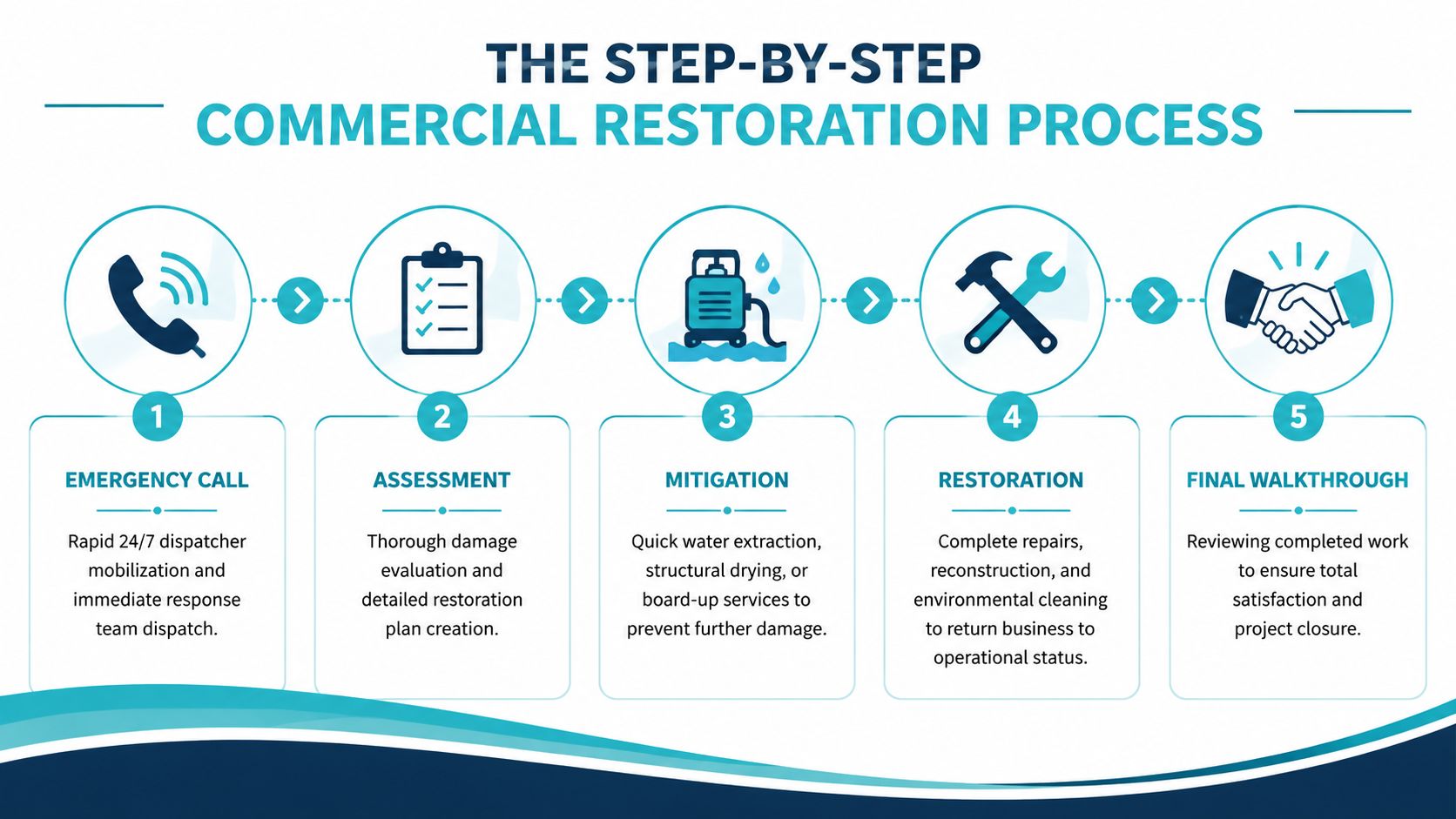
The Step-by-Step Commercial Restoration Process
When the right crew arrives, the job shouldn’t feel chaotic. Good commercial restoration follows a disciplined sequence. That sequence protects the building, keeps the claim organized, and gets you closer to reopening with fewer surprises.
Step 1 and Step 2 response and assessment
The first call should trigger dispatch, not voicemail. Commercial losses need a crew that asks the right questions immediately: what happened, whether the source is contained, what spaces are affected, whether the building is occupied, and whether sensitive equipment or inventory is involved.
Once on site, technicians inspect beyond the obvious damage. They check wall cavities, subfloors, base assemblies, ceiling plenums, adjacent units, and HVAC pathways. They also separate what’s an immediate mitigation issue from what belongs in reconstruction later.
A calm project lead holds significant importance. The owner needs one clear explanation of the scope, one contact path, and one operating plan for the next several hours.
Step 3 mitigation and controlled drying
This stage decides whether the loss stays manageable. In commercial water damage restoration, FP Property Restoration’s commercial damage guidance states that action within the first 24-48 hours is essential, that saturated materials can foster mold if not addressed, and that IICRC-certified technicians use high-capacity equipment to reduce drying time by 40-60%. The same source notes that delaying treatment beyond 72 hours can escalate restoration costs by 300-500% due to structural compromise and extensive mold remediation.
That’s why commercial crews don’t rely on a few rental fans. They build a drying system. Typical tools include truck-mounted extraction, air movers, dehumidifiers, moisture meters, and thermal imaging. The point isn’t noise. The point is measured moisture removal.
A practical example:
- Standing water on finished floors calls for immediate extraction.
- Wet drywall and insulation may require selective removal if the assembly can’t dry safely in place.
- Moisture trapped under flooring may push the crew toward specialty floor drying systems or controlled demolition.
Field judgment: The fastest-looking option isn’t always the fastest reopening option. Saving a wet wall assembly that should be opened can delay drying, extend odor issues, and create a mold problem later.
If your team is trying to understand where moisture can linger on unexpected surfaces, this outside article on mold on glass is a useful reminder that condensation and trapped humidity can create problems well beyond drywall and carpet.
Step 4 cleaning sanitizing and odor removal
After moisture control or fire suppression cleanup, the building still may not be ready for people. Surfaces need detailed cleaning. Contents may need pack-out, wipe-down, HEPA vacuuming, or deodorization. In smoke losses, HVAC cleaning is often part of the job because odor recirculates if residues remain in the system.
This is also where crews separate salvageable contents from items that are unsafe or uneconomical to restore. Good documentation here helps both operations and insurance.
Step 5 reconstruction and return to operations
Mitigation isn’t the finish line. Commercial jobs often move into repairs such as drywall replacement, paint, flooring, millwork, electrical corrections, and fixture resets. Some owners prefer one firm to handle both emergency response and rebuild because the handoff is cleaner.
One option businesses in the region use is AMPM Restoration Services, which handles emergency mitigation, drying, sanitization, repairs, reconstruction, and insurance coordination across the Tampa Bay area. The practical advantage of a full-service model is that fewer handoffs usually mean fewer delays between drying completion and actual repairs.
Navigating Insurance Claims and Managing Costs
Owners usually ask two questions before the water is even extracted. “What will this cost?” and “Will insurance cover it?” Both are fair. A bad claims process can hurt almost as much as the original loss.
Why documentation matters more than opinions
Insurance carriers don’t pay based on how stressful the situation feels. They pay based on documented cause, documented scope, and documented work. That means the restoration team should be building a file from the first visit: site photos, moisture maps, equipment logs, room-by-room notes, demolition records, and itemized estimates.
The difference between a messy claim and a manageable one usually comes down to whether someone created a clean record while the damage was fresh. If the source, affected materials, and mitigation actions aren’t documented early, disputes start later.
A good starting point for owners is this guide on how to file an insurance claim for water damage, especially if you’re trying to balance emergency action with carrier reporting requirements.
What a strong restoration partner actually does
The right commercial vendor doesn’t just dry the building. They help move the claim.
According to FP Property Restoration, commercial water and fire claims face denial rates around 15-20%, while claims handled with direct carrier coordination are processed about 30% faster. The same source states that proactive companies that handle the full claims process and respond within an hour can prevent secondary mold growth, which affects 40% of delayed commercial recoveries.
That matters because every delay compounds operational pressure. Rent is still due. Payroll continues. Customers start making other arrangements.
Use this checklist when speaking with any restoration company:
- Ask who documents the loss: If they can’t explain how they photograph, map, and log the job, expect friction later.
- Ask whether they coordinate directly with the carrier or adjuster: Faster communication usually means fewer estimate disputes.
- Ask how they separate emergency mitigation from rebuild scope: Claims often move more cleanly when those phases are clearly documented.
- Ask who tracks change conditions: Commercial losses evolve once walls or flooring are opened.
The cheapest estimate on day one can become the most expensive path if it leaves out documentation, misses hidden damage, or stalls the claim.
Checklist for Choosing Your Tampa Restoration Partner
In a commercial loss, owners often call the first company that answers. That’s understandable. It’s also risky. The better move is to qualify the vendor quickly against a few essential requirements.
Non-negotiables for commercial work
Use this short decision table when comparing emergency restoration services for businesses in Tampa:
| What to check | Why it matters | What to listen for |
|---|---|---|
| 24/7 availability | Losses don’t wait for business hours | A real dispatcher and clear arrival process |
| Commercial experience | Offices, retail, hospitality, and mixed-use properties behave differently | Specific examples of commercial scopes and occupancy planning |
| IICRC-certified technicians | Drying, cleaning, and contamination control require trained decisions | Moisture mapping, equipment planning, containment, documentation |
| Insurance coordination | Claims slow down when nobody owns the paperwork | Direct carrier communication and detailed estimating |
| Reconstruction capability | You don’t want a gap between drying and repairs | Ability to carry the project through final repairs |
For businesses comparing providers, commercial restoration company services in Tampa Bay should include both emergency mitigation and a clear path to rebuild. If a company only handles extraction and leaves the rest to someone else, you may lose days during handoff.
Red flags owners miss
Some warning signs only show up after the crew arrives.
- No instrument readings: If nobody is checking moisture conditions, the drying plan is guesswork.
- No containment strategy: In mold or soot jobs, contamination can spread during cleanup.
- No discussion of business operations: Commercial work should account for access, tenant coordination, customer traffic, and reopening priorities.
- No written scope changes: Surprise invoices often start with undocumented job expansion.
A strong vendor answers operational questions as clearly as technical ones. They should be able to tell you what happens to the building and what happens to your workday.
Tampa Bay Specifics and Business Continuity Planning
Tampa businesses don't just need a restoration vendor. They need a continuity plan that matches Gulf Coast reality. Storms don't only create dramatic losses. They also expose weak roof details, aging sealants, neglected drains, poor grading, vulnerable storefronts, and buildings that already had hidden moisture issues before the weather arrived.
Why proactive planning pays in Tampa
Storm exposure has become a planning issue, not just an emergency issue. According to BluSky's Tampa page, recent NOAA data shows Tampa Bay storm losses are up 25% year-over-year due to intensified hurricanes. The same source says FEMA studies show pre-season board-ups can reduce damage by 60%, and that properties with pre-event moisture mapping and leak detection recover 40% faster after a storm.
That doesn't mean every business needs a massive disaster manual. It means a few practical actions taken before the season can save days of confusion later.
A continuity plan that works in the real world
Keep it simple and usable:
- Map your weak points: Roof transitions, window systems, rear service doors, ground-level storage, and past leak areas should already be known.
- Create a shutdown protocol: Staff need to know who can authorize closure, who shuts off utilities, and who secures stock and equipment.
- Store key records off site or in the cloud: Leases, vendor contacts, insurance details, and equipment lists should be available even if the building isn't.
- Set up staff communication before the event: A phone tree is better than group-text chaos. For teams building that process, Call Loop's automated campaign solution offers a practical model for emergency notifications.
- Know your priority zones: Some businesses don't need the whole building back on day one. They need one production area, one POS location, or one customer-facing section operational first.
For Tampa Bay retail operators especially, retail property damage restoration in Tampa Bay is easier to manage when merchandising priorities, stock movement, and customer access routes are planned before a storm hits.
What doesn't work after a storm
Waiting for visible damage to “declare itself” rarely helps. Water intrusion often starts small, then moves inside assemblies while operations continue around it. Another common mistake is calling separate vendors with no single project lead. Roofing, extraction, cleanup, and repairs all need one coordinated timeline.
The businesses that recover with less disruption usually made key decisions before landfall, not after.
FAQs and Your Next Steps with AMPM Restoration
Tampa has 77 providers in this market, and the broader industry was projected to reach $7.1 billion by 2024 according to this market overview on Tampa restoration services. For a business owner, that doesn't make the choice easier. It makes clarity more important. You need a company that can control the site, document the loss, coordinate the claim, and move toward reopening without wasting critical time.
Six common questions from business owners
How fast should we call for emergency restoration services for businesses in Tampa
Immediately after the site is safe and the source is controlled. Waiting gives water, smoke residue, and humidity more time to spread into materials and systems that may still be recoverable.
Can electronics documents and inventory be saved
Sometimes yes, sometimes no. Salvage depends on exposure, contamination level, and how quickly the items are stabilized. Sensitive contents usually need separate evaluation instead of blanket disposal.
Will employees be able to work during restoration
That depends on the loss area, indoor air conditions, safety hazards, and whether crews can isolate the work zone. Partial occupancy is often possible in commercial buildings when the site is managed correctly.
How long will the process take
The answer depends on source control, affected materials, building layout, and whether reconstruction is needed. Mitigation and full restoration are different phases, and owners should ask for a timeline for each.
Is the building safe after cleanup
It should only return to use after the affected areas are dried, cleaned, repaired, and cleared for safe occupancy. In smoke, mold, or contamination cases, verification matters more than appearance.
Can a restoration company help with insurance paperwork
Yes, and that support can make a major difference. The most useful help usually includes damage documentation, estimate preparation, direct communication with the carrier, and organized records of the work performed.
If you're dealing with active damage right now, the next step is simple. Get a qualified commercial team on site, protect the claim from the start, and make reopening the operational goal from hour one.
If your property needs emergency restoration services for businesses in Tampa, contact AMPM Restoration Services for immediate help. We're available 24/7 and can be reached at 941-946-7807 for a free inspection and estimate. We also provide insurance claim assistance and financing options to help business owners move from emergency response to full recovery with less disruption.