

At 2 a.m., a sprinkler line above a second-floor IT room in a Tampa Bay office building can turn a quiet night into a business emergency. Water runs through ceiling assemblies, reaches servers and cabling, soaks drywall, and drops into the tenant space below. The property manager calls the fire department, shuts down power where it's safe, and throws towels across the floor, but none of those actions stops water from migrating through concealed spaces.
The clock matters. Independent guidance identifies the first 24 to 48 hours after water intrusion as a critical drying window, because porous materials left wet beyond that period become vulnerable to mold colonization and secondary damage (restoration drying guidance). For commercial property owners searching for commercial water damage restoration near me, the right question isn't who offers the cheapest estimate. It's who can dispatch a commercial crew, extract water, protect building systems, document the loss, and help you make sound occupancy decisions before the damage spreads.
When Water Hits Your Business at 2 a.m.
The first few minutes feel chaotic because every decision seems urgent. Should you evacuate the floor? Can tenants stay open? Is the electrical room safe? Should you wait for the building engineer, or call the insurer first?
Call emergency services if there's an immediate life-safety threat. If water is near electrical equipment, isolate the affected zone only when an authorized person can do so safely. Stop the source if you can reach the shutoff without entering a hazardous area, then keep people away from sagging ceilings, wet electrical components, contaminated water, and unstable flooring.
What won't work is waiting for daylight while saturated materials continue to release moisture into the building. Electronics can corrode, wood can swell, ceiling systems can fail, and water can travel through wall cavities and HVAC pathways. The commercial emergency restoration team serving Tampa businesses should be able to begin stabilization overnight, not take a message and promise a morning callback.
Practical rule: Protect people first, isolate hazards second, and call a commercial restoration contractor before you start moving contents or opening walls.
Allianz Global Corporate and Specialty analyzed more than 470,000 claims across 200 countries and territories over five years. Its analysis placed water damage as the third-highest number of insurance claims for global business, at 6% overall, and the eighth-highest cause of loss by value, at 3% overall (Allianz Global Corporate and Specialty water damage analysis). North American insurers paid out more than $2 billion in water-damage claims over the past 10 years, according to the same analysis.
That history explains why carriers ask about response time, source control, extraction, drying records, and access restrictions. Your first call should go to a contractor with commercial extraction capacity, dehumidifiers, moisture-measurement tools, trained personnel, and a documentation process that can support the claim. Price shopping can wait until the building is stable. Water won't.
How Commercial Water Damage Restoration Actually Works
Commercial restoration isn't just pumping out visible water. The IICRC S500 standard applies to residential, commercial, and institutional buildings, and its framework supports a documented process built around extraction, controlled drying, and protection of building systems and contents (IICRC S500 standard).

The first response controls the loss
Emergency mitigation begins with identifying and stopping the source, assessing hazards, isolating power when appropriate, and extracting standing water. Commercial crews may use truck-mounted extraction units, portable pumps, commercial air movers, and dehumidifiers. The objective is to remove liquid water quickly and prevent it from moving into additional rooms, assemblies, and contents.
Structural assessment and drying follow extraction. Technicians map moisture in drywall, flooring, cabinets, wall cavities, and other assemblies. They use psychrometric readings, moisture meters, thermal imaging where appropriate, and daily monitoring to decide whether equipment needs adjustment. Drying isn't complete because a floor feels dry. It's complete when documented readings show that affected materials have reached appropriate drying conditions.
The structural drying methods used in professional restoration help technicians address moisture that can't be seen from the surface. Drying duration depends on the building, materials, water category, ventilation, temperature, and moisture load, so a responsible contractor measures progress instead of promising an arbitrary schedule.
Sanitation, contents, and reconstruction
Sanitization becomes critical when water is contaminated. Category 2 and 3 losses, including sewage backups and certain flood conditions, require controlled work practices, appropriate containment, cleaning, and antimicrobial treatment. An office break room, restaurant kitchen, healthcare-adjacent space, or shared restroom can't be treated like a clean-water carpet spill.
Contents handling may include a pack-out, inventory photography, document drying, electronics evaluation, and climate-controlled storage. Technicians should separate salvageable contents from unsalvageable materials and maintain clear records of what moved, where it went, and what condition it was in.
Reconstruction and validation complete the process. That can involve drywall, insulation, flooring, ceiling tile, paint, millwork, and tenant build-outs. For properties that need temporary workspaces or rapid site changes, owners may also review modular solutions for first responders as part of a broader continuity plan.
Every phase creates evidence for the claim file. Expect arrival photographs, source documentation, moisture maps, equipment logs, daily readings, material-removal records, and a final drying report. Skipping documentation can leave the insurer unable to connect the emergency work to the original loss.
Why Commercial Losses Are Not Just Big House Jobs
A commercial water loss has two damage tracks. The first affects the building and its contents. The second affects the business operating inside the building.
An office may lose access to network rooms, conference areas, elevators, or tenant suites. A retailer may lose inventory and point-of-sale capability. A restaurant may need to close because a contaminated line reached food-preparation areas. A landlord may have to coordinate several tenants, protect common areas, and preserve evidence for different policies.
The claim itself can become substantial before full reconstruction begins. One industry source reported a mean commercial water-damage claim loss of $89,000 in 2019, while another compilation reported average office-space restoration costs of about $15,000 per incident and said delayed leak detection can push average costs to $28,500 (commercial water damage cost data). Those figures describe different data points, but they make the same operational point: delay and business interruption can enlarge a loss quickly.
Commercial versus residential response
| Factor | Residential Loss | Commercial Loss |
|---|---|---|
| Occupancy | Usually one household or a small number of occupants | Tenants, employees, customers, vendors, and building staff |
| Building systems | Smaller plumbing, electrical, and HVAC footprint | Risers, larger HVAC systems, multiple electrical zones, elevators, and shared infrastructure |
| Work scheduling | Access often follows the homeowner's schedule | Work may require after-hours access, tenant notices, security coordination, and phased isolation |
| Documentation | Photos and a basic scope may support the claim | Detailed scopes, moisture logs, equipment records, inventories, and operational evidence are commonly needed |
| Business impact | Displacement affects a household | Downtime can affect revenue, tenant obligations, inventory, staff, customers, and liability |
| Reconstruction | Repairs may involve a room or limited area | Repairs may require coordinated build-back across suites, common areas, and occupied zones |
Commercial buildings also use concrete, steel, commercial roofing membranes, raised flooring, extensive ceiling systems, and plumbing networks that feed multiple tenants. Water can move through these systems in ways a residential-only contractor may not recognize or document correctly.
That's why choosing a residential-only contractor for a commercial loss is risky. The contractor may extract water successfully but lack the staffing, safety planning, contents process, insurer communication, or reconstruction coordination needed to reopen the property responsibly. Review commercial restoration company services with the building's operational requirements in mind, not just the extraction price.
Services AMPM Restoration Delivers for Commercial Properties
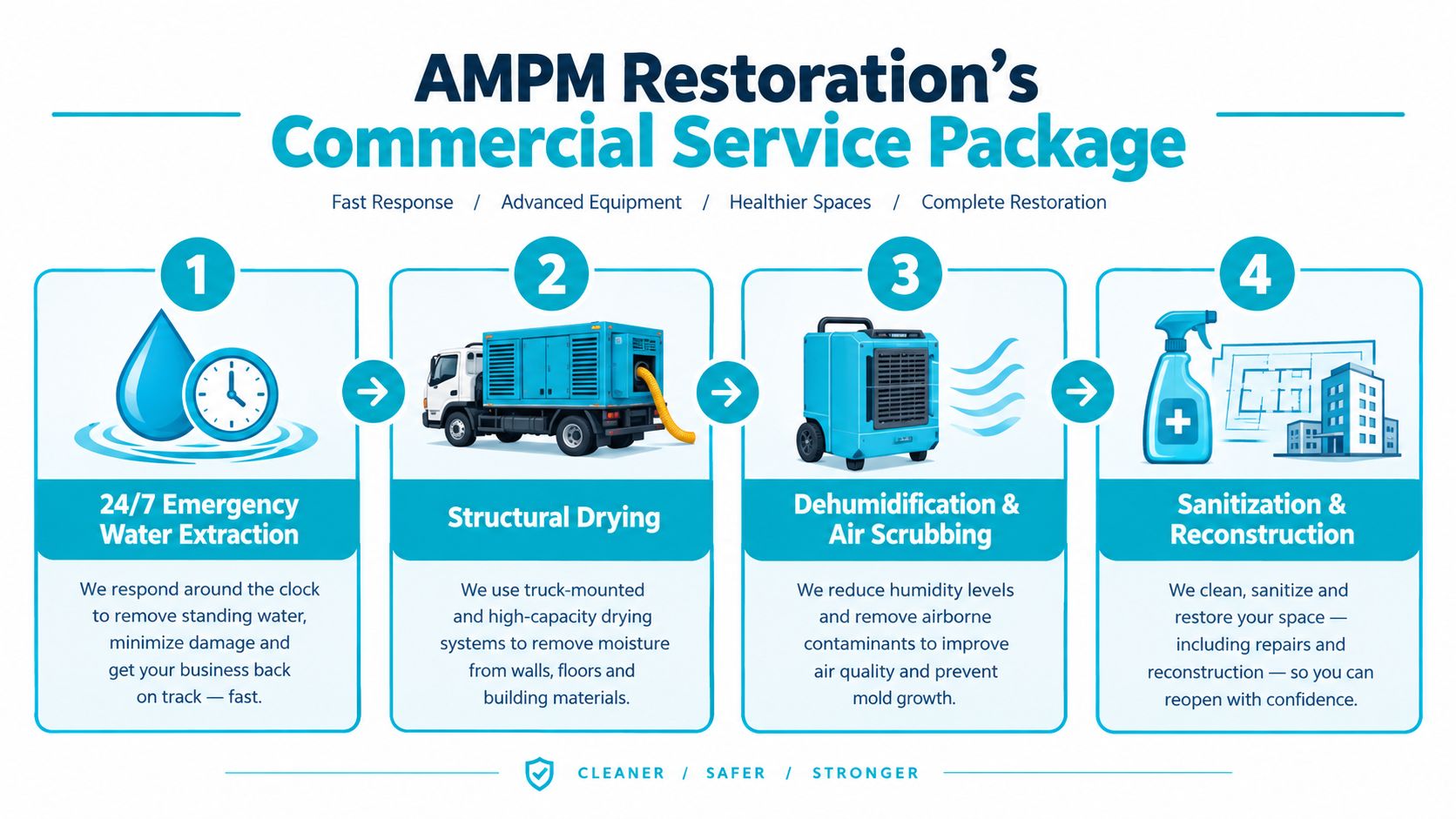
Commercial owners need one coordinated plan, not four vendors passing responsibility between one another. AMPM Restoration Services provides commercial water extraction, structural drying, mold-related services, contents handling, sanitization, and reconstruction for offices, retail properties, hospitality sites, schools, government buildings, and other commercial facilities across Florida's Suncoast.
Emergency extraction and drying
The first service priority is 24/7 emergency water extraction. Crews use truck-mounted extraction units and commercial dehumidification equipment to remove standing water and reduce moisture loading. Thermal imaging can help identify wet areas behind drywall, beneath raised flooring, and inside wall cavities, although technicians still confirm conditions with direct moisture readings.
Structural drying requires more than placing fans in the affected room. Technicians establish a drying plan, position air movers and dehumidifiers, monitor temperature and humidity, and record readings over the course of the project. The goal is to dry affected assemblies without spreading contamination or disrupting unaffected tenants.
Contamination, contents, and controlled repairs
Sewage backups and contaminated-water events require containment and specialized cleanup. Restaurants, medical offices, schools, and shared commercial facilities need careful separation between affected and unaffected zones, along with cleaning and sanitization appropriate to the water category.
Contents services can include pack-out, inventory, document drying, electronics evaluation, and storage for office equipment, retail merchandise, furniture, and hospitality contents. Reconstruction may cover drywall, flooring, insulation, ceiling tile, paint, and selective demolition. Keeping mitigation and build-back under one coordinated scope reduces the handoff problems that can delay reopening.
Schools and government buildings often need after-hours scheduling, occupancy coordination, access controls, and selective demolition so adjacent operations can continue. Daily moisture readings, photo logs, equipment records, and psychrometric data give property managers and adjusters a common record of what happened and why each action was taken.
The cheapest scope is not the one with the fewest line items. It's the one that removes moisture without leaving the next loss hidden inside the building.
Owners planning larger repairs may also need capital beyond the immediate claim process. A resource covering SBA loan options from GoSBA Loans can help frame financing conversations for eligible commercial property projects. For local coordination, see commercial cleaning and restoration in Bradenton.
Service Area and True 24/7 Availability on the Suncoast
For a Florida commercial owner, “near me” should mean more than a search result with a local phone number. It should mean a contractor with an active dispatch system, crews available overnight and on holidays, and equipment positioned to reach the property without waiting for a distant truck.
AMPM Restoration is based at 4301 32nd St W b18, Bradenton, FL 34205, and serves Bradenton, Sarasota, Tampa Bay, Saint Petersburg, Lakewood Ranch, and surrounding Gulf Coast communities. The company identifies Sarasota and Bradenton as core service zones, with commercial response extending through Tampa, St. Petersburg, Clearwater, Venice, North Port, Englewood, Palmetto, Ruskin, Riverview, and Pinellas Park.
Commercial coverage at a glance
| City | Typical Arrival | Commercial Services Available |
|---|---|---|
| Bradenton | One-hour commercial response | Water extraction, drying, mold, fire, storm, reconstruction |
| Sarasota | One-hour commercial response | Water extraction, drying, sanitization, reconstruction |
| Tampa | One-hour commercial response | Emergency mitigation, commercial drying, contents, repairs |
| St. Petersburg | One-hour commercial response | Water, mold, fire, storm, and reconstruction services |
| Clearwater | Commercial dispatch availability | Emergency mitigation and restoration coordination |
| Lakewood Ranch | Commercial dispatch availability | Water damage, drying, mold, and build-back |
| Palmetto | Commercial dispatch availability | Extraction, drying, contents, and reconstruction |
| Venice and North Port | Commercial dispatch availability | Water, storm, mold, and restoration services |
| Englewood, Ruskin, Riverview, and Pinellas Park | Commercial dispatch availability | Commercial emergency response and recovery |
A true 24/7 operation means a live dispatch process can activate a crew after a late-night pipe break, during a holiday, or when a tropical storm affects multiple properties. It isn't the same as an answering service that records your information and waits until morning to contact someone.
Florida weather adds another pressure. Hurricane and tropical-storm conditions can create simultaneous roof leaks, flooding, power interruptions, and access problems across the Gulf Coast. A commercial contractor should explain how it prioritizes calls, stages equipment, communicates delays, and keeps property managers informed when demand rises.
Insurance Claims and Financing for Commercial Restoration
Call the insurer and the restoration contractor in the same hour. Don't wait for the carrier to inspect before controlling active water, and don't authorize major demolition without a documented emergency scope unless safety requires immediate action.
The first-day file should show the source, affected zones, standing-water extent, visible hazards, contents condition, access restrictions, and emergency work performed. Independent commercial-loss guidance recommends documenting and approving a detailed scope with the insurance carrier before restoration proceeds, while daily records should track equipment, moisture readings, drying progress, and removed materials (commercial-loss documentation guidance).

Build the claim file while work begins
Ask the crew to photograph the source and affected areas before removing materials when conditions are safe. Keep copies of moisture readings, equipment logs, inventory photographs, work authorizations, daily updates, and communications with tenants. Landlords should also collect tenant information about interrupted operations, damaged contents, access restrictions, and any business-interruption documentation requested by the carrier.
Commercial policies can treat actual cash value, replacement cost, building coverage, contents coverage, and business-interruption coverage differently. Don't assume a restoration contractor can interpret every policy provision. Ask the adjuster to explain applicable deductibles, valuation method, exclusions, reporting requirements, and whether temporary measures require preapproval.
Plan for the part insurance doesn't cover
A high deductible or coverage dispute can create a cash-flow problem even when the building needs immediate stabilization. AMPM offers financing options for eligible out-of-pocket portions, including deferred-payment arrangements, third-party restoration loans, and direct carrier billing where applicable. Confirm the terms in writing before authorizing the work.
Use water damage insurance claim tips to organize questions for the carrier and restoration team. The practical sequence is simple: protect people, document conditions, call AMPM and the insurer, approve emergency mitigation, and keep the claim record current.
Proof That AMPM Delivers When It Matters
A commercial restoration contractor should prove more than availability. The useful evidence is operational: local continuity, qualified processes, review history, claim fluency, and the ability to coordinate work while a property remains partly occupied.
AMPM Restoration has operated on the Suncoast for more than a decade, and its published company information identifies an IICRC-certified team, a satisfaction guarantee, free inspections and estimates, insurance coordination, and financing options. Its service footprint includes Bradenton, Sarasota, Palmetto, St. Petersburg, Tampa Bay, and surrounding Gulf Coast communities.

The company also presents 500+ verified Google and BBB five-star reviews and 24/7 emergency response availability as part of its public service profile. Those markers don't replace a written scope, moisture documentation, safety plan, or insurance review, but they give a property manager useful signals when several contractors claim similar capabilities.
What to verify before signing
Ask direct questions before work begins:
- Commercial staffing: Can the company handle multiple tenants, common areas, and after-hours access?
- Drying records: Will technicians provide moisture readings, equipment records, and progress photographs?
- Claim coordination: Who communicates with the adjuster and supplies the scope?
- Occupied operations: Can the crew isolate work zones and protect unaffected areas?
- Reconstruction: Can the same project team coordinate repairs after mitigation?
The right choice is the contractor that can connect a one-hour dispatch promise to disciplined work after arrival. If water is still moving through the building, the more important question isn't whether AMPM can handle the job. It's whether your property can afford another hour without professional mitigation.
Get Help Now and Get Your Building Back Open
The practical drying window begins immediately. EPA guidance for schools and commercial buildings says carpet and backing should be dried within 24 to 48 hours, and if mold has developed or materials have remained wet beyond 48 hours, the EPA recommends following mold-remediation guidance for those materials (EPA mold remediation guidance). The EPA also cautions that mold can develop even when materials dry within that window, so treat the timeframe as a risk boundary, not a guarantee.
If you can't determine how long water has been present, use the conservative approach. The NIH Office of Research Facilities states that unknown-duration infiltration should be handled as though it has existed for more than 48 hours, which can affect decisions about drying, removal, and potential mold remediation (NIH moisture-duration guidance).
Take these actions while the crew is coming
- Shut down affected zones if safe. Keep employees and tenants out of wet areas, and don't enter spaces with electrical hazards.
- Stop further intrusion. Close a valve or contain a roof leak only when you can do so without exposing anyone to danger.
- Photograph the conditions. Capture the source, standing water, ceiling damage, contents, affected rooms, and any visible hazards before cleanup changes the scene.
Call 941-946-7807 and a live dispatcher can start the emergency response process. AMPM Restoration provides a free inspection and estimate, coordinates with the insurance carrier, and offers financing for eligible out-of-pocket costs. Its commercial response covers emergency mitigation, extraction, structural drying, sanitization, contents handling, and reconstruction under one coordinated scope.
Don't wait for a visible mold smell, a collapsed ceiling, or a tenant complaint to make the call. Contact AMPM now, protect the claim file, isolate the building intelligently, and start the work needed to get your property back open.
AMPM Restoration Services provides 24/7 commercial water damage restoration, mold inspection and removal, storm and flood cleanup, fire and smoke restoration, and reconstruction across Bradenton, Sarasota, Tampa Bay, Saint Petersburg, Lakewood Ranch, and nearby Gulf Coast communities. Call 941-946-7807 for a free inspection and estimate, and ask about insurance claim assistance and financing options, or visit AMPM Restoration Services to begin coordinating your response.