


AMPM Restoration: Commercial Sanitization Services
If you’re running a business on Florida’s Gulf Coast, you’ve probably had this thought after a storm, a plumbing leak, or a week of heavy foot traffic: the place looks clean, but is it actually safe? In Bradenton, Sarasota, Tampa Bay, and nearby communities, humidity, moisture, and daily occupancy can turn a simple cleaning concern into a real operational issue.
That’s where commercial sanitization services come in. Done correctly, they help reduce contamination on surfaces, support healthier indoor conditions, and protect your staff, customers, tenants, or patients. Done poorly, they create a false sense of security.
For Florida business owners, the challenge isn’t just visible dirt. It’s also what lingers in break rooms, restrooms, shared touchpoints, food prep areas, HVAC components, and hidden spaces affected by moisture. A reliable sanitization plan needs to account for all of that.
Your Guide to Commercial Sanitization Services
Commercial sanitization services are professional cleaning and germ-reduction services designed for business environments. They go beyond routine janitorial work when a property needs a higher level of hygiene control, post-incident cleanup, or a documented process that aligns with workplace, health, or facility standards.
The industry’s scale reflects the widespread nature of this need. IBISWorld reports 884,632 Commercial Cleaning & Sanitation Services businesses in the United States in 2024, up 3.4% from 2023. This isn’t a niche add-on service; it’s part of normal business risk management.
What business owners are really buying
A concerned owner usually isn’t buying “spraying.” They’re buying:
- Health protection: Reducing contamination in high-contact areas.
- Business continuity: Keeping operations moving after a leak, illness event, or storm.
- Documentation: Showing that a defined process was performed.
- Better decision-making: Knowing whether the issue is limited to surfaces or tied to moisture, air movement, or concealed contamination.
In Florida, that last point gets overlooked. A retail store in Sarasota may need routine attention to entry doors, counters, and restrooms. A medical office in St. Petersburg may need stricter protocols. A building in Bradenton with recent water intrusion may need sanitization plus moisture control and deeper restoration work through commercial cleaning and restoration in Bradenton.
Practical rule: If the property has had moisture, odor, visible residue, or recurring indoor air complaints, surface treatment alone usually isn’t the full answer.
Why local conditions change the conversation
Florida properties deal with humid air, storm season, and frequent transitions between indoor cooling and outdoor moisture. That creates conditions where contamination can spread beyond obvious touchpoints. Pest activity can complicate sanitation too, which is why some facility managers also review related prevention resources such as Green Advantage for Crown Point businesses when evaluating broader building hygiene risks.
A sound sanitization plan should match the property type, the contamination source, and the way people use the space.
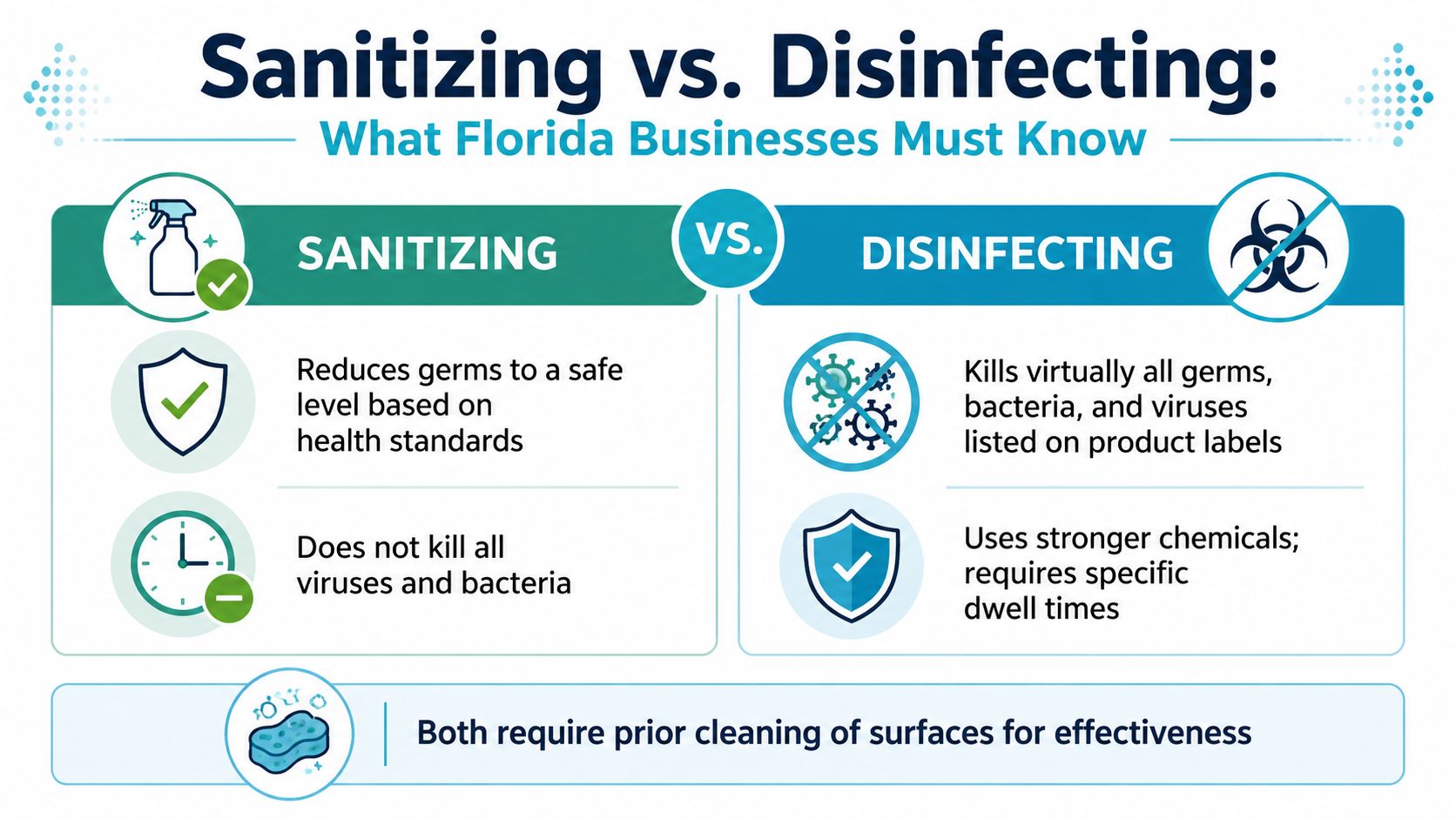
Sanitizing vs Disinfecting What Florida Businesses Must Know
Many owners use the words cleaning, sanitizing, and disinfecting as if they mean the same thing. They don’t. That confusion can lead to the wrong service, the wrong chemicals, or a process that looks thorough but misses the actual requirement.
A simple kitchen example helps. You can wash a plate so it looks clean. You can sanitize it so the germ level is reduced to a safer level. Or you can disinfect a hard nonporous surface with a product intended to kill listed germs, if used exactly as directed.
The three terms in plain language
| Method | What It Does | Primary Goal |
|---|---|---|
| Cleaning | Removes dirt, debris, spills, and residues | Make surfaces physically clean so the next step can work |
| Sanitizing | Reduces germs to a safer level based on applicable standards | Lower routine contamination risk |
| Disinfecting | Uses a labeled product to kill listed germs on appropriate surfaces | Address higher-risk contamination concerns |
Why the order matters
If a surface is greasy, dusty, or coated with residue, the chemical step becomes less reliable. Dirt gets in the way. That’s why professionals don’t jump straight to the final product. They assess the material, remove soil, and then apply the right sanitizer or disinfectant for that surface.
The most important technical point is contact time. The CDC states that after applying a disinfectant, the surface must remain visibly wet for the full label-specified contact or wet time, because that dwell period is what allows the product to kill target germs. If crews wipe too soon or apply too lightly, the label claim may not be achieved.
A disinfectant that dries early can fail even when the correct product was chosen.
What that means for Florida businesses
Different facilities need different outcomes.
- Restaurants and food-service spaces: Food-contact surfaces require the right sanitizing approach, not just a stronger-looking chemical.
- Offices and retail stores: High-touch surfaces may need routine sanitizing, with targeted disinfection after illness events.
- Clinics and care settings: Product choice, application method, and documentation carry more weight because the risk profile is higher.
For business owners, the takeaway is simple. Don’t ask only, “What product do you use?” Ask, “What standard are you trying to meet, and how do you verify the process was followed?”
Who Needs Commercial Sanitization in the Tampa Bay Area
Not every property needs the same schedule or scope, but many businesses across Bradenton, Sarasota, Lakewood Ranch, Tampa, and St. Petersburg have good reasons to use commercial sanitization services. The trigger may be customer traffic, regulation, a water event, a mold concern, or the need to maintain a healthier shared environment.
Demand for this work became much more visible after the pandemic. SchedulingKit reports that commercial cleaning demand surged after COVID-19, with 43% more disinfection services and rising budgets. That fits what many Florida operators have experienced firsthand. People now ask harder questions about hygiene, indoor conditions, and response plans.
High-traffic businesses
Retail stores, gyms, restaurants, apartment common areas, and hospitality properties see constant hand contact and repeated occupancy. In those settings, owners usually need a practical program for entrances, counters, fixtures, seating, restrooms, and staff areas.
Common reasons include:
- Customer confidence: People notice visible hygiene and odors quickly.
- Staff wellness support: Shared surfaces can become a recurring concern during cold and flu season.
- Post-incident response: Vomit, sewage backup, leaks, or fire residue can all change the required level of cleaning.
Regulated and sensitive environments
Medical offices, schools, daycares, and food-service operations face a different level of scrutiny. These properties often need tighter procedures, staff protection measures, and more careful attention to product selection.
A medical practice, for example, may already be reviewing wider workflow improvements such as enhancing operations for medical practices, but sanitation remains foundational because every other efficiency depends on a safe, functional environment.
Post-damage and emergency scenarios
Some businesses don’t think about sanitization until something goes wrong. Then it becomes urgent. Water damage, mold growth, smoke residue, storm intrusion, and plumbing failures can all leave behind contamination that routine cleaning crews aren’t equipped to address.
In those situations, the response often overlaps with broader emergency restoration services for businesses in Tampa. The main question shifts from “How often should we clean?” to “What was affected, what can be restored, and what hidden contamination may still be present?”
The Professional Sanitization Process Step by Step
A proper sanitization job is a controlled workflow. It isn’t just fogging a room and leaving. The best providers move in a sequence that reduces cross-contamination, protects materials, and matches the treatment to the actual condition of the building.
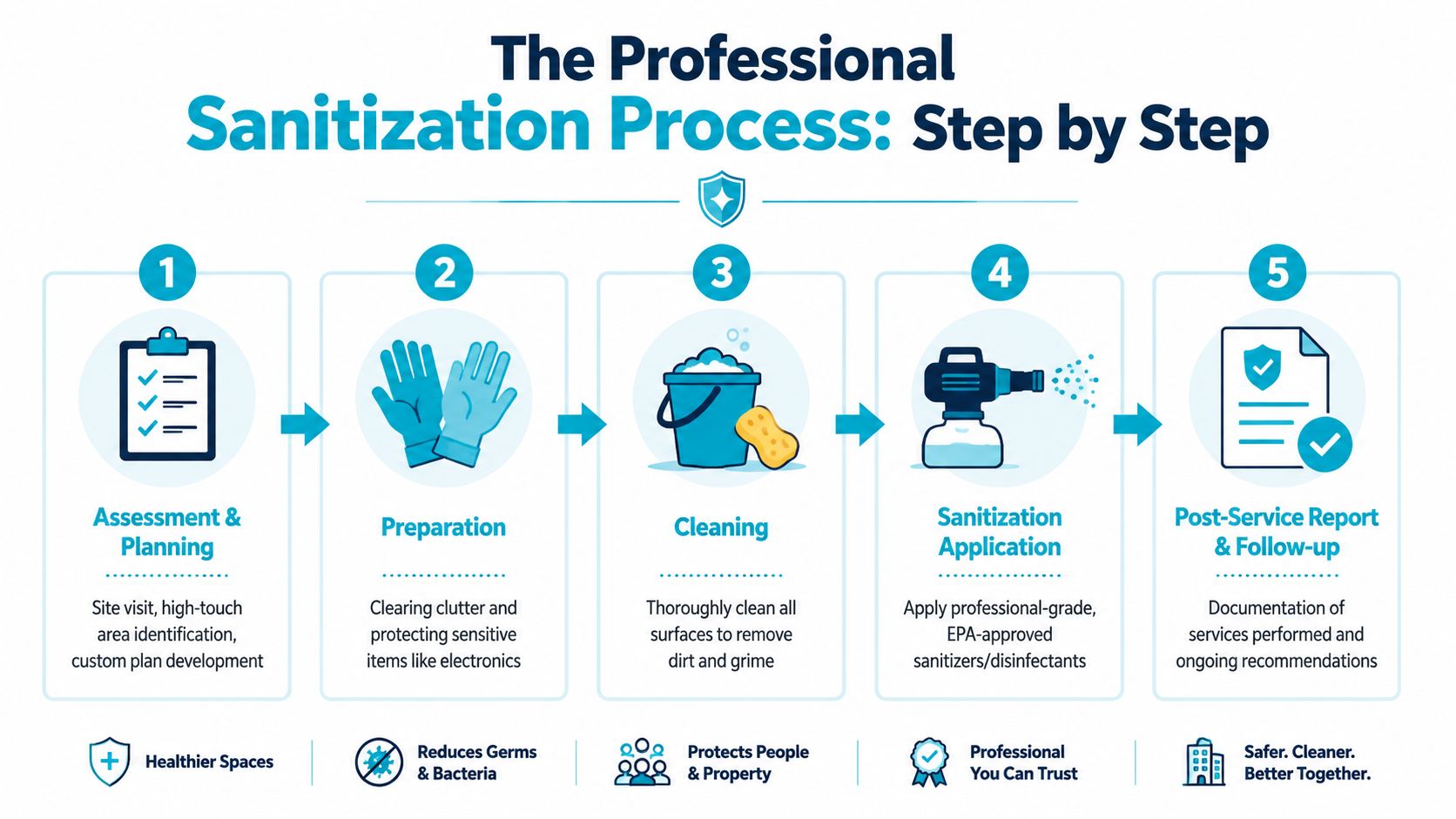
Assessment and job planning
The first task is inspection. Crews identify high-touch points, material types, moisture issues, visible residue, and any signs that the problem extends beyond surfaces. Electronics, porous furnishings, food-contact areas, and occupied zones all need different handling.
A good assessment also asks a basic question many vendors skip: is this a hygiene issue, a water issue, an air issue, or all three?
Preparation and containment
Before application starts, teams protect sensitive items and control the work area. That may include:
- Relocating vulnerable contents: Papers, electronics, and exposed stock may need protection.
- Separating traffic paths: Staff and customers shouldn’t move through active treatment zones.
- Adjusting airflow: Ventilation matters both for worker safety and for more consistent drying behavior.
Physical cleaning before chemical treatment
A common point of confusion is that sanitizers and disinfectants don’t replace cleaning. Residue has to be removed first so the active product can contact the surface directly.
In practice, crews may use microfiber cloths, detergents, extraction tools, or detail-cleaning methods based on the setting. A greasy break room, a dusty office, and a restroom affected by backup water won’t be handled the same way.
Clean first. Then sanitize or disinfect. Reversing that order weakens the result.
Application and wet-time control
After pre-cleaning, the selected product is applied using the method that best fits the area. Depending on the job, that could mean targeted wiping, pump sprayers, or other professional application tools. The critical part is not the gadget. It’s whether the surface stays wet for the required time and whether the chemistry matches the material.
Crews should also pay attention to hidden risk indicators. If occupants keep reporting musty odor, irritation, or recurring dust after surface work, it may be time for deeper evaluation such as air quality testing for mold.
Final review and documentation
A professional finish includes visual review, safe re-entry guidance, and clear notes on what was treated. That record helps facility managers, tenants, and owners show that the work followed an actual process instead of a vague “spray and pray” approach.
Scope of Work From Surface Wipes to HVAC Systems
Not all commercial sanitization services cover the same ground. One company may wipe desks, door handles, and restroom fixtures. Another may assess hidden contamination, moisture pathways, and HVAC distribution. Those are very different scopes of work, and the difference matters in Florida buildings.
Basic service versus comprehensive service
A basic wipe-down service usually focuses on visible, frequently touched surfaces. That can be appropriate for routine upkeep in stable conditions.
A detailed plan goes further. It asks where contamination may be collecting, how air moves through the building, and whether moisture has created hidden reservoirs behind contents, inside ductwork, or around mechanical components.
| Service level | Typical focus | Best fit |
|---|---|---|
| Basic surface sanitization | Counters, handles, switches, restrooms, shared touchpoints | Routine upkeep in low-complexity spaces |
| Expanded sanitization | Surface treatment plus targeted detail cleaning in problem areas | Higher occupancy, recurring complaints, post-illness events |
| Comprehensive contamination control | Surfaces, hidden spaces, moisture-related concerns, HVAC review, source removal planning | Water damage, mold concerns, odor issues, storm-related events |
Commercial kitchens need measurable control
Food-service environments are a strong example of why details matter. In a kitchen, “we sanitized it” isn't enough if the concentration or heat level was wrong.
Clatsop County's commercial kitchen guidance lists chlorine sanitizer at 50 to 100 ppm with 10 seconds contact time, and heat sanitization at 171°F or higher for at least 30 seconds. That tells owners something useful: effective sanitization is tied to measurable conditions, not guesswork.
For restaurants and commissaries, a serious provider should understand:
- Chemical strength verification: Sanitizer solution can drift during the day.
- Separation of steps: Cleaning, rinsing, and sanitizing are not the same action.
- Surface category: Food-contact items need different treatment logic than floors or walls.
Offices and mixed-use buildings need more than desk cleaning
In offices, many complaints start with surfaces but end with airflow. A building can smell clean and still circulate dust, spores, or residue through the HVAC system if moisture or contamination has built up where no one looks.
That's the hidden-contamination gap many owners miss. Ceiling plenums, return paths, duct interiors, and areas behind fixed furniture can hold material that simple wipe-down service never touches. In a humid Gulf Coast climate, those hidden zones deserve attention, especially after roof leaks, condensation issues, or tenant complaints.
If you want a simple comparison to understand how airflow equipment affects indoor conditions, even resources aimed at residential HVAC systems can help frame the basics of filtration and air movement. Commercial systems are more complex, but the principle is similar. What moves through the system affects the occupied space.
Hidden contamination doesn't stay hidden if the HVAC system keeps redistributing it.
When there's reason to suspect mold or residue in the duct system, owners should consider a deeper review such as how to remove mold from air ducts. That's often the difference between a short-term cleanup and a more durable indoor-environment solution.
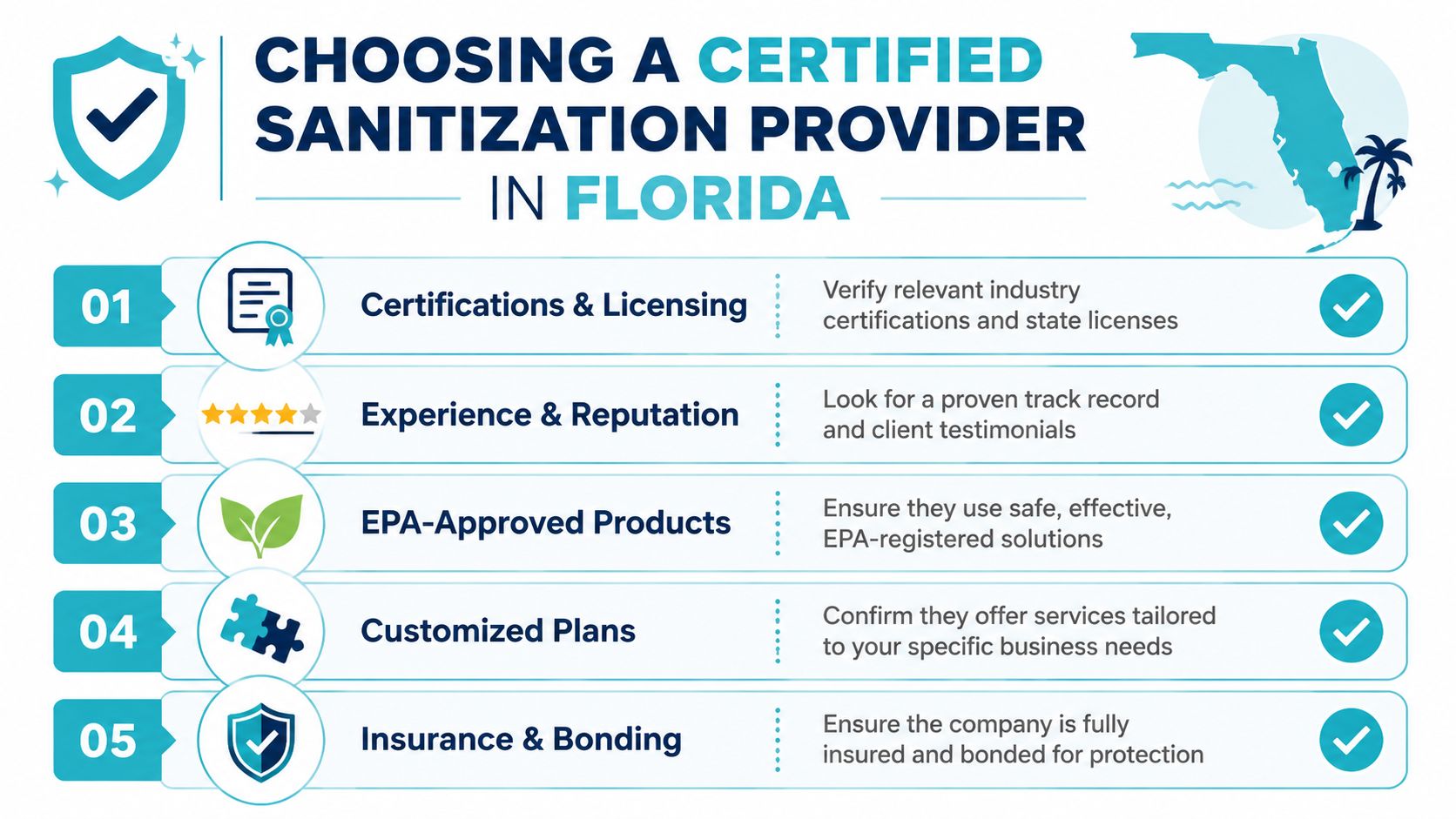
How to Choose a Certified Sanitization Provider in Florida
Choosing a sanitization company is a risk decision, not just a purchasing decision. The wrong vendor may use the right buzzwords and still miss the actual contamination path. The right one will ask better questions, define the scope clearly, and know when sanitization should be paired with other services.
One of the most overlooked issues is hidden contamination. This industry discussion highlights a major content gap: sanitization often needs to be paired with HVAC cleaning, source removal, and post-remediation verification in offices, schools, retail, and multifamily buildings, especially as demand for healthier indoor environments remains elevated.
The short checklist that matters
Use this when comparing proposals:
- Verify credentials: Ask about licensing, insurance, and restoration or cleaning certifications relevant to commercial work.
- Review the scope carefully: The quote should state what areas are included, what surfaces are excluded, and whether HVAC or concealed-space review is part of the job.
- Ask for product details: The provider should identify the sanitizer or disinfectant type and explain where each product can be used safely.
- Look for emergency capability: Florida properties need vendors who can respond after storms, leaks, and overnight incidents.
- Request documentation: You want a written record of the work performed, not just an invoice with a vague line item.
Questions that expose weak proposals
A few direct questions usually reveal whether the company is serious:
- How do you determine whether cleaning, sanitizing, or disinfecting is the correct standard?
- How do you manage wet time and surface compatibility?
- What happens if the problem involves hidden moisture, ductwork, or contamination behind materials?
- Will you recommend source removal if sanitization alone won't solve the issue?
If the answers are vague, the risk is higher. If the company can discuss surfaces, airflow, moisture, and post-loss conditions clearly, that's a better sign. For larger or more complex needs, owners should also review whether the vendor handles broader commercial restoration services so one issue doesn't get split across multiple contractors with conflicting scopes.
Frequently Asked Questions About Commercial Sanitization
How much do commercial sanitization services cost?
Pricing depends on the size of the space, the type of business, the level of contamination, after-hours access, and whether the job includes hidden areas or post-damage work. A routine office visit won't be priced like a restaurant kitchen or a water-damaged medical suite.
How often should a business schedule sanitization?
That depends on occupancy, traffic, and risk. Some facilities need routine recurring service. Others only need targeted sanitization after illness events, storm intrusion, plumbing problems, or restoration work.
Are the products safe for employees and customers?
They can be, when trained crews use the correct product on the correct surface and follow label directions, ventilation guidance, and re-entry precautions. Safety depends on process control, not just the product name.
Does sanitization help after water damage or fire damage?
Yes, but it's usually one part of a larger recovery plan. Water, smoke, and soot can leave contamination and odor issues that require cleaning, removal of damaged materials, drying, and sometimes HVAC attention before the property is fully back to normal.
Can commercial sanitization be part of an insurance claim?
In some loss situations, it may be connected to an insurance-covered restoration scope. That usually depends on the cause of loss, the policy, and how the work is documented.
What should make one provider stand out from another?
Look for clear scope definitions, emergency response capability, strong documentation, understanding of moisture and hidden contamination, and the ability to tell you when sanitization alone isn't enough. That honesty is often the mark of an experienced restoration-minded contractor.
If your business needs commercial sanitization services in Bradenton, Sarasota, Tampa Bay, Saint Petersburg, Lakewood Ranch, or nearby Gulf Coast communities, contact AMPM Restoration Services for help. Their team is available 24/7 for a free inspection and estimate, and they can assist with insurance claims and financing options to make the process easier. Call 941-946-7807 today.