

Commercial Mold Inspection: AMPM Restoration
A property manager in a Sarasota office building gets a tenant complaint about a musty odor. Dark spotting has appeared along an HVAC drip line, and replacing the stained ceiling tile hasn’t removed the smell. Within the wall cavity, insulation and framing may be holding moisture that no one can see.
That situation is why commercial mold inspection should be treated as a building-systems and documentation assignment, not a quick search for visible growth. A qualified inspection helps identify moisture sources, concealed conditions, affected materials, HVAC concerns, and the records needed for remediation, insurance review, tenant communication, and liability management.
What Commercial Mold Inspection Means
A ceiling stain is only the visible endpoint of a larger building problem. In a Sarasota commercial property, the inspector asks why the drip line stays wet, whether condensation is reaching nearby materials, whether the return-air system is carrying odor, and whether another leak has affected the same tenant area. Each condition is recorded so the dark spot is not treated as an isolated cleaning task.
A professional commercial mold inspection is a systematic evaluation of the building and its moisture history. It may include visual assessment, moisture mapping, air sampling, surface sampling, and HVAC evaluation. Sampling can help characterize materials or airborne conditions, but the inspection still must establish where moisture entered, which materials are affected, and how far the condition extends.
Practical rule: A mold report that identifies growth without identifying the moisture source leaves the property manager with an incomplete scope.
Commercial buildings add operational and documentation challenges. An office, retail center, school, hotel, or medical facility may contain multiple tenants, shared mechanical systems, restricted areas, concealed plenums, extensive ductwork, and separate parties responsible for maintenance. The report must support communication among owners, managers, tenants, restoration contractors, insurers, attorneys, and, when required, public agencies.
The documentation function is reflected in ASTM E2418 and its commercial building survey framework. It describes a walk-through survey, document review, and interviews for a baseline review of readily observable mold and conditions that support mold growth during commercial real estate transactions. Its treatment of de minimis conditions reinforces the move from informal visual checks toward repeatable due diligence.
For a property manager, the inspection creates a defensible record of what was observed, where it was found, and what action should follow. It can help distinguish an active water event from an older condition, preserve evidence before demolition, and give the remediation contractor a scope based on building conditions rather than assumptions.
Florida’s Gulf Coast adds pressure to that process. High humidity, heavy rain, roof exposure, and HVAC operation can create moisture pathways that remain concealed until occupants report an odor. A structured inspection helps connect those conditions to liability management, insurance readiness, and repair decisions.
For a structured professional mold inspection assessment, the goal is a documented building evaluation, not a quick visual opinion.
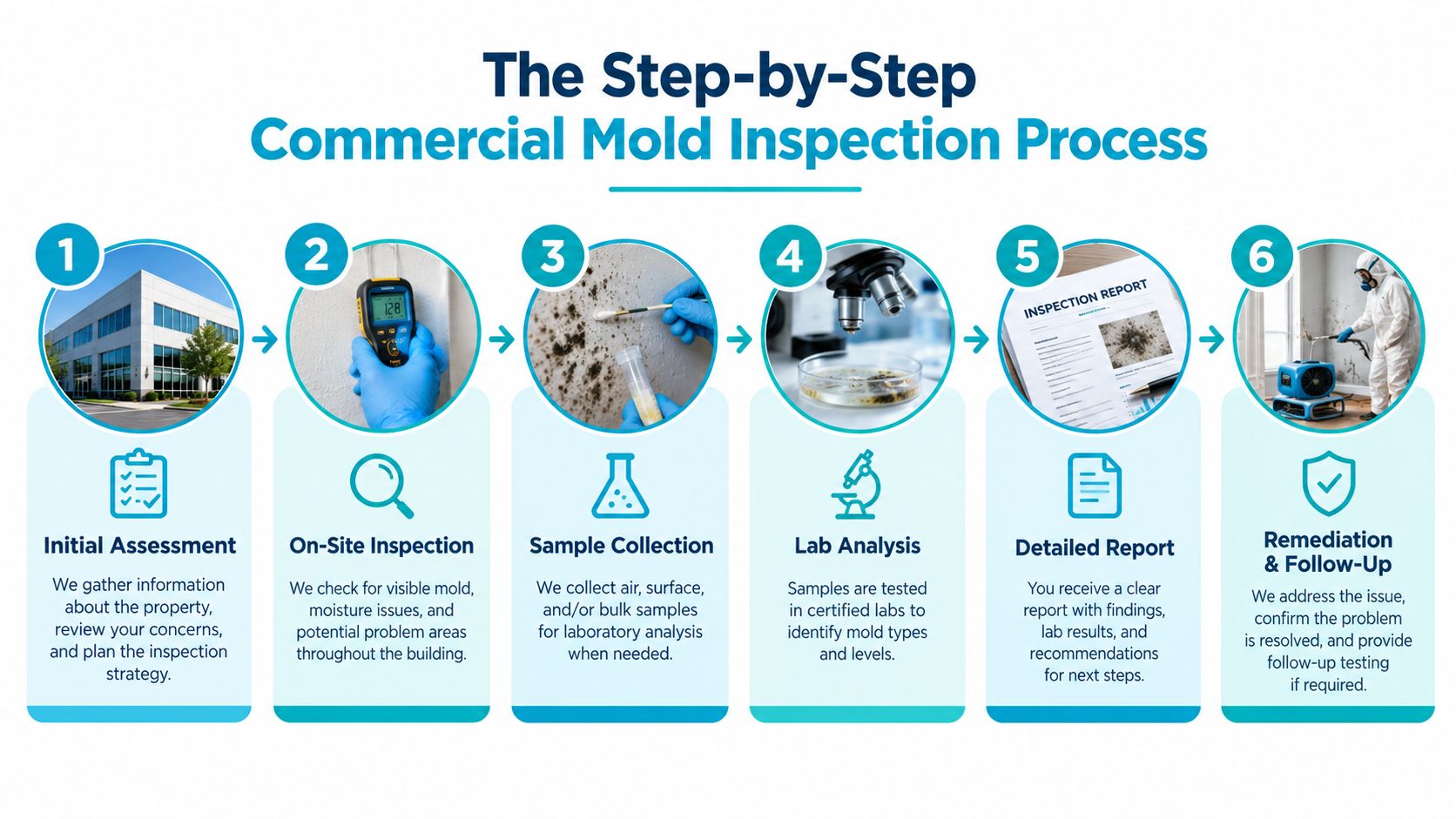
The Step-by-Step Commercial Mold Inspection Process
A sound inspection follows a logical sequence. Each phase answers a different question, and skipping one can create gaps in the final scope.
Begin with records and occupant information
Before entering the building, the inspector reviews available maintenance records, prior water losses, roof or plumbing repairs, mechanical drawings, tenant complaints, odor reports, and areas with repeated staining. This history helps define the inspection boundary. A current complaint may be connected to an older roof leak, a failed condensate drain, a prior flood, or a recurring humidity problem.
The on-site walkthrough then covers occupied rooms, ceilings, baseboards, wall penetrations, storage areas, mechanical rooms, roof access points, and accessible concealed cavities. The inspector looks for staining, peeling finishes, warped materials, condensation, musty odors, damaged insulation, and visible growth. EPA guidance identifies visual inspection as the primary diagnostic tool, and EPA guidance on mold testing and sampling explains that visible growth can justify remediation while routine air sampling generally isn’t necessary.
Map moisture before ordering tests
Moisture mapping uses pin and pinless meters to compare suspect materials with unaffected areas. Hygrometers measure air conditions, while thermal imaging can identify temperature patterns associated with wet materials, missing insulation, air leakage, or condensation. Thermal imaging doesn’t prove mold is present, so the inspector confirms abnormal patterns with direct moisture readings and building observations.
This is also where hidden-wall questions arise. A detailed guide to detecting hidden mold behind walls can help property managers understand why odor, moisture readings, and limited exploratory openings may need to be considered together.
Use sampling to answer targeted questions
Air sampling with spore traps can compare indoor and outdoor conditions or examine a specific concern. Tape lifts and swabs can characterize growth on a surface. Bulk samples can help identify the material and its fungal condition when removal or laboratory confirmation requires physical evidence.
Sampling works best when it follows a documented question. Testing every room without a theory can produce a long laboratory report without explaining the leak, the affected materials, or the required controls. A practical overview of ways to protect your home from mold also reinforces the broader principle that moisture control comes before test results.
Evaluate the HVAC system
The inspection should include accessible air handlers, coils, drain pans, condensate lines, return-air paths, duct interiors, duct insulation, rooftop units, and nearby plenum spaces. HVAC findings can explain why an odor travels beyond the original leak or why growth keeps returning after surface cleaning.
The final report should connect observations, readings, photographs, sample locations, laboratory results when used, and recommended controls. The result isn’t “mold present” or “mold absent.” It should provide a defensible description of the source, extent, affected systems, limitations, and remediation protocol.
Building Science Behind the Inspection
Inspectors don’t interpret a moisture reading in isolation. They compare it with the material, location, temperature, ventilation, recent weather, HVAC operation, and history of wetting.
Relative humidity above 60 percent increases mold risk, while 30 percent to 50 percent is commonly presented as a preferred indoor range and 55 percent to 60 percent as a caution zone in EPA-aligned summaries on humidity and mold. Those readings don’t establish contamination by themselves, but sustained high humidity can explain growth in areas without a visible plumbing failure.
Porous materials also deserve attention when surface moisture rises above 16 percent, a commonly used germination trigger in the inspection framework described for this topic. Duration matters as much as the reading. Materials that stay wet beyond the 24-to-48-hour response window described in workplace mold guidance require a careful drying assessment and may need removal when they can’t be restored to a sanitary, dry condition.
Read the building as a moisture system
Florida buildings often experience condensation when warm, unconditioned air enters the envelope and contacts a cooler surface. The dew point helps the inspector judge whether air contains enough moisture to condense on chilled pipes, supply ducts, metal roof components, window frames, or poorly insulated walls.
HVAC design and operation can amplify the problem. An oversized system may short-cycle instead of removing enough moisture. A poorly maintained drain pan can keep a mechanical room damp. Contaminated duct insulation can hold growth where ordinary cleaning won’t solve the condition.
| Metric | Threshold | What It Means |
|---|---|---|
| Relative humidity | Above 60% | Sustained conditions increase mold risk and justify moisture-control investigation. |
| Preferred indoor relative humidity | 30% to 50% | Commonly used target range for managing indoor moisture. |
| Caution-zone relative humidity | 55% to 60% | Conditions warrant closer monitoring and HVAC review. |
| Porous-material surface moisture | Above 16% | Supports concern about germination and continued wetting. |
| Wetness duration | Beyond 24 to 48 hours | Triggers a more serious drying and removal assessment. |
| Critical relative humidity reference | 80% | Some common indoor species can encounter highly favorable growth conditions. |
The Florida humidity and mold explanation provides useful context for why property managers should monitor humidity rather than waiting for visible staining. Inspectors use these measurements to choose sampling locations and determine whether the envelope, mechanical system, or both require correction.
Findings, Documentation, and When Remediation Becomes Urgent
The fieldwork becomes useful only when another professional can act on it. A commercial report should include room-by-room observations, dated photographs, floor-plan references, moisture maps, instrument readings, sample locations, limitations, and a narrative that explains the likely source and extent of the condition.
EPA commercial-building guidance separates affected areas into small areas under 10 square feet, medium areas from 10 to 100 square feet, and large areas over 100 square feet in its response framework for containment and control decisions. These categories influence containment, PPE, work practices, and whether a localized response remains appropriate.
Escalation starts with more than visible area
A small patch can still require urgent attention if it sits inside an air handler, behind a wall, above an occupied ceiling, or next to a recurring leak. Repeated saturation events also change the risk profile. A property that has received cosmetic repairs several times may need destructive inspection or envelope investigation rather than another replacement of stained finishes.
A useful report distinguishes conditions that require immediate action from those that can be monitored:
- Immediate controls: Active leaks, spreading growth, contaminated HVAC components, wet porous materials, strong odor with concealed moisture, and conditions affecting occupied areas.
- Targeted investigation: Staining without current moisture, intermittent odor, suspected wall-cavity growth, and repeated condensation near mechanical equipment.
- Monitoring: Dry, stable materials with no odor, no visible growth, and no evidence of ongoing moisture, provided the report clearly states the inspection limitations.
Documentation often matters more than a dramatic laboratory result when parties disagree about cause, timing, or responsibility.
Every sample should have a location, collection date, method, and chain-of-custody record. The report should also preserve the original condition before cleaning or demolition begins. A well-organized mold remediation report gives the property manager a clearer handoff between inspection, remediation, and verification.
Standards and Certifications That Separate Qualified Inspectors
Credentials help, but the name on a business card does not show how the inspection will be conducted. Ask who will enter the building, what training they hold, which standards guide the work, and how they document limitations. A qualified inspector should explain what the engagement can establish without promising a universal “mold-free” result.
The IICRC Applied Microbial Remediation Technician designation relates to remediation practice, while the American Council for Accredited Certification Certified Mold Inspector credential addresses inspection competency. NAMRI standards and training pathways apply to non-residential properties, including commercial buildings, industrial facilities, schools, and institutional structures. They define scope, procedures, limitations, and documentation requirements in its mold inspection standards.
For property managers, an IICRC-certified restoration company may bring useful remediation knowledge, but inspection and remediation should still be clearly separated in the scope and report. That separation supports defensible decisions, insurance documentation, and liability control when Florida humidity, recurring condensation, or concealed leaks are involved.
Florida licensing and business compliance require the same review as national credentials. A certificate does not confirm that a firm is legally qualified for the advertised services or carries insurance suited to commercial work.
| Credential or Standard | Scope | Why It Matters |
|---|---|---|
| IICRC Applied Microbial Remediation Technician | Microbial remediation practices | Indicates training related to controlled remediation work. |
| ACAC Certified Mold Inspector | Mold inspection competency | Gives owners a credential to verify when comparing inspectors. |
| NAMRI standards | Residential and non-residential inspection practice | Provides a documented framework for scope, procedures, limitations, and reporting. |
| IAC2 inspection standards | Complete and Limited Mold Inspection types | Helps define whether the engagement covers the full property or a restricted area under its inspection standards. |
| ASTM E2418 | Commercial baseline survey practice | Connects walk-throughs, document review, and interviews to commercial due diligence. |
Be cautious with certificates earned through short online courses that require neither supervised field experience nor a proctored exam. Ask about continuing education, HVAC access, moisture mapping, sampling limits, report delivery, and post-remediation verification. Those answers reveal more about practical readiness than a certificate alone.
Costs, Timelines, and What Influences Both
Florida commercial inspection pricing depends on the building and the scope, not just the presence of mold. A visual and moisture assessment commonly falls between $300 and $800, while a larger engagement involving full sampling, thermal imaging, and written protocols may range from $1,500 to $4,000 or more. These figures are planning ranges, not a substitute for a written proposal.
Square footage is only one factor. Costs rise when the inspector must access rooftop units, crawlspaces, ceiling plenums, duct interiors, locked tenant areas, or multiple floors. The number of sampling locations, laboratory requirements, report complexity, active claim coordination, and rush reporting can also change the fee.

Budget for the full engagement
Most inspections take one to two days on site, with written reports commonly delivered within three to seven business days when the scope and laboratory work are straightforward. Active insurance claims may require faster communication, but expedited reporting can add cost and may not be appropriate if the inspector hasn't received access to all relevant areas.
Property managers often budget for the first inspection and forget the return visit. Post-remediation verification is a separate service because the inspector must evaluate completed work, confirm that affected areas are clean and dry, review records, and issue appropriate clearance documentation when conditions support it.
The cheapest proposal can become expensive if it excludes HVAC review, concealed spaces, moisture mapping, or a usable written protocol. Compare proposals by deliverables, access assumptions, sampling plan, turnaround, limitations, and whether the report can support an adjuster's review.
Insurance Claims and the Documentation Inspectors Provide
A commercial mold inspection supports a claim only when it explains the loss clearly. The report should connect observed growth or damage to a plausible moisture event, such as a sudden pipe failure, roof leak from a covered event, or storm damage, while separating recent conditions from pre-existing problems.
Many commercial policies contain mold exclusions or limited coverage provisions. Carriers may focus on whether a covered peril caused the moisture, whether the policyholder acted promptly, and whether the claimed materials were already affected before the reported loss.
Build the claim record before remediation
Inspectors should document psychrometric readings, moisture maps, photographs, dew-point conditions, HVAC findings, sample locations, laboratory results when sampling is justified, and chain-of-custody records. Photographs should include timestamps and location information, while the written narrative should identify affected materials and the recommended remediation controls.
An itemized scope can help the adjuster understand what must be removed, cleaned, dried, or repaired. When estimates are prepared in a format compatible with common claims platforms, the carrier can review the work without repeatedly translating a narrative into line items.
| Document | Purpose |
|---|---|
| Cause-of-loss narrative | Connects the observed condition to a reported leak, storm, plumbing failure, or other moisture source. |
| Moisture map | Shows affected locations and supports the proposed demolition or drying boundary. |
| Psychrometric readings | Records temperature, humidity, and related environmental conditions. |
| HVAC inspection findings | Identifies contamination or moisture conditions in air handlers, coils, drain pans, returns, and ductwork. |
| Dated, location-specific photographs | Preserves the pre-remediation condition for owners, carriers, and contractors. |
| Laboratory report | Provides analytical information when targeted sampling is appropriate. |
| Chain-of-custody records | Documents sample handling from collection through laboratory delivery. |
| IICRC S520 remediation protocol | Defines recommended controls, work practices, and project boundaries. |
| Post-remediation clearance letter | Gives the carrier and owner documentation after corrective work is complete. |
The inspector, restoration contractor, and adjuster should agree on the scope before demolition whenever possible. If concealed damage expands after opening a wall or ceiling, supplemental photographs, readings, and revised documentation can help explain why the scope changed.
Florida Suncoast Considerations and Your Next Steps
The Suncoast from Tampa through Saint Petersburg, Sarasota, Bradenton, and into Port Charlotte has a moisture profile that demands active building management. Gulf humidity can push indoor relative humidity above 70 percent, while dew points above 70°F can keep surfaces damp after air-conditioning cycles end. Those conditions make a small roof, window, plumbing, or HVAC defect more consequential than it may appear during a brief walkthrough.
Salt air can accelerate corrosion around roof systems, fasteners, exterior equipment, window assemblies, and HVAC components. Tropical storms and hurricanes can deliver intense rainfall that saturates roof assemblies and drives water through parapets, flashing, wall penetrations, and rooftop equipment curbs. Older buildings may also lack the moisture-control details found in newer construction, so property managers should avoid assuming that a recently repaired surface represents a durable solution.
Set a repeatable prevention routine
A practical Suncoast program should include:
- After-storm inspections: Schedule a baseline review after every named storm, with roof, ceiling, mechanical, and tenant-complaint documentation.
- Annual roof records: Photograph roof conditions and repairs so later claims have a clear maintenance history.
- Continuous humidity monitoring: Use data-logging hygrometers in vulnerable areas such as storage rooms, mechanical spaces, tenant suites, and poorly ventilated interiors.
- Fast moisture response: Treat new leaks, wet insulation, ceiling staining, and HVAC condensate problems as inspection triggers rather than cosmetic maintenance items.
- Claim preparation: Preserve photographs, readings, invoices, work orders, and tenant communications before cleanup changes the evidence.

A one-hour response can limit the time water remains in porous materials, reduce disruption, and help the property manager make decisions before odor complaints, tenant relocation pressure, or contractor bidding complicates the situation. The right inspection produces a condition report, moisture map, targeted testing plan when justified, and remediation scope tied to the actual building.
AMPM Restoration Services provides 24/7 commercial mold inspection, water damage response, mold removal, storm recovery, HVAC-related assessment, and reconstruction support across Bradenton, Sarasota, Tampa Bay, Saint Petersburg, Lakewood Ranch, and surrounding Gulf Coast communities. Call 941-946-7807 for a free inspection and estimate, and ask about insurance claim assistance and financing options, or visit AMPM Restoration Services to start coordinating your next step.
Commercial Mold Inspection FAQs
What does a commercial mold inspection include?
It typically includes a records review, visual assessment, moisture mapping, evaluation of affected materials, HVAC review, targeted air or surface sampling when justified, photographs, and a written report describing conditions, limitations, and recommended next steps.
Is air sampling required for every commercial property?
No. EPA guidance identifies visual inspection as the primary diagnostic tool, and routine air sampling usually isn't necessary. Sampling is more useful when it answers a specific question about concealed conditions, occupant concerns, comparative indoor and outdoor conditions, or disputed findings.
Can an inspector find mold behind walls?
An inspection can identify clues such as persistent odor, abnormal moisture readings, thermal patterns, staining, and related building defects. Confirming concealed growth may require limited exploratory openings, borescope work, or targeted sampling, depending on the property and the inspection scope.
What size mold area requires containment?
EPA commercial-building guidance describes small areas as under 10 square feet, medium areas as 10 to 100 square feet, and large areas as over 100 square feet. The affected location, HVAC involvement, material type, occupancy, and spread pattern can also increase the required controls.
How long does a commercial mold inspection take?
Many inspections require one to two days on site, though a multi-tenant building, complex HVAC system, restricted access, or concealed damage can extend the engagement. Report delivery commonly takes three to seven business days, depending on documentation and laboratory work.
Will insurance cover commercial mold remediation?
Coverage depends on the policy, exclusions, cause of loss, timing, maintenance history, and whether a covered peril caused the moisture. A detailed inspection record can help the carrier evaluate the claim, but it can't guarantee coverage.