


Air Movers for Water Damage Dryout
Your ceiling is dripping, the carpet feels heavy, and the air in the house has turned warm and damp. If you’re in Bradenton, Sarasota, Tampa Bay, Saint Petersburg, or Lakewood Ranch after a leak or storm, air movers for water damage are what separate a fast recovery from a slow, mold-prone mess. AMPM Restoration handles these jobs every day, and the rule is simple, extract the standing water first, then move air in a controlled way so the materials can effectively dry.
Understanding Air Movers for Water Damage
Air movers for water damage are not household fans. They’re restoration tools built to push a focused stream of air across wet surfaces so moisture can evaporate faster and move toward dehumidifiers. If you’re staring at soaked flooring after a pipe burst or a Gulf Coast storm, the first instinct is to plug in fans and hope for the best. That’s the wrong move.
Why extraction comes first
Standing water has to come out before any drying equipment does useful work. One industry guide says to extract standing water before deploying air movers and dehumidifiers, because these machines only work on evaporable moisture. That’s the dividing line between cleanup and real structural drying.
Practical rule: If water is still pooling, you’re not drying yet. You’re just moving humid air around.
After extraction, air movers take over by pushing air along the surface of wet drywall, subflooring, baseboards, carpet, and framing. That airflow strips off the thin moisture layer clinging to the material, then dehumidifiers pull the vapor out of the room. If you skip the extraction step, you waste time, electricity, and floor space.
What homeowners should expect
A proper drying setup is measured, not improvised. The goal is controlled evaporation, not a blast of air that splashes water into corners or pushes humidity deeper into hidden cavities. For a homeowner, that means the machine count, angle, and placement all matter as much as the brand name.
If you want a practical walkthrough for the first hours after a loss, use this step-by-step flooded home drying guide. It pairs well with the advice here because air movers only make sense inside a larger drying plan.
Calculating and Selecting the Right Air Movers
Sizing calculations are frequently erroneous. It is often assumed that a couple of fans will handle a single wet room. That’s not how water-loss drying works in Florida homes, where water can spread under baseboards, along slab edges, and into adjacent rooms before anyone notices.
Convert square footage and wall length into equipment counts
The most useful benchmark is the IICRC-style ratio used in restoration publications, 1 air mover per 50–70 sq. ft. of wet flooring plus 1 per 100–150 sq. ft. of wet wall or ceiling above 2 feet (R&R Magazine on low-profile air movers). When both floor and wall rules apply, the higher count is the safer one. That’s why a 1,000 sq. ft. room may require 14–20 units when damage is widespread.
| Air Mover Sizing Ratios | Recommended Ratio |
|---|---|
| Wet flooring | 1 unit per 50–70 sq. ft. |
| Wet wall or ceiling above 2 feet | 1 unit per 100–150 sq. ft. |
| Wet wall space by linear length | 1 unit per 10–16 linear feet |
For a Bradenton living room, that means you don't size by the room label. You size by the wet surface area. A hallway with long wall exposure can need more units than a bigger room with less affected material. That's why technicians treat layout like a measurement job, not a guess.
Match the machine to the material
Commercial-grade water-damage drying often uses low-profile units because they sit close to the floor and can push air along carpet, vinyl, tile, and baseboards. The Phoenix manual notes that commercial structures typically use one air mover per 50–60 square feet (Phoenix AAM Manual). That tighter spacing is useful when water has spread through open-plan Florida interiors or across office suites.
Count wet surfaces, not rooms. A half-dry room with one soaked wall still needs serious equipment.
When comparing DIY rental gear to professional service, the gap becomes apparent. A store rental can be fine for a small spill. Once the water has gone under multiple materials, or into several rooms, you need a measured deployment plan. For a local example of that kind of work, see AMPM's structural drying service in Tampa Bay.
Implementing Optimal Placement for Air Movers

Placement decides whether the equipment dries anything. If you point an air mover straight across a room, you're wasting the airflow. If you aim it properly, you create tangential movement along the wet material, which is what strips moisture from the surface and feeds the dehumidifier.
The angle and surface target matter
ANSI and IICRC-aligned guidance says to position air movers at about 15–45 degrees toward walls and aim for roughly 400–500 feet per minute at the surface (Dr. Moisture air movement guidance). That angle is the difference between drying the wall face and just stirring the room.
Here's the practical version:
- Aim low and along the surface. Air should run over the material, not bounce off it.
- Keep the pattern circular. The room should move humid air back toward the dehumidifier intake, not trap it in a dead end.
- Watch for dead zones. Closets, hall bends, and wall offsets dry slower if you don't place additional units there.
- Re-map after the first day. Moisture moves, so the equipment layout has to move with it.
Tight Florida spaces need disciplined setup
In a Sarasota condo or a St. Petersburg storefront corridor, the biggest mistake is overblowing a narrow space. Air movers should sit at floor level, with cords routed cleanly and the airflow directed along the wet surface instead of across open air. That lets the boundary-layer moisture peel off the material without creating splash-back or uneven drying.
The National Water Damage Authority says air movers should be arranged to create a circular airflow pattern and only removed after written verification that all monitoring points meet drying goals (NWDA structural drying guidance). That's the standard you want, because it turns drying into a documented process instead of a guess.
How to dry wet carpet after flooding is useful if carpet is part of the loss, but the bigger principle is the same. Direct the air, create the loop, and don't pull equipment too early.
Coordinating Air Movers with Dehumidifiers and Monitoring

Air movers alone don't finish the job. They release moisture into the air. Dehumidifiers remove that moisture so it doesn't go right back into the drywall, subfloor, or framing. That's the whole system.
Start with baseline readings
The National Water Damage Authority says the drying process should begin with baseline moisture readings, then equipment placement, then written verification before removal (NWDA structural drying guidance). That sequence matters because you can't prove progress if you never measured the starting point.
A moisture meter tells you whether a room is improving or just feeling less damp to the touch. That's especially important in Florida, where warm, humid air can make a home feel better before the materials inside have stabilized.
Good drying is documented drying. If nobody logged the readings, nobody can prove the structure is ready.
Build the drying circuit
Air movers push vapor off the surfaces. Dehumidifiers collect it from the air. Moisture meters confirm whether the process is working. When those three pieces are tied together, the room becomes a drying circuit instead of a damp holding pattern.
Use the equipment for the material, not the other way around. A slab room with saturated carpet needs different placement than a kitchen toe-kick leak. If the moisture readings aren't dropping, the answer isn't always more fans. Sometimes the layout is wrong, or the dehumidifier placement is weak, or a hidden cavity still holds water.
For a broader estimate of what that kind of process looks like in real jobs, check how long water damage restoration takes. The timeline depends on what's wet, how fast the equipment is mapped, and whether the readings are improving.
Maintaining Safety and Equipment Performance
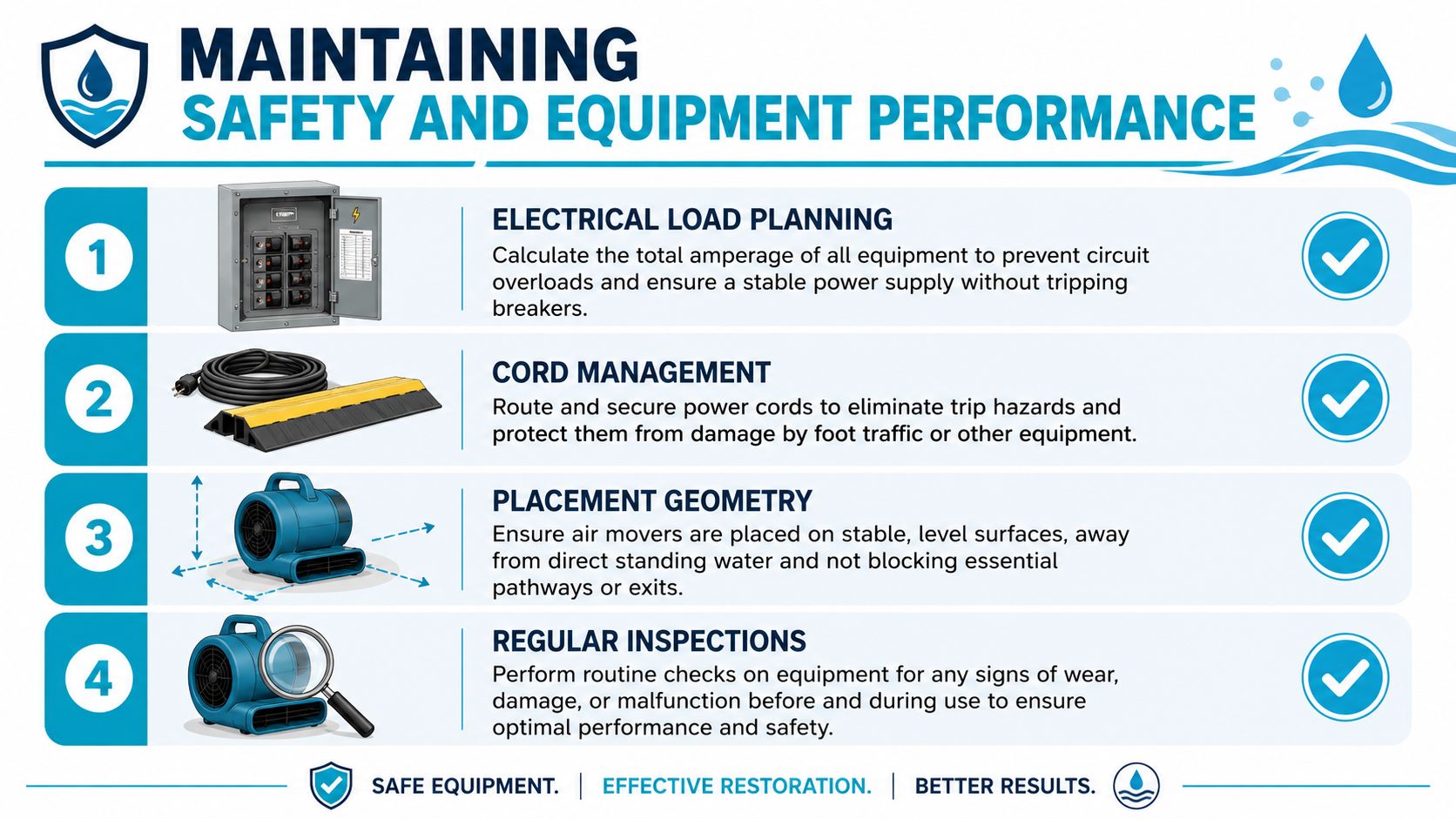
Water-damage drying can go sideways fast if the power plan is sloppy. You're dealing with wet floors, heavy cords, multiple machines, and a home that's already under stress. The job has to stay safe before it can stay productive.
Treat power and cord layout as part of the setup
Phoenix's air-mover manual says low-profile units draw about 1.9 amps each and can run 6–8 per 15-amp breaker if loads and cord runs are managed safely (Phoenix AAM Manual). That's useful, but only if you spread the load out and keep cords from creating a trip hazard.
- Plan electrical loads first. Don't plug in equipment until you know where each unit is going.
- Route cords cleanly. Keep them out of walk paths and away from water.
- Set units on stable surfaces. An air mover that rocks or sits in standing water is a problem.
- Inspect daily. Check for heat, noise, filter buildup, and damage before the next run.
Keep the machines working the whole time
Drying jobs aren't static. If a wall dries faster than the floor, the equipment has to be shifted. If a machine starts running weak, it's not doing the work you paid for. That's why restoration teams recheck conditions and reposition gear as the structure dries.
One practical note for homeowners in Lakewood Ranch, St. Petersburg, and everywhere else on the Suncoast, don't let cords snake through doorways where family members, pets, or contractors are walking. Safety gets ignored when a house is in chaos, and that's when preventable accidents happen.
AMPM Restoration's water damage restoration work includes specialty equipment and full mitigation support, which matters when the job needs constant adjustment instead of a one-time fan drop-off. The point isn't just to run machines. It's to keep the drying plan stable long enough to finish the structure correctly.
Deciding Between Rental Hiring and Calling Professionals
Renting air movers sounds cheaper, and for a tiny, contained spill, it can be. But most Florida water losses aren't tiny or contained. Once water has spread through baseboards, under flooring, or into more than one room, the primary cost is in mistakes, not equipment.
What DIY gets wrong most often
Homeowners usually underestimate three things, the number of units needed, the electrical load, and the need to keep rechecking moisture. They set up a few fans, hope the house dries, and find out later that the hidden materials stayed wet. That's how small losses become mold jobs.
Professionals bring a different workflow. They map the loss, place the equipment for the materials, monitor progress, and write down the readings. That matters for insurance, but it matters even more for preventing hidden damage that doesn't show up until weeks later.
If you want full-service mitigation rather than a rental gamble, see AMPM Restoration's water damage company page. A contractor is the better call when the loss is large, the water source is unclear, or the materials have been wet long enough to start breaking down.
When to stop guessing
Call for professional help fast if the damage involves ceilings, multiple rooms, crawlspaces, or any sign of widespread saturation in Bradenton, Sarasota, Tampa Bay, or St. Petersburg. That's especially true in Florida, where heat and humidity can make partial drying look successful long before it is completely dry.
If the damage has crossed from one surface into the structure, you need more than a fan plan.
AMPM Restoration is the kind of option homeowners use when they need a 24/7 response, insurance coordination, and a team that can handle drying, sanitizing, repairs, and final restoration without stalling out between steps. That's not overkill. It's what a serious water loss demands.
Conclusion and Next Steps
The right air movers for water damage aren't about blasting air into a room. They're about sizing the equipment correctly, placing it at the right angle, pairing it with dehumidifiers, and verifying progress with moisture readings. Do those four things and you're drying the structure. Skip one and you're gambling with mold, warped materials, and avoidable repairs.
If your home or business in Bradenton, Sarasota, Tampa Bay, Saint Petersburg, or Lakewood Ranch is wet right now, don't wait for the smell to tell you there's a problem. Call 941-946-7807 for a free inspection and estimate, ask about insurance claim assistance, and discuss financing options if the loss is bigger than expected. AMPM Restoration can move fast, document the work, and help you get your property back in shape.
A CTA for AMPM Restoration Services.