

A musty smell in the hallway, peeling paint beside a baseboard, or a family member suddenly coughing at home can make an ordinary Florida morning feel urgent. You may wipe down the visible spot and still wonder whether moisture is trapped behind the wall, under flooring, or inside the air-conditioning system. Mold remediation residential work is not only a cleaning job. It starts with finding the water, controlling exposure, and deciding which materials can be restored safely.
For homeowners in Bradenton, Sarasota, Tampa Bay, Saint Petersburg, Lakewood Ranch, and nearby Gulf Coast communities, warm temperatures, heavy rain, flooding, storms, and persistent humidity can keep a small leak active longer than expected. The right response protects both the structure and the people living in it.
Recognizing the Hidden Signs of Mold Growth
A common discovery begins with a leak that seemed minor. A supply line drips behind a vanity, a roof leak wets the insulation above a bedroom, or an air-conditioning drain pan overflows into a wall. The homeowner dries the floor, paints the stain, and assumes the problem is finished. Weeks later, a closet smells earthy, the baseboard swells, or dark growth appears where the wall meets the floor.
That pattern matters because visible mold is often only the exposed part of a moisture problem. A persistent musty odor can indicate damp drywall, wet insulation, contaminated carpet padding, or growth inside a wall cavity. Peeling paint and bubbling trim can point to moisture migration rather than poor paint adhesion. In Florida homes, HVAC condensation, plumbing failures, roof defects, storm intrusion, and high indoor humidity all deserve attention.
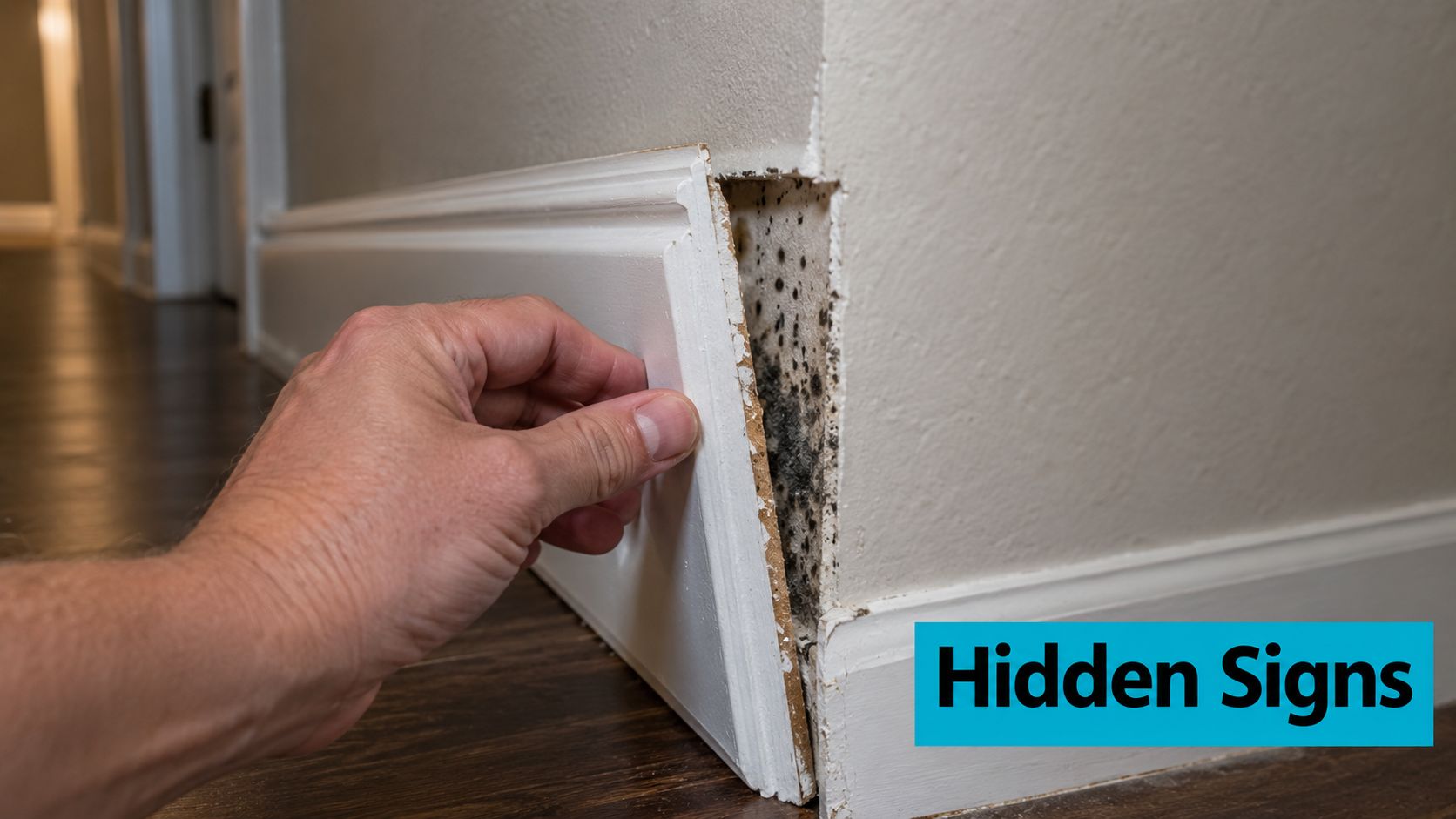
Odor, staining, and material changes
Surface mildew on a cleanable bathroom surface isn't automatically the same as widespread contamination behind a wall. The distinction comes from the pattern and the moisture history.
- Musty odor: A smell that returns after cleaning suggests an unresolved source or hidden damp material.
- Recurring staining: A ceiling mark that reappears after painting may indicate roof or plumbing intrusion.
- Soft or swollen materials: Drywall, trim, flooring, and cabinet panels can change shape when they absorb water.
- HVAC symptoms: Condensation around air handlers, wet insulation, or an odor that travels when the system runs can require targeted inspection.
- Storm-related changes: Wind-driven rain may enter around windows, roof penetrations, soffits, and wall assemblies without leaving an obvious interior puddle.
HUD housing research recorded indoor or outdoor leaks during the preceding year in 16.7% of occupied U.S. housing units in the 2015 American Housing Survey, while a separate HUD and EPA survey reported household dampness in approximately 21.0% of respondents. Musty odors were reported by 5.85% in the 2015 survey and 13.4% in the more targeted survey. These findings support looking beyond the colony itself and investigating how water entered or remained in the home. HUD housing moisture research
A useful starting point is to photograph stains, note when odors are strongest, and record recent leaks or storms. Homeowners can also review five signs of mold damage in homes when deciding whether a problem needs more than routine cleaning.
The Health and Structural Stakes of Damp Environments
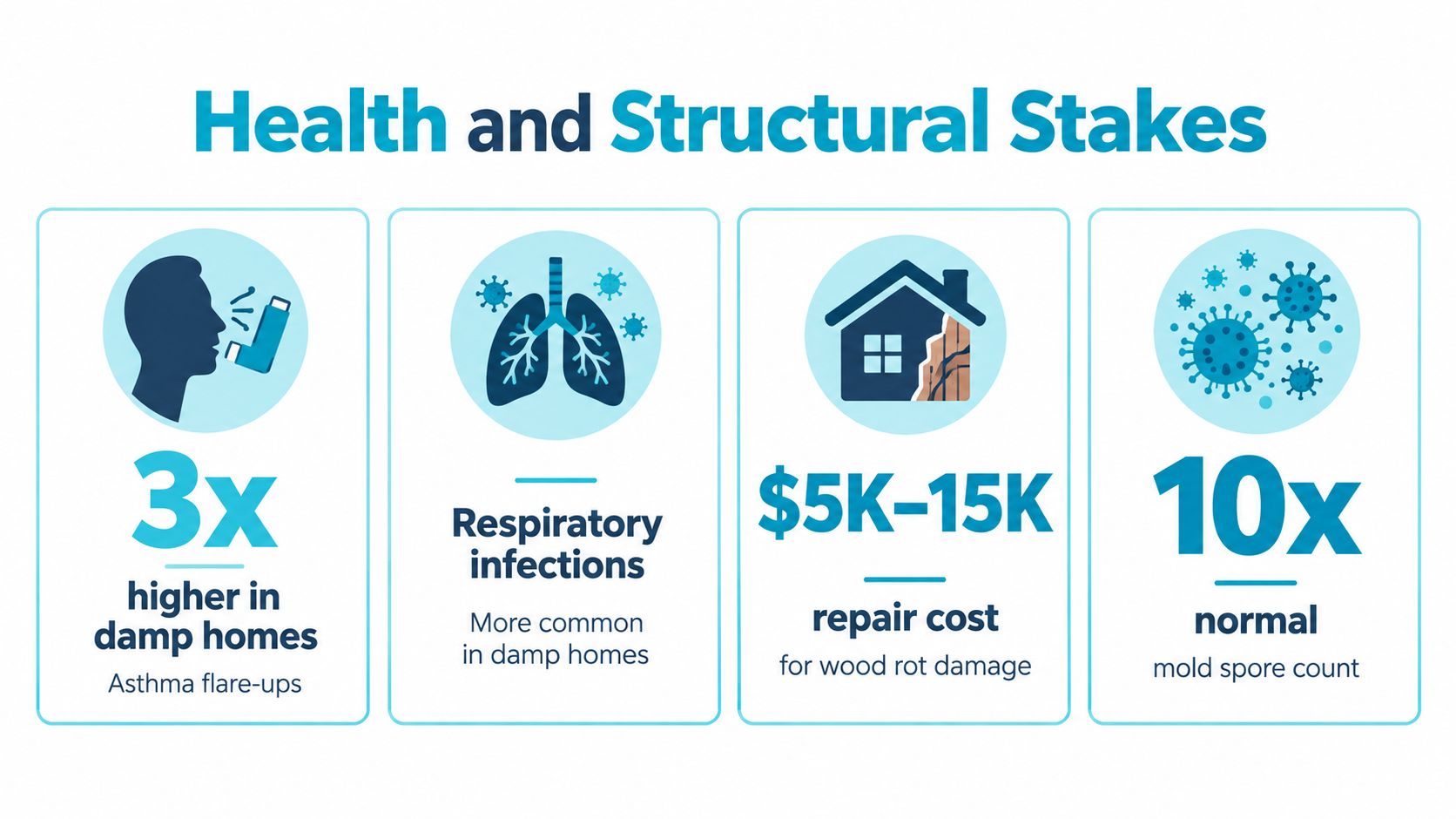
A musty room after a storm, a damp closet beside an exterior wall, or a bathroom that never seems to dry can affect more than comfort. A CDC-reviewed meta-analysis of 33 studies linked household dampness and mold exposure with roughly 30% to 50% higher risks of asthma development, ever-diagnosed asthma, and current asthma. One estimate attributed 21% of current asthma cases in the United States to dampness and mold in homes, or about 4.6 million of 21.8 million cases at the time of the analysis. CDC and HUD evidence on indoor dampness and health
Those findings describe population-level risk, not a guaranteed reaction to every visible spot. Exposure depends on the contamination, how long it remains, the building conditions, and a person's sensitivity. Damp interiors can contribute to coughing, wheezing, nasal and throat irritation, respiratory infections, allergic rhinitis, eczema, and worsening asthma in sensitive occupants.
What moisture does to a house
A surface can feel dry while moisture remains inside the assembly. Poor airflow makes that more likely. Drywall facing, insulation, carpet padding, paper-backed flooring, and some cabinet components may be difficult or impossible to restore after prolonged wetting or visible contamination.
Persistent moisture can also weaken wood framing. Rot, corroded fasteners, damaged finishes, and loose connections may appear after repeated water intrusion. A damp wall does not automatically require structural replacement, yet a technician should examine the assembly before it is closed behind new drywall.
Practical rule: Correct the moisture source and address contaminated materials together. Surface cleaning without leak repair leaves the conditions for renewed growth.
Indoor humidity and condensation deserve attention even when no major leak is visible. HUD moisture-monitoring research followed homes across hot-humid Southeast, cold Northeast, and marine Northwest climates, collecting frequent temperature and humidity readings. That work supports a closer inspection when condensation or hidden dampness keeps returning, rather than relying on a single visual check.
Protect occupants during the work. Children should not participate in cleanup, and people with asthma, significant respiratory disease, or weakened immune systems should stay out of mold-damaged areas. Water management outside the wall matters too. Drainage, grading, roof runoff, and foundation conditions can keep feeding an indoor moisture problem. Landscaping or root intrusion may warrant guidance on protecting home foundation from roots before the next repair is sealed.
When to Test and When to Act Immediately
Air testing sounds reassuring because it produces a report, but a report doesn't remove wet drywall or repair a leaking pipe. The useful question is not whether testing can be performed. It's whether the result will change the next decision.
If you can see active growth and identify ongoing moisture, source correction and professional evaluation usually matter more than waiting for a spore-count result. NIOSH guidance emphasizes identifying mold on materials and carrying out appropriate remediation with containment to reduce exposure. It doesn't establish a universal numerical threshold that proves a home is safe. NIOSH health hazard evaluation report

A plain-language decision path
Use the situation, not the test itself, to choose the response.
- Visible growth with active moisture: Stop the water, limit access, and arrange an evaluation. Don't delay necessary containment while waiting for laboratory results.
- Suspected hidden growth: Targeted inspection can help locate moisture inside walls, beneath flooring, or around HVAC components.
- No visible growth and no known moisture: Testing may answer a defined question, such as whether a suspected area needs further investigation.
- Post-remediation concern: A clearance assessment can document whether the cleaned area is dry, visibly clean, and ready for reconstruction. It serves a different purpose from pre-remediation sampling.
- Insurance or landlord documentation: Ask what records are needed before paying for a test that won't affect the work plan.
Outdoor comparisons, weather, HVAC operation, sampling location, and timing can all affect interpretation. A single air sample is a snapshot, not a complete map of the building. Homeowners needing help locating a concealed plumbing source may also consult a bilingual leak detection plumber before walls are opened.
For a practical overview of the limitations and uses of home sampling, see how to test air for mold at home. Testing has a place, but it shouldn't become a substitute for stopping water or protecting occupants from an obvious contaminated area.
The Professional Remediation Workflow
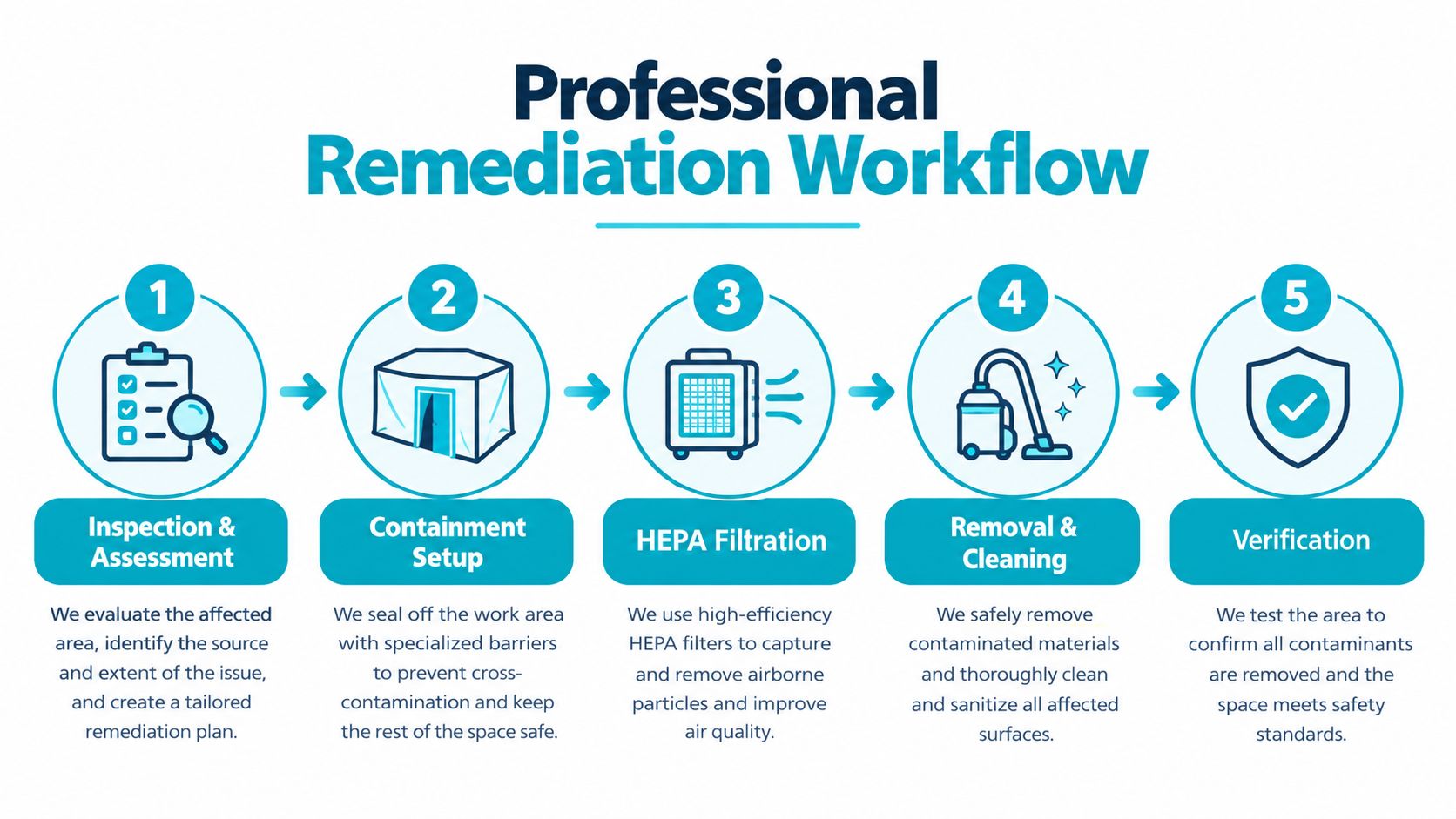
A careful project follows the moisture path instead of attacking the darkest-looking patch first. The crew should document conditions, identify the source, separate clean and contaminated areas, remove materials that can't be restored, and verify dryness before reconstruction.
Assessment and source control
The first visit should include visual inspection, moisture-meter readings, and a review of the water history. Depending on the assembly, technicians may inspect the roof, plumbing, HVAC equipment, crawlspace, attic, wall cavities, flooring, and contents. The scope should identify what will be cleaned, what will be removed, how the area will be contained, and what must happen before rebuilding.
EPA guidance recommends drying wet materials within 24 to 48 hours where feasible and keeping indoor relative humidity below 60%, ideally between 30% and 50%. EPA mold and moisture guide The benchmark is a response target, not permission to ignore a problem after the window passes. Once growth is present, the crew still needs to stop the source and dry the assembly.
Containment and controlled removal
For a limited work zone, professionals may use 6-mil fire-retardant polyethylene sheeting, a covered entry, and negative pressure to prevent contaminated air from moving into clean rooms. EPA commercial-building guidance describes limited containment for approximately 10 to 100 square feet and full containment when the affected area exceeds 100 square feet or conditions could spread contamination beyond the work zone. EPA containment guidance
The area is then cleaned with HEPA filtration, damp methods, and controlled removal. Wet or visibly moldy porous materials may need disposal because wiping the face of drywall or insulation doesn't reliably clean the interior. Painting, caulking, or spraying over growth conceals evidence without correcting the cause.
Drying and verification
Technicians continue measuring affected materials and indoor humidity during drying. Before reconstruction, the work area should be dry, free of visible contamination, and inspected for remaining moisture. Homeowners can review an outline of what affects the mold remediation timeline so the schedule is tied to the building condition rather than an arbitrary promise.
Evaluating DIY Cleanup Versus Professional Removal
DIY cleaning can make sense for a small patch of growth on a hard, non-porous surface, provided the water source is fixed and no vulnerable occupant is exposed. Mild detergent and water may clean that limited area. Opening a wall, removing wet carpet pad, disturbing a large contaminated space, or working on an HVAC system requires a different level of control.
Air testing is not automatically the first step. If there is visible growth and an active moisture problem, stop the water source and assess the affected materials before paying for sampling. Testing may help with an unclear or disputed situation, but it does not remove mold or correct the leak.
What a homeowner may handle
Wear gloves and eye protection, avoid dry brushing, and keep children away from the work area. If the surface is small, hard, and fully accessible, damp cleaning can remove surface residue. Fix the leak, remove standing water, and run dehumidification. Fragrance and paint only conceal the problem.
Bleach is not a universal answer. EPA guidance on mold and moisture explains that biocides such as bleach are not generally recommended as the primary mold-removal method. Porous materials may need disposal when they cannot be thoroughly cleaned and dried.
Where DIY becomes risky
A wall cavity, ceiling assembly, crawlspace, duct, or heavily water-damaged room can spread contamination beyond the visible area. Household fans may carry particles into clean rooms before proper controls are established. Dry sweeping and aggressive brushing can aerosolize spores and contaminated dust.
CDC guidance recommends, at minimum, a NIOSH-approved N95 respirator, eye protection, gloves, and protective clothing. Larger demolition tasks may require a half-face or full-face respirator under an appropriate respiratory-protection program. Wet cleaning and HEPA vacuuming are preferable to dry sweeping, and fans should not move air through visibly moldy areas before source removal and suitable controls. See this comparison of DIY mold removal and professional service for scope, cost, and safety considerations.
The cheaper option is not cheaper if cleaning spreads contamination into rooms that were previously unaffected.
Call a professional when growth is hidden, moisture continues, porous materials are involved, occupants are medically vulnerable, or the HVAC system may be affected. Florida distinguishes regulated mold-remediation credentials from general cleaning experience. Its licensing law addresses examination, character, education or field-experience routes, and documented training related to water, mold, and respiratory protection. Review the Florida mold-remediation licensing requirements before hiring.
Navigating Insurance Claims and Financial Options
Mold damage creates a practical problem as well as a technical one. A homeowner may know that a wall is wet but still need to document the event, preserve damaged materials, contact the carrier, coordinate a plumber, and decide whether temporary isolation is necessary.
Start with photographs and video before removing anything, provided the area is safe to enter. Record the date of the leak or storm, where water appeared, what was damaged, and what emergency steps were taken. Keep invoices, drying records, inspection findings, written scopes, and communication with the insurer or property manager.
Staging the work responsibly
If full reconstruction can't happen immediately, prioritize the actions that prevent additional harm:
- Stop the source: Repair the plumbing, roof, drainage, or HVAC condition allowing water into the home.
- Separate the area: Close doors, limit access, and avoid moving contaminated contents through clean rooms.
- Protect vulnerable occupants: Arrange an alternative space for children or residents with respiratory vulnerability.
- Address porous materials: Identify wet drywall, insulation, carpet pad, and other absorbent items that may need controlled removal.
- Protect the HVAC system: Don't circulate air through a visibly contaminated area until a qualified professional evaluates it.
- Get a written scope: Make sure the document states the source, affected assemblies, containment plan, cleaning method, disposal, drying, and verification.
Coverage depends on the policy, the cause of loss, exclusions, and the timing of the damage. A leak caused by a sudden covered event may be handled differently from long-term maintenance-related seepage. Read whether mold remediation is covered by insurance and ask the carrier specific questions rather than assuming that every mold condition is covered.
Financing decisions deserve the same caution as remediation decisions. Homeowners considering borrowing against property should understand the terms, fees, and repayment consequences, including information about line of credit reverse mortgage costs. A restoration contractor can help organize the scope and documentation, but the homeowner should confirm financial and insurance terms directly with the relevant providers.
Securing Your Florida Home with AMPM Restoration
Florida homeowners need a response that matches the building, not a generic spray-and-wipe package. A proper mold remediation residential plan connects moisture mapping, source correction, containment, filtration, controlled removal, drying, cleaning, and final inspection. The same approach applies whether the trigger was a burst pipe in Bradenton, storm intrusion in Sarasota, HVAC condensation in Lakewood Ranch, or flooding near Saint Petersburg and Tampa Bay.
AMPM Restoration is a 24/7 emergency restoration company based at 4301 32nd St W b18, Bradenton, FL 34205. Its services include water damage restoration, mold inspection and removal, fire and smoke damage restoration, storm and flood cleanup, commercial restoration, and reconstruction across Bradenton, Sarasota, Tampa Bay, Saint Petersburg, Lakewood Ranch, and surrounding Gulf Coast communities.
The company offers a one-hour response time, free inspections and estimates, insurance claim assistance, financing options, and a 100% satisfaction guarantee. Its licensed, bonded, and insured team handles projects for homes, offices, commercial properties, schools, and government facilities, coordinating emergency mitigation, drying, sanitization, repairs, and restoration.
Homeowners should ask direct questions before work begins. Who will correct the moisture source? Which materials will be removed? How will clean rooms be protected? How will the team document drying and final conditions? Florida licensing requirements matter too, particularly when a project involves regulated mold assessment or remediation work.
Frequently Asked Questions About Mold Remediation Residential
Is mold remediation residential work only needed when mold is visible?
No. A musty odor, recurring staining, damp materials, condensation, or a known leak can justify an evaluation even when growth isn't visible. Hidden moisture behind walls, beneath flooring, and around HVAC equipment can keep the problem active.
Should I order an air test before calling a remediation company?
Not always. If you have visible growth and active moisture, stopping the source and controlling exposure should take priority. Testing is most useful when it answers a defined question, such as whether suspected hidden growth requires further investigation or whether post-cleanup documentation is needed.
Can I paint over a mold stain?
Painting over a stain doesn't correct moisture or remove contamination. It can conceal a continuing leak and make later inspection more difficult. The material should be assessed, dried, cleaned, or removed according to its condition.
Does bleach remove mold from drywall?
Bleach isn't a reliable primary treatment for porous drywall, insulation, carpet pad, or similar absorbent materials. If those materials remain wet or visibly contaminated, controlled removal may be necessary.
Is it safe to run the air conditioner during mold cleanup?
Ask a qualified professional before operating the system when mold or moisture may involve the air handler, ducts, returns, or nearby building materials. Air movement can distribute particles from a contaminated area into clean rooms.
What should I do first after a Florida storm or plumbing leak?
Protect people from unsafe conditions, stop the water if possible, photograph the damage, limit access, and begin drying promptly. Don't disturb hidden materials or use ordinary fans to blow air through visibly moldy areas before containment and evaluation.
Call 941-946-7807 for a free inspection and estimate from AMPM Restoration Services, with insurance claim assistance and financing options available for mold, water, storm, and reconstruction needs. Visit AMPM Restoration Services to request help protecting your Florida home from moisture damage and unsafe mold growth.