


Your home looks normal again. The drywall is patched, the flooring is back in place, and the smell that worried you a week ago seems gone. But after water damage, mold removal, or smoke cleanup, most homeowners on Florida's Gulf Coast still ask the same question: Is my home restoration finished, or does it only look finished?
That question matters in Bradenton, Sarasota, Tampa Bay, Saint Petersburg, and Lakewood Ranch because Florida humidity gives hidden moisture and missed contamination a second chance to come back. A professional home restoration project isn't complete when the fans stop. It's complete when the property passes verification and you have documentation that shows the problem was addressed the right way.
Is My Home Truly Restored The Final Step to Peace of Mind
If you're reading this after a cleanup crew has packed up, you're probably doing a quiet mental check of the house. Does that corner still feel damp? Was all the mold really removed? If the fire damage was cleaned, why do you still notice a faint odor when the AC kicks on?
That uncertainty is normal. It also explains why the last step in home restoration is often the one that brings the most relief.

Why appearance isn't proof
A room can look clean and still have hidden moisture inside framing, under flooring, or behind baseboards. Mold can be removed from visible surfaces while spores remain airborne if containment and final clearance weren't handled correctly. Smoke residue can also linger in porous materials even after surfaces have been wiped down.
For homeowners across the Florida Suncoast, that gap between "looks better" and "is safe" is where problems restart.
Practical rule: The end of demolition or drying isn't the end of the job. The end is when the property can be shown to be dry, clean, and safe by objective verification.
What peace of mind actually comes from
Post-remediation verification is the final confirmation that your restoration work did what it was supposed to do. Think of it as the receipt for the work you paid for. It doesn't just say someone showed up. It shows whether the outcome meets the standard for a safe return to normal use.
That matters for three reasons:
- Your family needs clarity: You shouldn't have to guess whether a bedroom, nursery, kitchen, or living room is safe to use again.
- Your house needs proof: If you sell, refinance, or discuss follow-up work with your insurer, documentation matters.
- Your climate raises the stakes: In humid Florida conditions, missed moisture can turn a small oversight into a larger recurrence.
When homeowners in Bradenton or Sarasota feel uneasy after a cleanup, they're often reacting to the absence of proof, not the absence of effort. Verification closes that gap. It turns a visual result into a documented result, which is what brings real peace of mind.
What Is Post-Remediation Verification
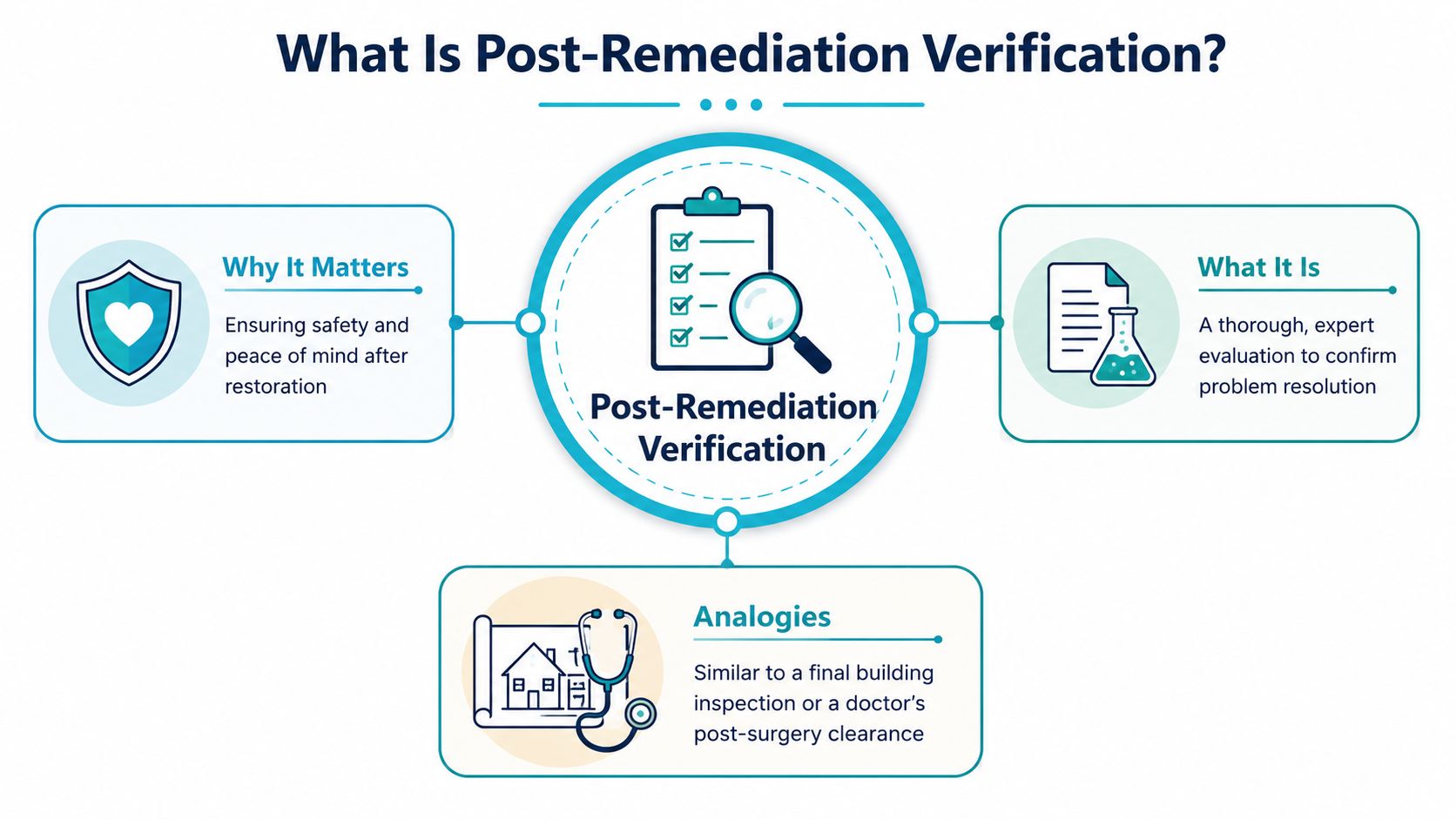
Post-remediation verification is the final inspection and testing process used to confirm that a damaged area has been restored to a safe, acceptable condition. In plain language, it's the moment where someone checks the work scientifically instead of just saying, "It looks good."
A simple analogy helps. If restoration is like surgery, verification is the follow-up clearance that confirms the problem was treated and healing is on track. If restoration is like rebuilding part of a car after an accident, verification is the final inspection before you drive it again.
It confirms safety, not just cleanup
A lot of homeowners assume the hard part is demolition, drying, cleaning, or rebuilding. Those steps matter, but they don't answer the final question by themselves. Verification does.
In a professional home restoration project, verification checks whether moisture has been controlled, contaminants have been reduced to acceptable levels, and the area is ready for normal occupancy. If mold was involved, the difference between assessment and actual remediation becomes important. A helpful explanation of that distinction appears in AMPM Restoration's mold assessment vs mold remediation guide.
Why homeowners should care
Verification protects more than the work area. It protects the people and the investment tied to it.
| Benefit | What it means for you |
|---|---|
| Health protection | Confirms the original contamination issue was addressed, not just hidden |
| Financial protection | Gives you a report to keep for insurance, records, and future disclosure questions |
| Prevention | Helps catch leftover moisture or incomplete cleanup before it causes another round of damage |
A proper verification result answers the question homeowners care about most: can we move back into this space with confidence?
What it isn't
Verification isn't a quick glance from the doorway. It isn't a contractor saying the walls feel dry. It isn't paint over a stain or caulk over a gap where moisture still sits behind the surface.
It's evidence-based confirmation. Depending on the type of loss, that may include moisture readings, visual review, air or surface sampling, and a final clearance decision. That's what separates professional restoration from cosmetic cleanup.
This difference is especially important in Florida homes. Sealing up a room before hidden moisture is gone can trap conditions that support mold growth later. The room may look finished, but the restoration isn't finished until the evidence says so.
The Four Pillars of Home Restoration Verification
A restored room can look finished and still hide the one problem that brings a homeowner right back to the start. In Florida, that problem is often moisture left behind in a wall cavity, under flooring, or inside framing where humid air slows drying and helps mold return. Verification protects against that outcome. It works like the final receipt for the money you just spent, showing whether the job is complete and whether the home is ready for normal use.
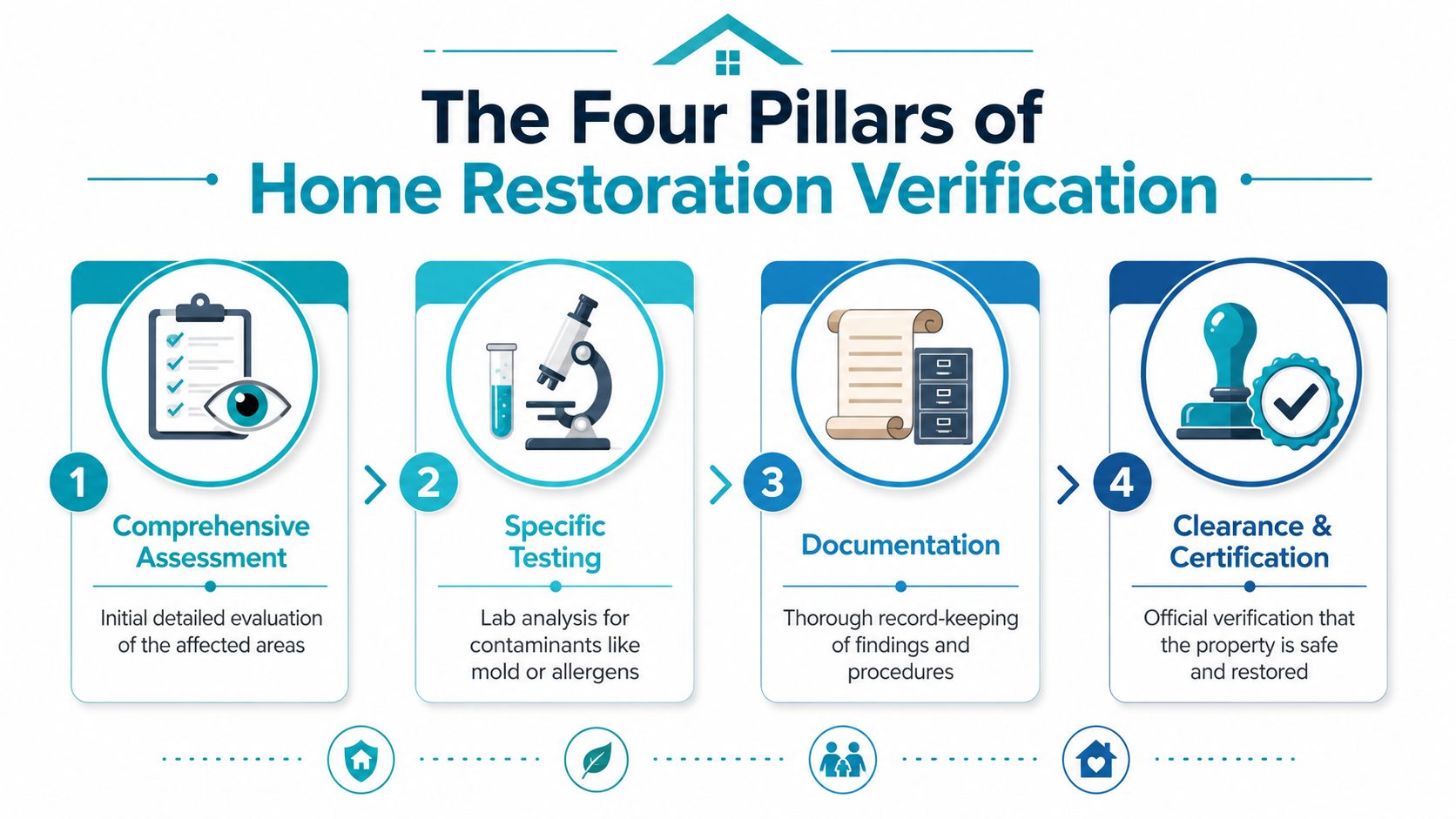
Pillar one is a careful visual inspection
Every verification starts with observation. A trained inspector studies the affected area the way a building doctor studies symptoms before ordering tests.
That inspection looks for residue, staining, demolition dust, damaged materials that should have been removed, trim that has swollen or shifted, and discoloration that suggests moisture or microbial activity may still be present. After mold remediation, the inspector also checks whether containment was removed cleanly and whether nearby rooms stayed clean during the work.
Visual review has limits, but it often reveals whether the project was finished in a disciplined, standards-based way.
Pillar two is moisture mapping
Moisture mapping answers a simple question with technical tools. Is there still water where it should not be?
Technicians use moisture meters, hygrometers, and thermal imaging to compare wet areas to unaffected materials nearby. That comparison is important because a wall can feel dry at the surface while the framing behind it is still holding moisture. In Florida homes, high outdoor humidity can blur the picture, so readings have to be interpreted carefully rather than guessed at.
The ANSI/IICRC S520 mold standard connects delayed drying with a higher chance of mold growth, which makes moisture verification a safety issue, not just a construction detail. If structural drying is still underway, homeowners can review what that process involves before rebuild work begins on this page about structural drying services in Tampa Bay.
Pillar three uses targeted sampling when needed
Sampling checks the conditions you cannot confirm with your eyes alone. It is not automatic on every job, and it should be used for a reason.
On mold-related projects, air or surface sampling may help answer whether indoor conditions have returned to a normal range, whether contamination remains on cleaned surfaces, and whether nearby rooms picked up cross-contamination during demolition or remediation. On other losses, sampling may not be necessary if inspection and moisture data already show a clean result.
A good verifier chooses testing based on the actual loss, the materials involved, and the questions that still need answers. That keeps the process focused and gives the homeowner evidence that means something.
A finished appearance is not the same as a cleared environment. Verification closes that gap.
Pillar four creates the clearance decision
This is the point where all findings are reviewed together. Visual conditions, moisture readings, and any sampling results are compared against the project scope and the applicable standard.
The clearance decision should tell you four things clearly:
- Were damaged or contaminated materials removed or cleaned properly?
- Have moisture conditions returned to an acceptable range for the materials and the space?
- Does the area now reflect normal indoor conditions for safe occupancy or reconstruction?
- Is any additional drying, cleaning, or correction still required?
For a homeowner, this final decision is more than a technical sign-off. It is the document that supports peace of mind, protects property value, and shows that the restoration investment produced a safe, defensible result in a climate where unfinished drying problems rarely stay hidden for long.
Understanding IICRC Standards and Florida Compliance
Standards matter because damage restoration isn't guesswork. When a company follows IICRC standards, the crew isn't deciding on the fly what "dry enough" or "clean enough" means. They're working from an accepted framework built around inspection, containment, drying, cleaning, and verification.
The International Institute of Cleaning and Restoration Certification certifies restoration technicians who are expected to follow established methods for water damage mitigation, including immediate source control, rapid extraction, and controlled drying, as outlined by Master Restoration Services in its summary of IICRC-certified practices. For a homeowner, that means the process should be repeatable, documented, and technically grounded.
What the S500 standard means in plain language
For water losses, the ANSI/IICRC S500 standard lays out a four-phase process. It includes inspection and classification of the water, rapid bulk extraction, strategic dehumidification with high-velocity air movers, and verification through daily moisture readings until wood reaches 15% equilibrium moisture content or lower, according to this explanation of the S500 standard.
That matters because every stage affects the final result. If water was Category 3, the cleanup standard is different from a clean water leak. If drying wasn't measured correctly, rebuilding can start too soon. If verification wasn't performed, nobody can say with confidence that the structure is ready.
Why this matters more in Florida
Florida homes deal with heat, humidity, and storm exposure. That combination makes small mistakes expensive. A room that might stay stable in a drier climate can hold moisture longer here, especially inside wall cavities, under flooring, or around HVAC areas.
Homeowners looking into mold concerns often start with an inspection, and that first step should also be standards-based. This overview of professional mold inspection services is a useful reference for what qualified evaluation should look like before or after remediation.
Standards also support insurance and liability protection
A standards-based home restoration process helps when an adjuster asks for documentation, when a reconstruction contractor needs clearance before rebuilding, or when a future buyer asks what happened after a loss. It also reduces the risk of informal shortcuts that leave the homeowner holding the problem later.
Florida compliance isn't only about passing a quick visual check. It's about creating a clear record that the property was assessed, treated, and returned to service using accepted methods.
Your Verification Report Costs and Insurance Claims
When verification is done correctly, you should receive a final document that explains what was checked, what was found, and whether the area cleared for normal use. This is the paper trail many homeowners don't think about until months later, when they need it for an adjuster, a contractor, a buyer, or their own records.
A verification report often functions as the practical closeout file for the loss.
What the report should include
The exact format varies by project, but a useful report usually contains:
- Scope details: Which rooms or materials were part of the loss and restoration work
- Inspection findings: Notes from the final visual review
- Moisture documentation: Readings or drying confirmation where applicable
- Testing summary: Air or surface sampling results if those were part of the job
- Clearance status: A statement showing whether the area passed or needs more work
If water damage was part of your claim, it also helps to review what insurers usually expect before the file closes. Homeowners can start with these water damage insurance claim tips.
Keep your final report with your policy documents, repair invoices, photos, and adjuster correspondence. If a question comes up later, that file becomes your timeline.
How to think about cost
Verification has a cost, but the more useful way to view it is as protection for the larger money already tied up in the claim, repairs, and property value. If the home is rebuilt before hidden moisture or contamination is fully resolved, the owner may end up paying for repeat demolition, additional cleaning, or another interruption to daily life.
This is also where homeowners get tripped up by "cheap" fixes. Surface-level sealing, paint, recaulking, or cosmetic patching can hide the problem if drying and remediation weren't complete first. In Florida's humid climate, that can lock moisture into the assembly and create a second round of trouble that feels like a new event but stemmed from incomplete closeout.
Questions to ask before work begins
Don't wait until the end of the project to ask how verification works. Ask early, while the scope is still being defined.
A short checklist helps:
| Ask your contractor | Why it matters |
|---|---|
| Who performs the final verification? | You need to know whether it will be documented and objective |
| Will moisture readings be tracked? | Drying should be measured, not guessed |
| Will mold clearance testing be included if mold is involved? | Mold jobs need a defined standard for completion |
| What documents will I receive? | Reports matter for insurance and future records |
| How will you coordinate with my adjuster? | Good communication reduces delays and confusion |
Insurance usually responds better to documentation than opinions
Adjusters and carriers want a file they can follow. A complete report helps show what happened, how it was addressed, and whether the property was returned to an acceptable condition. That can reduce back-and-forth at the end of a claim and make final payment discussions simpler.
For homeowners, the key point is straightforward. Verification isn't extra fluff. It's the written proof that the home restoration work reached the finish line.
How AMPM Restoration Guarantees a Safe Florida Home
You walk back into the house after cleanup, the air smells better, and the equipment is gone. In Florida, that does not always mean the risk is gone too. Humid outdoor air can slip back into wall cavities, attics, and flooring systems, so the last stage of a restoration project has to do more than make the property look normal. It has to prove the home is safe to live in and safe to rebuild.
AMPM Restoration is a 24/7 emergency restoration company based at 4301 32nd St W b18, Bradenton, FL 34205, serving Bradenton, Sarasota, Tampa Bay, Saint Petersburg, Lakewood Ranch, and nearby Suncoast communities. The company handles water damage restoration, mold inspection and mold removal, fire and smoke damage restoration, storm and flood damage restoration, commercial restoration services, and reconstruction.
How the guarantee works in practice
A reliable guarantee in restoration works like a final receipt. It shows what was done, what conditions were found at the end, and whether the property met the target for dry, clean, and ready. For a Florida homeowner, that matters for three reasons at once. It protects your family from unfinished moisture or contamination issues, supports the home's value, and gives you a clear record if questions come up later with an insurer or a future buyer.
AMPM's approach depends on process, not guesswork. Fast emergency response helps limit how far water spreads into drywall, baseboards, insulation, cabinetry, and framing. Early action gives a restoration team a better chance to dry and clean materials before Florida humidity turns a small wet area into a larger indoor air problem.
That early response is only the first half of the job.
The second half is proving the result. On a properly managed project, technicians document moisture conditions, track drying progress, use containment and HEPA filtration when the loss requires it, and confirm the area is ready for occupancy or reconstruction. If mold was part of the loss, clearance matters because a surface can look fine while hidden cavities or settled particles still need attention.
What homeowners should expect from AMPM
Homeowners should expect four things from the closeout process:
- Standards-based work: IICRC-guided mitigation and remediation methods that match the type of loss
- Field verification: Moisture meters, thermal imaging, and other jobsite tools used to confirm conditions instead of relying on appearance alone
- Clear records: Written documentation that shows what was affected, what was removed or cleaned, and how the final condition was checked
- Claim coordination: Communication with the insurance carrier so the file reflects the actual work performed
In plain terms, the goal is peace of mind you can document. If a room is rebuilt before it is thoroughly dry and cleared, the new materials can hide the original problem instead of solving it. In Florida's climate, that is like closing a lid on trapped humidity and hoping it stays put.
For homeowners dealing with an active loss, unanswered questions after cleanup, or concern about whether drying was finished correctly, AMPM can inspect the property and explain the next step in plain language. You can also review these water damage frequently asked questions if you want a clearer picture of what to expect during restoration and verification.
Call 941-946-7807 for a free inspection and estimate. AMPM Restoration also offers insurance claim assistance and financing options, which can make time-sensitive repair decisions easier after a water, mold, fire, or storm loss.
Frequently Asked Questions About Home Restoration Verification
Homeowners usually have a few practical questions after hearing about post-remediation verification. These are the ones that come up most often after a water, mold, fire, or storm loss.
Do I need verification if the room already looks clean
Yes, if the damage involved moisture, contamination, or demolition. A clean appearance doesn't confirm dry materials, normal air conditions, or safe clearance. Verification answers those questions with documentation instead of assumption.
Who should perform post-remediation verification
It should be handled by a qualified professional using accepted restoration methods and testing where appropriate. The important part is objectivity, proper tools, and a written report that explains the findings in plain language.
Is verification only for mold jobs
No. Mold jobs make the need more obvious, but water damage, storm intrusion, and some fire losses also benefit from final verification. Any loss that affects building materials, indoor air, or hidden cavities can leave unresolved conditions behind.
What if my contractor says testing isn't necessary
Ask what method they will use to prove the area is dry, clean, and ready for reconstruction or occupancy. If mold was involved, ask how clearance will be determined. If their answer is only visual, keep asking questions. Homeowners dealing with water losses can also review these water damage frequently asked questions for additional context.
If a company can't explain how it verifies completion, the homeowner has no reliable way to know whether the job is actually done.
Can verification help with insurance claims
Yes. A final report can support the claim file by showing what conditions were found and how the property was brought back to an acceptable condition. It can also help with final payment discussions, recordkeeping, and future questions about prior damage.
What if I already repaired the damage without verification
You can still request an inspection, but it may be harder to evaluate hidden conditions once finishes are closed up. That's why verification should be discussed before reconstruction starts. If there is still concern about odors, moisture, or mold, a professional inspection is the safest next step.
If you need help with home restoration in Bradenton, Sarasota, Tampa Bay, Saint Petersburg, Lakewood Ranch, or nearby Gulf Coast communities, contact AMPM Restoration Services. Call 941-946-7807 for a free inspection and estimate. The team provides insurance claim assistance and financing options to help you move from emergency response to documented peace of mind.