


Mold Growth Timeline After Water Damage
If you’re reading this with wet carpet under your feet, a ceiling drip over the hallway, or storm water pushing in from a doorway, slow down for a minute and work the problem in order. Panic leads people to do the wrong things first. Good water cleanup services in Tampa start with safety, then stopping the source, then limiting spread, then drying correctly. That’s the sequence that protects both the house and your wallet.
A lot of homeowners think the emergency ends once the visible water is gone. It doesn’t. The actual job is managing the full lifecycle of damage, from the first phone call to final drying, repair decisions, and mold prevention in Florida humidity. That’s where clear expectations matter.
Immediate Steps for Water Damage in Your Tampa Home
The first hour matters most. Not because you need to solve everything yourself, but because a few smart moves can prevent a manageable loss from turning into a major rebuild.
What to do first
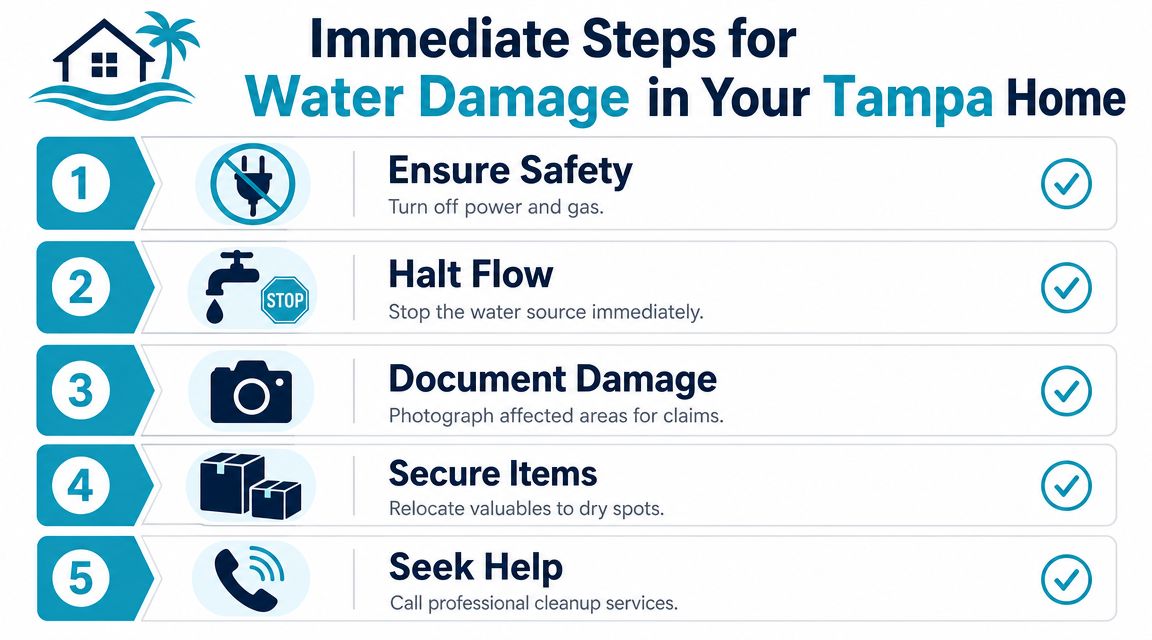
Start with hazards before cleanup.
- Shut off electricity to affected areas: If water is near outlets, appliances, baseboards with wiring, or your breaker panel area, keep out until power is safely shut off.
- Stop the water source if you can: Close the supply valve to a leaking sink, toilet, washing machine, or water heater. If you can’t isolate it, shut off the main.
- Protect people and pets: Keep children and animals away from wet rooms, especially if the source could be contaminated.
- Take photos before moving too much: Capture floors, walls, furniture, and the source if visible. Clear documentation helps when you file a claim.
- Move what you can to a dry area: Rugs, papers, electronics, small furniture, and loose contents should come off wet surfaces fast.
Practical rule: Don’t step into a wet room and start unplugging things or lifting soaked furniture until you’ve dealt with electrical risk.
If the water came from heavy rain or a storm event, keep a wider emergency mindset. A practical essential hurricane preparation guide is useful for backup lighting, charging, and household readiness if conditions are still unstable outside.
What not to do
Homeowners often mean well and make the job harder.
- Don’t use a household vacuum on standing water: That’s unsafe and ineffective for real extraction.
- Don’t run HVAC systems blindly: If ductwork or returns are affected, the system can circulate moisture and contamination.
- Don’t leave wet textiles in piles: Towels, clothing, and bedding trap moisture and odors quickly.
- Don’t assume dry-looking means dry: Water moves under flooring, into wall cavities, behind baseboards, and into insulation.
- Don’t throw away damaged materials too early: Wait until they’re documented unless they’re creating an immediate safety issue.
A simple homeowner checklist can help you stay organized after flooding. This guide on steps to take after home flooding is a good reference if you’re trying to manage the first decisions without missing something important.
While you’re waiting for help
Open communication matters. Tell the restoration team what happened, when you first noticed it, whether the source has stopped, and whether the water may be clean, gray, or black. That last detail affects both the scope of cleanup and what materials may need removal instead of just drying.
Use towels only for small containment, not as your main plan. If it’s safe, place foil, wood blocks, or plastic under furniture legs to reduce staining and swelling. Then stop. Overhandling wet materials can spread damage.
The Professional Water Cleanup Process Explained
A proper restoration job is a controlled drying job. Visible water removal is only the beginning.
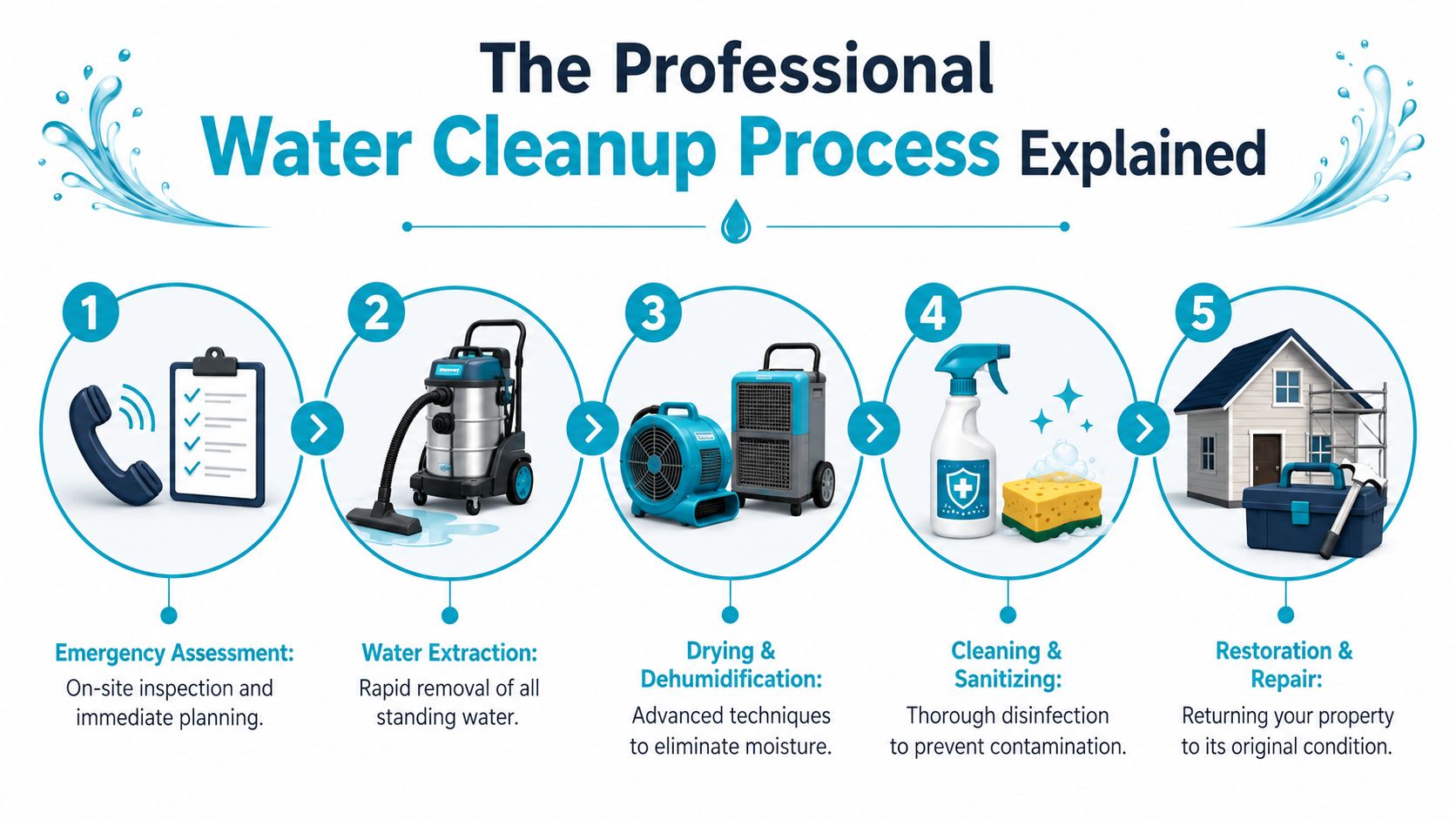
Step one starts with inspection, not guessing
The first thing a trained crew should do is inspect the affected area, identify the source, and map where moisture has traveled. That’s where tools matter. Moisture meters, infrared cameras, and moisture-intrusion inspection tools help locate hidden wet pockets in wall cavities, under flooring, and inside insulation.
The reason is simple. In Tampa-area restoration, the technically critical step is rapid moisture control. Industry workflows typically combine extraction, high-velocity air movement, dehumidification, and moisture-meter verification because delayed drying creates conditions for mold and structural deterioration, as explained in this Tampa emergency water damage restoration guide.
The five stages you should expect
- Emergency assessment
The crew evaluates safety, source, affected materials, and likely contamination level. This is when they decide what can be saved and what needs isolation. - Water extraction
Industrial pumps, truck-mounted extractors, or portable extraction units remove standing water fast. This is far more effective than mops, shop vacs, or box fans. - Drying and dehumidification
Air movers push evaporation off wet surfaces. Dehumidifiers remove that moisture from the air so materials can continue drying instead of reabsorbing it. - Cleaning and sanitizing
If the water source wasn’t clean, surfaces and contents may need antimicrobial treatment, detailed cleaning, and odor control. - Repair and rebuild decisions
Once readings show the structure has returned to a safe dry state, the team determines whether drywall, trim, flooring, cabinets, or insulation need repair, replacement, or no further action.
Water cleanup services in Tampa aren’t just about removing puddles. The job is finished when hidden moisture is found, dried, and verified.
What works and what doesn’t
What works is an equipment plan matched to the structure. A tile floor over slab needs a different approach than soaked laminate over underlayment. Wet base cabinets behave differently than wet drywall. Crews should adjust the drying setup as readings change, not place equipment once and hope for the best.
What doesn’t work is treating every job like a fan-and-pray situation. One of the biggest mistakes in this trade is relying on visible improvement. The surface may look fine while the wall cavity remains wet.
If you want to see what a full-service response usually includes, this overview of water damage restoration services shows the kind of end-to-end work a restoration contractor may handle, from extraction through structural drying and repair coordination. AMPM Restoration Services is one local option that offers that full-cycle model.
Why verification matters
Drying without verification is guesswork. Certified teams don’t stop because the room feels less damp. They stop when moisture readings support it.
That matters for two reasons:
| Area | What a proper check prevents |
|---|---|
| Walls and insulation | Hidden moisture, odor, and later material failure |
| Flooring systems | Buckling, trapped dampness, and subfloor damage |
| Cabinets and trim | Swelling, staining, and delayed deterioration |
| Air quality | Lingering damp conditions that support microbial growth |
Understanding Costs and Timelines for Tampa Water Cleanup
If you are standing in a wet kitchen at 10 p.m., the two questions usually come fast. What is this going to cost, and how long is my house going to feel like a drying chamber?
A fair starting point for water cleanup services in Tampa is this. Restoration averages $4,606 per job, with a typical range of $1,962 to $7,250. Tampa pricing is also commonly estimated at $3 to $7.50 per square foot, and labor often runs $70 to $200 per hour, according to Angi’s Tampa water damage cost guide.
Those numbers help, but they do not tell you what your job will cost. The actual price comes from what got wet, how far the water traveled, and whether the loss stayed clean or turned contaminated.
What pushes the price up or down
Crews price water losses based on conditions inside the structure, not just square footage.
| Cost factor | Why it matters |
|---|---|
| Size of affected area | More wet material means more extraction, more equipment, and more labor |
| Location of damage | Open rooms are faster to dry than wall cavities, underlayment, or hidden leak paths |
| Water category | Cleaner water usually means less disposal, cleaning, and protective work |
| Material type | Hardwood, laminate, insulation, cabinets, and drywall all react differently and may need different handling |
| Labor intensity | Tear-out, content moving, detach-reset work, and detailed cleaning add hours quickly |
Water category changes the scope fast. The same Angi pricing reference notes that clean water sits at the low end of the range, while gray and black water cost more per square foot because cleanup, removal, and sanitation get more involved. That matters in Tampa after storm surge, drainage backups, and wind-driven rain events where contamination is more likely.
Early action saves money. Water that gets extracted before it wicks into cabinets, insulation, and adjoining rooms is usually far less expensive to handle than water left overnight.
What timeline to expect
Drying time depends on the assembly, not just the size of the room. A supply-line leak on tile over slab may dry much faster than water trapped under laminate, inside cabinets, or behind wet drywall.
For many jobs, the mitigation phase lasts several days. Rebuild can take longer if materials need to be removed, special-order finishes are involved, or insurance approvals slow the schedule. If you want a realistic breakdown by phase, this guide on how long water damage restoration takes explains what usually happens from extraction through final repairs.
Here is the trade-off homeowners should understand. Aggressive demolition can shorten drying in some assemblies, but it also increases reconstruction cost. Conservative drying can preserve more materials, but only if moisture readings show those materials can be saved.
How to read an estimate without getting blindsided
Ask for the estimate in phases:
- Emergency mitigation
- Drying and monitoring
- Cleaning and sanitation
- Demolition of unsalvageable materials
- Reconstruction or repair
That format makes the job easier to understand. It also helps you compare bids that look similar on the surface but cover very different work.
One company may be pricing extraction and equipment only. Another may include drywall removal, cabinet detach-reset, antimicrobial treatment, and post-dry repairs. If those items are not separated, homeowners often assume they are comparing equal scopes when they are not.
The best estimate is not the lowest one. It is the one that clearly shows what happens first, what gets billed if conditions change, and what the home will still need after the structure is dry.
Navigating Insurance Claims for Florida Water Damage
Insurance confusion adds stress at the worst time. The claim process goes smoother when you treat it like documentation, not an argument.
What to gather before the adjuster asks
Start a simple claim file.
- Photos and video: Wide shots first, close-ups second
- Cause notes: When you discovered it, where it started, and what you did to stop it
- Emergency invoices: Extraction, tarp, temporary protection, plumber, or mitigation charges
- Damaged item list: Furniture, electronics, rugs, contents, and finishes
- Communication log: Names, dates, and what each representative told you
A lot of delays happen because homeowners rely on memory. Don’t. Write it down while it’s fresh.
Common mistakes that slow claims
One mistake is waiting too long to report the loss because you’re hoping it dries on its own. Another is discarding wet materials before they’re documented. A third is hiring a contractor who doesn’t produce clear moisture records, photo documentation, or line-item scope notes.
That’s why experienced restoration companies matter. They know the claim needs more than a wet floor photo and a verbal description. They document affected materials, drying progress, and the logic behind removal versus restoration. If you want a step-by-step reference before speaking to your carrier, this guide on how to file an insurance claim for water damage is a useful starting point.
The smoother claims aren’t always the smallest losses. They’re the best-documented ones.
How a restoration company helps
A good mitigation team doesn’t replace your insurer or your adjuster. They make the damage legible. That means readable photo sets, equipment logs, moisture readings, room-by-room notes, and a clear record of emergency actions taken to prevent further damage.
That support matters because the insurance side often moves on paperwork while the house needs action now. When a contractor can communicate in a way adjusters recognize, fewer details get lost between the field visit and the claim file.
You should also ask one direct question early: what part of the job is emergency mitigation, and what part is reconstruction? Keeping those buckets clear helps everyone understand what’s needed now versus what may follow after drying and review.
Why Choose a Local IICRC-Certified Tampa Team
Not all emergency response is equal. A website can say 24/7, but that phrase means very little unless the company can explain how fast they mobilize and what happens once they arrive.

Why response timing matters in real life
One of the biggest gaps in local content is that companies advertise nonstop availability without explaining the actual decision window. In Tampa, the first 24 to 48 hours after water intrusion are often the critical period for preventing secondary damage, as noted in this discussion of Tampa emergency response timing.
That means you shouldn’t just ask, “Are you open?” Ask better questions:
- How quickly can a crew reach my address?
- Will they bring extraction and drying equipment on the first visit?
- Do they document moisture beyond visible wet spots?
- Can they explain what happens after extraction?
What IICRC-certified should mean to you
Certification matters because water losses aren’t solved by enthusiasm. They require process discipline. A trained technician should understand material behavior, contamination concerns, drying goals, equipment placement, and verification.
You don’t need trade jargon on the phone. You need someone who can tell you what is urgent, what is optional for now, and what signs suggest a more involved restoration path. That’s the value of hiring a certified local team.
Why local knowledge helps
Tampa-area jobs bring their own patterns. Summer storms, flood exposure, slab homes, tile over concrete, humid interiors, and fast mold concerns all influence decisions. A local crew is more likely to recognize when a “small leak” has probably moved farther than the homeowner expects, and when outdoor humidity is working against indoor drying.
Local also means practical accountability. You want a team that knows the area, knows the insurance processes, and can return for monitoring, documentation, and follow-up repairs without treating your home like a distant dispatch.
Frequently Asked Questions About Water Cleanup
The questions below are the ones homeowners usually ask after the immediate panic settles and they start thinking about what comes next.
Should I stay in my house during water cleanup?
Sometimes yes, sometimes no. It depends on which rooms are affected, whether the water is contaminated, whether power is safe, and how disruptive the drying setup will be. If the loss is isolated and the environment is safe, many homeowners remain in the property while drying equipment runs.
If the source involved sewage, storm surge, or widespread ceiling collapse risk, staying may not make sense. Ask the restoration crew for a direct room-by-room recommendation instead of a blanket answer.
Is water extraction enough, or do I need drying too?
Extraction alone isn’t enough in most real losses. Water leaves surfaces quickly but remains inside porous materials and hidden cavities. That’s why professional water cleanup services in Tampa use extraction, air movement, dehumidification, and moisture verification as part of one drying plan.
If someone offers to “just suck up the water” and leave, that should concern you. The expensive problems usually come from what stayed wet after the puddles disappeared.
When are sanitization, mold testing, drywall removal, or reconstruction actually necessary?
Homeowners need straight answers. Existing Tampa content often doesn’t explain clearly when those steps are required versus optional. That’s a practical problem because water damage can become a longer restoration and indoor air quality issue in humid Florida conditions, as discussed in this water remediation overview.
Here’s how to look at it:
- Sanitization is more likely necessary when the water wasn’t clean, when surfaces were exposed to contaminants, or when odors remain.
- Mold testing may be considered when there are signs of ongoing moisture, visible growth, or unresolved air quality concerns.
- Drywall removal may be necessary when water wicked up walls, the cavity stayed wet, or the material loses integrity.
- Reconstruction comes into play after drying if removed materials need to be replaced to return the home to normal use.
If a material can be dried cleanly and verified dry, it may stay. If it can’t be dried safely or has been contaminated, removal becomes the smarter path.
What happens to my furniture, rugs, and personal belongings?
Contents are handled by category. Some items can stay in place with protection under the legs. Others need to be moved, lifted, cleaned, or packed out. Upholstered furniture, paper goods, electronics, and area rugs all need different decisions.
Don’t assume every wet item is ruined, but don’t keep soaked belongings piled in a closed room. If you need more homeowner-level answers about contents, drying, and follow-up steps, this page of water damage frequently asked questions is a helpful companion resource.
Will water damage affect me later if I want to sell the house?
It can, especially if the loss wasn’t handled thoroughly or documented well. Buyers and inspectors care less about the fact that a leak happened and more about whether it was addressed correctly, dried fully, and repaired professionally.
If you’re thinking long term, this article on disclosing water damage when selling gives a practical overview of what homeowners should be prepared to discuss.
What if I can’t pay for everything at once?
Ask about payment structure immediately. Some restoration companies can separate emergency mitigation from later rebuild work, which helps you understand what must happen now and what can be scheduled after claim review. Insurance may cover parts of the work depending on the cause and your policy terms, but you shouldn’t assume every phase will be handled the same way.
This is also where financing options can matter. If repairs extend beyond initial cleanup, a payment plan can help you move forward without delaying necessary restoration.
If you need water cleanup services in Tampa right now, AMPM Restoration Services is available 24/7 to help you stabilize the loss, document the damage, and move from emergency mitigation to drying, repairs, and final restoration. Call 941-946-7807 for a free inspection and estimate. The team can assist with insurance claims and discuss financing options so you can make fast, informed decisions without carrying the whole burden alone.