


AMPM Restoration: Structural Drying Service
A damp ceiling after a storm, a warm musty smell near the hallway, or a baseboard that feels swollen after a plumbing leak can make a Bradenton homeowner stop and wonder what’s really happening behind the walls. Structural drying services are the response when water has moved past the surface and into the building itself, because wiping what you can see doesn’t remove moisture trapped in drywall, framing, subfloors, or insulation. In a place like Bradenton, Sarasota, Tampa Bay, Saint Petersburg, and Lakewood Ranch, that hidden water matters quickly, because Gulf Coast humidity makes slow drying a bad bet.
AMPM Restoration works 24/7 from Bradenton, and that local availability matters when a leak starts spreading after hours. A fast inspection can separate a small cleanup from a larger drying job, and it can also show whether you’re dealing with salvageable materials or sections that need removal. For homeowners who want a practical starting point, the company’s water damage restoration service page is a useful place to understand what emergency mitigation usually includes, especially when the damage is more than a surface issue, water damage restoration services.
One useful comparison comes from flooring repair resources outside Florida. If you’re trying to understand what happens when water reaches hardwood or subflooring, find flooring restoration help in Richmond offers a helpful parallel on why flooring often needs more than a quick dry-out. The same basic principle applies here, moisture has to leave the structure in a controlled way, or the damage keeps developing out of sight.
Water Damage Reality for Florida Homeowners
A Bradenton homeowner can spot the first clue in a very ordinary way, a dark patch on a ceiling after a tropical storm, a damp hallway after a shower leak, or a closet that smells earthy a day after the AC has been running hard. The instinct is usually to fan it out, mop what’s visible, and hope it’s fine by morning. That’s where trouble starts, because the visible spot is often only the top layer of a much larger moisture problem.
Structural drying services matter because water follows gravity and building cavities, not just the floor you can see. Once moisture gets into framing or wall assemblies, it can sit in places where towels and household fans never reach. AMPM Restoration’s local coverage across Bradenton, Sarasota, Tampa Bay, Saint Petersburg, and Lakewood Ranch is relevant here, because the first hours after intrusion are the easiest time to limit the spread.
Why the first cleanup often isn’t enough
A wet carpet can mislead people. The surface may feel dry while padding, baseboards, and lower drywall still hold water, and that hidden moisture can keep feeding damage long after the room looks “better.” In that sense, the core problem isn’t the puddle, it’s the material inside the structure.
Practical rule: if the room smells damp or the materials feel soft, the water likely moved beyond surface cleanup.
A good response starts with a drying plan, not a guess. That’s why homeowners in the Gulf Coast area should think in terms of restoration, not just cleanup, especially after a storm surge, wind-driven rain, or a plumbing break that ran for several hours. When water damage is limited early, the job is simpler. When it keeps moving through the structure, the work becomes more technical and more dependent on documented moisture removal.
The common thread is urgency. Even a small leak can turn into a bigger project when the source isn’t fixed right away, and that’s why 24/7 response matters in a coastal climate. If you’re standing in a room that still feels humid after the obvious water is gone, the next step is inspection and drying, not just another pass with a towel.
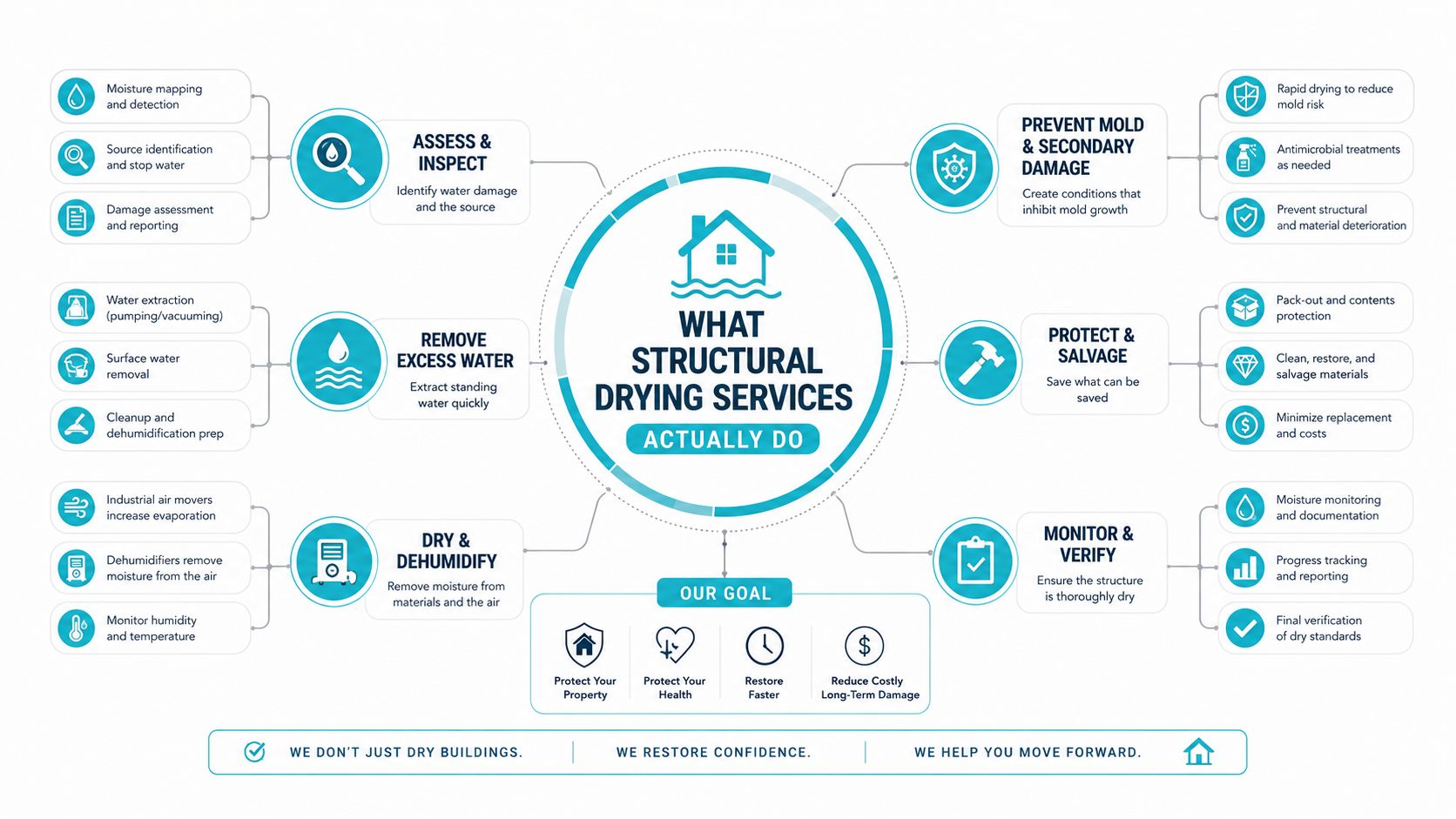
What Structural Drying Services Actually Do
Think of a soaked sponge. If you leave it on the counter, it doesn’t dry evenly from the middle outward on its own, it releases water only when the surrounding air can accept that moisture. Structural drying works the same way, except the “sponge” is your house framing, drywall, flooring, and hidden cavities. The job is to make wet materials give up moisture faster than the air can put it back.
The controlled process behind drying
Professional drying is a psychrometric process, which means technicians manage airflow, dehumidification, heat, and pressure so the building materials move back toward their normal moisture condition. The point isn’t to blast air at everything and hope for the best. It’s to change the environment enough that water naturally leaves the materials instead of staying trapped inside them.
Wood framing gives a good example. Industry guidance says wood is usually targeted below 19% moisture content because decay fungi can begin colonization above that threshold, according to structural drying guidance from Water Restoration Authority. That gives homeowners a concrete idea of why “looks dry” is not the same as “dry enough.”
The process also depends on the material. Porous materials, layered assemblies, and hidden cavities all release moisture differently, so the technician has to match the drying method to the structure instead of using the same setup everywhere. That’s why professional structural drying is closer to climate control than to simple ventilation.
Why DIY fans miss the point
A box fan can move air, but it can’t manage vapor pressure, remove enough humidity, or verify what’s happening inside a wall. Professionals use the air movement to help wet surfaces evaporate, then use dehumidification to pull that moisture out of the air before it settles back into the building. That cycle is what turns drying from a hope into a controlled job.
One of the most useful ideas for homeowners is this, the goal isn’t to dry the room faster at any cost. The goal is to dry the structure to a safe endpoint, with proof that the moisture has left the building materials. That’s the difference between a temporary improvement and a real restoration result.
Common Causes of Gulf Coast Water Damage
Florida properties see a wide range of water intrusion, and most of the common causes start with weather, age, or hidden mechanical problems. A storm can force water through a roof edge. An older supply line can fail behind a wall. An AC condensate line can clog and spill into a closet or hallway. Each one leaves a different pattern, but the end result is the same, materials get wet where they shouldn’t.
The Gulf Coast climate makes those events harder to forgive. Warm air holds moisture, which means a wet interior doesn’t naturally give up water as quickly as it might in a drier region. That’s why the same leak that seems manageable on paper can become a stubborn drying problem in a Bradenton or Sarasota home.
The usual suspects in local homes
- Hurricane and tropical storm flooding: Wind-driven rain and floodwater can push moisture into floors, walls, and lower cabinetry.
- Burst or aging plumbing: A split pipe can soak cavities before anyone notices the leak.
- Roof breaches: Even a small opening can send water into insulation and drywall during heavy rain.
- AC condensate leaks: These often start and show up as stains, swelling, or a mildew odor.
- High groundwater during prolonged rain: Water intrusion can happen from below as well as above.
Repeated small leaks deserve as much attention as one dramatic flood. A slow drip behind a vanity or under a sink can keep a cabinet base wet long enough to damage flooring and trim, and that damage often shows up after the source is already forgotten. The challenge is that these problems don’t always announce themselves with standing water.
For homeowners, the practical check is simple. Look at the ceiling line after storms, the base of cabinets near plumbing, the area around air handlers, and any flooring that feels spongy or starts to cup. Those are the places where a drying specialist usually finds the problem hiding.
If you’re comparing local restoration options, it also helps to understand how water damage fits into a larger emergency response. AMPM Restoration’s broader service lineup is built around that kind of situation, where the cause matters, but the property still needs immediate stabilization.
Inspection and Moisture Mapping Explained
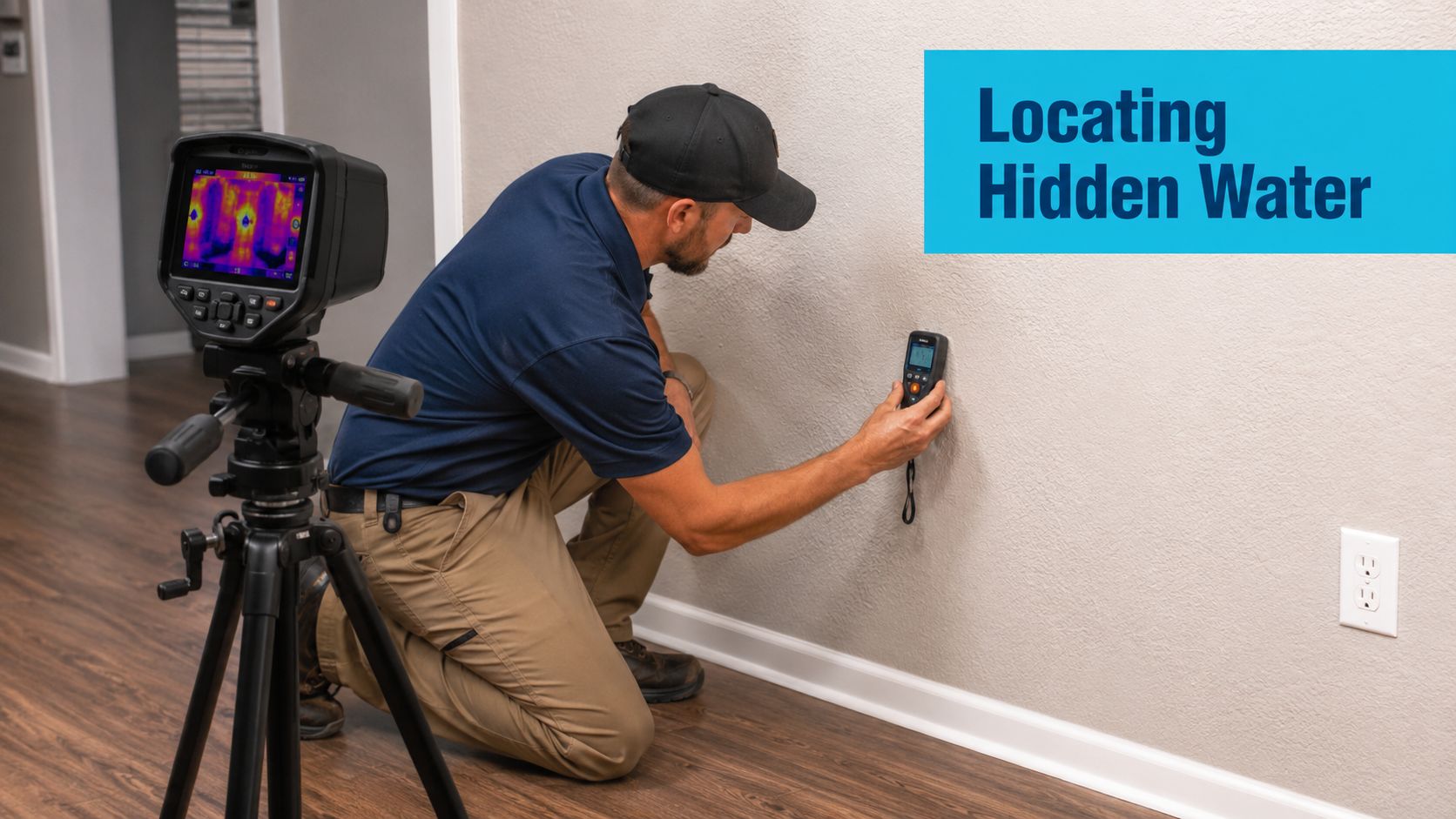
A good drying job starts with detective work. A homeowner may see a stain on drywall, but that stain doesn’t show how far water moved into framing, subflooring, or the backside of a cabinet wall. Technicians use moisture meters, infrared cameras, and systematic mapping to find what the eye can’t see.
What the tools reveal
Infrared imaging helps locate temperature differences that can point to damp areas behind finishes. Moisture meters then confirm whether those areas hold excess water. When the readings are taken in a pattern, technicians can map the wet zone instead of treating the room like one uniform space.
That matters because a surface wipe-down can miss hidden damage. A subfloor can stay wet under luxury vinyl, or a lower wall cavity can stay saturated even after the room feels dry. The inspection creates a baseline, which is what lets the crew track progress instead of guessing at it.
Good drying work is measured, not assumed.
AMPM Restoration’s inspection process fits into that logic, because the goal is to figure out where the water traveled before anyone makes decisions about removal or equipment placement. If you want a plain-language explanation of why inspection comes before demolition or drying, the company’s water damage inspection page is a useful reference, water damage inspection is it water damage.
Why this step protects the finish line
Moisture mapping also helps prevent premature equipment removal. If the visible surface dries first, it can trick people into thinking the job is done, while the deeper layers are still damp. That’s how hidden moisture lingers, and in Florida homes that can create a later mold issue or a rebuild problem that costs more than the original cleanup.
The simple takeaway is this. Inspection isn’t paperwork for its own sake, it’s how professionals decide where the water is, how far it spread, and what needs to happen next. Without that map, the drying setup is just a best guess.
Professional Drying Equipment and Staging
Once the wet areas are identified, the crew stages equipment like a mechanical climate system. Industrial air movers push air across wet surfaces, dehumidifiers pull water vapor from the air, and monitoring tools track whether the structure is moving toward dry standards. A smart setup isn’t random, it’s based on the size of the wet area and the materials involved.

How staging actually works
Industry field guidance says crews often use one air mover per 50 to 70 square feet of wet floor and one per 100 to 150 square feet of wet wall or ceiling, with dehumidifier selection adjusted to the drying class and load, according to field guidance on structural drying. That’s not a random equipment count. It’s the practical side of vapor-pressure differential and grain depression, which are the forces that make wet materials release moisture.
A homeowner can compare it to managing traffic in a busy hallway. Air movers create movement across the wet surface, then dehumidifiers clear the moisture out of the room so it doesn’t just settle back into the structure. If the room is set up correctly, each machine supports the next one.
The equipment choice also depends on the drying environment. If humidity stays high, the system has to work harder to remove moisture from the air before the building can finish drying. That’s why Florida jobs often feel more technical than people expect, especially in warm coastal weather.
What homeowners usually notice
A typical home setup may include compact air movers along a hallway, a dehumidifier near the central wet zone, and periodic meter checks in the morning and evening. The machines can be noisy, but that noise is part of the drying process, not a sign that something is wrong.
For homeowners trying to understand how humidity control affects materials during a move or storage period, a humidity controlled storage guide gives a helpful comparison. The same basic principle applies here, once moisture is in the air, the environment has to manage it before the materials can stabilize.
AMPM Restoration’s air mover placement and monitoring approach reflects that same engineering logic. The service is less about brute force and more about maintaining the right conditions until the structure reaches the right endpoint.
Timelines Costs and Insurance for Drying
Homeowners often want one clear answer, how long will it take and what will it cost. The honest answer is that the timeline depends on what got wet and how far the moisture spread. Industry guidance says complete structural drying typically requires 3 to 5 days for moderate water damage, while more complex losses can take longer depending on materials and saturation levels, according to structural drying science and field guidance. Another restoration benchmark says the average water damage restoration job takes 2 to 5 days, and 90% of companies use industrial dehumidifiers rated at 100+ pints per day, with 70% owning their own equipment, from the same source. For a fuller explanation of project timing, see our guide to how long water damage restoration takes.

Why some jobs finish faster than others
A surface-level leak with limited saturation may dry faster than a loss that reached subfloors or wall cavities. Hidden moisture keeps the job open because the structure needs to be checked, monitored, and verified before equipment comes out. That is why “3 to 5 days” works as a benchmark, not a promise.
A simple way to picture it is a wet sponge and a wet stack of paper towels. The sponge sheds water faster when air can move through it, while stacked materials hold moisture in layers that are harder to reach. The same idea applies in a house, especially when water has moved behind trim, under flooring, or into insulation.
Cost follows the same logic. More wet space, more equipment, and more monitoring usually mean a larger project, while smaller contained losses can be simpler. The smart comparison is not just price, it is whether the drying plan matches the actual damage and whether the readings show the structure is ready.
Practical rule: if the moisture still shows up in readings, the job is not done, even if the room looks normal.
AMPM Restoration helps homeowners manage the financial side by coordinating with insurance carriers, offering insurance claim assistance, and making financing options available when needed. If you are sorting out coverage questions after storm or flood damage, flood insurance help from Forever Florida is a useful companion read for understanding policy issues that often come up after water intrusion.
For local buyers, this matters because cost barriers sometimes push people to wait too long. Waiting can make the job bigger. A documented drying plan gives you a clearer path from emergency response to verification, and it gives your insurer something concrete to evaluate.
Choosing AMPM Restoration for Drying Help
A homeowner usually knows it’s time to call when the house starts telling the truth, musty odors linger, floors begin to warp, baseboards swell, or indoor humidity rises after the leak is supposed to be “handled.” Those signs often mean water is still inside the structure, even if the surface looks acceptable. In a Gulf Coast home, that gap between appearance and reality can be the difference between repair and rebuild.
Professional qualification matters here. The Applied Structural Drying path includes Council-certified Structural Drying Remediator (CSDR) and Council-certified Structural Drying Supervisor (CSDS) designations, and the certifying body says these professionals have verified knowledge of the principles, techniques, equipment, and regulations relevant to structural drying, according to ACAC structural drying certification. That’s a strong sign that this work is treated as a specialized discipline, not a generic cleanup task.
AMPM Restoration is based at 4301 32nd St W b18, Bradenton, FL 34205, and the company serves Bradenton, Sarasota, Tampa Bay, Saint Petersburg, Lakewood Ranch, and surrounding Gulf Coast communities. It’s available 24/7 with a one-hour response time, which matters when a leak starts spreading after business hours and every minute changes the drying plan.
What to look for before you hire
- Clear moisture documentation: Readings should be tracked, not guessed.
- Local response capacity: A crew that can get there quickly has a better chance of limiting spread.
- Insurance coordination: Claims move smoother when the restoration team can document the loss cleanly.
- Realistic endpoints: Drying should end when the materials are verified, not when the calendar looks convenient.
One specific option homeowners can evaluate is AMPM Restoration Services, which combines emergency water mitigation, drying, repairs, and claim coordination in one local process. That kind of full-service response can be useful when the drying job leads into reconstruction, because the handoff stays under one roof instead of being split between separate vendors.
The warning signs are usually simple, but the response has to be technical. If your home still smells damp, feels humid, or shows subtle floor movement after water exposure, it’s time for an inspection rather than another guess.
FAQs and Your Free Inspection Next Step
How do I know drying is complete?
You want documented moisture readings showing the structure has returned to safe levels, not just a room that feels better. Professionals verify the materials instead of relying on appearance alone.
Can I stay home during drying equipment use?
Usually, yes, if the affected area is stable and safe to occupy. The equipment can be noisy, and you may need to avoid the wet zone, but many homeowners remain in place during mitigation.
What changes if the water was contaminated?
Contaminated water can shift the decision toward removal instead of in-place drying. Material type, contamination level, and how long the water sat all affect whether salvage is practical.
How does financing help with a drying job?
Financing can reduce the pressure to delay emergency work while you sort out coverage or out-of-pocket costs. That matters because faster action often limits the size of the loss.
If you’re dealing with visible damage, a smell that won’t go away, or a room that still feels wrong after cleanup, call 941-946-7807 for a free inspection and estimate. AMPM Restoration offers insurance claim assistance and financing options for homeowners in Bradenton, Sarasota, Tampa Bay, Saint Petersburg, Lakewood Ranch, and nearby Gulf Coast communities.
If you need structural drying services after a leak, storm, or flood, AMPM Restoration Services can inspect the damage, document the moisture, and help guide the next step toward repair. Visit AMPM Restoration Services to connect with a local team that handles drying, restoration, and insurance coordination for Florida homeowners.