

Florida homeowners usually start thinking about HVAC duct cleaning the same way. The AC runs all day, the house still smells a little musty, someone keeps waking up congested, and dust shows up again right after cleaning. In Bradenton, Sarasota, Lakewood Ranch, and across the Gulf Coast, that concern makes sense. Heat and humidity put a lot of strain on indoor air systems.
What matters is knowing when HVAC duct cleaning is useful and when it's oversold. Ducts can collect dust, dander, pollen, and moisture-related contamination, but the ducts alone often aren't the whole problem. In many Florida homes, the main source sits upstream in the air handler, blower compartment, coils, or drain area. If those parts are dirty or wet, cleaning only the visible duct runs won't solve much.
AMPM Restoration is based at 4301 32nd St W b18, Bradenton, FL 34205 and serves Bradenton, Sarasota, Tampa Bay, Saint Petersburg, Lakewood Ranch, and surrounding Gulf Coast communities. As a 24/7 emergency restoration company, the team handles water damage restoration, mold inspection and mold removal, fire and smoke damage restoration, storm and flood damage restoration, commercial restoration services, and reconstruction. That restoration background matters because HVAC contamination often starts after a leak, humidity problem, or microbial issue, not from ordinary dust alone.
Improving Your Florida Home's Air Quality
By 3 p.m., the AC has been running for hours, the house starts to smell damp, and the vents get the blame. In a lot of Florida homes, that diagnosis is incomplete. The ductwork may hold dust, but the contamination that affects air quality often starts in the air handler cabinet, on the evaporator coil, around the blower, or in the drain area where moisture hangs around.
That distinction matters. Cleaning duct runs while leaving a dirty coil or blower in place often gives homeowners a short-lived result. The smell comes back. Dust returns faster than expected. If microbial growth is tied to moisture inside the equipment, the source is still there.
What poor HVAC air quality usually looks like in Florida
The warning signs tend to build slowly:
- Musty or sour odors when cooling starts
- Dust collecting around supply registers and return grilles
- More irritation indoors than outside
- Past leaks, overflow events, or high indoor humidity that may have affected the system
In practice, the pattern matters more than any single symptom. A little dust at a vent is common. A recurring odor during AC cycles, combined with moisture history, points to a system inspection, not just housekeeping.
Florida's long cooling season creates a specific problem. The evaporator coil stays wet, the blower compartment sees constant airflow, and any drain issue can leave organic debris damp for long periods. That is why a proper HVAC cleaning discussion should include the full system, not just the ducts. Homeowners looking at upgrades may also consider integrated air purification systems after the underlying moisture or contamination issue is identified.
If mold is part of the concern, testing should come before assumptions. Targeted air quality testing for mold helps separate ordinary dust from active microbial contamination and helps identify whether the actual problem is in the ductwork, the air handler, or a moisture source elsewhere in the home.
A practical rule applies here. If the odor or irritation shows up when the system runs, inspect the entire HVAC system path, especially the air handler, before treating duct cleaning as the whole answer.
Clear Signs You Need Professional Duct Cleaning
Routine HVAC duct cleaning has questionable value when there's no clear contamination. The better approach is simple. Look for observable triggers.
The EPA and industrial hygienists explicitly state that routine cleaning has questionable value and recommend it only when contaminants are confirmed through testing or direct observation, such as visible slime, persistent water damage, or debris restricting airflow, as noted in this NIH duct cleaning fact sheet.

Signs that move this from maybe to yes
Some warning signs are stronger than others. These deserve a professional inspection:
- Visible growth or slime near HVAC components. If you can see suspicious buildup on supply boots, near the air handler, or inside accessible duct sections, that isn't a wait-and-see issue.
- Debris blowing from vents. Dust discharging from diffusers is one of the clearest indicators that material inside the system is being redistributed.
- Persistent odor from the ductwork. A stale or musty smell that starts when the system runs usually points to contamination somewhere in the HVAC path.
- Pest activity. Rodents or insects in ductwork leave behind debris and contamination that shouldn't stay in service.
- Post-construction or renovation dust. Fine drywall dust and construction debris can settle into the system and circulate long after the job is done.
- Water damage history. If the property had leaks, overflow, or storm intrusion, the duct system may need inspection even if the ceilings and walls now look normal.
Signs that need context
A few symptoms get blamed on ducts too quickly. They may still matter, but they need interpretation.
| What you notice | What it may mean |
|---|---|
| More dust on furniture | Could be ducts, filter issues, leakage, or housekeeping conditions |
| Allergy irritation at home | Could involve HVAC contamination, but also humidity, carpeting, or active mold elsewhere |
| Higher utility bills | Could reflect dirty HVAC components, airflow restriction, or unrelated equipment issues |
That's why a visual inspection matters more than a sales pitch.
If no one can show you contamination, restriction, or moisture, they haven't shown you a real reason for professional duct cleaning.
If you're already seeing suspicious discoloration or moisture patterns elsewhere in the house, a broader mold assessment may be the smarter first step. These five signs of mold damage in homes often overlap with HVAC complaints.
The Professional HVAC Duct Cleaning Process Explained
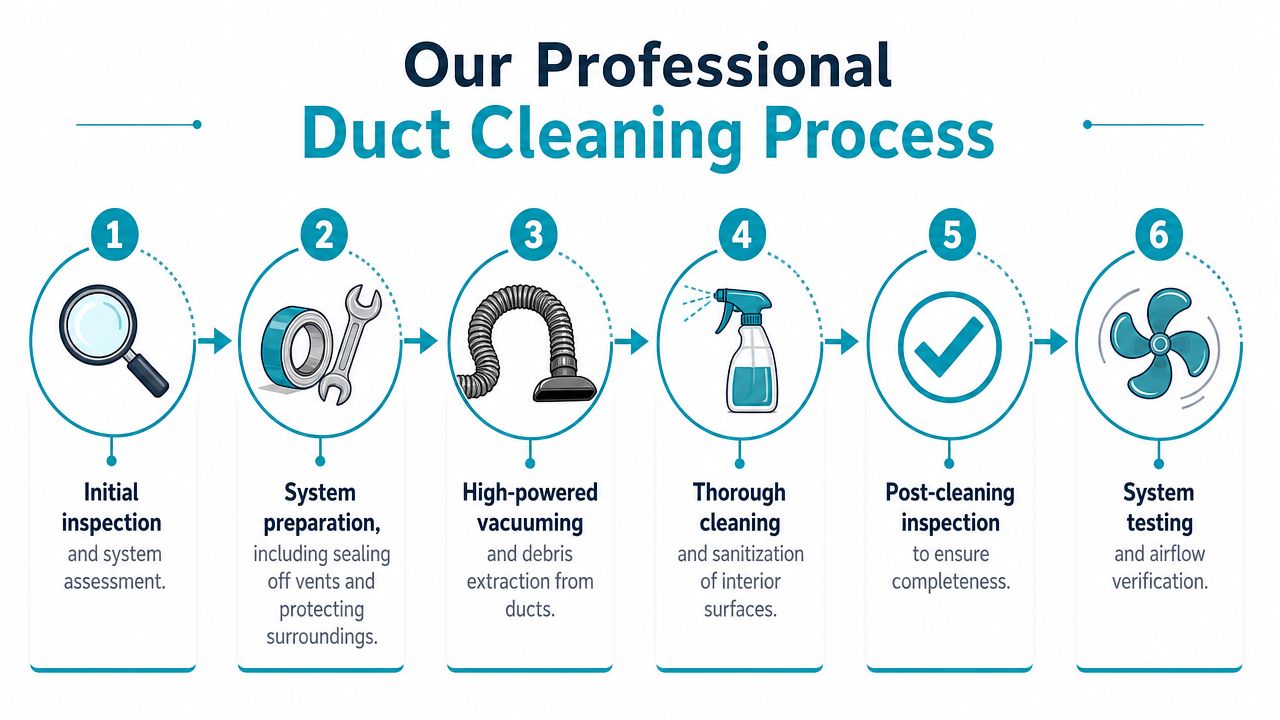
A proper HVAC duct cleaning job should look controlled, methodical, and a little boring. That's a good sign. The process isn't about blasting air through vents and hoping dust comes out. It's about source removal while keeping contaminants from spreading into the living space.
Step one is inspection, not cleaning
Before any agitation tool goes into the system, the contractor should inspect the full HVAC assembly. That includes supply ducts, return ducts, the air handler cabinet, blower area, coils, drain pan, and accessible transitions.
Many cheap duct-cleaning offers fail. They treat the duct runs as the whole job. In reality, the system has to be evaluated as one connected airflow path.
Negative pressure is not optional
Effective HVAC duct cleaning requires maintaining the entire system under a constant negative pressure to prevent dislodged contaminants from becoming airborne and dispersing into the building, which is a NADCA standard described in this NADCA specification document.
In plain terms, the vacuum collection equipment should be pulling debris toward containment the entire time. Agitation tools such as rotary brushes or compressed air whips loosen buildup from the duct walls. Without negative pressure, that debris can end up in the house instead of in the vacuum system.
What a complete cleaning usually includes
A standards-based job typically involves several controlled steps:
System assessment
Access points are identified, sensitive areas are protected, and the technician determines whether contamination appears limited or system-wide.Containment and setup
Registers may be sealed, access openings prepared, and vacuum equipment connected to create negative pressure.Mechanical agitation
Tools such as brushes, skipper balls, or compressed air whips dislodge adhered debris inside the duct network.Continuous extraction
A high-powered vacuum with high-efficiency filtration captures loosened material while the system remains under negative pressure.Component cleaning
This is the part that separates a real HVAC cleaning from a duct-only shortcut. The blower compartment, coils, drain pan, and air handler interior should be inspected and cleaned as needed.Verification
The system is checked for remaining debris, access panels are resealed, and airflow operation is reviewed.
Clean ducts connected to a dirty air handler won't stay clean for long.
Why Florida homes need whole-system thinking
Florida homes often struggle less with dust alone and more with what moisture does to HVAC equipment. The coil area and drain pan can become the actual contamination source. Once that happens, the blower can move particles and odors through the ductwork over and over.
That's why the best HVAC duct cleaning work doesn't stop at the ducts. If microbial contamination is suspected, the corrective work may expand into remediation. This guide on how to remediate mold is useful background if the problem goes beyond simple debris.
Health Benefits and System Efficiency Myths vs Reality
A Florida homeowner usually calls after the same pattern shows up. The house smells musty when the AC starts, someone in the family feels better when they leave for the weekend, and another company has already promised that “duct cleaning” will fix everything. It might help. It might also miss the underlying problem.
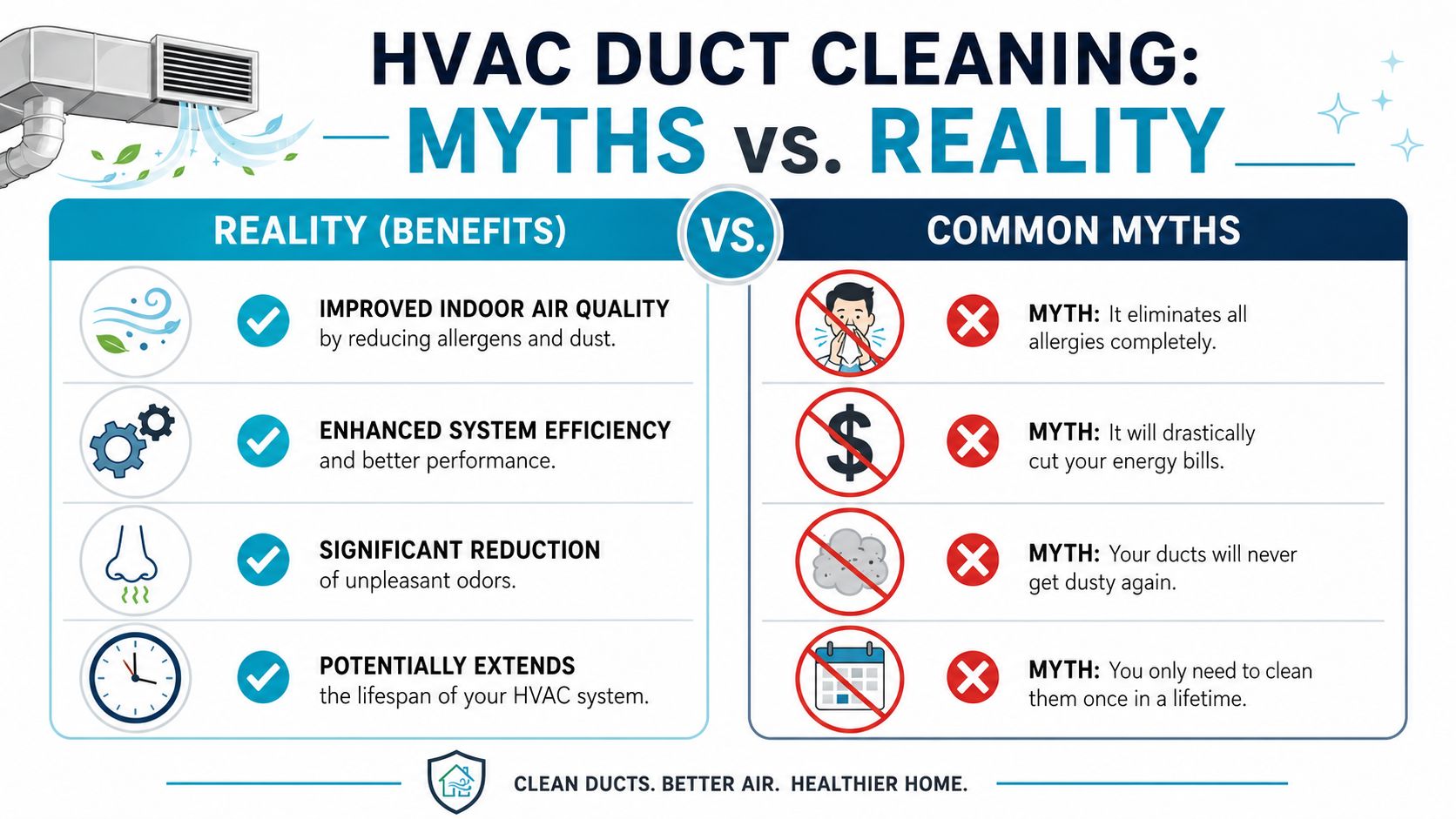
Health claims and efficiency claims need to be kept in bounds. Duct cleaning has value when contamination is present in the air path. It is not a blanket cure for allergies, asthma, odors, or high power bills.
What duct cleaning can realistically improve
A properly cleaned system can remove settled dust, construction debris, pest-related contamination, and some odor-holding buildup from the airflow path. That matters if those materials are present.
What homeowners in Florida need to hear is the part many sales pitches skip. Clean ducts do not stay clean if the air handler cabinet, evaporator coil, blower wheel, or drain pan is still dirty. In humid conditions, those components often drive the problem. The ductwork becomes the delivery route, but the air handler is frequently the source.
That distinction affects health outcomes. If the contamination is sitting on the coil or around the blower and drain area, duct-only service may leave the main reservoir in place. If you are dealing with suspected microbial growth, this guide on how to remove mold from air ducts explains why source removal matters more than surface-level treatment.
What duct cleaning does not prove
No honest contractor should promise guaranteed medical results from duct cleaning. Some homeowners notice less dust, fewer odors, or less irritation after a valid cleaning job. Others notice little change because their issue is coming from carpeting, humidity control, filtration, outdoor allergens, or contamination inside the equipment rather than inside the ducts alone.
That is why inspection matters more than marketing.
Visible debris, confirmed growth, pest activity, discharge from registers, or contamination after a renovation are solid reasons to clean. General fear-based claims are not.
The efficiency claim has one big catch
Dirty HVAC components can hurt airflow and heat transfer. That part is real. A matted blower wheel, fouled evaporator coil, or blocked drain area can make the system work harder and run longer.
Cleaning only the ducts is a different question. If the ducts have dust but the blower and coil are clean, the efficiency gain may be minor or unnoticeable. If the coil and blower are dirty, whole-system cleaning is far more likely to improve operation than a duct-only service.
I tell homeowners to match the service to the failure point. If the complaint is weak airflow, poor cooling, rising run time, or a musty smell at startup, the air handler deserves as much attention as the duct runs. In Florida, usually more.
The practical reality
Duct cleaning is useful when there is a defined contamination problem. Whole-system HVAC cleaning is often the better answer when moisture and buildup are centered in the equipment. For homes with recurring microbial concerns, selecting the right mold solution also depends on whether the issue is isolated dust, active growth, or a moisture problem that keeps feeding the system.
A credible contractor should be able to show you where the contamination is, explain what will be cleaned, and tell you plainly what the service can and cannot change. That is the difference between problem-solving and selling a package.
Duct Cleaning for Mold Remediation and Sanitization
When water gets into an HVAC system, time matters. On Florida's Suncoast, a drain line backup, air handler overflow, roof leak, or storm intrusion can turn the HVAC system into a distribution route for contamination. Once spores or wet debris enter the air path, the system can move that problem room to room.
That's when HVAC duct cleaning stops being optional housekeeping and becomes part of remediation.
Mold changes the standard of care
According to the ACR Standard from NADCA, mold remediation within HVAC ducts must follow ANSI/IICRC S520 guidelines, which require that visible microbial growth be cleaned or the affected component replaced to return the system to a normal fungal ecology, or Condition 1, as explained in this NADCA guide to duct cleaning and indoor air quality.
That means visible growth inside the system is not a cosmetic issue. It triggers corrective action.
Industry guidance also makes another point that matters to homeowners. If significant accumulations of contaminants or debris are visually observed, or if microbial growth is confirmed, cleaning is mechanically required rather than treated as routine maintenance. In some full-system mold situations, remediation can proceed based on the inspection findings without waiting for a separate independent assessment, according to the verified summaries tied to NADCA and restoration standards.
Water damage and duct materials
Wet fiberglass duct board and internally lined duct systems need special judgment. The IICRC S590 standard says that when Category 1 water is found in ductwork for less than 48 hours, it should be reported for extraction and drying, and when more contaminated water affects internally insulated components, the assessor must determine whether decontamination is practical. If fiberglass becomes matted or compressed, replacement is required rather than cleaning, according to this IICRC S590 draft standard summary.
That's a critical distinction. Not every wet HVAC component should be “sanitized and saved.”
Where sanitization fits, and where it doesn't
Sanitizers and disinfectants are often discussed as if they're the main event. They aren't. Physical removal comes first. Debris, dust, and visible growth have to be removed before any antimicrobial treatment has a chance of being meaningful.
For homeowners trying to understand product choices, this guide on selecting the right mold solution offers useful context on why product selection should follow identification of the contamination type and surface conditions. In HVAC systems, those decisions should be made by qualified professionals because overspray, off-label use, and incomplete cleaning can create a false sense of safety.
If you suspect mold is already inside the HVAC system, this resource on how to remove mold from air ducts helps explain why proper remediation involves much more than fogging the vents.
Why Choose AMPM for HVAC Cleaning in the Tampa Bay Area
Florida HVAC cleaning should be handled by people who understand more than dust. On the Gulf Coast, duct contamination is often tied to leaks, humidity, microbial growth, fire residue, or storm-related damage. That's why a restoration company brings a different level of problem-solving than a duct-only crew.
Experts note that cleaning ducts alone is insufficient because the air handler feeds the ducts and often harbors the primary source of contamination. They also note that EPA and NADCA standards require visual inspection of all system components, a step often skipped by duct-only providers but especially important in Florida's humid climate, as summarized in this Wirecutter advisory on air duct cleaning services.

What that means in practice
A restoration-focused approach is stronger when the HVAC issue overlaps with broader property damage:
- After water damage, the question isn't just whether ducts are dusty. It's whether the system got wet, whether microbial growth developed, and whether any lined materials need replacement.
- After mold discovery, the HVAC system may need inspection as a potential contamination route.
- After fire or smoke events, soot and odor migration can involve more than visible vent openings.
- In commercial spaces, duct contamination may tie into wider sanitization and occupant-safety concerns, which is why services like commercial sanitization services often intersect with HVAC work.
AMPM Restoration is built for those situations. The company serves Bradenton, Sarasota, Tampa Bay, Saint Petersburg, Lakewood Ranch, and nearby Gulf Coast communities with 24/7 emergency response, restoration expertise, insurance-friendly service, and full reconstruction support when the damage extends beyond the HVAC system.
Frequently Asked Questions About HVAC Duct Cleaning
How much does HVAC duct cleaning cost in the Bradenton and Sarasota area
The price depends on the size of the system, how accessible the ductwork is, whether the air handler and coils also need cleaning, and whether the job is ordinary debris removal or part of mold or water-damage remediation. Any company giving a flat quote without inspecting the system first is guessing. A proper estimate should reflect the full HVAC scope, not just the vent count.
How often should a home have HVAC duct cleaning
There shouldn't be a blanket schedule for every house. The better standard is as needed, based on visible contamination, odor, airflow restriction, pest activity, post-construction debris, or water-related events. If a company pushes annual cleaning as a universal rule, that's a red flag.
Is DIY duct cleaning a good idea
Not for the full system. Homeowners can change filters, vacuum registers, and keep vents unobstructed. Deep HVAC duct cleaning requires negative-pressure equipment, proper agitation tools, and controlled debris capture. DIY attempts often stir contaminants up without removing the source, and they can damage duct materials or spread microbial contamination.
Can duct cleaning remove bad smells from vents
Sometimes, yes. It depends on what's causing the odor. If the smell is coming from dust, debris, pest contamination, or buildup within the HVAC path, cleaning can help. If the odor is coming from an active moisture problem, a dirty evaporator coil, microbial growth in the air handler, or water-damaged materials, the source has to be corrected or the smell will return.
What certifications should I look for
Look for contractors who follow recognized HVAC and restoration standards. NADCA matters for source-removal duct cleaning practices. IICRC matters when mold, water damage, and contamination assessment are part of the job. In Florida, that combination is valuable because HVAC complaints often overlap with moisture-driven restoration issues.
Will homeowners insurance cover HVAC duct cleaning
Sometimes, but usually not as stand-alone maintenance. Coverage is more likely when duct cleaning is part of a covered loss, such as water damage, storm damage, fire, smoke, or a remediation claim tied to a specific event. That's why documentation, photos, moisture findings, and a clear scope of work matter. If you're dealing with a loss event, ask whether the HVAC work can be included in the larger claim.
If you're dealing with musty vents, post-water-damage contamination, or concerns about mold inside your HVAC system, AMPM Restoration Services can help you sort out what's needed. AMPM Restoration is a 24/7 emergency restoration company serving Bradenton, Sarasota, Tampa Bay, Saint Petersburg, Lakewood Ranch, and surrounding Gulf Coast communities with fast, reliable, insurance-friendly service. Call 941-946-7807 for a free inspection and estimate. The team can assist with insurance claims, explain your options clearly, and discuss financing options when needed so you can restore both your property and your peace of mind.