

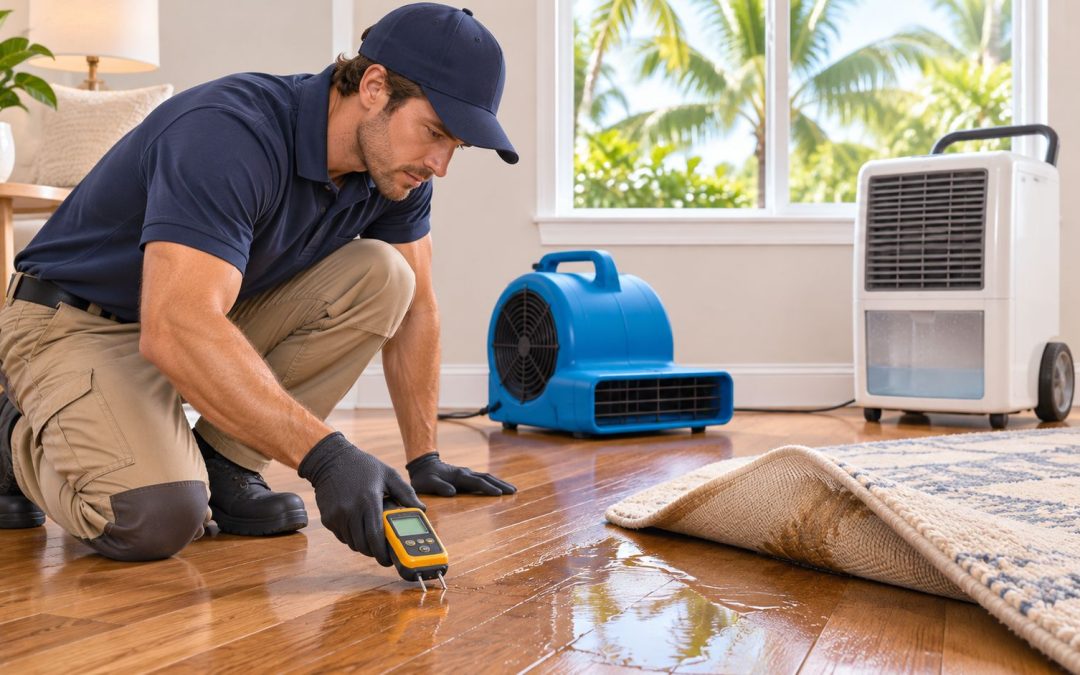
The dishwasher runs its final cycle, the braided supply line behind it splits, and by the time anyone notices, water has crossed the kitchen, slipped under the refrigerator, and found the seam where the hardwood meets the hallway tile. Or it's a water heater in the garage, a toilet supply that let go overnight, or a sliding door that leaked through a summer squall. However the water arrived, two questions land at once. Are these boards ruined, and what do I do right now?
The second question decides the first. Hardwood doesn't dry on a calendar, and it doesn't dry when the surface feels dry. It dries when a meter says the boards have come back to the reading they held before the water arrived. Learning how to dry wet hardwood floors is really learning how to measure them, compare them against a dry baseline, and keep the equipment running until the numbers stop moving.
Step-by-Step Drying Process for Wet Hardwood Floors
The first hour matters more than the next three days. No drying method keeps up with a running leak, so shut the supply valve or the main shutoff before you reach for a towel. Once the water has stopped, get the standing water up and get air moving.
The U.S. Environmental Protection Agency's mold guidance sets the order plainly: remove moisture from wooden surfaces immediately, then use dehumidifiers, fans and gentle heat to dry them. The same chapter warns that wet or damp materials generally should be dried within 24 to 48 hours to reduce the likelihood of mold growth. Treat that as a deadline for extraction and setup, not for the whole job.
Here's the sequence, and the reason each step earns its place.

- Stop the source. A shutoff valve takes ten seconds and ends the damage clock. Everything downstream of it depends on this being done first.
- Pull the water out. A wet vacuum or pump beats mopping because suction reaches water sitting in the seams rather than smearing it around. Roll up rugs and pads and pull baseboard trim on the wet wall, since both hold moisture tight against the boards.
- Log a baseline before any equipment runs. Meter an unaffected board in the same room and write the number down with the date and time. Without that reference you have no finish line.
- Sweep air across the floor, not at one spot. Position air movers to move a sheet of air over the whole wet area. A fan blasting one board dries that board faster than its neighbors and creates the imbalance that warps a floor. The drying equipment is sized for the room, not for the worst square foot.
- Pull the moisture out of the air. A dehumidifier running in a closed room lowers the moisture load so evaporation keeps going. Air movers alone just relocate water.
- Open the underside where you can. Crawlspace vents, a basement door, the gap at a threshold. Air reaching the bottom of the boards matters as much as air on top.
- Keep heat moderate. The EPA cautions specifically to be very careful when applying heat to hardwood floors, because excessive or poorly controlled heat damages the flooring or accelerates uneven drying.
- Read the same fixed spots every day. Same boards, same locations, same meter. A route that changes between visits produces numbers you can't compare.
- Hold off on sanding, finishing or reinstalling. Surface work locks moisture in place and converts a fixable floor into a replacement.
Quick check: if the surface feels dry but a board still feels cool, slightly springy, or damp when you press near a seam, drying isn't finished. Coolness means evaporation is still happening underneath.
The full professional sequence is assessment, extraction with pumps and vacuums, drying and dehumidification with specialized equipment, then restoration and repair. Drying uses air movers and dehumidifiers to pull lingering moisture from floors, walls and furniture, and that applies to your floor as much as to any commercial loss.
Moisture Targets That Show a Floor Is Dry
Moisture content, expressed as a percentage of the wood's dry weight, is the only reading that settles the question. A floor can feel dry to the hand and still hold water in the board core, along the tongue-and-groove seams, or in the plywood beneath.
Wood is hygroscopic: it constantly exchanges moisture with the air around it, so the correct target depends on the building's normal temperature and relative humidity rather than a number pulled from a chart built for another climate. U.S. Forest Service guidance notes that hardwood lumber for flooring, furniture, cabinets and millwork is commonly kiln-dried to roughly 6% to 8% moisture content, while heavy planking used for flooring may sit near 12% so that openings close as the boards reach equilibrium.
| Reading | Typical value | What it tells you |
|---|---|---|
| Expected in-use moisture for conditioned U.S. interiors | 6–9% | Typical endpoint for interior hardwood in an air-conditioned home |
| Kiln-dried hardwood flooring | 6–8% | Manufacturing reference for flooring stock |
| Heavy planking used for flooring | About 12% | Reference for thicker planks reaching equilibrium |
| Finish-ready reading | Within about 2 percentage points of expected in-use | NWFA benchmark; confirm against an unaffected baseline board |
Set the baseline before you set the equipment
The NWFA technical benchmark is to dry wood to within approximately 2 percentage points of its expected in-use moisture content, and that expected value comes from your own floor rather than from a table. Meter an unaffected area of the same species and finish, in a room the water never reached, and average several readings across several boards. That average is the baseline. A single board can be an outlier, which is why one reading never sets the target.
Then meter the damaged boards at marked locations, checking multiple spots on each board. A board can read dry at one end and wet at the other, and the wettest point decides whether drying continues.
The completion test: damaged boards sit within about 2 percentage points of the baseline, and they hold that reading across three consecutive daily checks with equipment still running.
The subfloor gets its own reading. Plywood, OSB and underlayment hold water differently from oak, and a subfloor that stays wet keeps feeding moisture back into the boards above it. On the Gulf Coast, air conditioning pulls interior humidity down while coastal air pushes it back up every time a door opens, so a Bradenton home may settle at a different equilibrium than the same floor in a dry-climate chart. Mapping those readings room by room is what separates a measured dry-out from a guess, and moisture mapping is the method technicians use to record them.
How Long Drying Takes and When Readings Rebound
There's no fixed number of days, and any contractor who quotes one before metering your floor is guessing. The endpoint is a stable reading, not a date circled on the calendar.
Minor water damage incidents can take a few days to restore, while more extensive damage may take longer. Professional drying commonly takes several days for moderate saturation and can extend to 5 to 10 days or longer when the subfloor or concealed layers are wet, according to practical drying guidance for hardwood losses.
| Damage level | Typical drying time | What extends it |
|---|---|---|
| Minor surface wetting, quick extraction | A few days | Slow response or dense rugs and pads |
| Moderate saturation under boards | Several days | Wet boards and wet adhesive layers |
| Wet subfloor or concealed layers | 5–10 days or longer | Crawlspace, slab edges, wet underlayment |
| Floodwater or sewage | Not complete until cleared | Contaminated water needs a separate sanitation assessment first |
Reading the trend instead of the calendar
Readings should fall steadily from one day to the next. A floor that drops from 22% to 17% to 13% is drying. A floor that sits at 19% for three days has a hidden source, trapped moisture, or equipment that's undersized for the space. A floor that falls and then climbs once the dehumidifier is switched off hasn't finished, and in Florida's summer air that rebound can happen within hours.
The same dry-or-replace judgment shows up on walls and ceilings, where the decision turns on how deep the water traveled into the assembly. This walkthrough of drying versus replacing damaged wallboard applies the same logic to a vertical surface.
Contaminated water changes the question entirely. Floodwater or sewage carries pathogens that drying doesn't remove, so porous flooring and subfloor materials need a separate sanitation assessment before anyone calls the job complete.
Keep a daily log with the date and time, room temperature, relative humidity, meter readings at each fixed spot, and how many hours the equipment ran. That record is what proves the floor is dry, what supports an insurance claim, and what a technician reads to decide whether to keep going or change approach. The broader schedule for a full water loss, from extraction through reconstruction, is laid out in our guide to how long water damage restoration takes.
When Drying Needs Board Removal or a Professional
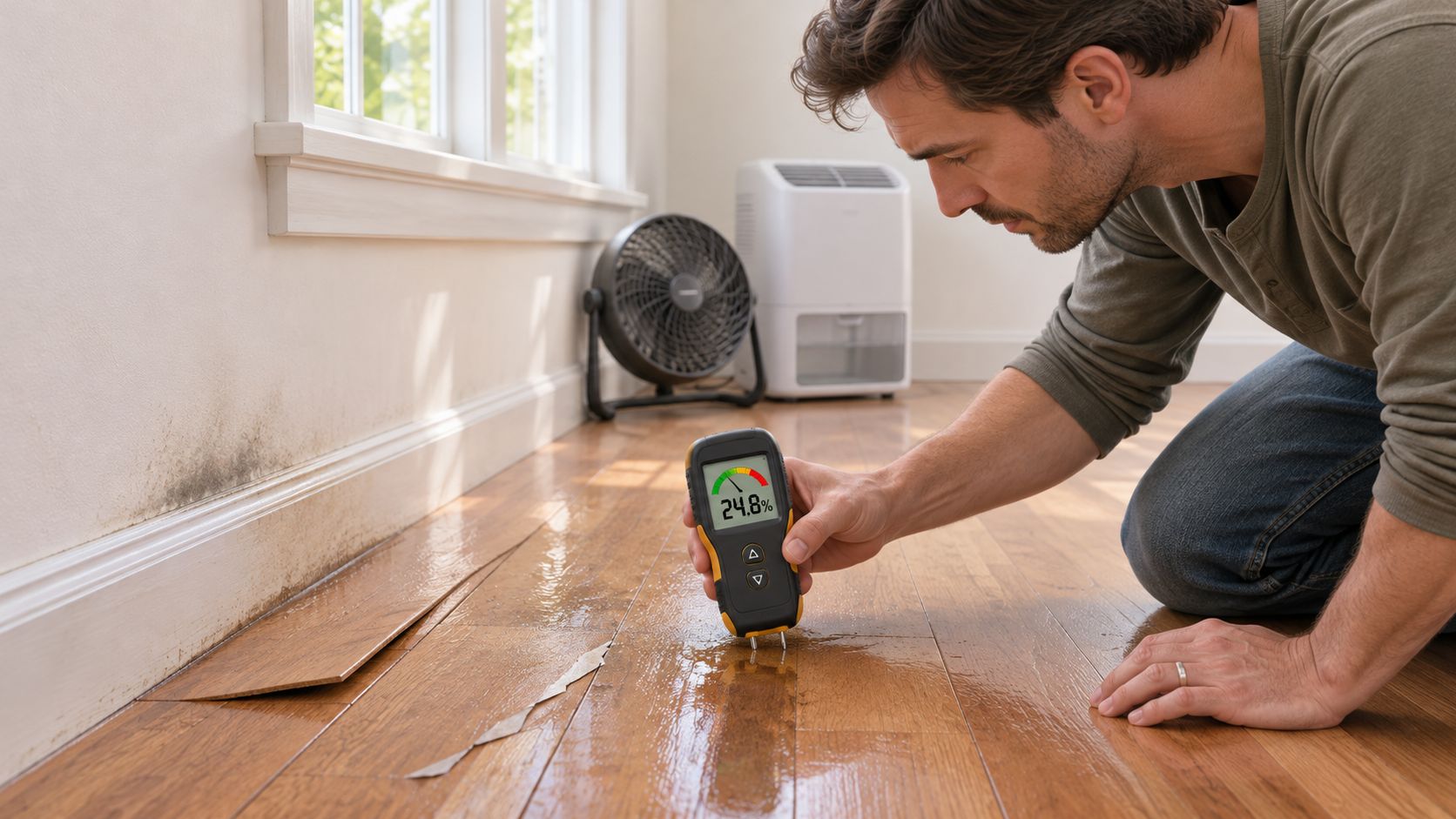
Three triggers end the homeowner phase. Readings that stay well above baseline after several days of steady equipment run. A musty odor or visible growth near the floor or in the crawlspace. Boards that feel soft, sound hollow, or have started to delaminate at the edges.
Swollen floors sometimes need mechanical relief. FEMA household cleanup guidance describes removing one board every few feet to reduce the buckling that swelling causes, and advises letting the subfloor dry thoroughly once coverings come off, which the document warns may take several months in some situations. It also recommends disinfecting wet surfaces to help prevent mildew and consulting a carpenter before pulling tongue-and-groove boards, since careless removal damages boards worth keeping. Before lifting anything, review how to repair a damaged wood floor so removal does not destroy boards that drying could have saved.
| Symptom | Likely cause | Next action |
|---|---|---|
| Readings stay well above baseline after several days | Trapped moisture below boards or in the subfloor | Open access and recheck the subfloor |
| Boards cup and do not flatten | Moisture imbalance between top and bottom of boards | Keep drying and reassess before any replacement |
| Musty odor or visible growth | Microbial growth in damp materials | Stop DIY work and request inspection and sanitation |
| Soft spots or delaminating boards | Subfloor or adhesive failure | Remove affected boards with carpenter guidance |
| Readings fall, then rise again | Ambient humidity or hidden water | Find the source and keep dehumidifying |
A crew brings what a single dehumidifier in the corner cannot. AMPM Restoration uses industrial-grade drying equipment and advanced moisture detection tools, applies industry-approved mold inhibitors during the drying process, and monitors moisture levels so every part of the floor reaches acceptable dryness standards. In Florida humidity, that monitoring matters, because a floor can read dry at noon and pick moisture back up overnight.
Mold work and moisture work are the same job. Removing growth without fixing what made the materials wet leaves the conditions in place, so remediation addresses the moisture cause directly: a leaking pipe, weak ventilation, or indoor humidity that stays high.
Before you call anyone, gather four things: photos of the floor and, if you can lift a board or reach the crawlspace, of the subfloor; your log of readings; the water source and what caused it; and the date and rough time the water first appeared. Those four items shorten the inspection and strengthen an insurance file.
Why Uneven Drying Warps Hardwood and How to Avoid It
A floor can feel dry underfoot and still be wet at the seams, along walls, or in the subfloor. In Florida humidity, that gap gets wider because damp air slows evaporation and can push a good reading back up after the equipment shuts off. The reliable finish line is documented readings matching an unaffected baseline and holding there, rather than a smooth surface or a set number of days.
The physics explains why patience pays. Above the fiber-saturation point of roughly 28% moisture content, wood is dimensionally stable because its cell walls are saturated with water, as U.S. Forest Service research on drying wood describes. Once moisture falls below that point, the cell walls release bound water and the board shrinks. If shrinkage happens faster on one face than the other, the board cups, crowns, checks, splits, or pulls at its joints.

Drying has to move moisture out of the whole assembly gradually: seams, edges near walls, subfloor, and both faces of each board at a similar pace. Airflow and dehumidification should keep moisture leaving the room without flashing the surface dry while deeper layers stay soaked.
Practical rule: if the top of a board dries faster than the bottom, the top shrinks first and the edges rise. That's cupping, and drying has to correct it before sanding makes sense. For photos of what unchecked cupping and checking turn into, see our breakdown of hardwood floor damage.
Most avoidable damage comes from the same errors. Sealing, gluing or finishing over wet wood traps moisture under an impermeable layer and turns temporary cupping into permanent distortion or finish failure. Closing the room or sealing vents before readings settle shuts off the airflow the floor still needs and turns the space into a humid chamber. Judging dryness by a clean-looking surface or elapsed days misses concealed water, and hardwood hides that water well.
A clean surface still is not the end of the job. Water damage work includes sanitizing affected areas and applying mold-prevention treatments, with industry-approved mold inhibitors applied during drying rather than after it. Treat sanitizing as part of finishing the dry-out, then keep logging readings until they match baseline and stay there.
Frequently Asked Questions About Drying Wet Hardwood Floors
Can cupped hardwood be saved?
Often yes, if the readings keep falling and the boards flatten as the wood equalizes. Sanding a cupped floor while it's still wet hides moisture, locks in the shape, and can turn cupping into crowning that no amount of sanding fixes.
Can I use a hair dryer or a space heater?
Only gentle, controlled heat, and never as the main drying method. The EPA warns against aggressive heat on hardwood floors, and a space heater pointed at one board creates exactly the uneven drying that cracks and warps wood.
How long before I can walk on the floor?
There's no fixed number of days. Walk on it once the surface is stable underfoot and readings are close to baseline, and keep equipment running in the room until the trend holds without help.
Does homeowners insurance cover floor drying?
It depends on the policy and the cause of the loss, so read the coverage section rather than assuming. AMPM Restoration coordinates with insurance carriers, helps document the claim with moisture logs and photos, and offers financing options when the timing of a payout doesn't match the timing of the work.
Is floodwater handled differently from a clean-water spill?
Yes. Contaminated water needs a separate sanitation assessment before drying can be considered complete, because drying alone doesn't make contaminated materials safe to keep.
When should I replace boards instead of drying them?
When boards stay soft, delaminated, or unstable after readings have stabilized. The symptoms table in the escalation section above lists the signs that point to replacement rather than more drying time.
Decide Whether to Keep Drying or Call a Crew Today
Keep drying yourself only when three things are true at once. The water source is stopped. The water was clean, from a supply line or an appliance rather than a flood or a sewer backup. And your daily readings are falling steadily toward the baseline you logged on day one.
One caveat on that third condition: in Florida humidity, readings can stall for reasons that have nothing to do with the floor. If a number flatlines, check whether humid outdoor air is feeding the room before you assume the wood is dry or the equipment is failing.
Call now if any escalation sign appears, if the source can't be shut off, or if the water was floodwater or sewage. Those conditions move the job from drying to remediation, and waiting a day rarely improves the outcome.
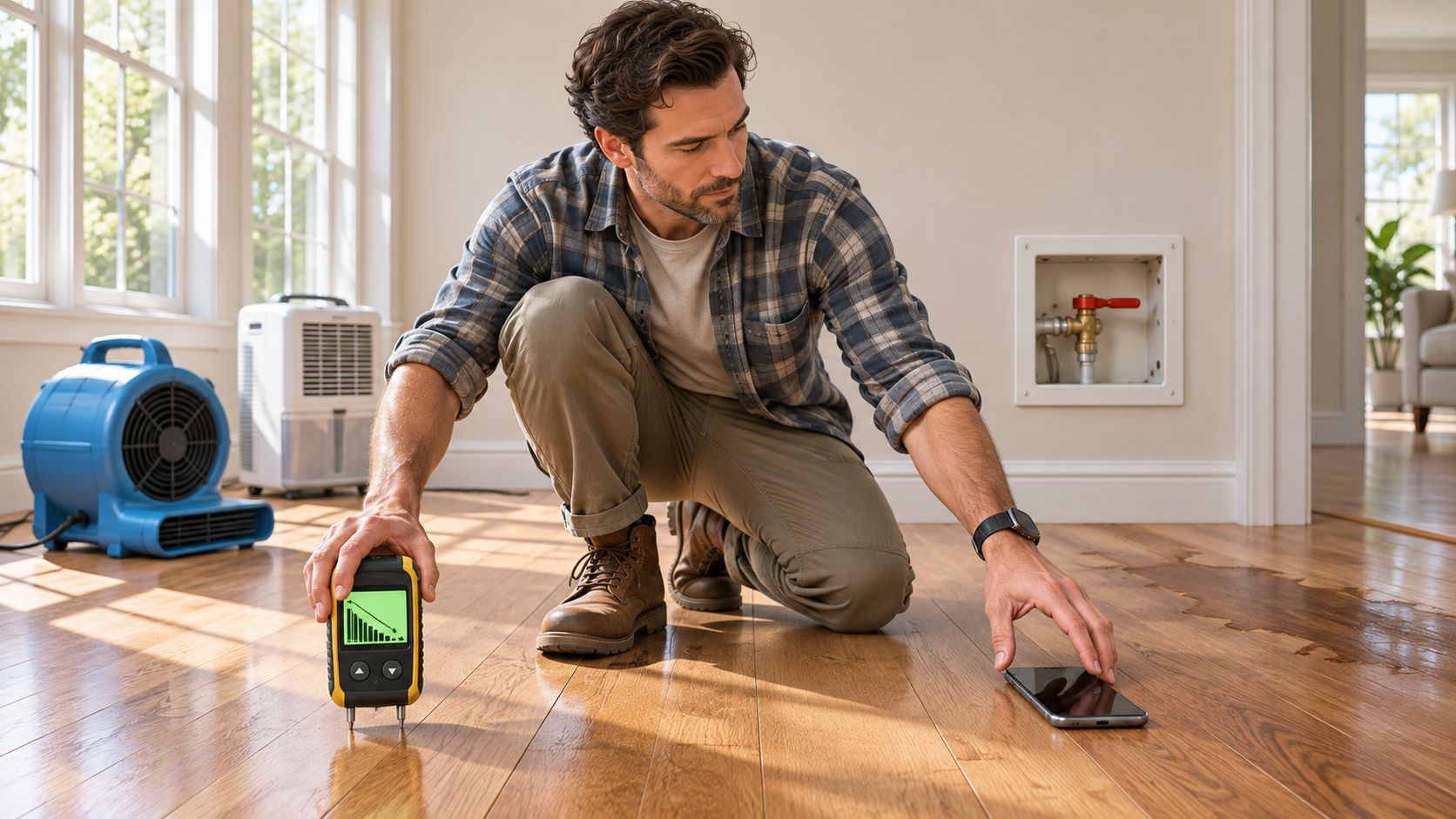
AMPM Restoration offers water damage restoration and emergency dry-out around the clock, and we monitor moisture levels throughout the dry-out so every part of the home reaches an acceptable standard before equipment comes out. The team serves Bradenton, Sarasota, Palmetto, St. Petersburg, and the greater Tampa Bay area. If you're still weighing how to dry wet hardwood floors safely, that three-part test is the fastest answer you'll get tonight.
Call 941-946-7807 today. Have your photos, the date of loss, your moisture log, and a note on where the water came from ready when you call.
When a wet floor leaves you comparing meter readings at midnight and wondering whether the dehumidifier is winning, AMPM Restoration Services can take the measurement problem off your hands. Our team handles emergency dry-out, moisture mapping against an unaffected baseline, industrial air movers and dehumidifiers, and monitoring until every reading meets the target, then coordinates with your insurance carrier and offers financing options so the repair isn't waiting on a check. Visit AMPM Restoration Services to schedule your free inspection and estimate.
