

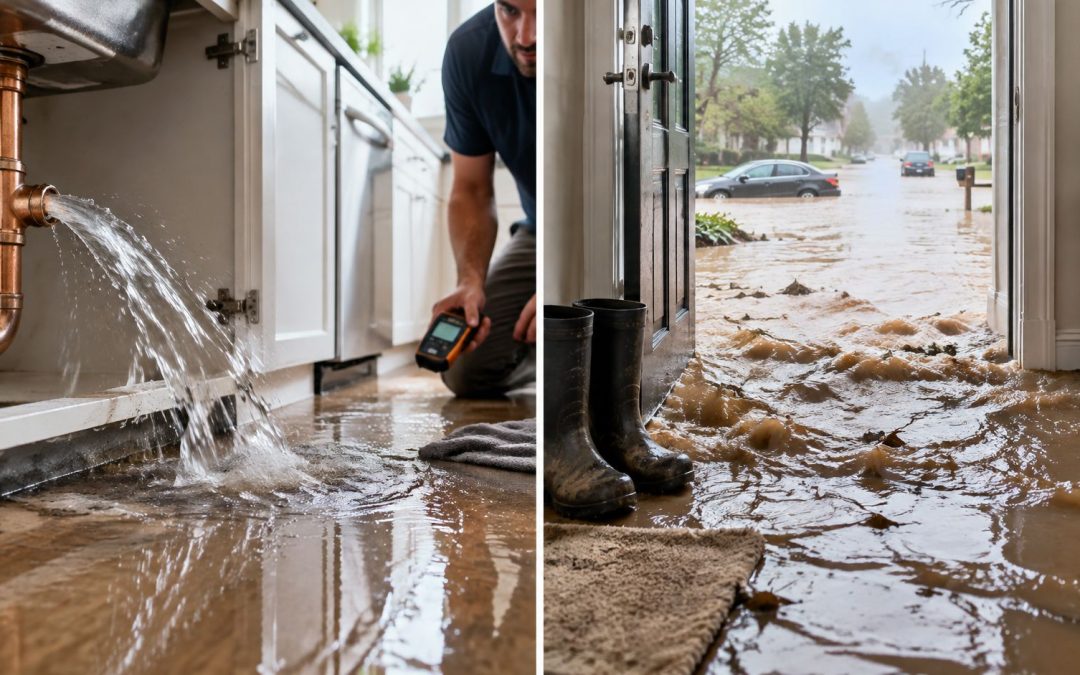
Most advice you'll hear after water gets into your home is simple. Dry it fast and you'll be fine. That advice isn't wrong about speed, but it's incomplete in the way that costs Florida owners the most money, because water damage vs flood damage isn't decided by how wet the floor looks. It's decided by where the water started, what it touched on the way in, and whether the right policy was already in place before it arrived.
I would start every loss the same way. Name the source before you touch a mop, a fan, or a claim form. A supply line that failed overnight and street water that pushed under a garage door can leave the same standing water in the same kitchen. The cleanup, the materials you can keep, and the policy that responds are different in each case.
Water Damage and Flood Damage at a Glance
Four inches of water across a hallway looks the same whether it backed up from a floor drain or fell from a failed supply line upstairs. What separates the two losses is the route the water took to reach the floor, and that route decides which policy responds and how much of the house survives the cleanup. A crew can dry a home correctly and still cost the owner the claim by writing the wrong source on the paperwork.
Water damage begins inside the building envelope: a burst pipe, a failed appliance connection, a roof or ceiling leak. Flood damage begins outside, when water leaves its normal channel and crosses normally dry ground before it enters the structure.
How the Two Losses Compare
| Factor | Water Damage | Flood Damage |
|---|---|---|
| Entry point | Inside the building: burst pipe, appliance leak, roof or ceiling leak | Outside, over normally dry land: overflow, storm surge, rapid runoff |
| Typical scope | Usually one unit or one building, set by the failed component | Often several properties in the same event, set by the weather |
| Contamination risk | Often clean supply water at first, degrading as it sits | Carries soil, sewage, chemicals and pathogens picked up on the way in |
| Standard homeowners policy | Often covers sudden, accidental discharge, subject to policy terms | Generally excluded |
| Standard flood policy | Not applicable | Separate coverage through the NFIP or a private carrier |
| Response focus | Extraction, moisture mapping and controlled drying | Contamination control, wider material removal and sanitation verification |
Contamination is the row that changes material decisions most often. A clean supply line failure can sometimes be dried in place, cabinets and all. Ground water rarely lets you keep the same drywall.
The flood side also scales well beyond one address. U.S. flood damage exceeded $8 billion in 2024, including $3.8 billion in communities not classified as high risk, according to FEMA's National Flood Insurance Program cost of flooding data. A low-risk zone on a map does not keep a street from overflowing.
A Bradenton kitchen supply line that fails at 2 a.m. and soaks cabinets and laminate by morning is an interior discharge. Document it room by room, and the costs follow the pattern in our guide to water damage repair cost factors. Two inches of street overflow across the same style of kitchen after a tropical rainstorm leaves the same wet floor with a different set of problems: ground contamination, more material going to the curb, and a flood policy instead of a homeowners policy.
Working rule: Record the entry point before you measure depth, and photograph it before anything moves.
When a storm opens a roof and pushes runoff through a garage door in the same afternoon, the two losses need separate evidence. Roof entry means ceiling staining, attic decking, wet insulation and the contents below, shot before debris is pulled. Yard flooding means the high-water mark at grade, exterior walls at the soil line, and a depth reading taken against a fixed reference such as a door frame. Adjusters evaluate each path on its own facts, and forcing a single label onto a mixed event leaves one of them undocumented.
Matching Common Losses to the Right Label
Match what happened at the property to the closest row, then test that first impression against the formal definition below. The source controls the label. Depth or square footage does not.
| Scenario | Likely Classification | Policy to Check First |
|---|---|---|
| Supply line bursts under a kitchen sink | Water damage, interior source | Homeowners policy and its water discharge terms |
| Roof leak enters through ceiling after a storm | Water damage through a roof opening, usually interior | Homeowners policy, including roof and rain terms |
| Street water enters through a garage door | Flood damage, outside water over dry land | Flood policy covering building and contents |
| Storm surge reaches a coastal home | Flood damage, tidal overflow | Flood policy; homeowners policy generally excludes it |
| Heavy rain pools in yard and seeps under slab | Flood damage if runoff was unusual and rapid over dry land | Both policies, with the source documented |
The everyday word flood is broader than the insurance word. FEMA's glossary definition of flood requires a general and temporary condition in which normally dry land is partially or completely inundated across at least 2 acres or at least 2 properties, with one property belonging to the policyholder. Covered causes include overflow of inland or tidal waters, unusual and rapid accumulation or runoff of surface water, mudflow, and certain shoreline collapses caused by waves or currents.
Apply that definition to the exterior evidence, not the interior mess. Street and yard inundation plus entry at a door threshold or slab edge supports a flood classification. No inundation outside, with water starting at a fixture, appliance, or roof opening, points to water damage under a homeowners policy.
For a sudden interior release, shutoff and documentation order matters. Our guide to what to do after a pipe burst lays out the valve, power, and listing steps before drying starts.
A Three Part Triage You Can Do Today
- Where did water first enter: A fixture, appliance, roof opening, door threshold, or slab edge each points to a different source record.
- Was dry land beyond the property inundated: Look for water across yards, streets, and neighboring lots, not just inside your rooms.
- Which policy insured what was damaged: Building damage and contents damage can sit under different coverage, so list them separately.
Property managers should run the same triage unit by unit. Shared walls and common areas mix sources fast, so a separate time stamped record for each unit keeps the building claim and the contents claims clean. AMPM Restoration offers storm and flood damage restoration for these multi unit situations. I recommend completing the source record before the adjuster walkthrough, because that record decides which policy responds to each room.
How the Water Source Changes Cleanup
Source drives cleanup because source determines what the water carried. A supply line leak usually starts as clean water inside the building. Floodwater can contact soil, sewage, roadway contaminants, pesticides, hydrocarbons, and pathogens before it enters, and those contacts change protective equipment, containment, cleaning, and disposal.
FEMA's NFIP flood damage guidance reflects that distinction, and it's why porous materials such as carpet pad, insulation, drywall, and upholstered contents commonly require a more conservative evaluation after flood contact than after clean interior supply water. Visible drying doesn't settle the question. Contamination and absorbed salts or sediment can remain after evaporation, so a surface that's dry to the touch can still be unfit to keep.
What Responders Document First
- Source and entry point: The fixture, appliance, roof area, or exterior opening where water began.
- Waterline and duration: Height on walls and how long materials stayed wet.
- Affected rooms and materials: Each room listed with its flooring, wall, and contents exposure.
- Exterior ground contact: Whether water crossed soil, pavement, or a street before entering.
Our technicians undergo training to identify the source of water damage, such as a burst pipe, heavy rain, or a malfunctioning appliance. That identification isn't paperwork for its own sake. It sets the sanitation decision for every material below the waterline, which is central to how effective flood damage restoration preserves structural integrity.
| Material | Clean Supply Water | Floodwater |
|---|---|---|
| Carpet and pad | Dry in place if wet under 48 hours; replace pad if soaked | Usually remove carpet and pad |
| Drywall and insulation | Cut and replace if moisture wicks above baseboard or the material is saturated | Remove drywall to a margin above the waterline; insulation usually discarded |
| Hardwood | Dry and monitor for cupping; often salvageable if drying starts quickly | Frequently removed after long soaking; if kept, clean, disinfect and verify dryness |
| Tile and concrete | Clean, dry and verify; usually salvageable | Clean and disinfect; sediment and salts may remain after drying |
| Upholstered furniture | Clean and dry promptly if wet under 48 hours | Usually discarded once floodwater has contacted it |
Carpet shows the split clearly. Clean water caught early can sometimes be extracted and dried in place, with pad replaced if it stayed saturated. Flood contact usually ends that discussion, because pad and backing hold sediment you can't reliably clean out.
Drywall follows the waterline plus wicking. Interior leaks may need a limited cut where moisture climbed above the baseboard. Flood losses usually need removal to a clean margin above the line, with wet insulation discarded because it holds contaminated water and dries poorly inside a closed cavity.
Hard surfaces are the exception that proves the rule. Tile and concrete can often be cleaned, disinfected, and verified dry after either source, although flood sediment and salts need actual cleaning, not just evaporation. Hardwood sits in between, salvageable after prompt clean water drying, frequently removed after long flood soaking.
If you can't name the source, record the waterline before any material is removed. That single measurement preserves options you'll otherwise lose.
The completion standard is verified moisture equilibrium with unaffected areas plus a documented sanitation and material disposition decision. Anything less leaves the next contractor, adjuster, or buyer guessing about what's inside the wall.
The 24-to-48-Hour Drying Window
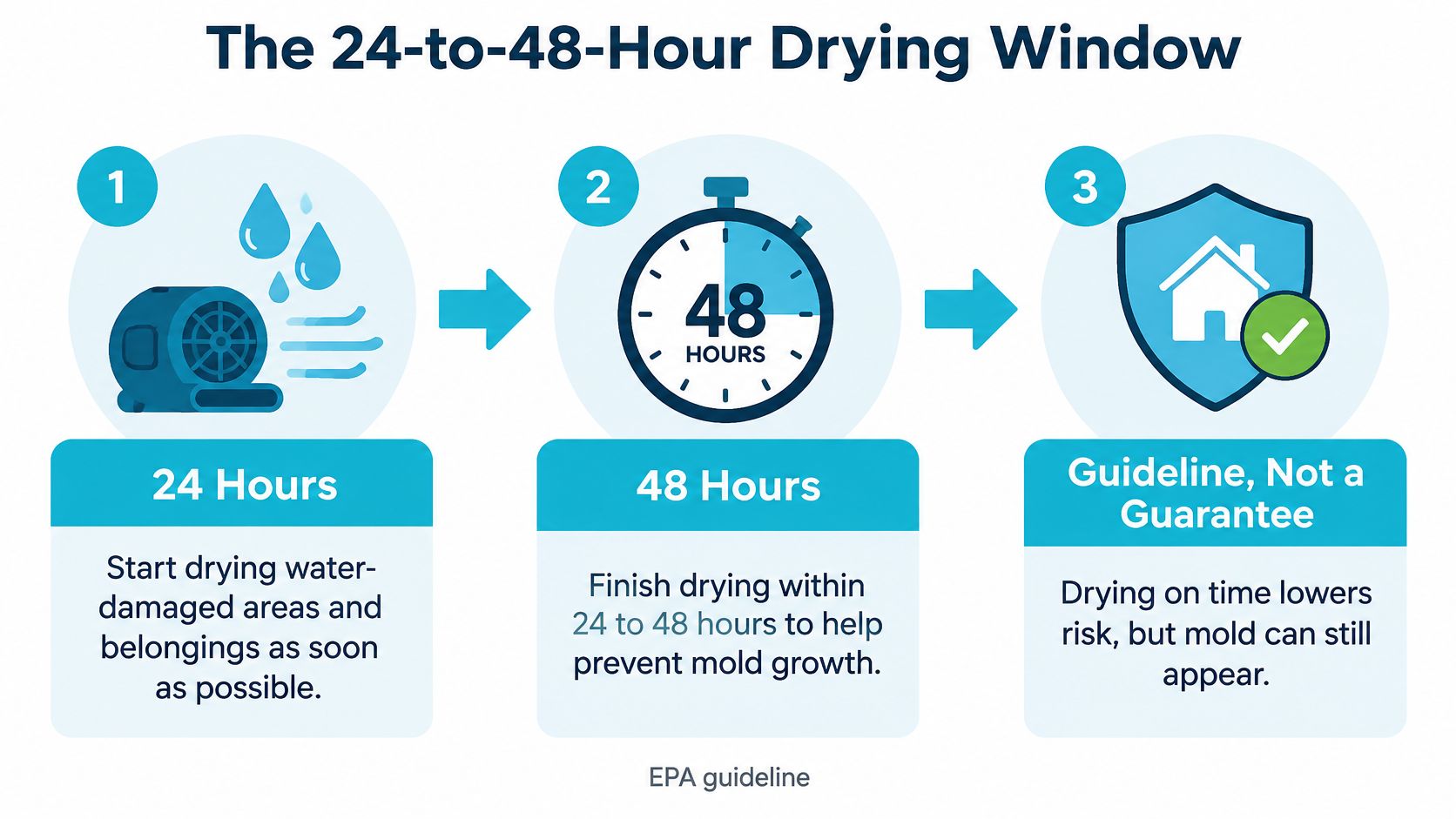
The clock starts when water enters, even if you discover the leak hours later. The U.S. Environmental Protection Agency mold guidance recommends drying water-damaged areas and belongings within 24 to 48 hours to help prevent mold growth. The window is a guideline for drying, and mold can still develop when materials stay wet longer or when moisture remains hidden inside a wall cavity.
| Time Since Water Entered | Priority Action | Mold and Contamination Check |
|---|---|---|
| 0 to 24 hours | Extract standing water; start air movers and dehumidifiers | Document waterline and affected rooms |
| 24 to 48 hours | Continue dehumidification; lift carpet and check the subfloor | Confirm materials reach dryness equal to unaffected areas |
| Beyond 48 hours | Stop routine drying for affected porous materials | Assess for mold growth; move to remediation if mold is visible or odor persists |
The table sets the order of work. Inside the first day, extraction and air movement start the drying process. The 24-to-48-hour row is where dehumidification and direct material checks matter most. Past 48 hours, porous materials that are still wet need a mold assessment before routine drying continues. Extraction removes standing water, but drying is what lowers moisture in framing, drywall, and subfloor. Florida humidity makes dehumidification as important as air movement.
AMPM Restoration monitors moisture levels during drying, and those readings decide when materials can be closed back up. A room can feel dry while the wall cavity still holds moisture. Readings taken inside the cavity and compared with an unaffected room show whether drying is finished. The lag between wet materials and visible mold is covered in our mold growth timeline after water damage.
If materials have remained wet for more than 48 hours or visible mold is present, ordinary water cleanup stops and mold remediation procedures take over. Continuing to dry a colonized material and calling it progress wastes time. Flood losses still follow the same clock, but contaminated water changes what can be saved once readings show the extent.
Ask for a written moisture reading for each affected room, compared with an unaffected area, before anyone closes materials back in. If a contractor can't produce readings, you're accepting a guess as a dry standard. I wouldn't sign off on that in a Florida home during humid months.
Which Policy Pays and When Flood Cover Starts
The policy that pays follows the source named in the adjuster's report: interior discharge falls under a homeowners policy, while inundation falls under a flood policy. Our overview of water damage insurance coverage walks through where those forms divide.

Timing decides the payout even when the source is clear. FloodSmart's guidance on buying a flood policy states that coverage ordinarily begins 30 days after the purchase date. A policy bought after a forecast names your county usually will not respond to that storm. Check the effective date on the declarations page, not the date you first called an agent.
A new flood policy pays only after its waiting period ends. Buying coverage once a forecast names your county rarely helps for that storm.
Exceptions Worth Checking Against Your Situation
- Mortgage related purchase: There's generally no waiting period when coverage is bought while making, increasing, extending, or renewing a mortgage.
- Change at renewal: A policy change made at renewal may also avoid the wait.
- New high risk designation: A 1 day waiting period can apply when coverage is purchased within 12 months of a newly designated high risk flood zone.
- Wildfire on federal land: A 1 day wait can apply when coverage is bought within 60 days of the wildfire containment date for flooding caused or worsened by that fire.
Contents coverage is separate from building coverage, with separate limits. A flood policy on the structure does not automatically replace furniture, clothing, or electronics. List building damage and personal property damage on different pages from the start, and keep receipts or photos that tie each item to a room.
If you want a primer on the claim file itself, this resource on documenting water damage for insurance claims explains what adjusters look for in source photos and inventories. Bring both declarations pages and a room by room damage list to your agent, because that pairing answers most first call questions. Take source photos before demolition so the file shows the waterline and affected materials as they were. AMPM Restoration coordinates with the insurance provider and supplies the necessary documentation for water damage claims.
Six Questions Florida Owners Ask Before They Call
1. Why can a flood claim be denied after heavy rain?
Heavy rain can produce a flood claim, but the label turns on what the water did before it reached your drywall. Flood insurance covers direct physical loss from qualifying inundation, including unusual and rapid runoff. The adjuster compares your documented source and waterline against that definition. Rain that entered only through a roof defect or window, without inundation of normally dry land, may fall outside the flood policy.
2. Can a home outside a high risk zone still flood?
Yes. Rainfall-driven flooding does not check zone boundaries, and streets, swales, and overwhelmed drainage can push water into neighborhoods with no mandatory purchase requirement. A low risk label describes probability for lending and rating. Street-level drainage can still fail after a storm that never shows up on a zone map.
3. What does a typical water damage claim cost?
The Insurance Information Institute homeowners insurance statistics report that U.S. homeowners insurance claims for water damage and freezing had an average severity of $15,400 and a claim frequency of 1.50 claims per 100 insured years in its latest reported period. That benchmark includes freezing losses. Use it to gauge the scale of interior claims; flood estimates follow a different policy and a different definition.
4. Is it safe to enter a home with standing water?
Keep out of floodwater where you can. Murky water hides contaminants, debris, and a floor that may no longer carry weight. If water reaches outlets or appliances, shut off power at the breaker only if you can reach it without standing in water. When contamination is possible, wait for a professional assessment.
5. What if one storm causes both interior and outside water?
Split the loss by source. A roof or window entry that admits rain is a homeowners claim for interior water damage. Water that crossed normally dry land to reach the building is the flood question. Describe each path in a separate paragraph of the claim file, with the time and location for each, and let the policy forms assign coverage.
6. What if the flood adjuster disputes the waterline?
Ask for the denial in writing with the policy definition the adjuster applied. Then separate two facts: the height of the mark and the path the water took. A high mark inside a room can come from a roof leak. A low mark outside can come from overland flow. If the dispute is whether normally dry land was inundated, exterior ground photos and the depth of water on the lot matter more than the stain on the drywall. Keep both in the claim file and ask the adjuster to reconcile them in writing.
Confirm the Source Before Calling for Help
Build a clean source record in order, while the evidence is still standing. Water recedes fast once towels and shop vacuums come out, and the one detail that decides the cleanup scope and the claim, where the water entered, gets harder to prove with every passing hour.

- Stop the water and cut power if needed. Close the supply valve if you can reach it safely, and shut off power to the affected area if water is at outlets or appliances.
- Write down the start time and the source in one line. Note when water first appeared and whether it entered from inside the building or from outside over normally dry land. That line is what separates an interior discharge claim from a flood claim.
- Photograph the room, the waterline, and any outside water with time stamps. Use the same shot list described earlier in this article so both sets of images carry matching detail.
- Pull both declarations pages. Building and contents limits can sit in different policies with different caps, and the coverage section above shows which lines to read.
- Call for a written inspection. Reach AMPM Restoration at 941-946-7807 for a free inspection and estimate, available 24/7.
A written estimate matters before any repair decision, because scope drives price more than square footage does. Minor water damage repairs can cost around $1,000, and extensive water damage restoration can exceed $10,000, so guessing from a phone photo helps no one. Insurance claim documentation comes with the job, and financing options can cover the gap between a claim payment and the final repair. If you're coordinating trades during a busy storm week, it also helps to connect plumbing call answering with dispatch so shutoff and repair calls don't get lost between providers.
We serve Bradenton, Sarasota, Palmetto, St. Petersburg and the surrounding Tampa Bay area. Wherever you are on the Suncoast, the math doesn't change. The water source sets the label, the cleanup, and the claim, so call 941-946-7807 for a free inspection and estimate before the drying window closes.
If you're sorting out water damage vs flood damage at your Suncoast property, AMPM Restoration Services offers 24/7 water and flood restoration with a free inspection and estimate, insurance claim assistance, and financing options. Call 941-946-7807 now and let the Bradenton team document the source, dry and sanitize what's salvageable, and restore your property and peace of mind.