

A musty smell that won't go away. Paint that keeps bubbling near a shower wall. Allergy symptoms that seem worse when you're home in Bradenton, Sarasota, Lakewood Ranch, or along the Gulf Coast. Those are the moments when homeowners ask the same question: can a mold inspection detect hidden mold behind walls?
Yes, it can. A proper mold inspection can detect hidden mold behind walls, but only when the inspector uses the right combination of tools and knows the limits of each method. That matters in Florida, where moisture gets trapped easily and mold often grows where you can't see it. AMPM Restoration is a 24/7 emergency restoration company based at 4301 32nd St W b18, Bradenton, FL 34205, serving Bradenton, Sarasota, Tampa Bay, Saint Petersburg, Lakewood Ranch, and surrounding Gulf Coast communities with water damage restoration, mold inspection and mold removal, fire and smoke damage restoration, storm and flood damage restoration, commercial restoration services, and reconstruction.
Why You Might Need to Find Mold You Can't See
A lot of hidden mold calls start the same way. The house looks clean. There's no black patch on the drywall. But the room smells damp, the AC seems to carry a stale odor, or someone in the home keeps reacting when they spend time in one part of the property.
That concern is valid. Hidden mold behind walls accounts for 70% of all residential mold infestations in the United States, and in Florida's coastal regions, where humidity averages 70% to 80%, hidden mold colonization occurs 30% faster than national averages, with 85% of inspected properties showing mold growth within 3 months of water damage, according to the EPA mold course chapter on hidden mold conditions.
Why Florida homes are especially vulnerable
On the Suncoast, moisture doesn't need much help. A small plumbing leak behind a vanity, an AC drain issue, old window seals, storm intrusion, or even repeated humidity loading can leave wall cavities damp long enough for mold to establish itself out of sight.
What makes this tricky is timing. Hidden mold often starts long before you see a stain on the painted surface. By the time drywall softens or trim starts swelling, the growth may already be established on the back side of the wallboard or inside the cavity.
Practical rule: If you smell mold but can't see mold, don't assume the problem is minor. Hidden growth is common, especially after any water event.
What a mold inspection can actually do
A real inspection doesn't rely on guessing from the room air alone. It looks for the moisture pattern, the temperature pattern, and, when needed, direct evidence from inside the wall cavity. That's the difference between finding the source and missing it.
Homeowners sometimes hope a quick DIY test kit will settle the issue. It usually won't. Hidden mold is a building investigation problem first, not just a surface cleaning problem. If the mold is behind drywall, under baseboards, or around a pipe chase, the inspection has to follow the moisture.
Telltale Signs of Mold Hiding in Your Walls
Some of the strongest warning signs of hidden wall mold aren't visual at all. In Florida homes, the first clue is often smell. You walk into a bedroom, hallway, or bathroom and catch that earthy, stale, damp odor, even after cleaning.
That smell tends to linger because the source isn't on the surface. It's inside the wall assembly, under flooring edges, behind cabinets, or around wet insulation.
What homeowners usually notice first
In Bradenton and Sarasota homes, these are common red flags:
- Musty odor in one area: Especially near bathrooms, laundry rooms, kitchens, garages, and exterior walls after heavy rain.
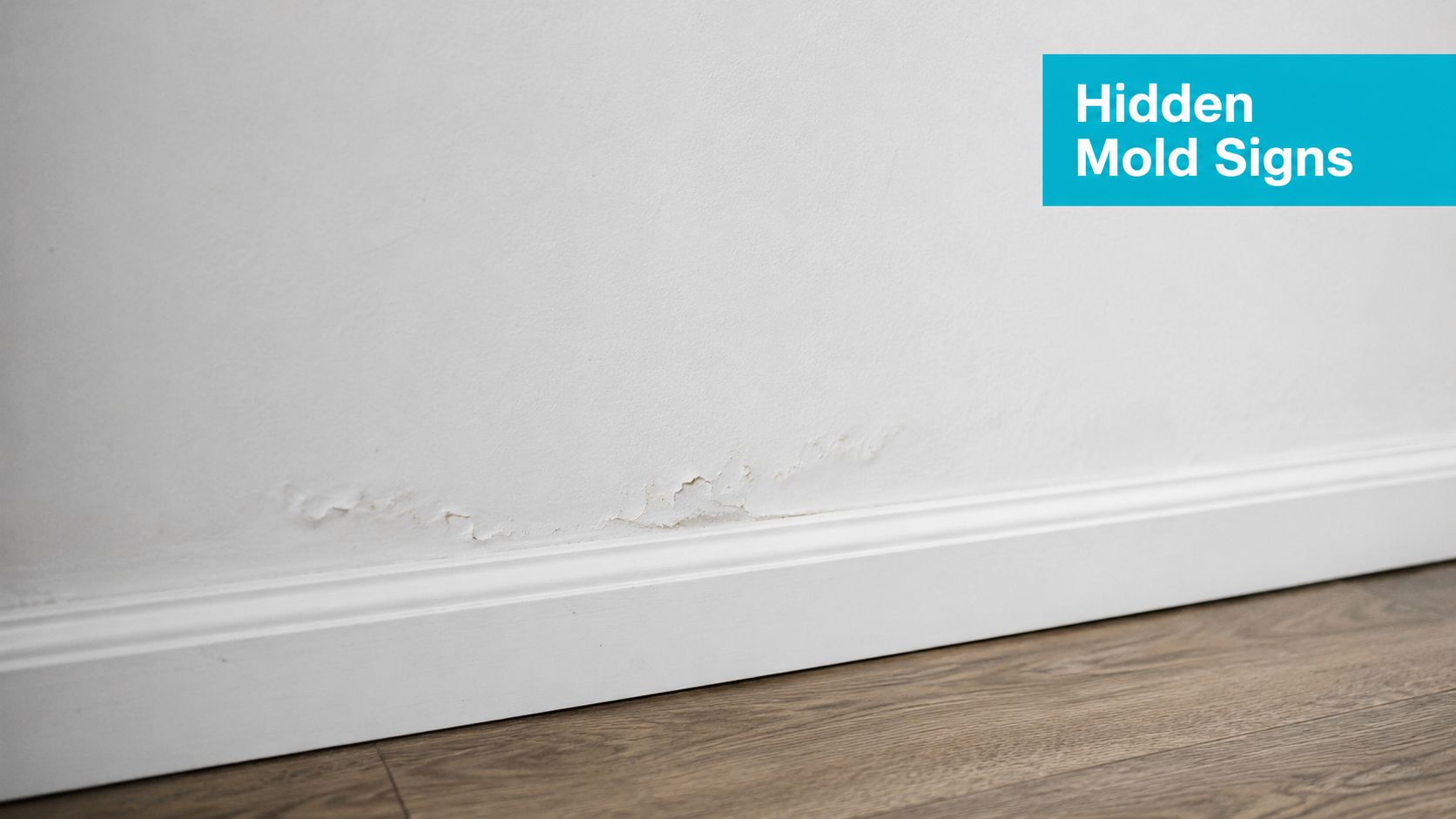
- Peeling paint or bubbling texture: Moisture trapped behind drywall often pushes finishes outward before mold becomes visible.
- Warped trim or swollen baseboards: Wood and composite trim can react to long-term moisture inside the wall.
- Recurring stains: Brownish or yellowish marks that reappear after repainting usually point to an unresolved moisture source.
- Health symptoms indoors: Sneezing, irritation, or respiratory discomfort that seems stronger in one room can be a clue worth investigating.
If you've seen any of those, it helps to compare them against broader signs of water damage in walls because hidden mold and hidden moisture usually travel together.
Signs that get misread
A lot of homeowners assume bubbling paint is just old paint. In coastal Florida, it often isn't. The wall may be taking on moisture from a shower valve leak, roof edge issue, poorly sealed window, or condensation around supply lines.
The same goes for “mildew smell” in a closet or spare room. If it returns after wiping surfaces and improving airflow, it may be coming from the back side of the drywall rather than the room itself.
A persistent odor with no visible growth is one of the clearest reasons to stop guessing and inspect the cavity behind the finished surface.
When not to poke around yourself
The instinct to cut a hole in the drywall is understandable. It's also how people spread spores through the room, disturb contaminated insulation, or miss the actual source because they opened the wrong section of wall.
If the problem involves a bathroom wall, kitchen plumbing wall, or an exterior wall after storm exposure, it's better to treat the area as a moisture investigation, not a home improvement project.
The Professional Toolkit for Finding Hidden Mold
Hidden mold behind drywall is found by building evidence, not by relying on one test. In the field, I look for a pattern. Moisture source, temperature change, material condition, and confirmation inside the cavity. If one piece is missing, the conclusion is weaker.
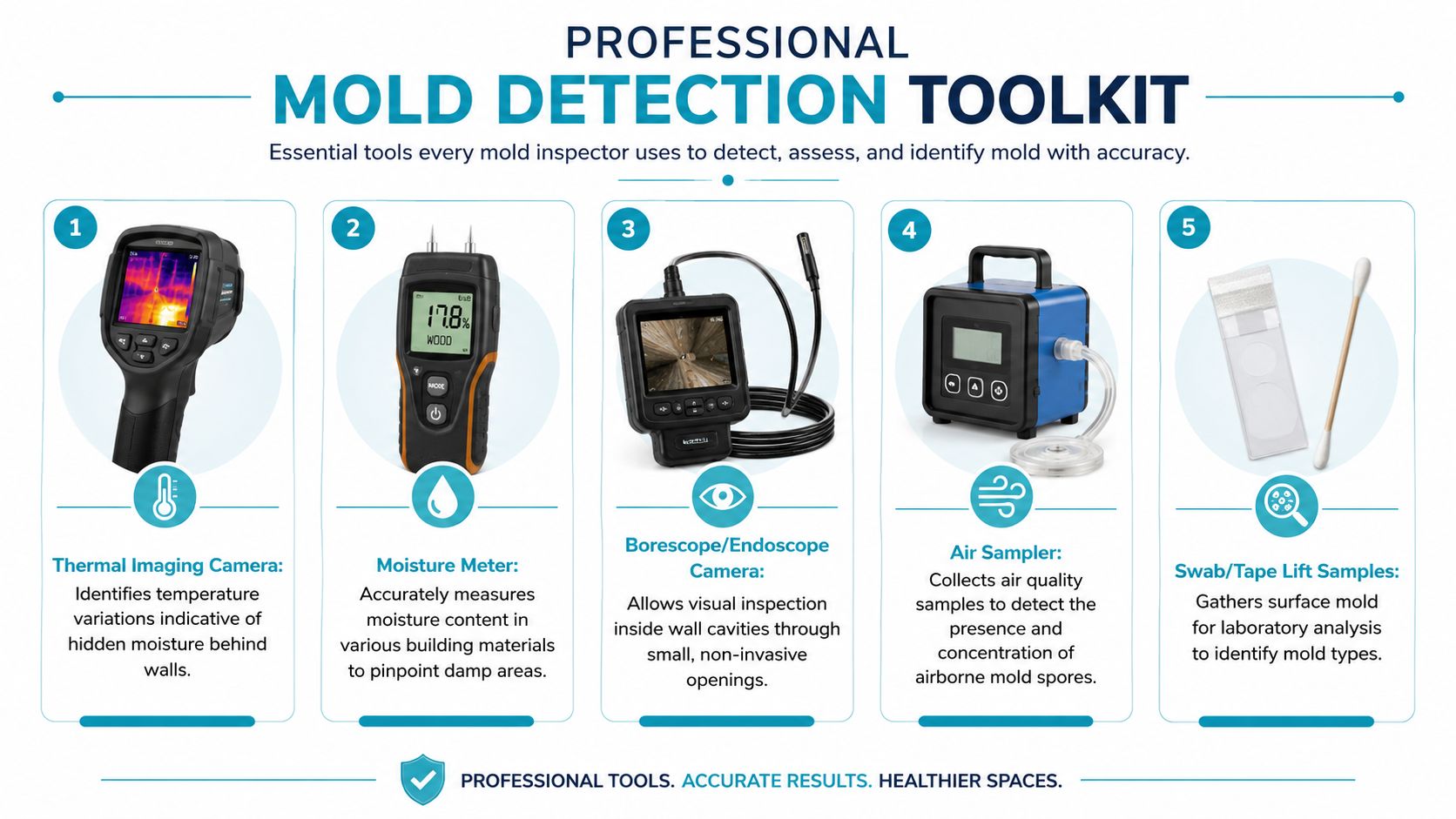
That is why professional inspections use several tools together. A thermal camera can flag an area that is cooler than the surrounding wall. A moisture meter checks whether the material is holding enough moisture to support growth. A borescope gives a limited but useful look inside the wall cavity through a small opening. Sampling helps confirm whether the suspect area is releasing mold spores or has visible growth on an accessible surface.
What each tool does well
Here is how the main tools perform in real homes:
| Tool | What it helps detect | Main limitation |
|---|---|---|
| Thermal imaging camera | Temperature anomalies tied to hidden moisture | It does not identify mold by itself |
| Moisture meter | Moisture in drywall, trim, and other materials | It shows wet conditions, not the type or amount of contamination |
| Borescope | Visual confirmation inside a wall cavity through a small opening | It only shows the section you can access |
| Air sampling pump | Airborne spore patterns in the tested area | Standard room sampling can miss hidden wall mold |
| Swab or tape lift | Surface identification when visible growth is accessible | It does not help if contamination is buried behind finishes |
Florida homes add another layer. High humidity, AC cycling, storm exposure, and slow plumbing leaks can keep the inside of a wall damp while the painted side still looks normal. In those cases, a single air sample from the middle of the room can come back low even when the cavity behind the drywall has active growth.
Why standard air testing can miss hidden mold
Homeowners are often surprised by this. A normal room-air result does not rule out mold inside a wet wall assembly.
Air sampling has value, but context matters. If spores are trapped behind drywall, tile, cabinets, or insulation, they may not be entering the room in enough volume to show up on a general sample. That is the false-negative problem. It is one of the main reasons DIY test kits and one-sample inspections miss concealed growth.
A better approach is to compare the air data to the moisture map and the building history. If the wall is damp, the thermal pattern is consistent, and the odor or staining points to one section, the next step may be targeted cavity evaluation. That can include borescope viewing, a small exploratory opening, or sampling taken from the suspect area rather than from the center of the room.
Field takeaway: Wet building materials matter more than a reassuring single air sample. If the wall conditions support mold, the inspection has to follow the moisture.
For homeowners trying to understand the testing side, professional air quality testing for mold is most useful when it is tied to moisture mapping and targeted cavity checks, not used as a shortcut.
What does not work well
Missed hidden mold cases usually come from overreliance on one method.
- Visual-only checks: Drywall can look clean while the back side and insulation are contaminated.
- DIY moisture meters alone: They can show dampness, but they cannot confirm whether mold is growing inside the assembly.
- One room air sample: It may reflect the breathing zone in the room, not what is sealed behind the wall.
- Blind demolition: Cutting without a plan can spread spores, disturb insulation, and still miss the main moisture source.
AMPM Restoration Services is one local option that offers free water and mold inspections using infrared tools to identify hidden moisture patterns before targeted verification begins.
The AMPM Restoration Inspection Process Explained
A typical call sounds like this. The guest bedroom smells musty after a summer storm, the paint still looks mostly fine, and a store-bought test came back inconclusive. At that point, the job is not guessing. The job is narrowing the problem down without opening more of the house than necessary.
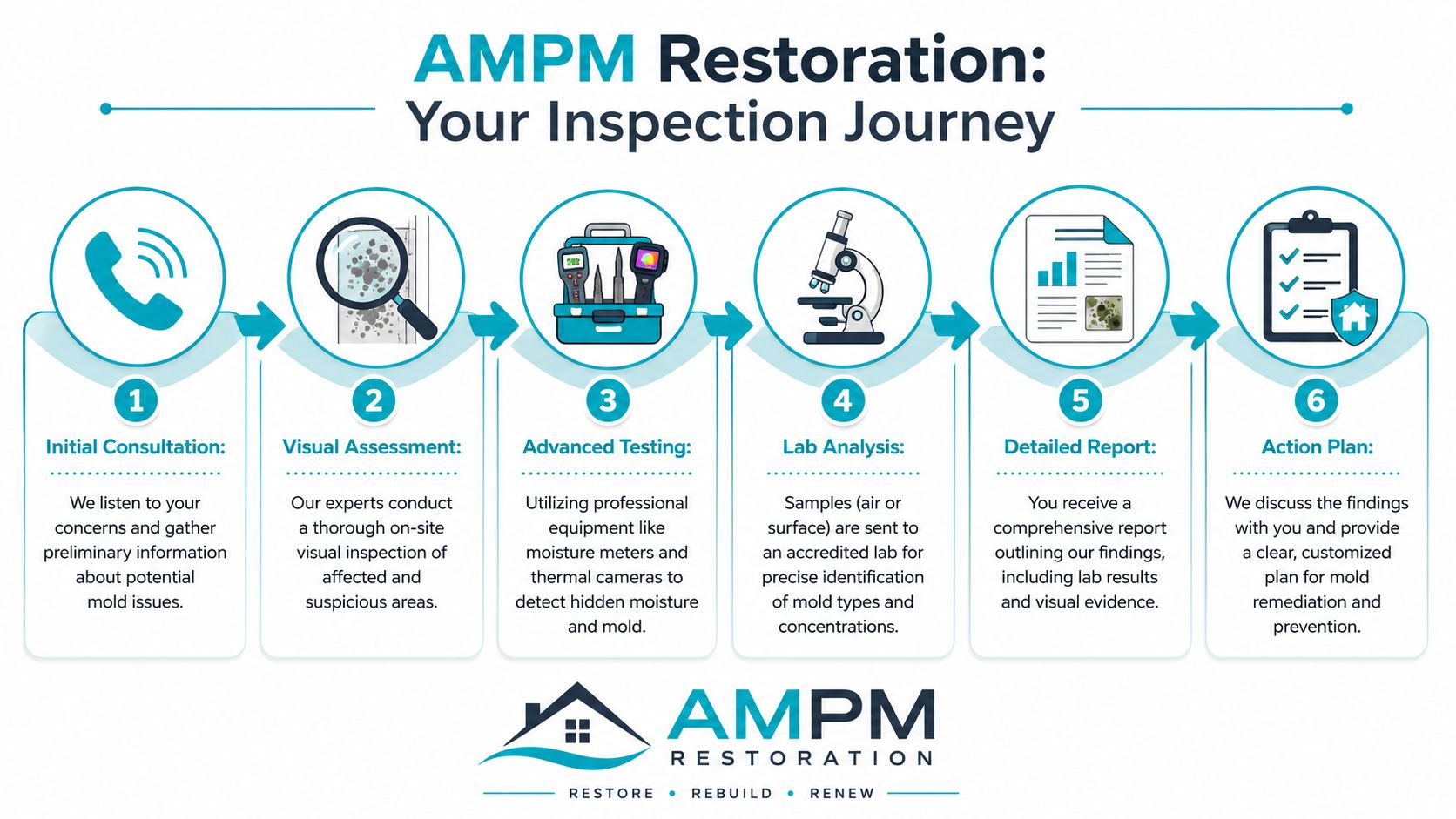
We start with context. I want to know where the odor shows up, whether the AC has struggled with humidity, if there was a roof or plumbing leak, and how long the area has felt off. In Florida homes, hidden mold behind drywall usually tracks back to moisture history, not a random lab result.
The on-site inspection then focuses on the building itself. We check the wall surfaces, trim, baseboards, window perimeters, and nearby ceilings for subtle signs of moisture movement or material change. Moisture meters help confirm whether materials are still wet or were wet long enough to raise concern. Infrared imaging helps us compare temperature patterns so we can spot areas that deserve closer evaluation.
That part matters because no single tool gives a complete answer. Thermal cameras can show anomalies, but they do not identify mold. Moisture meters can confirm damp materials, but they cannot tell you what is growing inside the wall. Standard air sampling has limits too. If the cavity is closed off, the spores may not be circulating into the room, which means a clean-looking sample can still miss a real wall problem.
When the evidence points to one section, we verify it in a targeted way. That may include a borescope through a small access point, direct cavity sampling, or a limited exploratory opening where the moisture and field signs line up. The goal is to answer three questions clearly: is mold present, how far has it spread, and what is keeping that area wet?
This is the point where DIY methods usually fall short. A hardware-store test can sample the air in the room. It cannot read the wall assembly, trace the moisture path, or tell you whether opening that wall will release contamination into occupied space. Professional judgment is what keeps the inspection focused and keeps the next step safe.
After verification, the findings go into a written scope with the affected areas, the evidence observed, and the recommended correction path. If the source is a hidden supply line or drain issue, repairs may need to start with a licensed plumber before any wall cavity can dry properly. In that situation, a Boerne emergency plumber is one example of the kind of trade support homeowners may need when active leaks are part of the mold problem.
If you are comparing providers, look for professional mold inspection services that include moisture investigation, targeted verification, and a clear plan for fixing the water source. That is what turns an inspection into a useful answer, instead of an expensive maybe.
From Inspection to Restoration Your Recovery Plan
Once hidden mold is confirmed, the job changes from investigation to controlled removal. The first priority is containment so spores and debris don't spread into clean areas. After that, affected materials are removed as needed, the space is cleaned with HEPA-focused procedures, and the original moisture source is corrected before rebuilding begins.
That order matters. If someone removes damaged drywall but leaves the leak, high humidity source, or ventilation issue untouched, the wall can fail again.

What recovery usually includes
- Containment and protection: Isolating the work zone helps limit cross-contamination.
- Removal of damaged materials: Drywall, insulation, trim, or other porous materials may need to come out.
- Detailed cleaning: HEPA vacuuming and antimicrobial cleaning address remaining contamination in the work area.
- Moisture correction: Plumbing repairs, drying, ventilation upgrades, or envelope repairs keep the issue from returning.
- Rebuild and finish work: Full reconstruction brings the area back to pre-loss condition.
If a hidden wall leak is involved and you need the water source handled fast, a licensed local plumbing specialist is often part of the solution. For readers outside Florida who want an example of what that emergency side looks like, this Boerne emergency plumber resource shows the kind of rapid leak response that can stop a mold situation from getting worse.
For homeowners here on the Suncoast, the next practical step after confirmation is learning how to remediate mold without spreading it through the rest of the house. Just as important, ask early about insurance claim assistance and financing options so cost concerns don't delay the work.
Florida Hidden Mold FAQs
Can a mold inspection detect hidden mold behind walls if nothing is visible?
Yes, if the inspection is built around the wall system instead of a single test. In practice, hidden mold is found by comparing moisture readings, checking temperature anomalies with infrared imaging, looking for pressure or odor clues, and opening a small access point when the evidence supports it. Air samples can help in some cases, but they also miss wall cavity growth regularly. A normal air result does not rule hidden mold out.
How much does a professional mold inspection usually cost?
Pricing varies by home size, access, and how much testing is needed, so quoting a national flat range is not very useful without context. What matters more is whether the inspection answers the core question. Where is the moisture coming from, is the growth active, and how far has it spread?
For local homeowners, AMPM Restoration offers a free mold inspection and estimate in Bradenton, Sarasota, Tampa Bay, Saint Petersburg, and Lakewood Ranch. That gives you a starting point before cutting drywall blindly or relying on a kit that cannot map the full problem.
Can I use a DIY kit or hardware store meter instead?
A DIY moisture meter can tell you a section of drywall is wet or has been wet. It cannot tell you whether mold is growing inside the cavity, whether insulation is contaminated, or whether the problem extends into adjacent framing.
DIY mold kits have the same limitation. They often collect something because mold spores exist in normal indoor and outdoor air. The hard part is interpretation. Homeowners need to know whether the readings match a moisture source, whether the location makes sense, and whether the result reflects settled background spores instead of a hidden reservoir behind the wall.
If the mold behind the wall is dead, does it still need to be removed?
Usually, yes. As explained by Mold Science in its review of dormant mold behind walls, dormant mold can reactivate when moisture returns, and non-viable material can still remain in the building assembly. In the field, the bigger issue is that a wall cavity that supported growth once often still has a moisture problem, contamination, or damaged porous material. Leaving it in place is rarely a sound repair plan.
Will homeowners insurance cover hidden mold?
It depends on the cause of loss and the policy wording. A sudden pipe leak has a better chance of coverage than a slow leak that went unresolved for months. Inspection findings matter here because photos, moisture readings, and a documented scope help show whether the damage came from a covered event or long-term maintenance issues.
Why does hidden mold keep showing up in Florida homes?
Florida homes stay under constant moisture pressure. High outdoor humidity, wind-driven rain, condensation around HVAC components, roof and window leaks, and plumbing failures all create conditions where wall cavities stay damp longer than they should.
That is why false negatives are such a problem here. A single air test taken on a dry day may look fine while mold is still active inside a bathroom chase, exterior wall, or laundry room partition. Reliable answers come from putting the whole picture together.
If you suspect hidden mold behind your walls, get it checked before the drywall softens, the odor spreads, or indoor air quality gets worse. AMPM Restoration Services helps homeowners across Bradenton, Sarasota, Tampa Bay, Saint Petersburg, Lakewood Ranch, and nearby Gulf Coast communities with mold inspection, mold removal, water damage restoration, reconstruction, insurance claim assistance, and financing options. Call 941-946-7807 now for a free inspection and estimate and get a clear plan to protect your property and indoor air.