

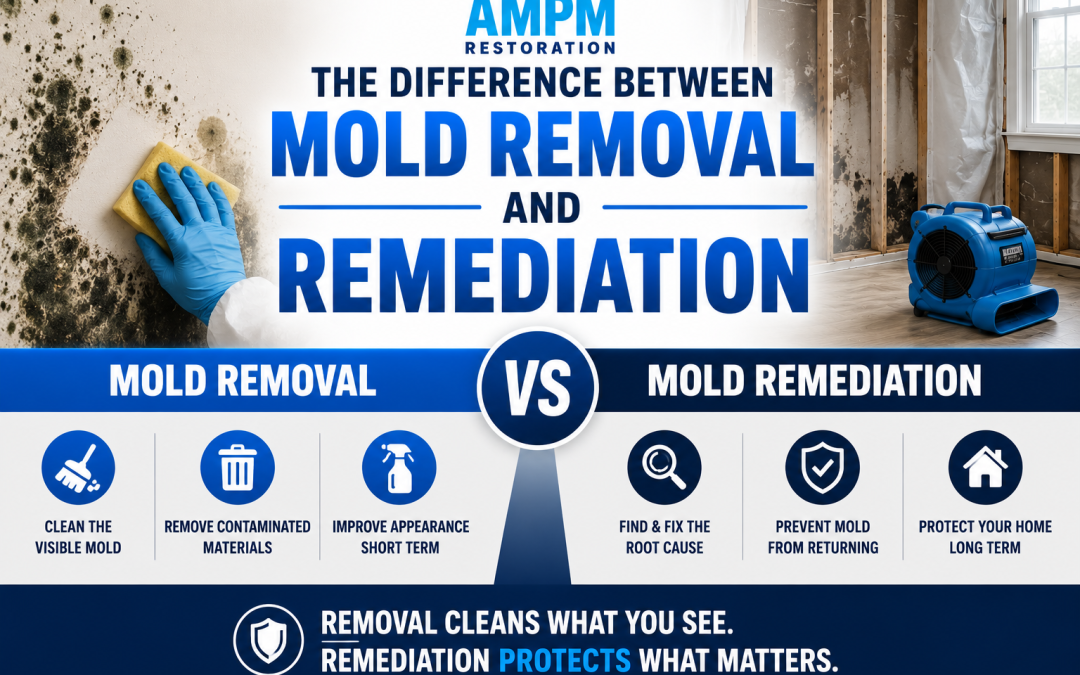
Difference Between Mold Removal and Remediation
A lot of Florida homeowners first ask about the difference between mold removal and remediation after something small seems to happen. A musty smell after a humid stretch. Dark spotting near an air vent. A bathroom wall that never fully dried after a leak. The problem is that the terms sound interchangeable, and they aren’t.
That difference matters because the wrong choice can leave mold inside walls, keep moisture active, create repeat cleanup costs, and complicate insurance conversations later. If you only pay for a cosmetic cleanup when the home needs a full remediation plan, you may end up paying twice. In Gulf Coast homes around Bradenton, Sarasota, St. Petersburg, and Tampa Bay, that’s a common and expensive mistake.
The Critical Difference Between Mold Removal and Remediation
At a practical level, the difference between mold removal and remediation comes down to scope. Mold removal usually means cleaning visible growth from a surface. Mold remediation is the broader process used to identify the moisture problem, control contamination during cleanup, remove affected materials when needed, and reduce the chance that mold comes right back.
For a homeowner, that distinction isn’t academic. It affects safety, how much of the home must be opened, whether the HVAC needs attention, and whether the issue is likely to return after the crew leaves.
| Service | Main focus | What it usually addresses | What it often misses |
|---|---|---|---|
| Mold removal | Visible mold on a surface | What you can see and wipe | Hidden spread, moisture source, airborne contamination |
| Mold remediation | Full mold problem | Visible growth, moisture source, containment, air cleaning, damaged materials | Less likely to leave root causes unresolved |
Why Florida homes need a more careful answer
Florida homes deal with persistent humidity, storm exposure, roof leaks, plumbing failures, and AC-related moisture. In that environment, visible mold is often only the front edge of the problem.
Many industry explanations now treat mold removal as a surface-cleaning task, while mold remediation is the broader standard because it also identifies and fixes the moisture source that allows mold to return.
Practical rule: If the surface can be cleaned but the moisture source remains, the job isn’t finished.
The financial risk of choosing the wrong service
A quick wipe-down can look cheaper on day one. It often isn’t cheaper over the life of the problem.
If mold comes back because the leak, humidity pocket, wall cavity moisture, or contaminated porous material was never addressed, the homeowner can face another cleanup, more material replacement, and more disruption. Insurance carriers also tend to look closely at cause, documentation, and whether the damage was handled as a full loss condition instead of a cosmetic issue.
What Is Mold Removal vs Mold Remediation
A Florida homeowner often sees the same pattern. A bathroom ceiling or closet wall gets wiped down, the staining fades, everyone feels relieved, and then the musty odor returns after the next stretch of heavy humidity or a small leak. That first bill looked cheaper. The second one usually is not.
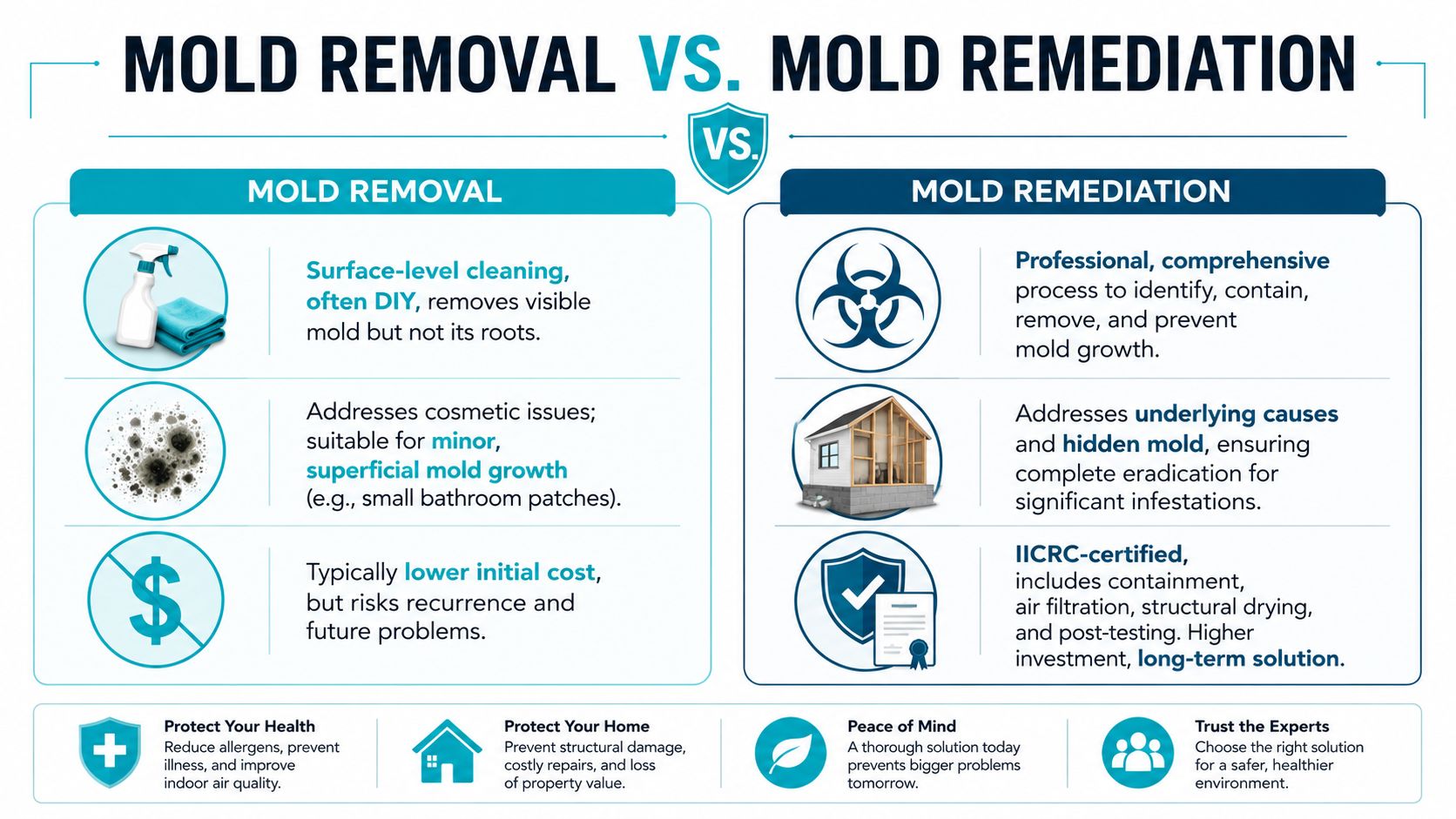
Mold removal usually refers to cleaning visible mold from the surface you can see and reach. It may solve a small cosmetic issue on a non-porous material, but it does not automatically answer the harder questions. Is the material still wet? Did spores spread into nearby contents or cavities? Will the same area bloom again in 30 days?
Mold remediation addresses the mold condition as a property problem, not just a dirty spot. It includes finding the moisture source, defining how far the damage extends, setting up controls to limit cross-contamination, cleaning affected areas properly, and removing materials that cannot be saved.
What removal usually includes
A removal-focused job is limited in scope. It often includes:
- Cleaning visible growth from tile, glass, metal, or other non-porous surfaces
- Applying household or commercial cleaners to improve surface condition
- Stopping at what is visible instead of tracing moisture behind walls, under flooring, or inside cabinets
That approach has a place. If a small amount of mold is caused by surface condensation on a bathroom tile wall, cleaning may be enough.
The risk shows up when removal is used on the wrong job. Drywall, insulation, wood trim, cabinets, and other porous materials can hold moisture and contamination below the surface. If that material stays wet, the homeowner pays for appearance work first and corrective work later.
What remediation includes
Remediation is broader because the job is broader. As explained in our guide to mold assessment vs mold remediation, the process can include inspection, scope development, containment, HEPA air filtration, moisture correction, selective demolition, detailed cleaning, and repairs needed to return the area to service.
In practical terms, remediation is the service used when the goal is stability, documentation, and a lower chance of repeat loss. That matters in Florida homes, where roof leaks, plumbing failures, AC drain issues, storm intrusion, and year-round humidity can keep feeding hidden growth.
Why the distinction matters financially
The wrong service choice can affect far more than the cleanup invoice.
A surface-only job may not produce the documentation an insurance carrier wants when there is a covered water event behind the mold problem. If the condition later expands and the original cause was never identified, the homeowner can end up paying for another inspection, another cleanup, added material replacement, and extra time out of the room or unit. In claim-related work, the scope matters because carriers and adjusters look at cause, affected materials, and whether the response matched the actual condition.
A clean-looking wall is not proof that the wall cavity is dry.
That is why repeated growth, musty odors, prior leaks, storm-related moisture, and staining on porous materials usually call for remediation rather than simple removal.
A Detailed Comparison of the Process and Scope
The easiest way to understand the difference between mold removal and remediation is to compare what happens on the job.
Mold Removal vs Mold Remediation at a Glance
| Aspect | Mold Removal | Mold Remediation |
|---|---|---|
| Primary goal | Clean visible mold | Correct the mold condition and reduce recurrence risk |
| Inspection | Basic visual review | Broader inspection for extent and moisture source |
| Work area control | Often limited or none | Containment is typically part of the workflow |
| Air handling | Usually not a major part of the service | HEPA air filtration may be used |
| Materials | Focus on cleaning surfaces | May include removing unsalvageable porous materials |
| Moisture correction | May be outside scope | A core part of the job |
| End point | Surface looks clean | Area is cleaned, dried, and brought back under control |
Where removal works and where it fails
Removal works best when the issue is small, visible, and superficial. A little spotting on non-porous bathroom tile from condensation is very different from mold on drywall after a pipe leak.
The problem is that many homes don’t present clean, simple conditions. By the time a homeowner sees growth on paint or baseboard, the backing material may already be affected. If someone scrubs the surface aggressively without isolation, they can disturb spores and spread contamination into adjacent rooms.
What remediation adds in the real world
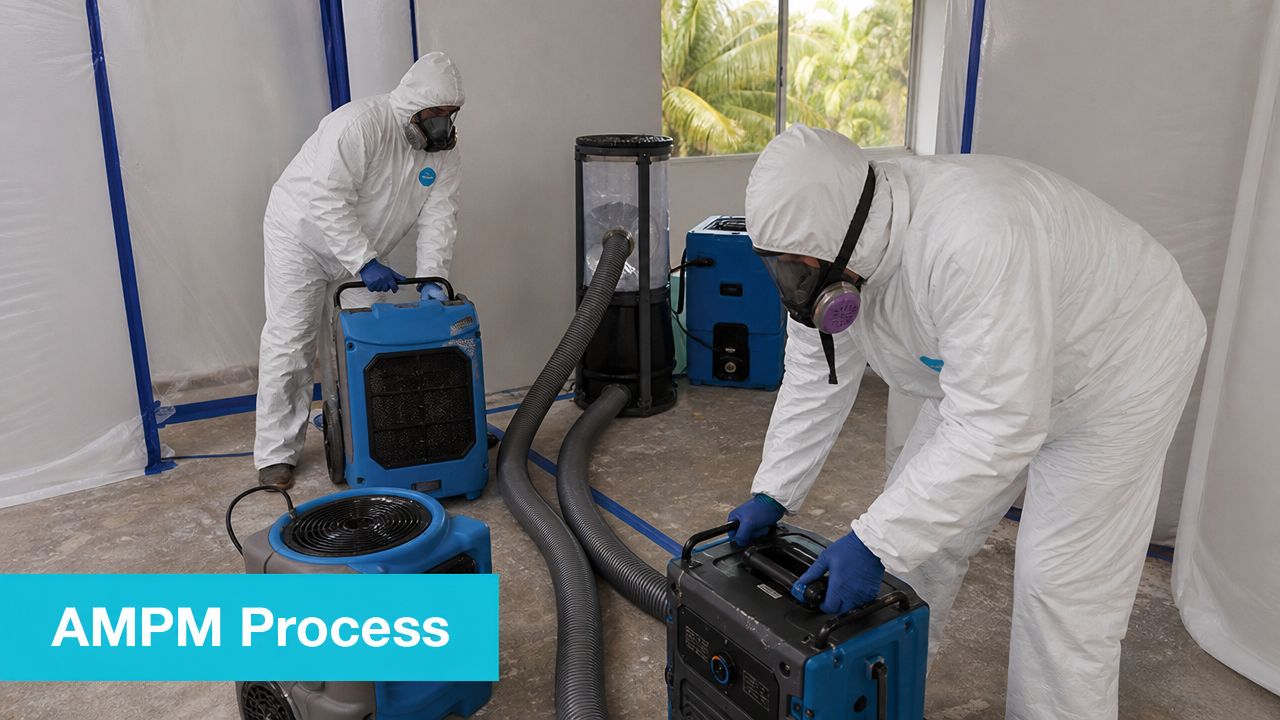
A true remediation workflow is more controlled. The job may involve isolating the affected area, using HEPA-filtered air scrubbers, opening materials selectively, removing contaminated porous contents, and drying the structure before rebuild work starts.
If you want a practical look at the sequence, this guide on how to remediate mold lays out the kind of steps involved in a remediation project.
Here’s what that means in plain terms:
- Inspection and scoping find where the mold is and why it formed.
- Containment helps keep spores from migrating through the house.
- Air filtration supports cleaner working conditions during demolition and cleanup.
- Selective removal takes out materials that can’t be reliably saved.
- Drying and restoration deal with the water side of the problem, not just the staining.
Why scope of work changes the cost
Homeowners often compare bids without noticing that one proposal is for surface cleaning and another is for actual remediation. Those aren’t equivalent services.
A low bid can look attractive until you realize it excludes containment, excludes moisture investigation, excludes material removal, and excludes restoration. A more complete scope may cost more upfront, but it usually reflects the actual condition of the property rather than the visible patch alone.
If two estimates are far apart, compare the scope line by line. Don’t assume both contractors are solving the same problem.
How to Decide Which Mold Service You Need
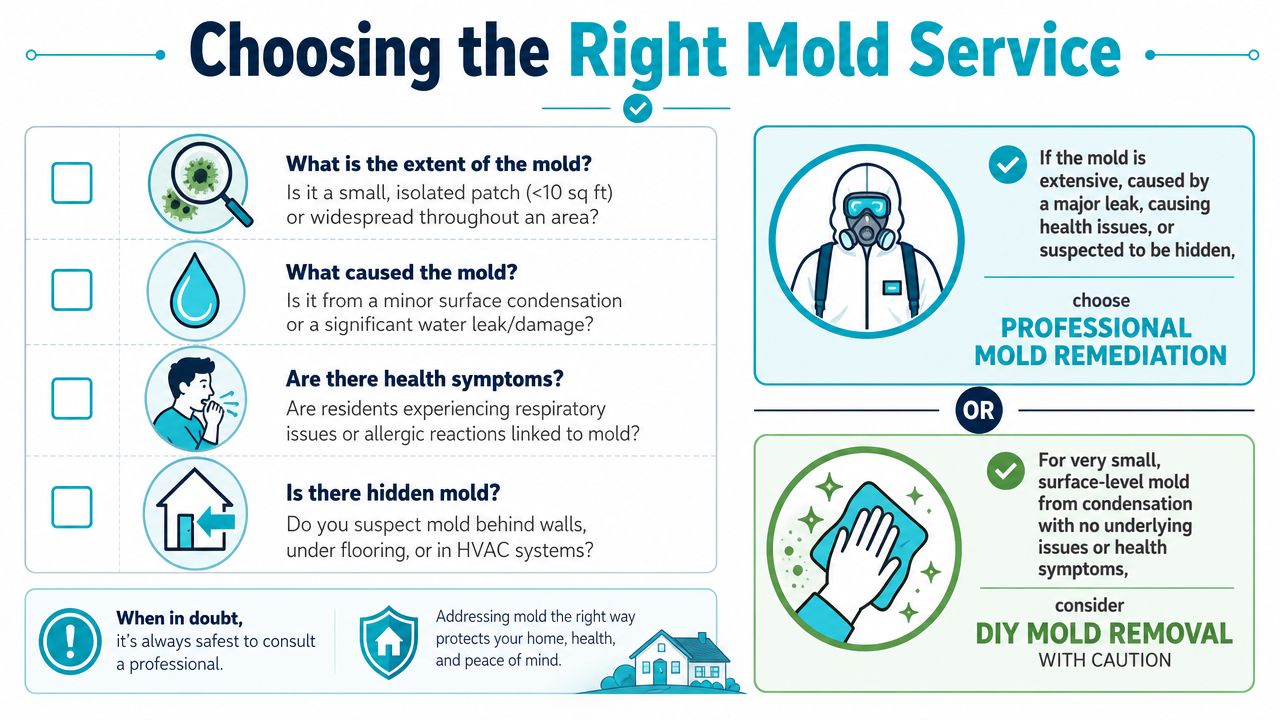
Most homeowners don’t need abstract definitions. They need a usable decision rule. The most helpful benchmark is the 10-square-foot threshold. When mold contamination exceeds that size, industry guidance commonly recommends professional remediation rather than simple cleanup.
Situations where simple removal may be enough
There are cases where a cleanup approach is reasonable.
- Small isolated area under the 10-square-foot threshold when the growth is clearly limited
- Non-porous material such as tile or metal
- Known minor moisture issue that has already been corrected
- No ongoing odor suggesting hidden spread elsewhere
That still requires caution. Even a small area should be handled carefully so spores aren’t pushed into clean parts of the house.
Situations that call for remediation
Professional remediation is the safer choice when the mold problem is tied to building materials, hidden moisture, or repeat growth.
- Growth larger than the 10-square-foot benchmark
- Mold after a leak or flood event
- Visible damage in multiple rooms
- Musty odor with no visible source
- Possible spread behind drywall, under flooring, or in HVAC
- Recurring mold after prior cleaning
If any of those apply, surface cleaning is usually too narrow.
A quick homeowner checklist
If you’re not sure what side of the line your property falls on, ask these questions:
- Is the mold only on the surface, or is the material itself affected?
- Has the water source been fixed?
- Do you smell mold where you can’t see it?
- Is the area bigger than a small isolated patch?
- Has anyone already tried cleaning it, only for it to come back?
If your answers point toward hidden moisture, porous materials, or recurring growth, review the warning signs on this page about when you need professional mold removal.
Health, Safety, and Insurance Considerations
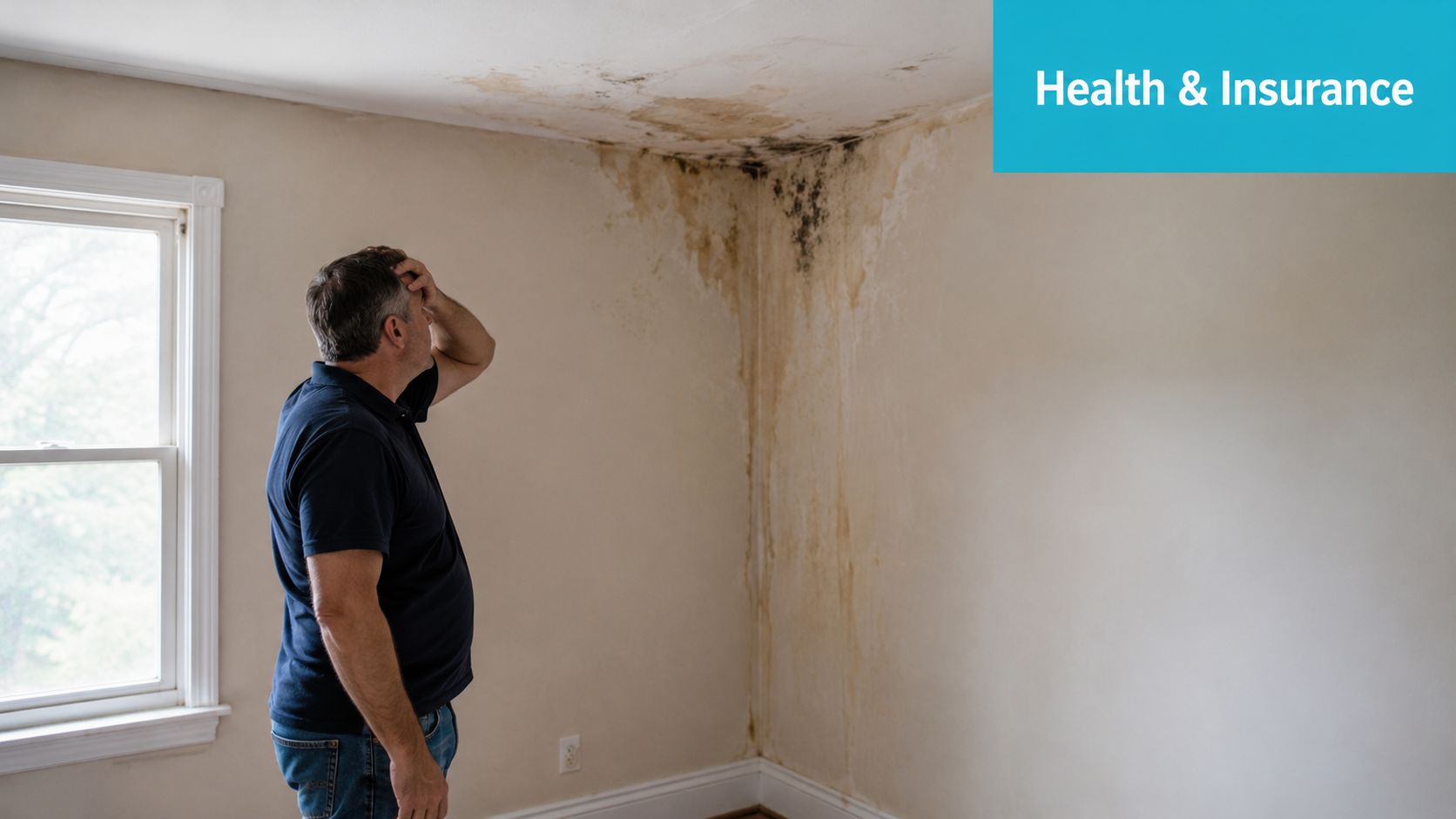
Cleaning visible mold without proper controls can make the situation worse. Disturbing contamination can send spores into the air and into rooms that weren’t affected before. That matters more in occupied homes, especially when the contamination sits near return vents, closets, wall cavities, or soft materials that trap moisture.
Why improper cleanup creates risk
A wipe-down approach may remove staining while leaving the actual reservoir intact. If wet drywall, insulation, carpet backing, cabinetry, or framing remains damp, mold can continue developing out of sight.
When homeowners suspect hidden spread or want to understand the role of verification, this article from gives useful context on why testing and air-quality concerns often come up together.
Insurance usually follows the cause and documentation
Insurance discussions around mold are rarely just about whether mold exists. They often focus on what caused it, how quickly the issue was addressed, and whether the response dealt with the full condition.
That’s one reason remediation tends to be more defensible than a cosmetic cleanup. A documented remediation scope shows that someone looked at the moisture source, controlled the work area, removed damaged material where needed, and treated the issue as part of a property loss, not just as staining on a wall.
Homeowners trying to understand claim handling can review this guide to insurance restoration services, especially if the mold followed a covered water event.
The financial implication most people miss
The cheapest invoice isn’t always the lowest-cost decision. If removal fails, you may pay for another cleanup, another tear-out, and another round of repairs. If the problem spreads during incomplete handling, that can expand the scope of reconstruction.
For many Florida homeowners, the best financial decision is the one that closes the loop on moisture, contamination, and repairs the first time.
The AMPM Restoration Process for Florida Homes
When a Florida property needs more than surface cleaning, the process has to address both the mold and the water conditions behind it. That usually starts with a site inspection, moisture tracing, and a scope that separates salvageable materials from materials that need removal.
What the workflow should include
A professional Florida remediation workflow typically includes:
- Emergency response and inspection so the moisture issue doesn’t keep feeding the loss
- Containment and HEPA air cleaning to control cross-contamination during work
- Selective demolition when porous materials can’t be reliably restored
- Drying and moisture verification before closing walls or rebuilding
- Repairs and reconstruction so the home returns to pre-loss condition
One local option for that full sequence is AMPM Restoration’s mold and water damage remediation service, which combines mitigation, drying, cleanup, and reconstruction under one scope.
Why this matters on the Gulf Coast
Homes in Bradenton, Sarasota, Lakewood Ranch, Tampa Bay, and St. Petersburg often need a coordinated response because mold problems rarely exist in isolation. A roof leak, appliance leak, AC drain issue, or flood intrusion can leave moisture in several assemblies at once.
A fragmented approach creates handoff problems. The inspection says one thing, the cleanup crew handles another, and the repair phase starts before materials are dry. A proper remediation process avoids that by treating moisture control as part of the mold job, not as a separate afterthought.
Restore Your Property and Peace of Mind Today
The difference between mold removal and remediation is the difference between cleaning what you see and solving the condition that caused it. For a very small, surface-level issue, removal may be enough. For leak-related, recurring, hidden, or widespread contamination, remediation is the safer long-term choice.
If you’re in Bradenton, Sarasota, Tampa Bay, Saint Petersburg, Lakewood Ranch, or nearby Gulf Coast communities, call 941-946-7807 for a free inspection and estimate. AMPM Restoration can help document the damage, assist with insurance claims, and discuss financing options so you can move forward without guessing.
Frequently Asked Questions About Mold Services
Is mold removal the same as mold remediation
No. Mold removal usually means cleaning or taking out visible growth. Remediation is a broader service that includes finding the moisture source, setting containment, protecting the air, removing damaged materials when needed, and reducing the chance the problem returns. That difference affects cost, scope, and whether the job solves anything.
Can I clean mold myself and skip remediation?
Sometimes, for a very small and clearly isolated area on a non-porous surface, careful cleaning may be reasonable if the water issue is already fixed.
Florida homes rarely stay that simple for long. If mold is on drywall, insulation, baseboards, cabinets, flooring, or around an HVAC system, surface cleaning can leave growth behind in the material or spread spores into other rooms. Homeowners also run into trouble with insurance when there is no documentation showing what caused the damage, how far it spread, and what was removed.
Why does mold come back after it was removed?
Mold comes back when moisture stays in the building. The surface may look clean, but a slow plumbing leak, high indoor humidity, roof intrusion, or condensation behind walls can keep feeding new growth.
I see this often after a low-cost cleanup that skipped moisture mapping and material checks. The first bill looks smaller. The second bill usually is not.
Does visible mold always mean there is hidden mold
Not always. But in Florida properties with leak history, musty odor, soft drywall, warped trim, buckled flooring, or AC-related moisture, hidden spread is common enough that it should be checked instead of guessed at.
Visible staining tells you where mold showed up. It does not tell you where the water traveled.
What should I ask before hiring a mold company?
Ask for the exact scope in writing. Homeowners should know whether the company is cleaning a surface stain or performing a remediation job with containment, HEPA air filtration, moisture detection, selective demolition, post-work documentation, and recommendations to prevent the mold from returning.
Also ask how they handle insurance files. A contractor who can document affected materials, moisture readings, photos, and the cause of loss gives you a stronger record if a covered water event led to the mold. Vague promises to “treat” or “remove all mold” often leave too much undefined.
Ask what happens if the wall cavity, insulation, or subfloor is affected. The answer usually tells you whether the company is pricing a cosmetic cleanup or a real remediation scope.
Will insurance pay for mold work?
Coverage depends on the policy and the cause of loss. In many Florida claims, the main questions are whether the mold came from a covered water event, how quickly the problem was reported, and whether the damage was documented in a way the carrier can review.
Choosing the wrong service can quickly become expensive. If a company only wipes visible growth and does not document moisture, affected materials, and corrective steps, you may end up paying out of pocket later for reopening walls, replacing materials, or addressing mold that returns. A remediation-style file usually gives the insurer a clearer explanation of what happened and why the work was necessary.
If you suspect mold in your home or business, contact AMPM Restoration Services at 941-946-7807 for a free inspection and estimate. We serve Bradenton, Sarasota, Tampa Bay, Saint Petersburg, Lakewood Ranch, and surrounding Florida Gulf Coast communities with insurance claim assistance, financing options, and 24/7 restoration support that helps restore both your property and your peace of mind.