


Emergency Water Removal In Tampa: Fast Response
Water is spreading across the floor, the baseboards are darkening, and the room already smells different. In Tampa, that moment gets worse fast because heat and humidity don’t give you much margin for error. Emergency water removal in Tampa isn’t just about pulling out visible water. It’s about making the property safe, stopping hidden moisture from staying behind, and protecting your insurance claim while the damage is still fresh.
If you’re dealing with a burst pipe after a summer storm, an overflowing appliance, roof intrusion, or storm-driven flooding, act now and stay methodical. Tampa has seen a 40% surge in water damage restoration requests, which means more homeowners are facing exactly this problem under the same pressure. For local help, AMPM Restoration is a 24/7 emergency restoration company based at 4301 32nd St W b18, Bradenton, FL 34205, serving Bradenton, Sarasota, Tampa Bay, Saint Petersburg, Lakewood Ranch, and surrounding Gulf Coast communities.
Your Guide to Tampa Water Emergencies
Water is on the floor at 2 a.m., the AC is running, and Tampa humidity is already working against you. In the first hour, a common mistake is focusing only on the visible puddle while moisture is still spreading into drywall, cabinet bases, subflooring, and wall cavities.
That early window matters because Florida conditions speed up secondary damage. Warm air holds moisture. Porous materials absorb it fast. Once that moisture gets trapped indoors, drying the structure becomes a controlled process, not a basic cleanup job.

Why Tampa homes need a faster response
Tampa properties deal with storm season, wind-driven rain, high groundwater, and year-round humidity. A small supply-line break in a dry climate is one problem. The same break in Tampa can leave framing, insulation, and flooring systems holding moisture long after the surface looks better.
That is why emergency water removal Tampa work has to start with control, then move quickly into measurable drying. Extraction removes the bulk water. It does not confirm that wall cavities, underlayment, or cabinet toe-kicks are dry.
Practical rule: Judge the loss by how long water had contact with building materials, not by how much water you still see.
Fast, organized action also helps the claim side. Insurers want a clear timeline, a defined source when possible, and evidence that the homeowner took reasonable steps to limit further damage. If the loss started with a burst line during unusual cold weather, this guide to frozen pipe claims can help clarify how coverage questions begin. If you need local service details, AMPM provides water damage restoration in Tampa.
What matters in the first hour
Three priorities drive a sound response:
- Safety: Water around outlets, appliances, or slick flooring can injure someone before the cleanup even starts.
- Source control: If water is still entering the property, every minute increases the drying load and repair cost.
- Moisture tracking: Hidden wet materials need to be identified early so the drying plan matches the actual spread.
Homeowners often ask whether they can wait until morning if the water looks contained. In Tampa, that choice carries more risk than many people realize. Humid conditions slow natural evaporation, and trapped moisture can push damage behind baseboards, under floors, and into adjacent rooms before there is obvious staining.
A disciplined response protects the structure and puts you in a better position when the adjuster reviews the loss.
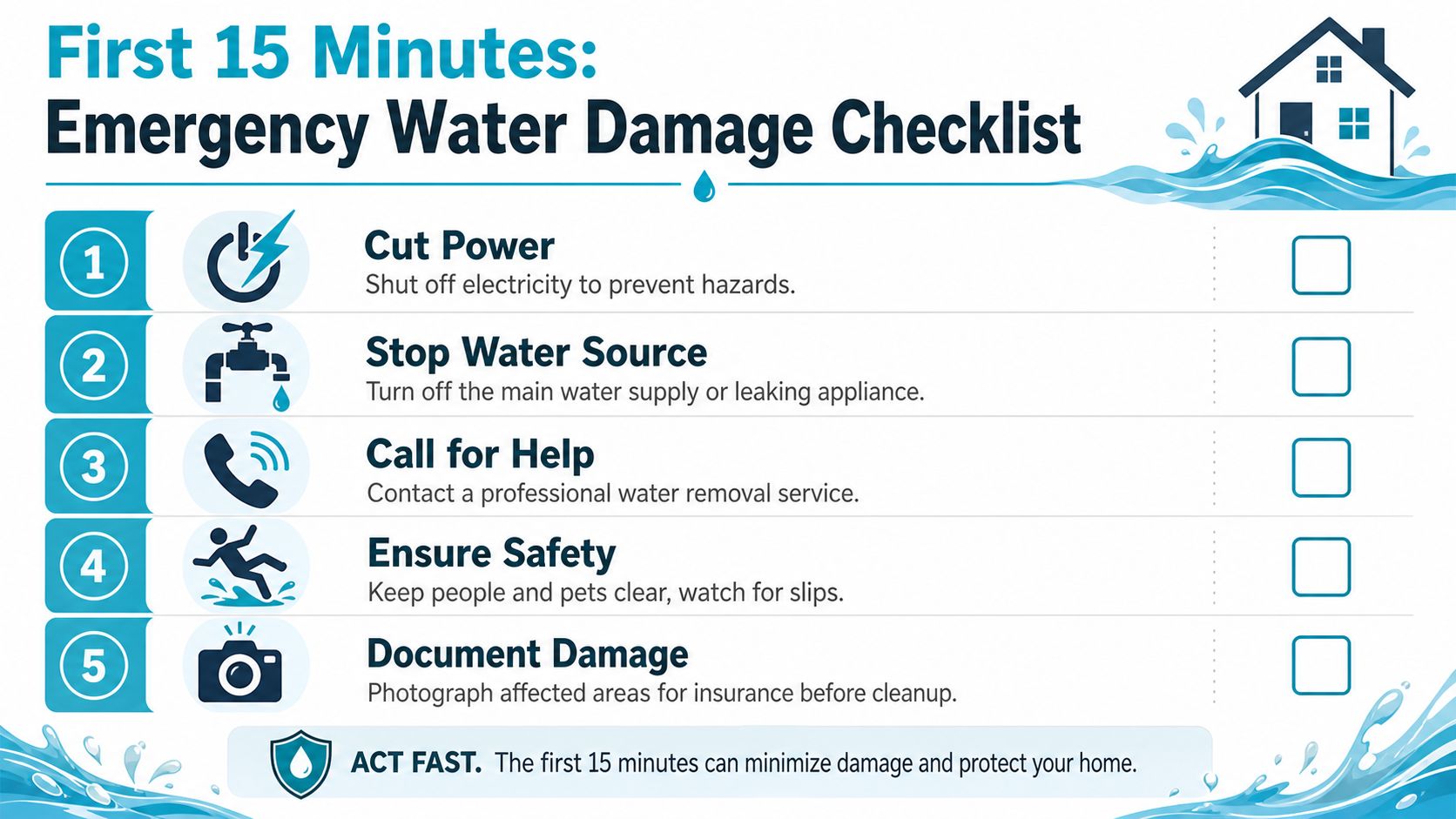
First 15 Minutes What To Do Right Now
In the first few minutes, forget cosmetics. Focus on hazards and loss control. The right moves now can keep a repairable situation from becoming a much larger restoration project.
Start with safety
If water has reached outlets, cords, appliances, or electrical devices, stop and cut power at the breaker if you can do it without entering the wet area. Professionals responding to water incidents must first shut off the main water valve and shut off power at the breaker when water has reached outlets or appliances because standing water with active electrical hazards creates immediate life safety risk, as noted in this Tampa water emergency guidance.
Keep children and pets away from the area. Wet tile, laminate, and concrete become slip hazards quickly, especially when people are trying to move fast.
If you can’t reach the breaker or the main water valve safely, back out and wait for trained help.
Stop the source, then protect contents
If the problem is a supply line, appliance hose, or visible plumbing failure, shut off the nearest valve or the main water supply. If rain is entering through the roof or around a window, don’t climb onto a slick roof. Interior containment is safer than improvising outdoors during active weather.
After the source is controlled, do what you can without spreading the damage:
- Move valuables first. Take phones, chargers, documents, medications, and irreplaceable items to a dry room.
- Lift furniture off the wet floor. Use foil, wood blocks, or plastic barriers if available.
- Remove loose rugs. They trap moisture underneath and can bleed color into flooring.
- Open cabinet doors if water entered below sinks or vanities. That can reduce trapped moisture while help is on the way.
A practical homeowner resource for this early stage is AMPM’s guide on the first 24 hours after emergency water damage.
What not to do
Some actions create more damage than they prevent.
- Don’t use household electronics in the wet zone. That includes plugged-in fans, extension cords, and shop tools near standing water.
- Don’t walk through suspected sewage or floodwater. The cleanup path changes completely when contamination is involved.
- Don’t tear out materials too early. Premature demolition can complicate the claim and remove evidence of the water path.
- Don’t wait to make the call. Water keeps moving even when everything looks still.
Take photos before you disturb the scene any more than safety requires. Then get professional help in motion.
Documenting Damage for a Smooth Insurance Claim
Once the area is safe and the active leak is controlled, shift your attention to documentation. In Florida, claim friction often starts because the homeowner cleaned up too much, threw away damaged items too soon, or failed to capture the source and extent of the loss before conditions changed.
A strong claim file shows what happened, where it happened, and what the water affected. It also gives the restoration estimator a clean starting point for scoping work.
What to capture before cleanup changes the scene
Use your phone and move room by room. Take wide shots first, then close-ups. Record slow video as you narrate what you’re seeing in plain language.
| Insurance Documentation Checklist | |
|---|---|
| Item to Document | Why It’s Important |
| Wide photos of each affected room | Shows the overall spread and relation between damaged areas |
| Close-ups of baseboards, walls, flooring, and cabinets | Captures material-specific damage and visible water lines |
| The source of loss, if visible | Helps connect the damage to the cause |
| Damaged personal property | Supports contents-related portions of the claim |
| Photos before moving items | Preserves the original condition of the loss scene |
| A running video walkthrough | Adds context that still photos sometimes miss |
| Notes on when you discovered the water | Creates a usable timeline for the carrier and estimator |
Don’t throw away damaged materials or contents until your carrier or restoration team tells you it’s appropriate. Bagging smaller items and moving them aside is usually better than disposing of them immediately.
Why timing matters
Insurance documentation isn’t just about having photos. It’s also about getting a formal scope developed while the loss is still verifiable. Industry protocols require formal damage scope documentation for insurer submission within a 48 to 96 hour window using Xactimate or equivalent estimating software. Once that window starts to slip, validation and settlement usually get harder.
The best claim files are boring. Clear photos, a simple timeline, intact evidence, and no guesswork.
If you want a practical walkthrough of claim preparation, AMPM has a useful page on water damage insurance claim tips.
A simple claim mindset
Think like an adjuster. They need proof of cause, proof of damage, and proof that you acted responsibly after discovery. That means documenting first, mitigating sensibly, and avoiding unnecessary disposal or demolition.
Why DIY Is Not an Option for Water Damage
DIY water cleanup feels cheaper because the visible problem seems straightforward. A mop, towels, and a wet vac can make the room look dramatically better in a short time. That visual improvement creates false confidence.
The problem is that visibly dry isn’t structurally dry. Water slips below vinyl planks, wicks into drywall, saturates underlayment, and settles into framing pockets where homeowners can’t verify dryness without the right tools and process.
Tampa’s humidity changes the risk
In a dry climate, you might get away with a smaller mistake. Tampa doesn’t give you that cushion. Materials here stay damp longer, and the indoor environment can hold enough moisture to keep hidden wet zones active after the surface looks normal.
Standing water should be removed immediately with pumps or wet-dry vacuums because the probability of mold colonization increases exponentially once materials remain wet for more than 24 to 48 hours. That timeline is short enough that a delay over one weekend can change the whole job.
What DIY usually misses
A homeowner can remove bulk water. A homeowner usually can’t confirm a proper dry standard inside assemblies.
Common failure points include:
- Under flooring: Water stays trapped below the finished surface.
- Inside walls: Baseboard gaps and sill plates can stay wet long after paint looks fine.
- Behind cabinets and vanities: Poor airflow leaves isolated damp pockets.
- In contaminated losses: Floodwater and sewage-related events require a different protocol entirely.
For homeowners comparing options, AMPM outlines the professional side of this work in its water damage restoration services.
Drying is a measurement job, not a guessing job.
The real trade-off
DIY can be useful for immediate loss control, like moving contents or pulling up a wet rug. It is not a substitute for extraction, moisture mapping, contamination assessment, and controlled drying. The cost you think you’re avoiding at the start often returns later as warped flooring, odor, microbial growth, or disputed insurance scope.
The Professional Water Removal Process Explained
A proper response follows a sequence. Good crews don’t just show up with fans. They inspect, classify, extract, dry, clean, and only then move into repairs.

Assessment before equipment
The first step is inspection. Technicians identify the source, evaluate how far the water migrated, and determine whether the loss involves clean water or something more hazardous. Moisture meters and infrared cameras help locate wet areas that aren’t obvious from the room’s appearance.
Many water removal jobs begin poorly. Most Tampa water removal content focuses on speed, but rapid extraction without immediate psychrometric drying calculations can leave hidden moisture behind walls, leading to mold within 24 to 48 hours. Fast arrival matters. Scientific drying matters just as much.
Extraction and controlled drying
After assessment, crews remove standing water with commercial extraction equipment. Then drying begins. This is not the same thing as placing a few fans in the room and hoping for the best.
Psychrometric drying means using measured relationships between air movement, temperature, and humidity to pull moisture from materials in a controlled way. The equipment is placed strategically, then adjusted as conditions change.
A typical sequence looks like this:
- Bulk water removal with extraction tools.
- Moisture mapping to identify wet structural materials.
- Air mover placement to increase evaporation from targeted surfaces.
- Dehumidifier setup to pull moisture from the air so materials can keep drying.
- Daily monitoring to confirm the structure is reaching dry goals.
For readers who want a broader explanation of how restoration fits into rebuilding, this overview of property restoration services adds helpful context.
Cleaning, sanitizing, and restoration
Once materials are drying correctly, the next step depends on what kind of water entered the property and what surfaces were affected. Clean water losses and contaminated losses don’t receive the same treatment. Cleaning and sanitizing are based on exposure, not just appearance.
Then comes repair. That may mean reinstalling baseboards, replacing damaged drywall sections, repairing flooring assemblies, or completing broader reconstruction where materials can’t be saved. Homeowners who want details on the drying side can review AMPM’s structural drying services in Tampa Bay.
One local option for this type of response is AMPM Restoration Services, which handles emergency mitigation, drying, sanitization, repairs, and insurance coordination across the Gulf Coast service area.
FAQs About Emergency Water Removal in Tampa
A Tampa water loss rarely stays simple for long. In this climate, trapped moisture spreads fast through drywall, baseboards, and subfloors, and that affects both the drying plan and how cleanly an insurance claim gets documented.
Quick answers homeowners need
| Frequently Asked Questions | |
|---|---|
| Question | Answer |
| How fast should I call for help after finding water? | Immediately. Early containment and extraction can limit spread, shorten drying time, and, as noted in this Tampa emergency restoration overview, may reduce overall restoration costs by up to 40%. |
| Can I stay in the house during water removal? | Sometimes. The decision depends on electrical safety, contamination level, equipment noise, indoor humidity, and which rooms are affected. In Tampa, high outdoor moisture can also make affected areas feel worse before the drying system stabilizes. |
| Will insurance cover emergency water removal? | It depends on the cause of loss and your policy language. Sudden pipe breaks are often handled differently than long-term leaks, repeated seepage, or storm-driven water entering from outside. Photos, moisture readings, and a clear timeline help support the file. |
| Should I start tearing out wet drywall myself? | Usually no. Premature tear-out can create safety issues, interfere with moisture mapping, and remove evidence the adjuster may need to see. The better first step is source control, documentation, and a measured inspection. |
| What if the water came from outside during a storm? | Storm losses in Florida often raise separate questions about wind-driven rain, flood exclusions, and contamination. Document entry points, water lines, damaged contents, and exterior conditions before cleanup changes the scene. |
| Do I need professional drying if the floor looks dry now? | Yes, if water reached structural materials. A dry surface does not confirm the subfloor, wall cavity, insulation, or framing is dry to target. That hidden moisture is what causes odor, swelling, and mold growth later. |
For more question-specific guidance, AMPM maintains a page of water damage frequently asked questions.
The cost question people usually mean
The primary concern is usually delay.
Waiting a few hours in Tampa can push indoor humidity higher, slow evaporation, and give moisture more time to move into adjoining materials. That changes the scope. A job that starts with extraction and controlled drying can turn into flooring replacement, drywall removal, cleaning, and a more contested insurance file if conditions are allowed to sit.
What to do next
Keep it simple. Protect people first, document what changed, and get qualified drying underway before hidden moisture spreads.
If you need emergency water removal in Tampa, call a team that understands Florida storm losses, psychrometric drying, and claim documentation, not just water extraction.
If you need immediate help, contact AMPM Restoration Services. AMPM Restoration is available 24/7 from 4301 32nd St W b18, Bradenton, FL 34205, serving Bradenton, Sarasota, Tampa Bay, Saint Petersburg, Lakewood Ranch, and surrounding Gulf Coast communities with water damage restoration, mold inspection and mold removal, fire and smoke damage restoration, storm and flood damage restoration, commercial restoration services, and full reconstruction solutions. Call 941-946-7807 now for a free inspection and estimate. The team also provides insurance claim assistance and financing options so you can move quickly without adding more stress to an already difficult situation.