


A lot of Sarasota homeowners find mold the same way. You walk into a bathroom after a stretch of rain, or open a closet that always feels a little damp, and there it is. A dark patch, a stale smell, and the uneasy feeling that the problem is probably bigger than what you can see.
That’s why sarasota mold removal isn’t just about wiping off a wall. In Florida homes, mold usually points to a moisture problem that has to be found, contained, and corrected. If that step gets skipped, the stain may disappear for a while, but the colony often keeps growing behind drywall, under flooring, or inside the HVAC path.
Homeowners also get mixed messages. One person says bleach fixes it. Another says any mold means tearing out half the house. The truth sits in the middle. Small surface issues may look simple, but once moisture has soaked into porous materials, proper removal becomes a controlled restoration job, not a cleaning chore.
Introduction to Sarasota Mold Removal
If you’re dealing with a musty room, a suspicious ceiling stain, or visible growth after a leak, sarasota mold removal starts with one basic rule. Treat mold as a moisture problem first and a cleaning problem second.
Sarasota homes face a local challenge that generic advice often misses. Warm air, frequent storms, salty coastal moisture, and long periods of indoor air conditioning create surfaces that collect condensation and stay damp. Add a roof leak, plumbing drip, or poor bathroom ventilation, and mold gets the three things it needs: water, warmth, and something organic to feed on.
Why quick action matters
Mold rarely stays where it starts. A patch on drywall can connect to damp insulation behind it. A smell near an air vent can point to growth inside surrounding materials. That’s why experienced restorers inspect beyond the visible spot.
Practical rule: If you can smell mold more strongly than you can see it, the hidden area is often more important than the visible one.
Waiting usually makes the repair more invasive. Materials soften, paint blisters, wood swells, and spores spread when people keep using the room as normal. In occupied homes, every fan, AC cycle, and footstep can disturb contamination and move it to other rooms.
Why DIY often falls short
Homeowners usually get tripped up in three places:
- They clean the stain, not the source. The moisture remains, so the mold returns.
- They disturb contaminated material. Scrubbing drywall or insulation can spread spores.
- They miss hidden zones. Mold often extends past the edge of what’s visible.
Professional remediation exists for that reason. The work isn’t just removal. It’s containment, air control, safe demolition when needed, drying, cleaning, and rebuilding the area so the problem doesn’t come right back.
Understanding Mold Growth in Sarasota Homes
Florida gives mold a head start. According to Mold Solutions’ review of mold-heavy states, Florida ranks as the #1 state with the most mold problems in the United States, driven by consistently high humidity that makes properties especially susceptible.
That statewide pattern shows up clearly in Sarasota homes. Even when a house looks clean and well-maintained, indoor moisture can linger in places people don’t check often, such as behind vanities, inside laundry walls, under vinyl flooring, around window framing, and near air handlers.
Think of mold like weeds in a garden
Mold behaves a lot like weeds. It doesn’t need neglect in the dramatic sense. It only needs favorable conditions.
If a yard gets water, heat, and soil, weeds show up. Indoors, mold needs:
- Moisture from leaks, condensation, overflow, roof intrusion, or damp air
- Warmth that Sarasota homes naturally provide much of the year
- Food from drywall paper, wood, dust, fabric, carpet backing, or insulation facing
That’s why a “small leak” under a sink can create a larger issue inside the cabinet wall. The leak provides water. The cabinet cavity traps humidity. The drywall paper and dust provide food.
Why Sarasota houses can hide moisture
Local construction methods matter. Many Florida homes use concrete block walls, but interiors still include porous finishes such as drywall, baseboards, framing components, insulation, and trim. Concrete itself doesn’t make a house mold-proof. Moisture can still migrate into adjacent materials and sit there.
Air conditioning adds another twist. Cool indoor surfaces can attract condensation when humid air gets in from outside or from unbalanced airflow. That’s one reason mold often appears around vents, window perimeters, closets on exterior walls, and rooms that stay shut.
A bathroom is the easiest example. Shower steam rises, lands on cooler surfaces, and sticks around if the exhaust fan is weak or never used. Over time, that repeated dampness works like daily watering.
Common local triggers
Here are the situations that most often set off indoor growth in Sarasota properties:
- Storm intrusion: Wind-driven rain gets past roofing, flashing, or window seals.
- Plumbing leaks: Slow drips under tubs, sinks, refrigerators, or supply lines stay hidden.
- HVAC issues: Poor drainage, dirty drain pans, or restricted airflow keep areas damp.
- Laundry moisture: Washers, dryer vents, and nearby walls collect humidity.
- Closets and storage rooms: Closed spaces trap stale air and hold moisture longer.
If you’re trying to understand one particularly concerning variety, this guide on what causes black mold in homes helps explain why water damage and poor drying often sit at the center of the problem.
Mold doesn’t need a dramatic flood to take hold. In Sarasota, a hidden drip and trapped humidity can be enough.
Identifying Mold Signs and Health Risks
Homeowners often expect mold to announce itself with obvious black spots. Sometimes it does. More often, the first clue is a smell that won’t go away.
A musty odor in a closet, a sour smell near an AC vent, or a room that always feels “old” even after cleaning can all point to growth nearby. Sarasota homes with intermittent leaks or humidity pockets often show warning signs before the colony becomes visible.
What to look for in the house
Watch for changes in materials, not just color.
- Persistent odor: A musty smell that returns after cleaning usually means active moisture remains somewhere.
- Wall or ceiling changes: Bubbling paint, staining, soft drywall, or warped trim can indicate trapped dampness.
- Flooring movement: Cupped boards, lifting vinyl edges, or soft subflooring suggest moisture under the surface.
- HVAC clues: Dust that smells earthy when the system runs can point to contamination in or around the air path.
- Bathroom and laundry spotting: Recurrent staining around caulk lines, under cabinets, or behind machines deserves a closer look.
One pattern I’ve seen often on the Gulf Coast is the “clean but still smells wrong” home. The owner has scrubbed every visible surface, yet one hallway or bedroom still carries a stale odor. In many cases, the hidden source turns out to be behind drywall near an old window leak or around an air handler closet.
What people may feel physically?
Mold exposure doesn’t affect everyone the same way. Some people react quickly. Others notice only mild irritation until they spend longer in the room.
Common complaints include:
- Sneezing or nasal irritation that seems worse indoors
- Coughing or throat discomfort in a specific room
- Eye irritation that flares when the AC runs
- Skin sensitivity after contact with contaminated items
- Breathing discomfort for people who already have respiratory concerns
If you’re comparing symptoms with what may be happening in the house, this article on the 10 health effects of mold exposure gives a useful overview in plain language.
A good rule for homeowners is simple. If symptoms improve when you leave the house and return when you come back, the building deserves attention.
The health side and the property side usually connect. Materials don’t become moldy unless moisture has stayed in place long enough to support growth. So even when symptoms are mild, the building still needs a proper inspection.
Overview of the Mold Removal Process
A proper mold job in Sarasota follows a sequence that protects the rest of the house while the damaged area is cleaned and dried. In a Florida home, that order matters. Warm outdoor air, frequent AC use, and moisture trapped inside wall cavities can turn a small disturbance into a larger contamination problem if the work is rushed.
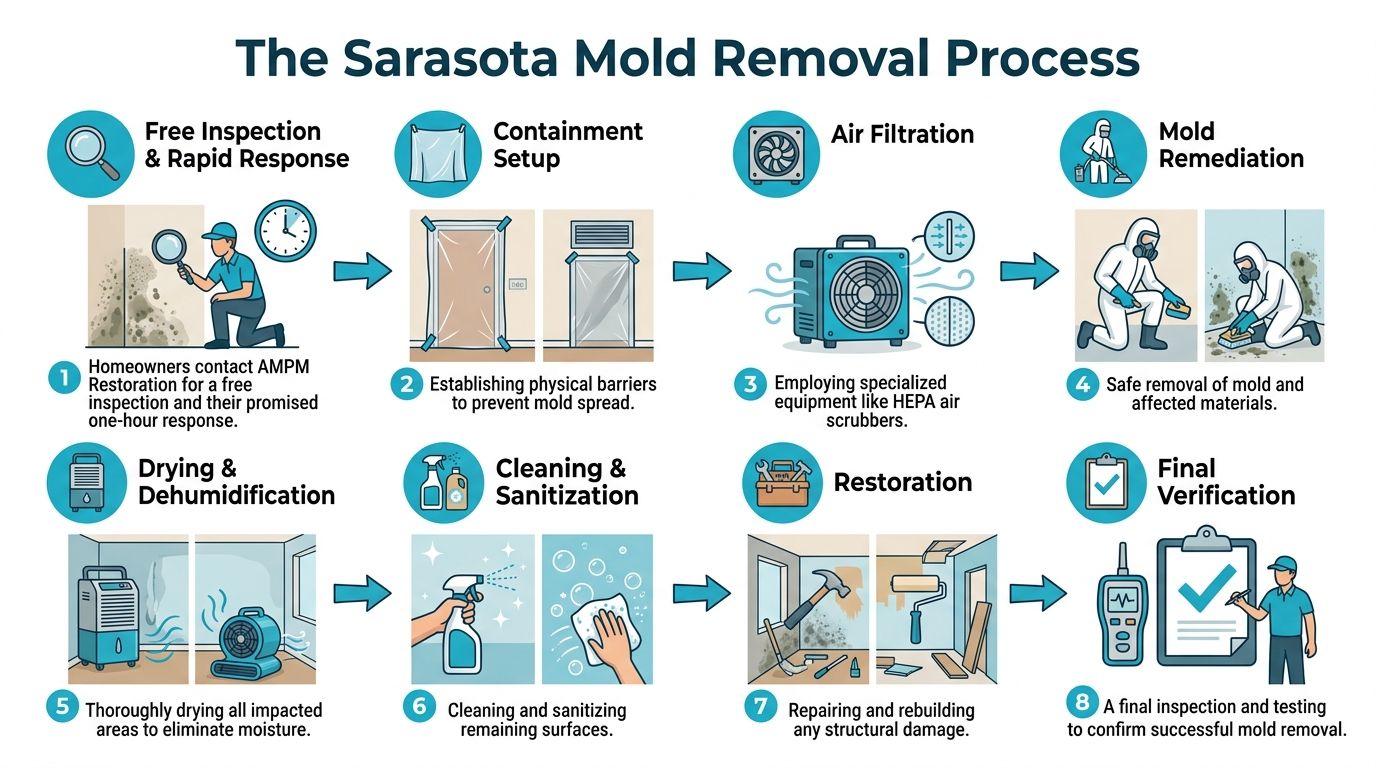
The process starts by isolating the problem
The first task is finding the actual work zone. In Sarasota homes, that may be the obvious stained area, but it may also include the damp drywall around a window, the insulation inside an exterior wall, or the closet around an air handler. Homes near the coast often deal with wind-driven rain, high indoor humidity, and condensation around HVAC equipment, so the visible patch is not always the full footprint.
Containment works like putting plastic walls around a construction zone inside the home. Crews separate the affected area from clean rooms so disturbed spores and dust stay where they can be captured. If you want a clearer breakdown of the roles involved, this comparison between mold assessment and mold remediation explains why testing, scoping, and cleanup are related but different steps.
What crews usually do, step by step
Professional remediation usually moves through a predictable set of actions:
-
Scope the affected materials
Technicians inspect where moisture traveled and which materials absorbed it. In Florida houses, that often means checking drywall, baseboards, insulation, carpet pad, engineered flooring, and wood framing around windows, sliders, bathrooms, and AC closets. -
Set containment barriers
Poly sheeting, zipper openings, and controlled entry points keep the work area separated. This matters in occupied homes because opening a moldy wall without containment can spread particles into hallways, bedrooms, and return vents. -
Run negative air and HEPA filtration
Air machines pull air from the contained area and filter it through HEPA media. The goal is simple. Keep airborne debris from drifting into the rest of the house while demolition and cleaning are underway. -
Remove materials that cannot be cleaned
Porous items such as wet drywall, insulation, carpet, and some ceiling materials often need to be cut out and discarded if mold growth has penetrated them. Homeowners sometimes expect spray-only treatment to solve this, but porous materials behave more like a sponge than a countertop. Once growth gets inside, surface cleaning is usually not enough. -
Clean remaining surfaces in detail
Framing, concrete, tile, and other salvageable materials may be HEPA vacuumed and wiped down. The point is to remove settled dust and fine debris left behind after the damaged materials are gone. -
Dry the area to a stable condition
Removal alone does not fix the source. The area has to be dried so the same moisture problem does not feed new growth. In Sarasota, this step can take extra attention because outside humidity stays high for much of the year, and opening the house during cleanup can slow drying if the space is not controlled properly. -
Repair and rebuild
After cleaning and drying, the removed sections are restored. That may include insulation, drywall, trim, texture, paint, or sections of flooring.
Why removal matters more than spraying
Homeowners often ask about fogging or antimicrobial products. Those tools can support cleaning in the right setting, but they do not replace removing contaminated material.
A simple comparison helps here. If mold is growing on the face of a non-porous surface, cleaning may address it. If mold has grown into drywall or insulation, the material itself has become part of the problem. Spraying over it is similar to sealing a wet sponge in a plastic bag. The moisture and contamination are still there.
How professionals confirm the area is ready for repair
A finished job is judged by condition, not by odor alone. The work area should be visibly clean, dry, and free of debris, and the moisture source should be corrected before rebuilding starts. Depending on the project, post-remediation verification may also be part of the process, especially after larger losses or when a separate assessor is involved.
That extra verification can be useful in Sarasota properties with recurring humidity problems, seasonal occupancy, or insurance documentation needs. One local provider that offers this broader workflow is AMPM Restoration Services, which handles inspection, containment, remediation, drying, repairs, and insurance coordination for Gulf Coast properties.
Estimating Timelines and Insurance Claims
The question most homeowners ask after “How bad is it?” is “What is this going to cost me?” That’s reasonable. Mold work can range from a focused repair in one small area to a larger project involving demolition, drying, and reconstruction.
The best way to think about pricing is by scope, not by stain size alone. A visible patch may be small while the hidden affected area is larger. The opposite can also happen. A broad-looking surface issue may stay relatively contained if moisture never reaches deeper material.
Why does one job cost more than another
Two mold jobs can look similar from the doorway and still price very differently.
Common cost drivers include:
- Material type: Removing contaminated drywall and insulation is different from cleaning a limited hard surface.
- Access difficulty: A simple bathroom wall is easier than a tight attic, crawlspace, or behind built-ins.
- Moisture source: If the leak is ongoing, repair and drying have to happen alongside remediation.
- Reconstruction needs: Costs rise when trim, cabinets, flooring, or wall assemblies must be rebuilt.
- Air control requirements: More containment and filtration equipment usually means a more involved project.
A homeowner should ask for a written scope so the estimate explains what’s being removed, what’s being cleaned, what’s being dried, and what’s being restored.
If you want a broader breakdown of how contractors structure these estimates, this page on mold removal cost 2026 is a useful companion read.
What about project timelines
Timelines depend on moisture, access, and repair needs. A contained issue in a small room may move quickly. A larger problem involving demolition, drying, HVAC isolation, and reconstruction takes longer.
The key is to separate the work into stages:
- Emergency response and inspection
- Containment and removal
- Drying and environmental cleaning
- Repairs and finish restoration
Homeowners often get confused because they hear a one-time estimate for “mold removal,” but that may only refer to the remediation phase, not the rebuild.
Insurance paperwork and reconstruction scheduling can extend the overall calendar even after the contaminated material is gone.
How insurance usually fits in
Mold coverage depends on the cause of loss and the policy language. In everyday terms, insurers often focus on whether the moisture event was sudden and covered, or whether the damage built up over time through maintenance issues.
That means documentation matters. Good photos, moisture findings, repair records, and a clear scope help everyone understand what happened and what work is necessary. Restoration contractors who coordinate with carriers can make the claim process easier by organizing evidence and communicating the mitigation steps already taken.
If insurance doesn’t cover the full scope, some homeowners use financing to handle urgent remediation first and sort out the longer repair budget afterward. That approach can protect the property from getting worse while paperwork catches up.
Hiring Professional Remediation Services
You open a closet in August, catch that musty smell, and call the first company that says they can “treat” it by the afternoon. In Sarasota, that is where homeowners often lose time and money. A proper remediation job works more like a surgical cleanup than a quick spray. The contractor has to isolate the affected area, remove what cannot be saved, clean what can be saved, and address the moisture problem that let mold grow in the first place.
That process matters even more in Sarasota because local homes face a very specific mix of conditions. Long cooling seasons create condensation around vents and registers. Concrete block walls can trap moisture in ways homeowners do not expect. Seasonal occupancy also changes the risk. A house that sits closed for months with the thermostat set high can feel fine at the front door and still hold damp air in closets, garages, and air-conditioned back rooms.
What to ask before you hire
A good interview should feel clear and practical. If the answers sound vague, the work probably will be too.
Ask questions like these:
-
What exactly are you remediating, and how did you confirm the affected areas?
You want more than a glance and a guess. A careful contractor should explain what they observed, what materials are involved, and whether hidden moisture is likely. -
What will stay in the house, and what has to be removed?
Mold on a non-porous surface is a different problem than mold growing through drywall, insulation, carpet pad, or particle board cabinetry. Sarasota homes often have materials that swell or break down quickly after repeated humidity exposure. -
How will you keep spores from spreading through the home?
Listen for plain-language discussion of containment, filtered air scrubbing, and controlled demolition. If a crew plans to tear into a wall near the return side of the HVAC system, they should be able to explain how they will keep the rest of the house from becoming part of the job. -
Who is handling the moisture source?
Remediation and moisture correction have to connect. That could mean a roof repair, plumbing repair, drainage correction, AC condensate repair, or better dehumidification. -
What documentation will I receive?
Homeowners in Sarasota often need photos, moisture readings, and a written scope for insurance discussions, property managers, or a future buyer.
Green flags and red flags
Hiring the right company is a lot like hiring the right roofer after a storm. The test is not the sales pitch. The test is whether the contractor can explain the building problem in plain English.
Good signs include:
- A written scope that names the affected materials and rooms
- A containment plan for occupied homes
- Moisture testing, not just visual inspection
- Clear explanation of whether HVAC components are involved
- Coordination with plumbers, roofers, or AC contractors if needed
- Post-remediation guidance for cleaning and prevention
Use extra caution if a company:
- Offers a price before inspecting the property
- Promises to solve the issue with fogging or spraying alone
- Avoids questions about drywall, insulation, cabinets, or flooring
- Cannot explain how they will protect the unaffected rooms
- Talks about odor removal but not moisture control
One more local detail matters here. Sarasota homes with laundry equipment inside conditioned space, garage conversions, or older windows often develop mold from repeated low-grade humidity, not one dramatic event. That is why a contractor should ask about AC performance, seasonal shutdowns, and appliance maintenance. If your issue started around the laundry area, it also helps to review how to disinfect a washing machine to banish mold so the appliance does not keep feeding the problem.
Sarasota Home Restoration
A local remediation company should understand how Florida buildings behave. Salt air, storm-driven rain, high outdoor dew points, and long AC runtimes create moisture patterns that a generic mold checklist can miss. For example, a wall may test damp not because of a plumbing leak, but because humid outdoor air is entering around an older window assembly and condensing on cooler interior surfaces.
Insurance and condo rules can also shape the job. In Sarasota, condo owners may need to sort out whether the unit owner, association, or master policy handles parts of the damage. A contractor who has worked in local condos, ranch homes, and seasonal properties is more likely to document the loss in a way that matches those real-world questions.
For homeowners who want to screen a company’s prevention advice while comparing bids, this full home guide to preventing mold is a useful reference. A qualified contractor should give recommendations that line up with the basic physics of moisture control, not just a list of products.
The best hire is the company that can walk you through the job room by room, material by material, and moisture source by moisture source. If they can teach you what happened in your home, they are far more likely to fix the right problem.
Preventing Mold in Florida Homes
A Sarasota home can feel dry because the AC is running all day, while hidden areas stay damp enough for mold to grow. That mismatch catches many Florida homeowners off guard. The air in the living room may seem fine, but a closet on an exterior wall, the space under a sink, or the laundry room can hold moisture much longer.
The humidity rule that matters
For prevention, indoor humidity should stay low enough that moisture does not settle on cool surfaces and feed growth. In Sarasota, that usually means paying attention during long wet stretches, summer afternoons, and any period when the house sits closed up.
Florida homes make this tricky for a few local reasons. Block construction can hold moisture after wind-driven rain. Older windows and sliding doors can let humid outdoor air leak inside. Seasonal homes often stay shut for weeks, which lets small moisture problems build.
A good rule is simple. If a room smells musty, feels clammy, or stays cooler than nearby rooms, treat it as a warning sign even if you do not see staining yet.
A practical prevention checklist
Prevention works like brushing your teeth. Small routines done often beat one big cleanup later.
- Run exhaust fans where moisture starts. Use bath fans during showers and long enough afterward to clear steam from mirrors and walls.
- Check small leaks before they become wall leaks. Look under sinks, around toilets, near water heaters, and behind refrigerators.
- Inspect after heavy rain. In Sarasota, storm water often shows up first at window corners, ceiling edges, and exterior-facing baseboards.
- Keep air circulating in quiet rooms. Guest rooms, closed closets, and bonus rooms often trap humid air.
- Watch appliance zones closely. Washing machines, dishwasher connections, and AC drain lines create slow, easy-to-miss moisture.
One overlooked task is appliance cleaning. If your laundry area smells musty, learning how to disinfect a washing machine to banish mold can help prevent a small source of moisture and odor from affecting the room around it.
Build a Florida-friendly routine
The best prevention plan fits the way Sarasota homes age and operate. A newer inland home may struggle with garage humidity and AC drain issues. A coastal condo may deal with salt air, closed-up periods, and condensation near sliders. An older ranch house may have trouble around window seals, attic transitions, or rooms that were added later and never balanced well for airflow.
That is why a room-by-room routine works better than a generic checklist. This full home guide to preventing mold is useful if you want a practical plan for bathrooms, kitchens, laundry areas, closets, and HVAC trouble spots.
Keep the routine simple.
- After storms, check windows, ceilings, and exterior walls.
- After any plumbing repair, look at the same area again a few days later.
- During humid months, pay extra attention to closets, supply vents, and rooms that stay shut.
- If a musty smell appears, inspect right away instead of waiting for visible growth.
Homeowners who stay ahead of moisture usually avoid the larger remediation jobs. In Florida, mold prevention is less about one product and more about catching damp conditions early, before they get time to spread.
FAQs and Final Steps
When homeowners understand mold, they make better decisions faster. That matters in Sarasota, where moisture problems can hide behind finished surfaces and grow until repairs become much larger than expected.
The best approach is straightforward. Confirm the moisture source. Contain the area if contamination is active. Remove damaged porous materials when needed. Dry the structure thoroughly. Then restore the home so it’s safe, functional, and comfortable again. That’s the heart of effective sarasota mold removal.
Frequently asked questions
Is mold removal the same as mold inspection?
No. Inspection identifies the likely source, scope, and affected materials. Removal is the controlled process of containment, cleaning, demolition where needed, drying, and restoration.
Can I clean mold myself with bleach?
Surface cleaning may improve appearance in limited cases, but bleach doesn’t solve hidden moisture or deep contamination inside porous materials. That’s why professional remediation often requires removal, not just spraying.
Do I always need testing?
Not always. In many homes, visible growth plus a known moisture source is enough to justify remediation. Testing becomes more useful when the source is unclear, the growth is hidden, or verification is needed after cleanup.
Will mold come back after professional remediation?
It can return if the moisture problem remains. Proper remediation lowers that risk by combining removal with drying and moisture correction.
How do I know if mold is behind the walls?
Clues include musty odor, soft drywall, bubbling paint, staining, warped baseboards, or symptoms that get worse in one room. Hidden growth often needs professional inspection to confirm.
Will insurance help pay for mold removal?
That depends on the policy and the cause of loss. Coverage often hinges on whether the moisture event was sudden and covered versus gradual and maintenance-related.
If you need sarasota mold removal, call AMPM Restoration Services at 941-946-7807 for a free inspection and estimate. The team is available 24/7, provides insurance claim assistance, and offers financing options to help you move quickly when mold, leaks, or storm damage put your property at risk.