

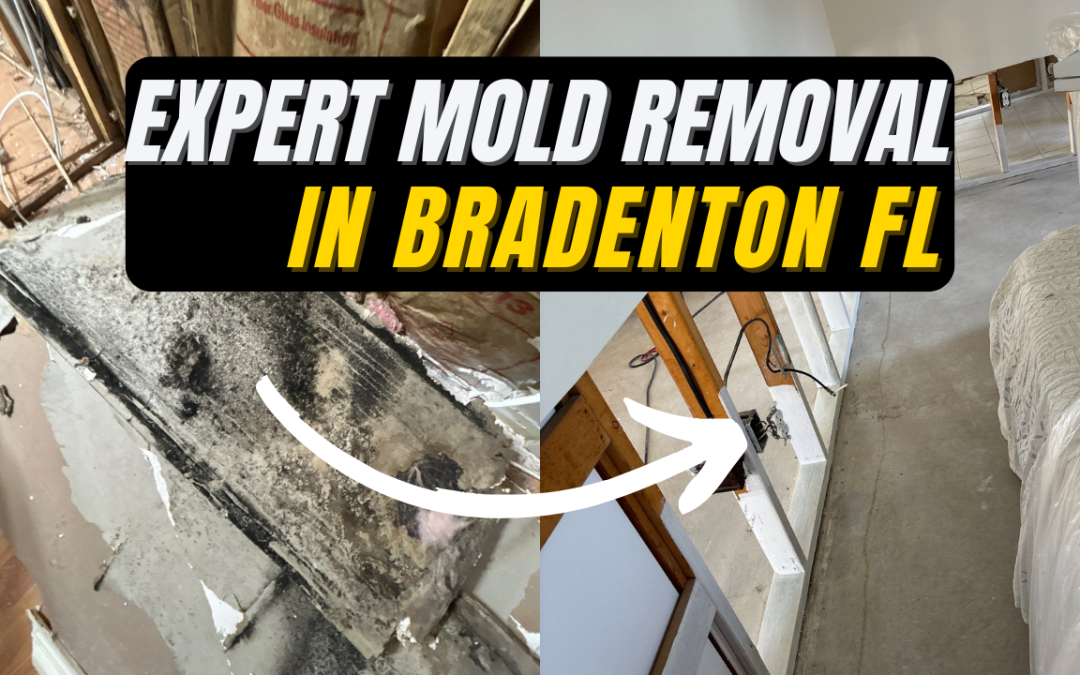
If you are dealing with a musty room, a wall stain that keeps growing, or an AC system that suddenly smells off, you are probably not just dealing with a cosmetic issue. In this climate, mold removal in Bradenton FL, often start with something small: a slow plumbing leak, a roof drip after a storm, damp drywall near a window, or flooring that never fully dried after water intrusion.
Bradenton properties do not get much margin for delay. Moisture lingers, air stays heavy, and mold takes advantage of both. That is why a professional response has to move quickly, document the cause, contain the spread, and restore the space in a controlled way that protects both the building and the people inside it.
Bradenton Mold Problems Start Small But Grow Fast
A common Bradenton scenario starts with a harmless-looking water spot. The homeowner wipes it, runs the AC lower, maybe sprays a store-bought product, and assumes the problem is handled. A few days later, the odor gets stronger. Then the paint bubbles, the baseboard swells, or the closet starts smelling damp every time the door opens.
That pattern is common in this region because Florida creates ideal mold conditions. Florida ranks as the top mold risk state in the nation with a 2025 risk score of 9.4 out of 10, and in areas like Bradenton, where humidity often exceeds 70% year-round, up to 70% of post-flood properties develop visible mold within 48-72 hours if not professionally remediated (moldremediationbradenton.com).
Why small leaks become major problems here
Bradenton homes and commercial buildings deal with long cooling seasons, heavy rain, coastal moisture, and storm-related water intrusion. Even when the visible water disappears, damp framing, insulation, subflooring, and wall cavities can remain wet enough to support mold growth.
The danger is not just what you can see. It is what stays hidden behind drywall, under cabinets, inside HVAC components, and around window framing.
Practical takeaway: If a surface stayed wet, felt humid, or smelled musty after a leak or flood event, treat it like a mold-risk area until it is properly inspected.
What urgent response should look like
A proper response starts with speed, but speed alone is not enough. The goal is to stop ongoing moisture, identify affected materials, and keep contamination from spreading into clean areas.
In Bradenton, that often means:
- Checking concealed moisture: Walls, ceilings, flooring transitions, and cabinetry can hold water long after surfaces appear dry.
- Separating the moisture event from the mold event: The water source has to be addressed, or mold will return.
- Moving early on documentation: Fast records matter for both scope of work and potential insurance support.
When people call during the first signs of a mold problem, the work is usually cleaner, more contained, and less disruptive than when they wait for visible growth to spread across multiple rooms.
Recognizing Mold Growth In Your Bradenton Property
Mold is not always obvious. In Bradenton homes, some of the earliest clues show up as odor, texture changes, or recurring irritation rather than dramatic black staining on a wall.
If you want a broader homeowner checklist, this guide on 8 unmistakable signs of mold in your house is a useful companion to what restoration teams look for on site.
Sensory signs that deserve attention
The first warning is often smell. A musty odor that gets stronger when the AC starts up usually points to hidden contamination, lingering moisture, or HVAC involvement.
Watch for:
- Persistent musty odor: Especially in closets, laundry rooms, under sinks, around air vents, or after rain.
- Odor that comes and goes: That often suggests airflow is moving spores or moisture-related particles through the space.
- A damp smell in one room only: Localized odor often means a hidden source behind a nearby wall, vanity, or baseboard.
Visual clues people often dismiss
Not all mold appears as dark circular spotting. In the field, many problem areas show up first as material breakdown caused by moisture.
Look closely for:
- Discoloration: Yellowing, brown staining, greenish spotting, or uneven darkening on drywall and ceilings.
- Peeling paint or bubbling texture: Moisture pushes finishes away from the substrate.
- Warped trim or flooring: Swelling and cupping often indicate a moisture condition that can support mold growth.
- Soft drywall: If the wall feels weak or crumbly, contamination may extend deeper than the surface finish.
Signs tied to your HVAC system
In Bradenton, central air can hide and spread mold-related issues. If a room smells normal until the system runs, the HVAC path needs attention.
Common clues include:
- A musty burst when the unit kicks on
- Dust around vents that smells stale or damp
- Recurring residue near supply registers
- One zone that always feels clammy
For more localized homeowner warning signs, this internal guide on five signs of mold damage in homes gives a practical overview of what to watch for before damage gets wider.
Occupant symptoms that match the building
A building problem often shows up in people before it shows up on surfaces. If symptoms improve when someone leaves the property and return when they come back, indoor contamination should be considered.
Pay attention to:
- Recurring allergy-like symptoms
- Eye, nose, or throat irritation
- Coughing that worsens indoors
- Headaches tied to certain rooms or AC use
When to stop inspecting and start calling
Homeowners should absolutely pay attention to these clues, but there is a limit to what visual checks can confirm. Hidden moisture, contaminated porous materials, and HVAC spread require equipment and controlled testing methods.
Rule of thumb: If you smell mold, see material changes, or know a leak or flood happened, schedule a professional assessment instead of waiting for growth to become obvious.
Health and Structural Dangers Of Unchecked Mold
Mold is not just a surface-cleaning issue. Once it establishes itself in a damp building assembly, it affects both the indoor environment and the materials that hold the property together.
What mold does to indoor health
People do not all react the same way. Some notice irritation quickly. Others live with fatigue, congestion, or respiratory discomfort for weeks before they connect it to the building.
Verified local guidance notes that untreated mold can pose health risks affecting 25% of the population with allergies or respiratory issues (moldremediationbradenton.com). That matters in occupied homes, rentals, offices, and properties with children, older adults, or anyone already dealing with asthma or sensitivity.
The most common concerns include:
- Respiratory irritation: Coughing, wheezing, throat discomfort, and chest tightness.
- Allergic response: Sneezing, watery eyes, congestion, and skin irritation.
- Ongoing exposure stress: Symptoms can linger when occupants continue breathing contaminated air from affected rooms or ductwork.
For a deeper look at occupant impacts, AMPM’s resource on 10 health effects of mold exposure outlines the kinds of reactions property owners should take seriously.
What mold does to building materials
Mold feeds on organic material found in common construction assemblies. Drywall paper, wood framing, insulation facings, trim, cabinets, and stored contents can all become part of the problem.
The progression often looks like this:
| Material | Early damage | Advanced concern |
|---|---|---|
| Drywall | Staining, odor, paint failure | Softness, loss of integrity, removal required |
| Wood trim and framing | Surface growth, swelling | Deep contamination, structural weakening over time |
| Insulation | Dampness, odor retention | Hidden contamination, poor drying, replacement needed |
| Flooring systems | Warping, cupping, edge swelling | Contaminated subfloor and trapped moisture below finish floor |
Why delay gets expensive
When owners wait, contamination tends to move from a localized cleanup into demolition, drying, content cleaning, and reconstruction. Verified local data notes that untreated mold can reduce property values by 10-20% and that remediation expenses can escalate from $500 for minor issues to $10,000 for extensive water and mold damage (moldremediationbradenton.com).
That is why experienced restoration teams do not look at mold as a stain problem. They look at it as a combined health, moisture, and material failure problem that has to be solved at the source.
Key point: If mold is visible, the actual affected area may extend beyond what is visible. Drywall, framing cavities, insulation, and HVAC pathways often tell a bigger story than the surface does.
Why Professional Mold Remediation Is Non-Negotiable
Many people try to handle mold with bleach, vinegar, aerosol sprays, or a quick wipe-down. That approach feels cheaper and faster, but in Bradenton’s climate it often turns a contained problem into a wider contamination event.
Why DIY fails
The basic problem is that mold is not only what you see on the surface. Spores move through the air, settle into dust, and take hold where moisture remains. Surface products do not address concealed dampness or contamination inside porous materials.
Verified local cost and service data states that DIY mold removal methods fail in approximately 80% of cases in Florida’s coastal environments due to invisible spore spread and hidden moisture (homeyou.com).
Common DIY mistakes include:
- Spraying bleach on drywall or wood: Bleach may change the appearance of staining without solving the underlying contamination.
- Scrubbing without containment: Disturbing growth can release spores into nearby rooms.
- Painting over affected areas: Encapsulation without proper removal traps the issue instead of correcting it.
- Ignoring moisture mapping: If the water source remains, mold returns.
What professionals do differently
Professional remediation follows a controlled process. The work is built around source correction, containment, filtration, removal, detailed cleaning, and verification.
Professional mold removal in Bradenton FL services differ from handymen, janitorial cleanup, or a homeowner weekend project in this regard. Certified teams use tools and methods designed for contamination control, not just appearance.
A good starting point for understanding that threshold is this internal resource on when do I need professional mold removal.
Cost trade-offs that matter
People often delay because they want to avoid a restoration bill. In practice, delay usually shifts a smaller inspection and remediation scope into a larger reconstruction scope.
Verified local pricing shows that professional mold inspection and remediation for a 500-square-foot area averages around $357 (homeyou.com). That should not be treated as a universal quote for every project, but it does show why early professional action is often the less expensive decision compared with repeated failed cleanup, recurring odors, and hidden damage.
Trade-off to remember: DIY feels cheaper on day one. Proper remediation is usually cheaper by the time the issue is resolved.
AMPM Restoration’s IICRC-Certified Mold Removal Process
Mold remediation works best when every step is deliberate. Random cleanup creates random results. A standards-based process gives the property a real path from contamination to clearance.
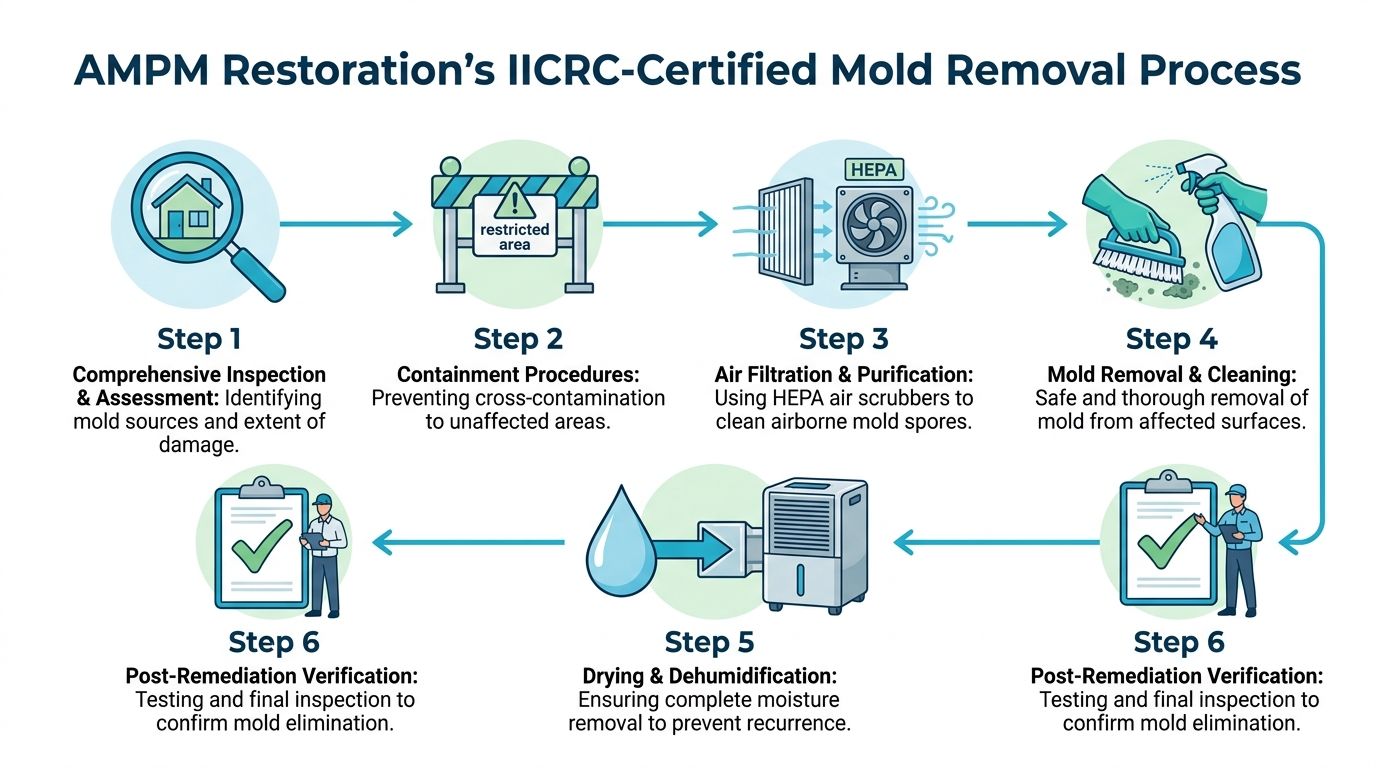
Inspection and moisture assessment
The first job is not removal. The first job is figuring out where moisture came from, how far contamination traveled, and which materials are salvageable.
Technicians use tools such as:
- Moisture meters: To identify wet drywall, wood, and flooring assemblies.
- Infrared cameras: To spot temperature differences that can point to concealed moisture.
- Air and surface sampling when needed: To help identify the contamination profile and support a remediation plan.
In Bradenton, this step matters because visible mold often represents only part of the affected area. The full scope can include wall cavities, cabinet backs, insulation, and nearby HVAC components.
Containment that prevents spread
Once the affected area is defined, the next priority is preventing cross-contamination. That means isolating the work zone from the rest of the property.
According to IICRC S520 standards, professional remediation requires negative air pressure containment and HEPA air scrubbers, and those systems can capture up99.97% of airborne mold spores, preventing cross-contamination and reducing spore counts by over 90% (puroclean.com).
Containment typically includes:
- Polyethylene barriers: To isolate affected rooms or sections.
- Negative air machines: To keep contaminated air from drifting into clean areas.
- Controlled entry and exit: So workers do not track particles through the building.
Air filtration during active remediation
HEPA filtration is not an optional add-on. It is central to safe work. Once moldy materials are disturbed, airborne particles rise quickly. Air scrubbers continuously pull contaminated air through high-efficiency filtration while the work is underway.
That matters in homes with children, pets, sensitive occupants, or shared HVAC systems. It also matters in commercial spaces where neighboring rooms need protection.
Removal, cleaning, and material decisions
Not every material can be saved. Non-porous and some semi-porous surfaces may be cleaned if the contamination is limited and the material remains structurally sound. Heavily affected porous materials usually need removal.
Typical decisions include:
- Drywall and insulation removal when contamination extends through the assembly.
- HEPA vacuuming and damp wiping on salvageable surfaces.
- Detailed cleaning of settled dust and debris so the space is not left with residual contamination.
- Targeted antimicrobial treatment where appropriate after physical removal and cleaning.
This is also where clear judgment matters. Over-demolition wastes money. Under-removal leaves a problem behind.
For property owners comparing scopes of work, this guide on mold assessment vs mold remediation helps explain why inspection alone is not the same as corrective work.
Drying and source correction
No mold project is complete until the moisture issue is corrected. That could mean leak repair, drainage correction, drying wet structural materials, or adjusting ventilation and humidity control.
A cleaned surface in a still-damp wall is not a completed remediation. It is a delayed callback.
Final verification and return to service
At the end of the project, the work area should be cleaned, dried, and ready for verification. Depending on the project, that can include visual review, moisture confirmation, and post-remediation testing.
One provider serving this region, AMPM Restoration Services, handles mold remediation with emergency response, drying, sanitization, repairs, and insurance coordination for residential and commercial properties. What matters most for the owner is that the contractor follows a complete protocol rather than treating mold as a one-step cleaning job.
What good remediation feels like: The area no longer smells damp, the moisture source is corrected, affected materials have been properly handled, and the property has a clear path back to safe occupancy.
Protecting Your Air Quality With HVAC and Duct Cleaning
One of the most overlooked parts of mold remediation is the HVAC system. A wall can be cleaned and rebuilt, but if spores remain in ductwork, on interior components, or in connected airflow paths, the property can keep smelling musty and keep cycling contamination.
Why duct verification matters after remediation
In humid climates, skipping post-remediation HVAC work creates a real recurrence risk. Verified guidance for this topic notes that an estimated 15-25% of mold problems return within 6 months if post-remediation HVAC duct cleaning and verification are skipped (fprestoration.com).
That happens because the HVAC system can act like a distribution path. Spores and contaminated dust move through returns, handlers, coils, and supply ducts, then re-enter cleaned rooms after the main remediation is complete.
What thorough HVAC follow-up includes
A proper post-remediation HVAC review should answer practical questions, not just offer vague reassurance.
That usually means:
- Inspecting whether the system was affected: Not every mold job requires full duct cleaning, but every mold job should consider HVAC exposure.
- Cleaning affected ductwork and components, especially when contamination entered the air path.
- Verifying the result: The homeowner should know whether the ducts were assessed, what was cleaned, and whether the system is suitable to run normally again.
For homeowners trying to understand this process, AMPM’s guide on how to remove mold from air ducts explains why ductwork cannot be treated as an afterthought.
Where HVAC contractors fit in
Some projects also need mechanical evaluation, especially if poor airflow, drainage issues, or equipment performance contributed to the moisture problem. In those situations, working with qualified HVAC services can help resolve the conditions that made mold easier to sustain in the first place.
Missed step to avoid: If the mold smell disappears during cleanup but returns when the AC starts, the job is not finished until the HVAC side has been evaluated.
Navigating Insurance Claims And Financing For Mold Damage
Mold work is stressful enough without fighting through claim language, coverage questions, and documentation problems. In Florida, the financial side of the job can be almost as frustrating as the remediation itself.
Why claims get denied
Mold claims often turn on one issue: what caused the moisture. Insurers may treat a sudden leak differently from a long-term maintenance problem. If the source is poorly documented, the property owner may end up arguing about timing, neglect, or whether the damage was preventable.
State data from the Florida Office of Insurance Regulation shows that roughly 35% of mold-related insurance claims are denied annually, and success often depends on proving a sudden and accidental water source (ampmrestorations.com).
What helps a claim
The strongest claims usually include:
- Fast reporting: Delay makes cause-and-timeline disputes more likely.
- Clear moisture-source documentation: Leak origin matters.
- Photos and written scope notes: The building should tell a consistent story.
- Professional assessment: A trained team can distinguish active moisture, historic damage, and affected materials.
Financing matters when coverage is limited
Even when coverage exists, deductibles, exclusions, and partial approvals can leave owners with a gap. Financing options matter in those moments because mold usually does not wait for paperwork to become convenient.
For many Bradenton owners, the practical path is simple. Start remediation early enough to limit spread, preserve documentation from the first inspection forward, and make coverage decisions with a contractor who understands how Florida claims are reviewed.
Your 24/7 Bradenton Restoration Partner
Mold problems in this region rarely stay small on their own. A damp wall cavity, a flooded room, an AC system carrying odor, or a recurring bathroom leak can move from nuisance to real contamination faster than most owners expect.
That is why mold removal in Bradenton FL, has to be handled with discipline. The property needs moisture investigation, containment, HEPA filtration, material judgment, cleaning, HVAC review when needed, and a clear plan for final restoration. Shortcuts usually show up later as odor, repeat growth, or disputed insurance damage.
Bradenton owners also need practical support, not vague advice. They need a team that can respond day or night, inspect the loss, document the cause, explain what can be saved, and walk them through the next step without adding confusion.
What people usually want to know first
Most callers are trying to answer a few urgent questions:
- How bad is this really?
- Is it safe to stay here?
- Do I need testing, remediation, or both?
- Will insurance help?
- How do I keep this from returning?
Those are the right questions. Good remediation is not just removal. It is a controlled return to a safe, dry, stable indoor environment.
Frequently Asked Questions
How long does the mold removal process take in Bradenton?
The timeline depends on the extent of the mold growth and water damage. A small, contained issue, such as under a sink, may take a few days. More extensive contamination affecting multiple rooms or structural elements can take longer.
After a free inspection, the contractor should provide a written scope and realistic timeline so you know what to expect before work begins.
Is the mold removal process safe for my family and pets?
Yes, when the work is performed correctly. Proper remediation uses containment barriers, negative air pressure, HEPA filtration, and personal protective equipment so contamination stays inside the work zone instead of spreading through the property.
Occupants and pets should stay out of the affected area until cleanup and verification are complete.
What is the difference between mold removal and mold remediation?
Mold removal is one part of the larger remediation process. Remediation includes inspection, moisture identification, containment, air filtration, physical removal of contaminated materials, cleaning, drying, and correcting the source that allowed mold to grow.
That bigger process is what prevents the same issue from returning.
Can I stay in my home during the mold remediation process?
Sometimes yes, sometimes no. If the contamination is isolated to a small contained area, many homeowners can remain in the property while avoiding the work zone.
If the job involves large affected areas, significant demolition, or HVAC contamination, temporary relocation may be the safer and more comfortable option.
How can I prevent mold from returning after remediation?
The moisture source has to be fixed first. After that, keep the property dry, use exhaust fans where needed, address leaks immediately, and have the HVAC system evaluated if musty odor returns when air starts moving.
In Bradenton, humidity control and fast leak response matter more than many realize.
Do you offer a warranty or guarantee on mold removal services?
AMPM Restoration states that it offers a 100% satisfaction guarantee as part of its service approach, as described in the company background provided for this article. Property owners should always ask what post-remediation verification is included, what repairs are part of the scope, and how completion is documented before the project starts.
If you need mold removal in Bradenton FL, service now, call 941-946-7807 for a free inspection and estimate. AMPM Restoration serves Bradenton, Sarasota, Tampa Bay, Saint Petersburg, Lakewood Ranch, and nearby Gulf Coast communities with 24/7 emergency response, insurance claim assistance, and financing options to help you move from damage to recovery with less stress.
If you need help now, contact AMPM Restoration Services at 941-946-7807 for a free inspection and estimate. The team provides 24/7 emergency response, insurance claim assistance, and financing options for mold, water, storm, fire, and reconstruction work across Bradenton and the surrounding Gulf Coast communities.