

A musty smell in a Sarasota office usually shows up before anyone sees staining. It starts near an AC register, behind a retail stockroom wall, or around a baseboard after a roof leak or plumbing issue. Then employees mention irritation, a tenant asks questions, and you’re left balancing health concerns, tenant expectations, cleanup logistics, and whether insurance will fight the claim.
That’s why commercial black mold removal services sarasota can’t be treated like janitorial work. In Gulf Coast buildings, mold is almost never just a surface problem. It’s a moisture problem first, an indoor air problem second, and a business continuity problem the whole time.
Protect Your Sarasota Business from Black Mold
A Sarasota business owner usually calls after one of three things happens. Someone smells something earthy that won’t go away. A maintenance tech opens a wall and finds dark growth on drywall paper. Or a storm, roof failure, plumbing leak, or AC drain problem leaves part of the building damp longer than expected.
In commercial settings, the risks are greater than they are in a spare bedroom or garage. You may have staff, customers, tenants, inventory, and shared HVAC all tied to the same issue.
What business owners notice first
The first sign often isn’t visible black mold. It’s a pattern.
- Odor complaints: Staff describe a stale, musty smell that gets stronger after rain or overnight HVAC cycling.
- Localized staining: Ceiling tile spotting, bubbling paint, warped base, or dark caulking near wet areas.
- Recurring moisture: The same suite, closet, or back room keeps feeling damp even after cleaning.
- Air handling concerns: Occupants feel worse in one zone of the building than another.
When that happens, speed matters. Not because panic helps, but because delay gives moisture more time to stay in the assembly.
On the ground in Sarasota: The buildings that are easiest to stabilize are usually the ones where ownership acts on odor and moisture clues before visible spread gets extensive.
Florida’s climate makes that harder. Coastal humidity keeps materials from drying as fast as owners expect, especially inside wall cavities, under flooring transitions, around storefront framing, and near HVAC components. If you’re also working to reduce indoor moisture after cleanup, practical humidity control solutions can help support the long-term side of prevention.
Why a small leak becomes a larger commercial problem
Commercial mold jobs rarely stay isolated if the source is ignored. A slow roof intrusion above office suites can affect insulation, metal framing, ceiling systems, and returns. A condensate issue can move from a utility closet into adjacent tenant space. A flood event can leave hidden wet pockets long after floors look dry.
For owners who want a plain-language primer on how mold starts in the first place, this overview on what causes black mold in homes applies to many of the same moisture dynamics found in small commercial properties too: https://ampmrestorations.com/what-causes-black-mold-in-homes/
The right response is controlled, documented, and technical. That means identifying the moisture source, defining the affected area, isolating contamination, removing compromised material where necessary, drying the structure correctly, and verifying conditions before normal occupancy resumes.
The Risks of Black Mold in Commercial Properties
In Sarasota commercial buildings, black mold isn’t just an ugly wall problem. It creates four different kinds of exposure at once. Health exposure, building damage, operational disruption, and reputation risk.

Health liability inside occupied spaces
In Sarasota, Florida, black mold can begin growing within 24-48 hours after water exposure, incomplete remediation can lead to recurrence rates as high as 50% within a year if structural drying is neglected, and up to 20% of exposed occupants can experience respiratory issues, according to the local property insurance analysis citing EPA guidance and CDC-related health concerns at sarasotalaw.org.
That matters more in commercial buildings because occupancy is continuous. You may have employees working full shifts, customers entering and leaving, and tenants who expect safe indoor conditions.
Common trouble spots include:
- Shared HVAC zones: Spores and odor concerns don’t always stay in the room where growth started.
- Break rooms and restrooms: Ongoing moisture and poor drying can keep contamination active.
- Storage areas: Cardboard, drywall, and insulation provide mold with what it needs once they stay wet.
- Reception and customer-facing spaces: Even minor visible growth creates immediate concern.
If you want a practical overview of how exposure can affect occupants, this page on mold exposure health effects is a useful reference for owners and managers.
Structural damage and business interruption
Mold feeds on organic material in building assemblies. Drywall paper, ceiling tile, insulation facings, wood trim, and stored contents can all be affected. In a commercial property, that doesn’t just create repair work. It interferes with use of the space.
A retail operator may lose a stockroom. An office may need to relocate staff from affected suites. A restaurant, salon, clinic, or professional office may have to limit access to parts of the building while containment is in place.
Here’s the practical trade-off:
| Issue | If ignored | If handled early |
|---|---|---|
| Moisture source | Keeps feeding growth | Can be corrected before spread widens |
| Occupied area | Odors and complaints continue | Impact can often be limited to contained zones |
| Repair scope | More materials may need removal | Fewer assemblies may be affected |
| Reopening confidence | Harder to reassure staff and tenants | Clearance and documentation support decisions |
Brand and tenant confidence
A mold problem can become a trust problem. Employees talk. Tenants compare notes. Customers notice odors and stained finishes even if they never see active remediation.
Indoor comfort also ties into broader building management. Good remediation fixes contamination, but long-term prevention also depends on ventilation and moisture control. For owners reviewing broader building performance, maintaining optimal Indoor Air Quality is part of the same conversation.
Buildings don’t lose trust because one leak happened. They lose trust when the leak keeps happening and nobody can show that the problem was fully corrected.
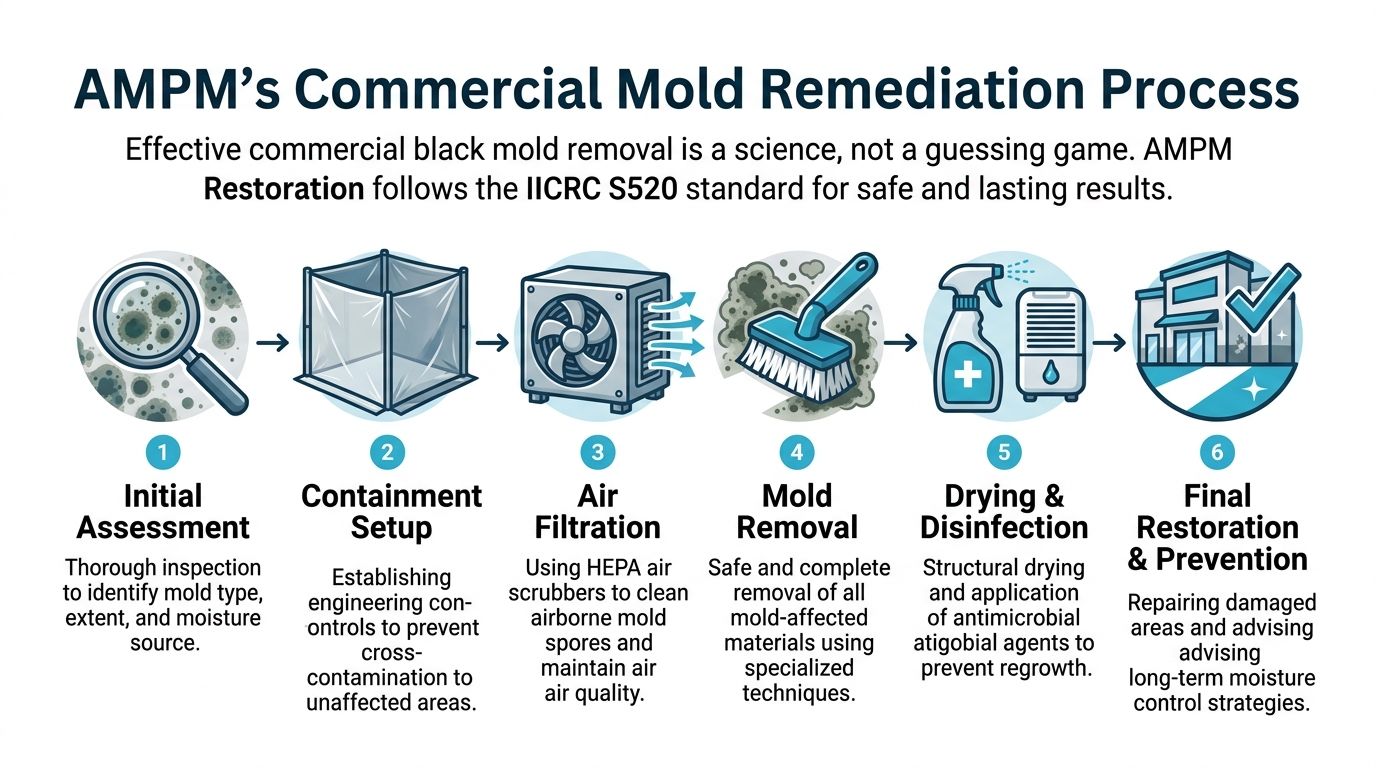
AMPMs Step-by-Step Commercial Mold Remediation Process
A Sarasota business owner usually sees the problem after operations are already being affected. A musty complaint from staff, staining above a tenant suite, or a failed inspection after a roof leak often starts the call. At that point, the job is not just removing mold. It is containing the loss, protecting unaffected areas, documenting the work for the carrier, and keeping downtime as controlled as possible.
Initial assessment and moisture mapping
The first move is a site assessment that defines the actual scope of contamination and the moisture source feeding it. On commercial properties, that means more than checking visible growth. The team needs to review surrounding assemblies, nearby suites, mechanical systems, and the way the space is used so the work plan fits business operations.
A proper assessment often includes:
- Visual inspection of finishes, penetrations, and suspect materials
- Moisture readings on nearby walls, floors, and ceilings
- Thermal or related diagnostic review to identify hidden wet areas
- Occupancy and workflow review so containment and work hours fit the tenant or business schedule
This stage also separates cosmetic staining from active mold contamination. That distinction affects scope, cost, and insurance documentation. A clear explanation of the difference between mold assessment and mold remediation helps owners avoid paying for the wrong service first.
Containment and pressure control
Containment keeps a localized loss from becoming a building-wide problem. If affected material is opened without barriers, negative pressure, and controlled access, spores can spread into hallways, returns, neighboring suites, and occupied work areas.
According to the IICRC S520 process details summarized at goaboveandbeyond.us, remediation uses negative air pressure of 0.02-0.03 inches water gauge through HEPA scrubbers with 99.97% efficiency at 0.3 microns, and post-remediation verification confirms spore counts below the 500-1000 spores/m³ baseline.
For a Sarasota commercial job, containment planning also has to account for access points, delivery routes, after-hours work, and whether parts of the building can stay open. Good setup limits interruption. Poor setup creates new complaints from unaffected tenants.
A commercial containment plan may include:
- Poly barriers and sealed entries: To isolate the work zone from occupied space
- Negative air machines: To keep airflow moving into containment
- HVAC isolation: To reduce distribution through ductwork
- Controlled worker access: To keep debris and dust out of clean areas
Practical rule: If the plan is to open the wall and spray a product, the contractor is skipping core remediation controls.
Physical removal of affected materials
Commercial owners often want to know whether materials can be cleaned or have to be removed. The answer depends on the material, the level of growth, and how long the moisture remained in place. Drywall, insulation, ceiling tile, and other porous materials frequently need removal because contamination extends below the surface.
Standard material removal work includes:
- Removing unsalvageable porous materials
- HEPA vacuuming settled particulate
- Damp wiping and detail cleaning salvageable non-porous or semi-porous surfaces
- Bagging and disposing of debris from within containment
Methods that create trouble later include painting over staining, fogging cavities without removal, or relying on bleach as a cure-all. The same IICRC-based source above notes that bleach is prohibited on porous surfaces because its high water content can worsen conditions in those materials.
This is usually the point where insurance questions intensify. Carriers often want to see why specific materials were removed, how far contamination extended, and whether the moisture source was sudden, long-term, or tied to a maintenance issue. Good field documentation matters as much as the physical labor.
Air filtration and structural drying
After demolition and cleaning, the structure has to be dried to a condition that does not support renewed growth. Florida buildings make this harder. Outdoor humidity, frequent rain events, and HVAC loads can slow drying and cause moisture to rebound if equipment is removed too early.
Drying on commercial jobs usually involves coordinated use of:
| Equipment or method | Why it matters |
|---|---|
| HEPA air scrubbers | Reduce airborne particulate during active remediation |
| Dehumidification | Pull moisture from the air so materials can release trapped water |
| Air movement | Supports evaporation where appropriate |
| Targeted demolition openings | Allows inaccessible wet cavities to dry correctly |
| Moisture monitoring | Confirms the structure is trending toward dry conditions |
The strategy changes by property type. A medical office with strict occupancy limits, a restaurant with heavy humidity loads, and a multi-tenant office floor with shared HVAC all require different drying decisions. On active commercial losses, those decisions affect reopening dates, temporary relocation plans, and claim handling.
Cleaning, antimicrobial application, and repairs
Once removal and drying are complete, technicians perform detailed cleaning inside the work area. EPA-registered antimicrobial products may be used where appropriate as part of the remediation plan. They support cleaning and source correction. They do not replace either one.
Repairs follow after the environment is dry and contamination has been addressed. That may include replacing drywall, insulation, trim, ceiling systems, flooring transitions, or other finishes removed to reach wet or contaminated assemblies.
A full-service restoration contractor like AMPM Restoration Services becomes practical here because one team can carry the project from mitigation through remediation, drying, repair, and final rebuild. For a business owner, that usually means fewer handoffs, clearer documentation, and less schedule drift between trades.
Clearance and return to service
The final step is verification and controlled re-entry. A clean-looking area is not enough on a commercial loss, especially if tenants, employees, or insurers may later ask for proof of what was done.
Independent post-remediation verification is important because it confirms the work area is safe for re-entry and that the mold problem has been fully resolved. That documentation also supports claim review, tenant communication, internal risk management, and reopening decisions.
Return-to-service planning should address more than clearance results. It should also cover which areas reopen first, whether HVAC zones were affected, what repairs remain, and what records the owner needs to keep if the carrier requests more support later.
Why Certified Professionals Are Essential for Your Business
A commercial mold loss is one of the worst situations for improvisation. Owners sometimes call a handyman, a maintenance vendor, or a general contractor first because it feels faster. For black mold contamination, that shortcut usually creates more work.

What certified remediation changes
A certified remediation team doesn’t just clean visible staining. It documents scope, establishes engineering controls, removes affected materials correctly, manages drying, and leaves a paper trail that supports reopening and insurance review.
That matters because business owners are managing more than the physical cleanup:
- Employee safety concerns
- Tenant communication
- Carrier documentation
- Property management reporting
- Downtime decisions
- Future recurrence risk
According to the Sarasota black mold remediation source at moldremediationsarasota.com, professional remediation protocols achieve over a 95% success rate, compared with a 40% failure rate in DIY efforts, and proactive upgrades such as mold-resistant drywall can reduce recurrence by 75% in humid markets.
Those numbers fit what experienced restorers see in the field. The failure point usually isn’t effort. It’s method. Untrained cleanup often misses hidden spread, skips containment, or never fully corrects moisture conditions.
DIY versus controlled commercial remediation
Here’s the practical comparison.
| Approach | Typical weakness | Commercial consequence |
|---|---|---|
| DIY cleanup | No containment, incomplete removal | Spores spread into occupied or adjacent areas |
| General maintenance fix | Solves leak but not contamination scope | Odor and growth return |
| Cosmetic contractor patch | Covers damage without drying verification | Hidden wet materials remain |
| Certified remediation | Follows a documented process | Better support for safe reoccupancy |
If you’re evaluating providers for a business property, this page on selecting a commercial restoration company helps frame what qualifications and capabilities matter.
The contractor you hire becomes part of your liability management. On commercial jobs, that’s never a minor detail.
Compliance and continuity
Commercial work also needs to fit building operations. A certified team plans containment around customer access, tenant separation, after-hours work, debris routes, and documentation needs. That reduces friction during a stressful project.
The strongest remediation plans also think beyond the immediate cleanup. If replacement materials and moisture management choices can lower the chance of recurrence, that protects your budget and your uptime.
Navigating Costs Timelines and Insurance Claims
Business owners usually ask three questions right away. How long will this take. What drives the cost. Will insurance pay.
Those questions are connected. Scope affects duration. Duration affects interruption. Documentation affects the claim.
What changes project cost?
Commercial mold remediation pricing isn’t based on one line item. The main drivers are the extent of contamination, the type of materials affected, the complexity of containment, whether HVAC is involved, and how much reconstruction is needed after removal.
In Florida, policy terms matter too. Standard mold limits can be tight, and payment often depends on whether the loss ties back to a documented water event rather than a long-running humidity problem.
For owners comparing scopes and estimates, this overview of mold removal cost considerations helps explain why two projects that look similar on the surface can price very differently.
Timelines in real commercial settings
The timeline depends on where the mold is, what fed it, and whether the business can stay partially operational during containment.
A smaller isolated office area may move faster than a multi-suite loss with shared air handling. A straightforward wall cavity issue is usually simpler than contamination tied to repeated roof intrusion or widespread floodwater exposure.
The key variables are:
- Moisture source correction: The project can’t finish cleanly if the leak or humidity driver is unresolved.
- Extent of demolition: Removing limited drywall is very different from opening multiple rooms or suites.
- Drying requirements: Wet assemblies have their own timetable.
- Clearance scheduling: Independent verification has to be coordinated before full turnover.
Owners usually get better outcomes when they plan around continuity instead of hoping the issue can be hidden until a slow season.
Why mold claims get denied so often?
This is the part many contractors gloss over. Commercial mold claims are often not denied because mold wasn’t present. They’re denied because the documentation didn’t prove the right cause, timeline, or covered event.
According to the Sarasota insurance-focused remediation source at teasdale-sarasota.com, commercial black mold claims show 30-50% denial rates, and a 2025 Florida Insurance Consumer Advocate study found 42% of commercial mold claims were denied, often because carriers wanted proof of a sudden and accidental water source rather than gradual humidity.
That changes how a smart commercial remediation job should be documented.
What helps a claim?
Owners improve their position when the file clearly shows cause, extent, and response.
Useful claim support usually includes:
- Photos tied to the moisture source
- Moisture readings and site notes
- A clear timeline of discovery and mitigation
- Records of emergency actions taken to reduce further damage
- Scope documentation separating remediation from unrelated pre-existing issues
A restoration contractor can help organize that information, but the owner or property manager should also preserve maintenance logs, leak reports, tenant emails, and any prior repair records connected to the area.
Insurance adjusters don’t just ask, “Is there mold?” They ask, “What caused it, when did it happen, and what proves it?”
Business continuity matters as much as the invoice
The cheapest scope isn’t always the lowest-cost outcome. If a weak plan causes recurring odor, repeat closures, tenant disputes, or a denied claim, the hidden cost is much larger than the remediation invoice.
That’s why commercial black mold removal services sarasota should be evaluated as an operations decision, not just a cleanup purchase. The best plan is the one that restores usable space, preserves documentation, and reduces the chance that you’ll be dealing with the same area again in six months.
Local Sarasota Restoration Success Stories
A retail storefront near the coast took on water after a tropical weather event. At first, staff focused on flooring and visible wall staining near the rear stock area. Once drywall was opened, contamination extended farther than the paint damage suggested.
That kind of scenario is common in high-risk areas like Sarasota, where post-storm conditions can lead to mold infestations in 30-40% of flooded commercial buildings within weeks if the property isn’t addressed promptly by a professional service, according to accutechrestoration.com.
Retail and customer-facing properties
In storefront work, the challenge isn’t only removal. It’s keeping the contamination from affecting the sales floor and restoring the space without turning a back-room issue into a whole-building disruption.
A disciplined response usually includes:
- Isolating the affected support area
- Protecting adjacent merchandise and customer routes
- Removing compromised wall components
- Drying the structure before rebuilding
When that’s handled correctly, the owner gets a cleaner path back to normal operations.
Multi-tenant office buildings
Another common Sarasota problem starts with a hidden HVAC or condensate issue. Nobody notices it right away because the leak is slow, the wall cavity hides it, and the first complaints are about odor or comfort.
In those properties, the work hinges on source identification and communication. Building management needs a documented scope. Tenants need clarity on where containment starts and ends. The remediation crew has to protect unaffected suites while correcting the wet assembly and cleaning impacted areas.
That’s what separates a controlled commercial project from a building-wide headache. Good process keeps one tenant issue from becoming three more.
Your Commercial Mold Removal Questions Answered
What exactly is black mold and is all of it toxic?
“Black mold” usually refers to Stachybotrys chartarum, a greenish-black mold associated with water-damaged materials such as drywall and carpet. Not every dark-colored mold is Stachybotrys, and you can’t identify species accurately by sight alone. In practice, commercial owners should treat any visible mold growth as a building and indoor air problem that needs professional evaluation.
Can my business remain open during the mold removal process?
Sometimes yes, sometimes no. It depends on the size of the affected area, whether the HVAC system is involved, and whether containment can fully separate the work zone from occupied space.
For a smaller isolated loss, a business may keep operating in unaffected areas. For broader contamination, shared air movement, or customer-facing exposure, partial closure or temporary relocation is often the safer option.
How can I be certain the mold is gone?
Visual cleanliness isn’t enough. Confidence comes from process and verification.
A proper project should include source correction, controlled removal of affected materials, structural drying, detailed cleaning, and independent post-remediation verification. That final clearance step gives you objective documentation to support reoccupancy.
What do IICRC certifications mean for my project?
IICRC certification means the remediation team is trained to follow recognized industry procedures rather than improvising on site. For a commercial owner, that typically translates into better containment, safer work practices, stronger documentation, and fewer shortcuts.
It also means the crew understands that mold remediation is different from general construction cleanup. The order of operations matters.
My insurance company suggested another vendor can I still choose my own contractor?
Yes. Property owners generally retain the right to choose who performs restoration work on their building. Carrier-preferred vendors are one option, not the only option.
What matters most is whether the contractor can document the loss well, communicate with the adjuster clearly, and perform work that supports the claim instead of complicating it.
Do you offer financing and help with insurance paperwork?
Yes. Large commercial remediation projects can put pressure on cash flow, especially when coverage decisions take time. Financing can help owners move forward with necessary work while the claim is being reviewed, and insurance coordination helps organize scope, photos, notes, and communication so the file is easier to understand.
For Sarasota-area businesses, that combination is often what keeps a mold event from becoming a long operational disruption.
If you need commercial black mold removal services sarasota, contact AMPM Restoration Services for a free inspection and estimate. We serve Sarasota, Bradenton, Tampa Bay, Saint Petersburg, Lakewood Ranch, and nearby Gulf Coast communities with 24/7 emergency response, insurance claim assistance, and financing options. Call 941-946-7807 now to get your property inspected and your recovery plan moving.