

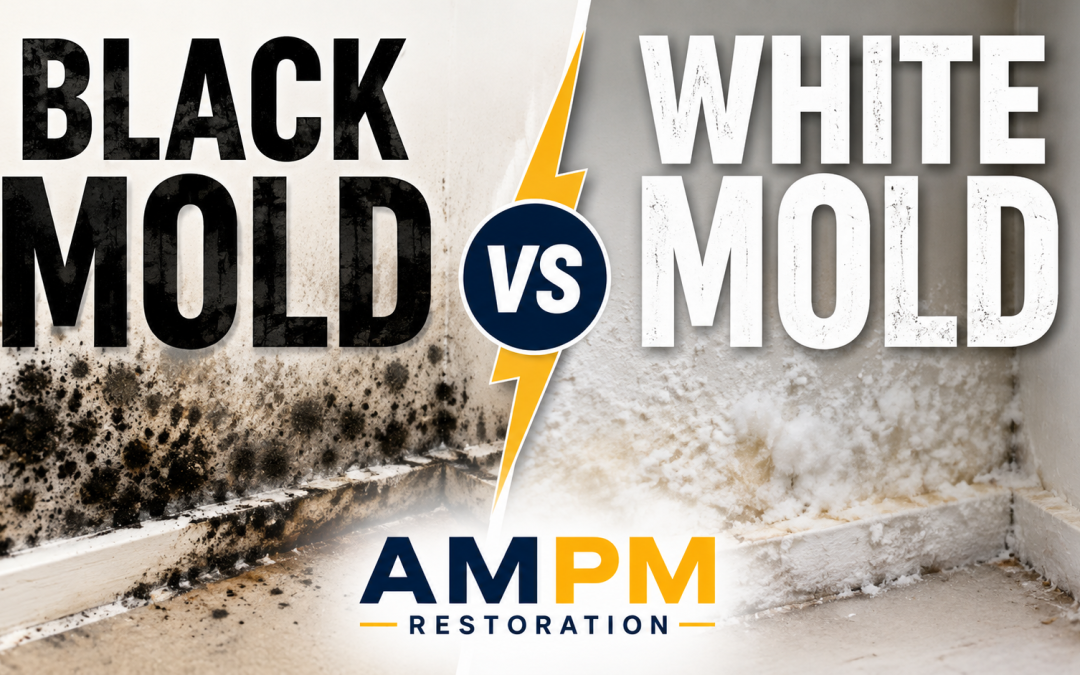
Black Mold vs White Mold Explained
You notice it after the leak, not during it. A brown ring on drywall in a Bradenton hallway, a fuzzy patch behind a bathroom cabinet in Sarasota, and the first question is usually the same, black mold vs white mold, which one is dangerous? In Florida, that question comes up fast because warm air, frequent rain, and hidden moisture give mold a head start long before most homeowners realize there is a problem.
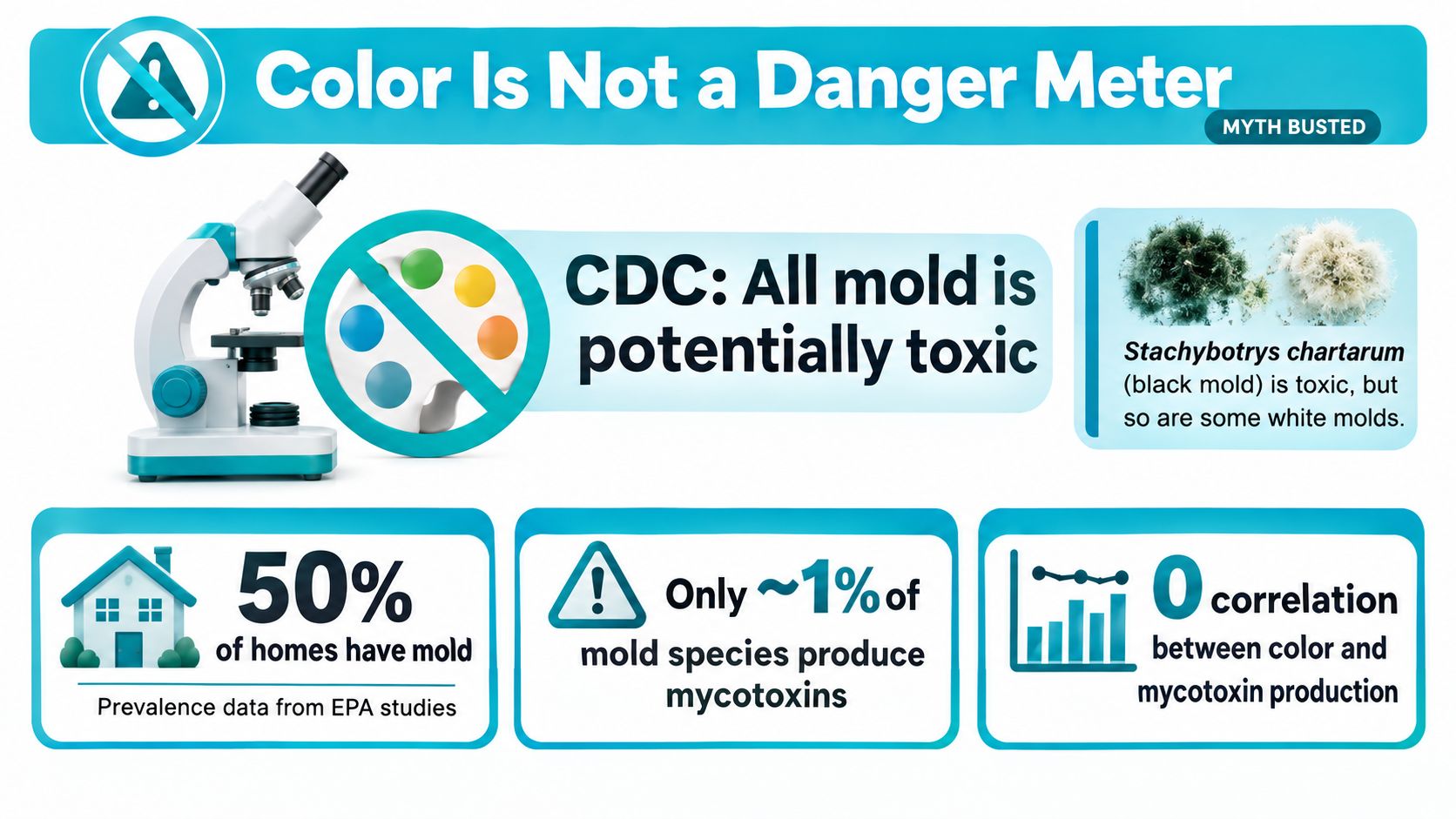
The hard truth is that color alone does not tell you much. The CDC confirms that mold color is not a reliable way to judge danger, and that is exactly why guessing from appearance gets people into trouble. What matters more is what species it is, where it is growing, and how long the material has been wet.
| Characteristic | Black Mold | White Mold |
|---|---|---|
| What the name means | A visual description, often used for dark molds such as Stachybotrys chartarum | A visual description for several fungi, often Penicillium, Aspergillus, or Cladosporium |
| Moisture pattern | Usually tied to prolonged, heavy wetting | Can show up with lower or intermittent moisture |
| Texture | Often slimy or embedded | Often powdery, cotton-like, or fuzzy |
| Typical surface behavior | More likely to penetrate porous material | More likely to sit on the surface early on |
| Best next step | Confirm species and moisture source | Confirm whether it is mold or something else, then trace moisture |
Florida homeowners do not need more scare tactics. They need a clear read on what growth means, what it does not mean, and when to bring in a pro. For a practical first pass at spotting mold growth at home, see this guide. If you want to know what to check on your own before calling for help, here is a simple home mold inspection guide. That is why black mold vs white mold becomes an operational decision, not a guessing game.
Why Florida Homeowners Confuse Black Mold and White Mold
A homeowner in Lakewood Ranch notices a pale patch on the back of drywall after a small plumbing leak. A week later, the patch darkens, and the internet search spiral begins. That is usually where black mold vs white mold gets flattened into a dangerous myth, with color treated like a risk score instead of a surface clue.
In reality, the situation is more ordinary and more frustrating. Black mold is often used to describe dark growth like Stachybotrys chartarum, but that is a color label, not a diagnosis. White mold is also just a color label, and it can refer to multiple fungi that show up early or on less obvious surfaces.
Why the confusion gets worse in Florida
Florida homes are built to manage heat and rain, but the same conditions that make the state livable also help mold spread after a leak or storm event. In coastal homes, the growth window is fast, and mold can begin developing on a damp surface in about 24 to 48 hours after water damage filterking mold statistics. In a Gulf Coast climate, that means the homeowner who waits a few days is often already behind.
Practical rule: if the material stayed wet, color is almost beside the point. The critical question is whether the substrate dried fast enough to stop growth.
That is why the first job is not to debate whether the patch is black or white. It is to trace where the water came from, what the material is, and whether the affected area has spread beyond a surface stain. For a Florida homeowner who wants to sanity-check visible growth before deciding what to do next, spotting mold growth at home is a useful reminder that color alone never gives the full answer.
A quick internal checklist helps, too. If the growth showed up after a leak, if it is on drywall or wood, and if the area smells musty, that is enough to treat it as a moisture problem first and a color problem second. AMPM Restoration also has a practical guide on how to check home for mold, and Florida homeowners often need that kind of real-world check before they start opening walls. For a closer look at why mold shows up so often in local homes, see why Florida homes have mold.
Identifying Black Mold vs White Mold by Appearance and Growth Conditions
In Gulf Coast homes, the divide is how the growth started, how long the material stayed wet, and whether the colony is sitting on the surface or working into the substrate.
Black-looking growth often shows up after a leak has had time to soak drywall, framing, or other porous building materials. White-looking growth often appears in areas with condensation, intermittent dampness, or early-stage moisture problems, where the surface is active but not yet heavily saturated.
Side by side comparison
| Characteristic | Black Mold | White Mold |
|---|---|---|
| Appearance | Dark green to black | Powdery, cottony, or fuzzy |
| Texture | Slimy, slightly fuzzy, often embedded | Surface-level, soft, sometimes dust-like |
| Moisture pattern | Prolonged, heavy wetting, near-100% saturation | Lower or intermittent moisture |
| Common substrate | Drywall, wood framing, other cellulose-rich materials | Wood, drywall, organic material, masonry surfaces in early-stage growth |
| Common Florida locations | Behind walls, under sinks, around long-term leaks | Attics, crawl spaces, closets, attic sheathing, joists |
| Removal difficulty | Harder if it has penetrated porous material | Easier if caught early on the surface |
The operational difference matters in the field. Black-looking growth is often tied to long-term water intrusion, especially when drywall paper or wood framing stays wet long enough for mold to move below the surface. White growth can show up before the homeowner recognizes there is a bigger moisture problem, which is why it gets mistaken for dust, mineral residue, or normal staining.
What the moisture pattern tells you
A dark colony inside a wall cavity usually means the material has stayed wet long enough for growth to spread beyond a surface spot. A white patch on attic sheathing can mean the space has enough humidity and condensation to support mold even without a dramatic roof leak. That is why Florida inspections have to focus on moisture behavior first, then appearance.
A quick visual check is still useful. If the growth looks fuzzy, dusty, or slimy and the material is porous, treat it as a moisture intrusion until someone confirms otherwise. For a homeowner trying to sort out visible growth before opening up walls, how to check home for mold gives a practical starting point, and spotting mold growth at home is a good reminder that what you see on the surface rarely tells the whole story.
What the surface tells you about removal
White growth on a surface can sometimes be cleaned off before it spreads deeper, but only if the moisture source is found and corrected first. Black-looking growth in porous materials usually takes more work because the colony may have penetrated drywall, trim, or framing, which changes the scope of remediation.
That is the trade-off Florida homeowners run into most often. Color can hint at how far the growth has advanced, but the decision point is whether the material dried fast enough to stop colonization, or whether the area needs a full moisture and material assessment before cleanup begins.
Health Risks and the Color Myth That Puts Families at Risk
A mold patch in a bedroom, nursery, or bathroom can look light enough to seem harmless. That is where Florida homeowners get misled. Black means harmful and white means harmless is a shortcut that does not hold up in real homes. The CDC's guidance is straightforward, the color of mold does not necessarily indicate that it is more or less dangerous CDC mold guidance.
Why the risk comes from species and exposure
The color is only one clue, and it is a weak one. The concerns are the species present, the material feeding it, and whether moisture is still active in the area. In Florida, a damp wall cavity, a humid closet, or a bathroom that never fully dries can keep growth active long after the first visible spot appears.
Health problems do not require a dramatic collapse or a huge stain. Ongoing exposure can irritate the eyes, nose, and throat, worsen allergies, and make asthma harder to control, especially for children, older adults, and immunocompromised residents. If the growth is near a child's room or play space, AMPM Restoration's guide on effects that mold has on children gives a clear look at why early attention matters.
The prevalence data that makes color a poor shortcut
The idea that black mold is the main threat also misses how indoor mold shows up. Stachybotrys appears in 16% of tested indoor air samples, while the Penicillium/Aspergillus group appears in 38% of tested indoor air samples and 57% of kitchen samples. In ordinary indoor sampling, the molds that draw the most fear are not the ones that show up most often CDC mold guidance.
That does not make pale growth safe. It makes color an unreliable filter. A white colony on drywall can still be active fungal growth, and a dark patch can be something else entirely. Color alone does not tell you whether the material is still wet, whether spores are being released, or whether the area needs containment before cleanup starts.
Real-world takeaway: if the building is still damp, the exposure is still happening, even if the mold looks light.
Florida humidity keeps that exposure window open longer than you might expect. The practical response is to stop treating black and white as a safety test, check whether the room is dry, check whether the material is porous, and bring in a professional when the growth is tied to ongoing moisture or a child's living space.
Testing and Lab Confirmation Before Remediation
A lot of homeowners in Florida ask the same thing in different ways. Is this mold, or is it just efflorescence, dust, or salt residue on concrete? That question matters, because white growth on masonry can be misread easily, especially in slab-built homes where moisture moves differently than it does in framed walls.
Start with the surface, then move to the source
Visual inspection is helpful, but it's not definitive. White growth on drywall, concrete, or block can look like mineral deposits, and that's why mold testing exists in the first place. If the spot is small, surface-level, and clearly on a non-porous material, a closer inspection may be enough to decide whether cleaning is reasonable or whether a pro should document it first.
What testing changes
Professional air quality sampling and surface swab testing answer different questions. Air sampling looks at what's circulating in the room, while a swab or tape sample helps identify what's growing on the surface. Neither one changes the fact that moisture has to be stopped, but they do help determine whether the growth is mold, how widespread the problem may be, and whether the cleanup plan needs to shift from simple removal to full remediation.
Porous materials and non-porous materials don't behave the same way. A hard surface can often be cleaned if the growth is caught early. Drywall, insulation, and similar porous materials are different, because the growth can move below the visible layer and keep coming back. That's why species identification is useful, but material type is often what decides whether a section can be cleaned or needs to be removed.
AMPM Restoration's professional mold testing service fits the situations where homeowners are staring at a stain and can't tell whether they're looking at mold, residue, or both.
Don't start with the question “black or white.” Start with “mold or not, porous or not, small enough for cleanup or too large for a safe DIY approach.”
If the space has hidden moisture, recurring odor, or a wall cavity that may have been wet for more than a day or two, testing can keep you from opening the wrong area first. That's especially useful in Florida construction, where an apparently minor stain sometimes leads to a bigger hidden problem behind the surface.
DIY Containment vs Professional Mold Remediation
Homeowners can handle some mold cleanup, but the decision has to be based on scope and exposure, not optimism. The EPA's commonly used dividing line is 10 square feet, which helps separate manageable DIY cleanup from situations that need professional remediation. Once the area is larger, deeper, or tied to hidden moisture, the risk of spreading spores goes up fast.
DIY works only when the problem is truly small
For a tiny surface patch on a non-porous area, a careful homeowner can sometimes isolate the space, wear basic protective equipment, and clean without spreading contamination. That approach breaks down when the material is porous, when the source is still active, or when the growth is inside a wall, under flooring, or in HVAC components.
Practical rule: if you need to cut, tear, or pull back more than a small spot to find the mold, it's no longer a simple wipe-down job.
What professional remediation changes
Professional remediation is built to stop cross-contamination. In an IICRC-style process, the work starts with containment, then negative air pressure, HEPA filtration, material removal, antimicrobial treatment, and post-remediation verification testing. That sequence matters because it keeps the job from becoming a whole-house dust and spore problem.
AMPM Restoration's IICRC-certified technicians use that kind of structured process on Florida jobs where the source is active or the material has already been compromised. In practice, that means the scope gets controlled before demolition starts, which is where DIY attempts often go wrong.
Cost, claims, and the hidden expense of doing it twice
A cheap cleanup that misses the moisture source usually becomes an expensive cleanup later. Spores spread, the stain returns, and the damaged area gets larger. That's why homeowners with insurance questions should get documentation early, especially when the leak is sudden and there may be a claim path to follow.
Florida homeowners also need a contractor who can talk to the carrier without slowing the job down. AMPM Restoration coordinates directly with insurance carriers, which helps reduce the back-and-forth that often delays drying, removal, and rebuild work. The company also offers financing options, which matters when the choice is between immediate containment and waiting until the problem spreads.

If the leak has already crossed into walls, ceilings, or carpet padding, the line between DIY and professional work is already narrowing. AMPM Restoration's page on can I remove mold myself or should I hire a professional is the right next stop when you're deciding whether the cleanup is still manageable.
Prevention Strategies for Florida Suncoast Homes
Florida prevention is never just about one bad leak. It's about the everyday conditions that keep moisture in the house long enough for mold to take hold again, especially in Bradenton, Sarasota, Tampa Bay, Saint Petersburg, Lakewood Ranch, and the surrounding Gulf Coast communities.
The main moisture sources to watch
Storm-driven intrusion is the obvious one, but it's not the only one. Plumbing failures in slab construction can stay hidden, HVAC condensation can drip, and a roof or window seal can leak just enough to keep a corner damp. In this climate, even a small flaw in the building envelope can keep feeding mold growth.
The practical goal is to keep the interior dry enough that fungi don't get a foothold. That starts with indoor humidity control, because increased moisture is what turns ordinary surfaces into a growth zone. It also means checking condensate lines, drip pans, and venting around kitchens and bathrooms before a small issue becomes a repeat one.
Prevention that actually holds up
A homeowner doesn't need a dozen gadgets. They need habits that reduce wet time and improve airflow. The basics are straightforward, and they work because they interrupt the moisture cycle instead of reacting after the fact.
- Keep humidity controlled: Aim to keep indoor humidity under 60%.
- Use exhaust fans: Run bathroom and kitchen fans when moisture is created.
- Repair leaks fast: Fix roof and plumbing leaks within 24 hours when possible.
- Maintain the HVAC system: Clean condensate lines and drip pans regularly.
- Protect the exterior: Make sure rainwater moves away from the foundation.
- Plan for flood exposure: Raise items and use flood-resistant materials where practical.
For homeowners looking for a practical outside perspective, the Palm Beach humidity mold tips resource lines up with the same moisture-control basics that matter across the Suncoast.
When prevention isn't enough
Older homes, repeated condensation, and prior water damage all make preventive checks more important. Annual mold inspections make sense when the house has a history of leaks, or when a room has that recurring musty smell even after cleaning. That's not paranoia, it's good property management in a humid market.

Prevention in Florida is really about speed. Dry it, vent it, repair it, and keep checking the spots that trap moisture longest.
Protect Your Home with a Free Mold Inspection from AMPM Restoration
If you're staring at black mold vs white mold and still not sure what you've got, the safest move is a professional assessment. AMPM Restoration serves Bradenton, Sarasota, Tampa Bay, Saint Petersburg, Lakewood Ranch, and surrounding Gulf Coast communities with 24/7 emergency availability, a one-hour response time, and IICRC-certified mold inspection and remediation services.
The company handles mold inspection, mold removal, water damage restoration, storm and flood cleanup, and full reconstruction, so the work can move from diagnosis to drying to repair without bouncing between vendors. That matters when moisture is active, because delays give mold more time to spread.
AMPM Restoration also offers free inspections and estimates, insurance claim assistance, and financing options, which removes a lot of the friction that keeps homeowners from acting quickly. If the growth is on drywall, behind a cabinet, or coming back after cleanup, it's time to stop guessing and get the problem documented properly.
Call AMPM Restoration at 941-946-7807 for a free inspection and estimate, and get a clear plan for mold removal, moisture control, and any insurance claim support you need. If you want one local team to handle mold inspection, remediation, and reconstruction across Florida's Suncoast, visit AMPM Restoration Services and take the next step before the damage gets worse.