


You wake up in your Bradenton home to a musty smell, your child is rubbing itchy eyes, and a cloud of dust appears when the air conditioner starts. Searching for HVAC duct cleaning near me feels reasonable, especially in Florida, where air conditioning runs for much of the year and indoor humidity can create moisture problems. But duct cleaning isn't automatically the right answer, and a polished sales pitch isn't proof that your ductwork needs service.
The practical rule is simple: pay for duct cleaning when contamination is documented and tied to a real problem. The U.S. Environmental Protection Agency says routine cleaning hasn't been shown to prevent health problems, and a light amount of household dust in ducts isn't established as a health risk. Cleaning deserves serious consideration when you can see mold, pests have entered the system, or dust and debris are being released through supply registers. EPA guidance on cleaning residential air ducts provides the right starting point.
Why Florida Homeowners Search for HVAC Duct Cleaning Near Me
A Florida homeowner may notice the problem gradually. The house smells stale when the system turns on. Furniture gets dusty again soon after cleaning. A family member feels congested indoors but feels better after leaving for the day. Those signs are frustrating, but they don't prove that dirty ducts are the cause.
Florida homes face conditions that deserve closer inspection. High humidity, storm-related water intrusion, and frequent air-conditioning use can expose concealed parts of an HVAC system to moisture. If a roof leak, plumbing failure, flooded air handler area, or condensation problem has affected the system, contamination can become a genuine restoration concern. The moisture source matters as much as the dust inside the ductwork. Homeowners can learn more about the connection between indoor humidity and mold through this guide to how humidity causes mold in Florida homes.

When the search is justified
A local inspection makes sense when you can point to a specific condition:
- Musty odors with visible moisture: An odor that returns whenever the system operates deserves investigation, particularly after water damage.
- Dust leaving supply registers: Dust on a vent cover isn't the same as debris being blown into rooms. Look for material actively emerging from the register.
- Mold or pest evidence: Visible growth, insect activity, nesting material, or droppings require more than a quick vacuum.
- Recent contamination: Construction dust, fire residue, floodwater, or damaged building materials can affect the HVAC system.
Duct cleaning may remove a source of contamination, but it won't repair a leaking roof, dry a wet wall, correct a condensate problem, or solve every allergy complaint. A reputable provider should inspect first, explain what was found, and tell you when cleaning isn't warranted.
Neighborly advice: If a company recommends cleaning every home on a fixed schedule without showing contamination, get another opinion.
What Professional HVAC Duct Cleaning Actually Involves
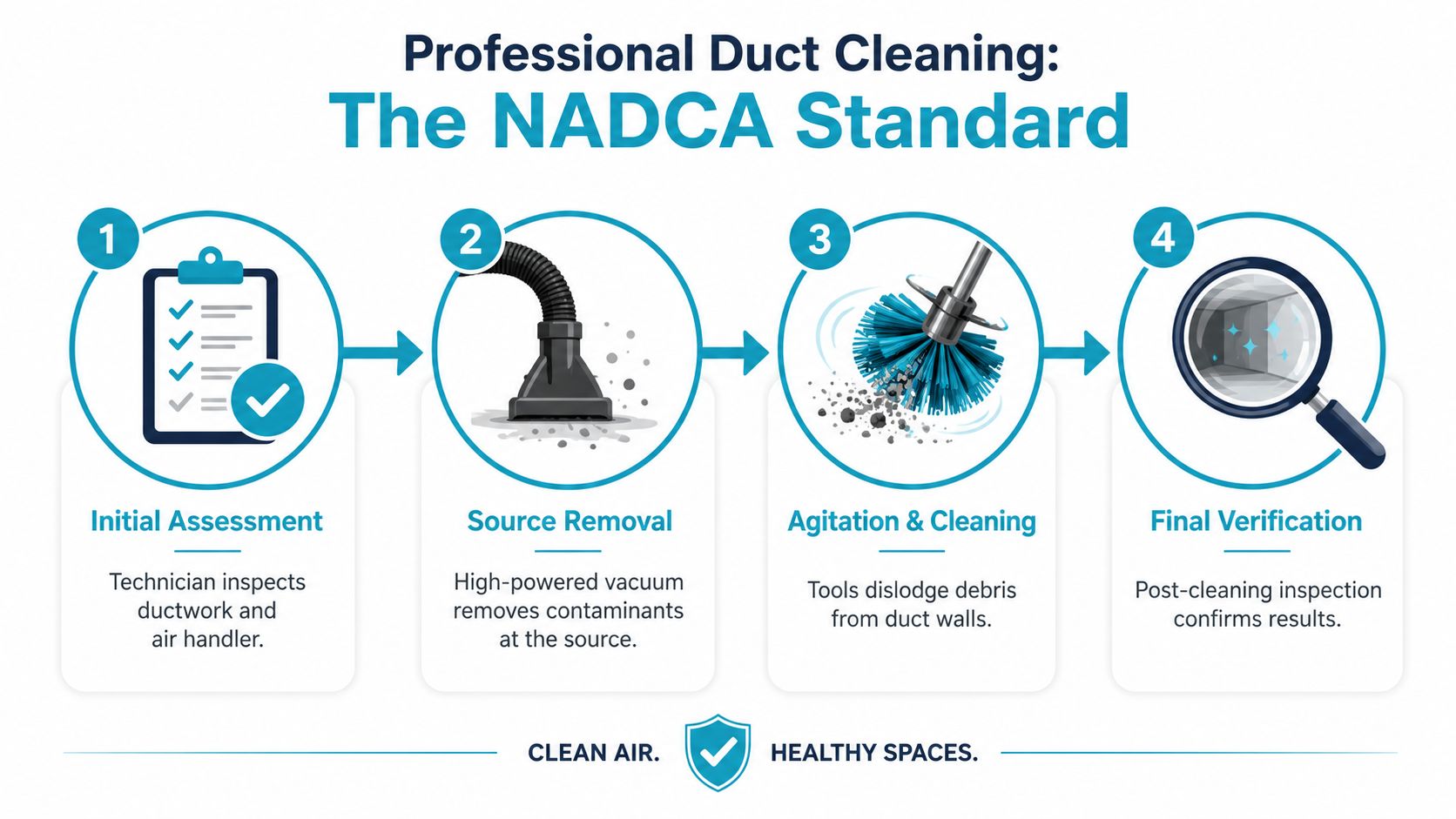
Professional duct cleaning is source-removal work, not a deodorizing treatment and not a vacuum hose pushed a short distance through one register. The National Air Duct Cleaners Association's ACR standard requires contaminants to be physically dislodged and extracted under continuous negative pressure. The system should be cleaned so non-adhered substances are removed, then checked against the standard's cleanliness requirements. NADCA's ACR standard explains why equipment, access, agitation, and verification all matter.
The four elements of a credible job
Assessment comes first. The technician should inspect the air handler, supply and return paths, registers, accessible duct surfaces, and likely contamination points. The inspection should identify where equipment can connect and whether the concern is in the ductwork.
Negative pressure controls the work area. A properly configured vacuum system pulls air and loosened debris toward the collection equipment instead of allowing disturbed material to escape into the home. Without containment and sustained negative pressure, cleaning can spread contamination rather than remove it.
Mechanical agitation loosens attached debris. Rotating brushes, air tools, or comparable equipment dislodge material from duct surfaces. Simple suction often misses deposits that cling to the interior.
Verification closes the job. The provider should show what was found, what components were cleaned, and how the result was checked. Before-and-after photographs, inspection records, and a clear scope of work are more useful than a vague promise that the system is “fresh.”
A quick register vacuum can have a place in routine housekeeping, but it isn't equivalent to whole-system source removal. If you want to evaluate whether airborne contamination remains after a suspected mold issue, consider a focused air quality testing service for mold rather than accepting a chemical spray as proof of successful cleaning.
Three Clear Signs You Need Your Ducts Cleaned
Florida homeowners do not need duct cleaning on a calendar. The EPA identifies three conditions that justify considering it: substantial visible mold inside hard-surface ducts or HVAC components, vermin infestation, and excessive dust or debris released through supply registers. The EPA's specific cleaning triggers provide a condition-based test for deciding whether the service addresses a real problem or wastes your money.
Visible mold inside the system
A dark ring around a vent does not prove mold is growing inside the duct. Dust, insulation, and other residue can cause similar discoloration. The relevant concern is substantial visible growth on hard-surface duct interiors or HVAC components.
Dry water-damaged areas within 24 to 48 hours to help prevent mold growth. Cleaning should follow moisture control, not replace it. EPA information on water damage and mold prevention supports that order of work. Florida's humid conditions make lingering dampness more likely, especially around air handlers, insulated ducts, and areas affected by condensation.
Vermin inside ductwork
Rodents and insects can leave nesting material, droppings, and other contamination. Arrange pest control and exclusion before duct cleaning. Otherwise, animals can return and recreate the problem. A vacuum cannot solve an active infestation.
Suspected mold in a register does not prove the duct is the only affected area. Florida property owners should check for broader building contamination, including damp drywall, insulation, or concealed growth. This guide to five signs of mold damage in homes can help determine whether the inspection should extend beyond the HVAC system.
Dust or debris entering rooms
Dust sitting on a grille is not enough. The stronger sign is excessive debris visibly blowing from supply registers while the system operates. That indicates the HVAC system may be distributing contamination into the living space.
Have the technician document the source and identify whether the material is inside the duct, at the register, or elsewhere in the air handler.
Decision rule: If you have no visible contamination, infestation, or released debris, skip duct cleaning based only on a salesperson's claim that every Florida home needs it.
The Professional Duct Cleaning Process Step by Step
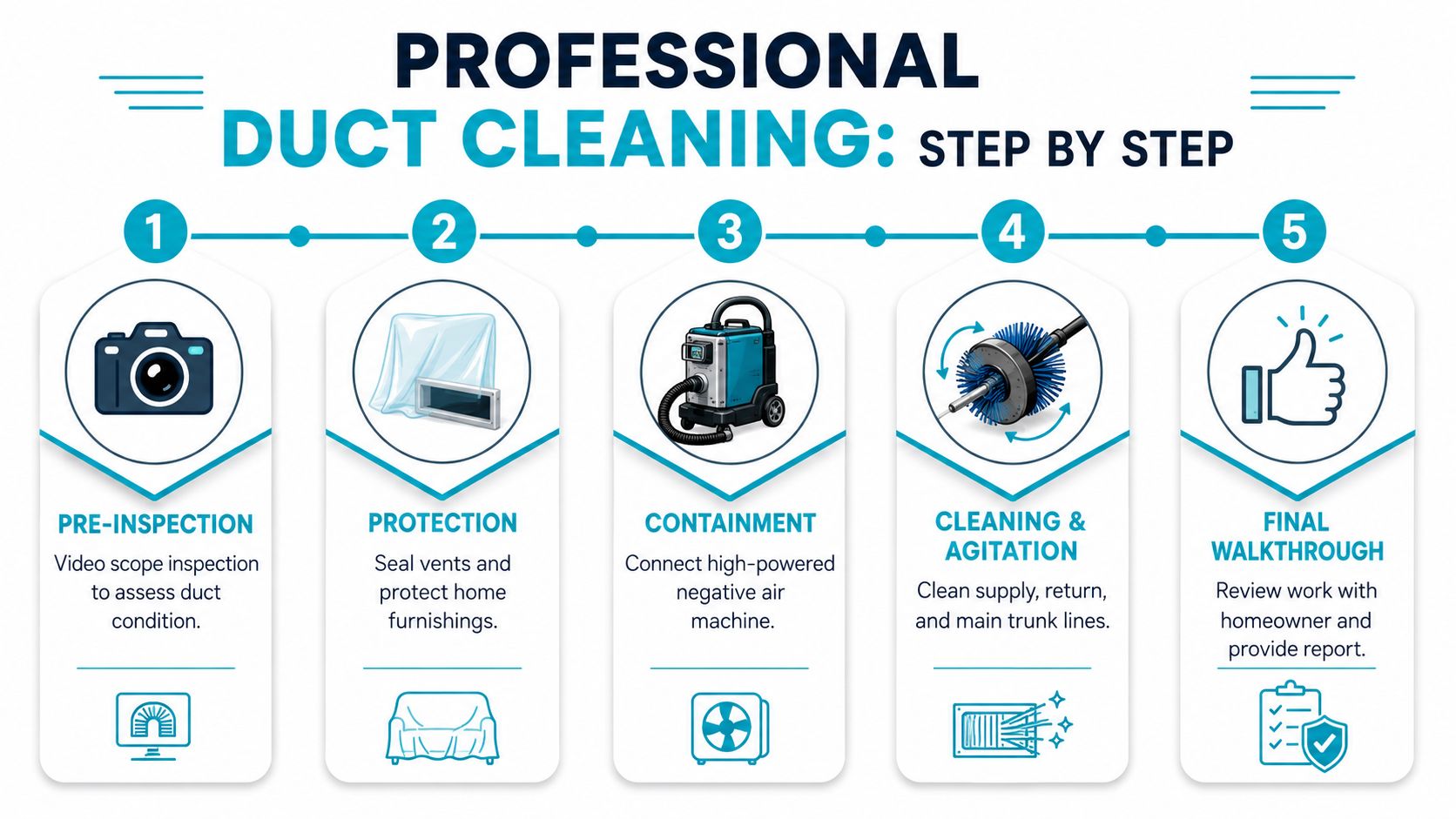
A sound service visit follows a controlled sequence. The technician should explain the scope before opening equipment, protect the home from loosened debris, and show you the result afterward. If the crew skips inspection or can't explain where the vacuum connects, the service isn't meeting the standard you should expect.
1. Inspect before disturbing anything
The technician examines the air handler, supply and return ducts, grilles, registers, access points, and visible contamination. A camera or inspection scope can help reveal conditions that aren't visible from the room side. The provider should record damaged insulation, disconnected sections, standing moisture, pest evidence, or mold-like growth.
2. Protect the home
Furniture, flooring, and nearby surfaces need protection. Registers may be covered or sealed as the crew configures the system. Pets should be secured, and homeowners should clear access around vents, closets, attic entrances, and the air-handling equipment.
3. Establish containment and negative pressure
The crew connects professional vacuum equipment to the duct system and creates negative pressure. This setup gives loosened contaminants a controlled path into collection equipment instead of allowing them to drift through the home.
4. Agitate and extract contamination
Technicians work through supply branches, return paths, and accessible trunk lines using mechanical brushes or air tools. They should address the components identified in the scope, not merely vacuum the visible register openings. The work may also involve cleaning appropriate HVAC components when contamination has spread beyond the duct surfaces.
5. Verify and document
The final walkthrough should show what the crew cleaned and what it found. Ask for photographs, notes about inaccessible areas, and confirmation that covers and access panels were properly replaced. If biological growth is suspected, antimicrobial products shouldn't be used as a shortcut. NADCA guidance says agents should be applied only when active growth is reasonably suspected and only after surface deposits and debris have been removed. NADCA's general specification addresses that order of operations.
For broader contamination, homeowners can review how to remove mold from air ducts before approving a treatment plan.
Understanding Duct Cleaning Costs and Choosing the Right Provider
A trustworthy quote depends on the actual system, not a bait price advertised before anyone sees the property. Home size, the number and complexity of HVAC systems, access limitations, contamination severity, and the components included in the scope all affect the work. Sanitization, mold remediation, repairs, and dryer vent cleaning are separate services and should appear as separate line items.
Don't choose the lowest quote automatically. An unusually cheap offer may cover only a few registers, exclude the return side, omit the air handler, or rely on a quick vacuum without agitation and verification. Ask for a written scope, equipment description, access plan, and explanation of any added treatment.
Provider comparison checklist
| Criteria | What to Look For | Red Flags |
|---|---|---|
| Credentials | IICRC training or certification, relevant duct-cleaning knowledge, and documented procedures | Credentials that can't be verified or vague claims about certification |
| Insurance | Proof of appropriate business and liability coverage | No documentation or pressure to begin immediately |
| Inspection | Written findings, photographs, and a clear explanation of contamination | A fixed recommendation before seeing the system |
| Equipment | Negative-pressure extraction and mechanical agitation | One household vacuum or a hose used only at registers |
| Scope | Supply, return, accessible trunk lines, and relevant HVAC components listed | “Whole house” with no components identified |
| Pricing | Itemized estimate with exclusions and optional services disclosed | An extremely low advertised price followed by heavy upselling |
| Documentation | Before-and-after evidence and a completion report | No proof of work or refusal to explain inaccessible areas |
A company that handles water and mold problems may be better equipped to identify the root cause, but you should still ask direct questions. AMPM Restoration Services offers duct cleaning, whole-system inspection, source-removal cleaning, constant negative pressure, and free inspection and estimate options for contamination concerns. You can review what to ask an IICRC-certified restoration company before scheduling service.
Florida homeowners should also separate duct cleaning from fuel-burning appliance safety. If your home has a fuel-burning furnace, stove, or fireplace, the EPA says those appliances should be inspected for proper operation and serviced before each heating season to reduce carbon monoxide risk. EPA guidance on air ducts and fuel-burning equipment makes clear that this inspection is a separate safety responsibility.
Why AMPM Restoration Is the Trusted Choice on Florida's Suncoast
Searching for HVAC duct cleaning near me in Bradenton, Sarasota, Tampa Bay, or Saint Petersburg should lead to a provider that understands more than dust. Florida duct concerns often connect to water intrusion, condensation, storm damage, mold, smoke residue, or damaged building materials. A restoration team that can investigate those conditions has a broader view than a company selling a stand-alone vacuum service.
AMPM Restoration is based at 4301 32nd St W b18, Bradenton, FL 34205, and serves Bradenton, Sarasota, Tampa Bay, Saint Petersburg, Lakewood Ranch, and surrounding Gulf Coast communities. Its IICRC-certified team provides water damage restoration, mold inspection and removal, fire and smoke restoration, storm and flood cleanup, commercial restoration, leak detection, and reconstruction solutions. The company is licensed, bonded, insured, and available around the clock, with a stated one-hour emergency response.
What homeowners can expect
AMPM offers free inspections and estimates, direct insurance claim assistance, financing options, and a 100% satisfaction guarantee. Its restoration work covers homes, offices, retail properties, hospitality sites, schools, government facilities, and other commercial spaces. That range matters when duct contamination forms part of a larger loss instead of appearing as an isolated maintenance issue.
The company is one local option for homeowners who want the HVAC system inspected alongside a moisture or contamination problem. A proper evaluation should still determine whether duct cleaning is warranted, identify the source, and explain what the service can and cannot accomplish.
Call 941-946-7807 for a free inspection and estimate. AMPM Restoration can assess suspected duct contamination, coordinate with your insurer, discuss financing, and help address related water, mold, fire, smoke, storm, or reconstruction needs before secondary damage grows.
Frequently Asked Questions About HVAC Duct Cleaning
How often should ducts be cleaned?
The EPA's position is as needed, not on a fixed routine schedule. Consider cleaning when there is visible mold in the system, vermin infestation, or excessive dust and debris released through supply registers. A provider should document the condition before recommending work.
Can I clean the ducts myself?
You can vacuum accessible register covers and keep the surrounding area clean, but whole-system source removal requires containment, negative pressure, access, and mechanical agitation. A household vacuum won't provide the same controlled extraction or reach.
Will duct cleaning improve energy efficiency?
The evidence is mixed and limited. A published review found that existing studies were insufficient to establish solid conclusions about health benefits, cost savings, indoor-air quality, or HVAC performance. The evidence review on duct cleaning also describes field conditions where airborne particle and bioaerosol levels could rise during cleaning before later measurements changed, which reinforces the need for proper containment and realistic expectations.
Will cleaning cure allergies or odors?
No responsible provider should promise that. Cleaning can address contamination inside the HVAC system, but allergies, odors, moisture, building materials, filters, pests, and outdoor air entry may have other causes.
What should I do between professional cleanings?
Replace filters according to the equipment manufacturer's requirements, keep supply and return registers unobstructed, and watch for moisture, odors, pests, or debris. If a storm, leak, flood, or mold concern affects the HVAC system, arrange an inspection rather than masking the odor.
What should I ask before hiring?
Ask what components will be cleaned, how the crew will establish negative pressure, what agitation tools they use, how they protect the home, and what documentation you'll receive. AMPM Restoration offers free inspections to help homeowners decide whether cleaning is justified.
Call 941-946-7807 to request a free inspection and estimate for HVAC duct contamination, mold, water damage, or related restoration needs, with insurance claim assistance and financing options available. Visit AMPM Restoration Services to learn how the team serves Florida's Suncoast with duct cleaning, mold remediation, water extraction, fire and smoke restoration, storm cleanup, and reconstruction.