

Commercial Fire Damage Repair Services: 24/7 Response
You open the front door expecting a normal workday, and the first thing you smell is wet ash. The fire is out, but the building isn’t fine. Ceiling tiles are sagging from suppressed water. Soot has settled on desks and shelving. The server room looks untouched until you notice the smoky film on every vent and cable tray. In that moment, commercial fire damage repair services aren’t just about cleanup. They’re about getting control of a business interruption before it turns into a longer shutdown.
For business owners in Bradenton, Sarasota, Lakewood Ranch, St. Petersburg, and the wider Tampa Bay area, the first challenge is mental. Everything feels urgent at once. Safety, insurance, customers, payroll, equipment, reopening. The right response is structured, and it starts by treating the fire loss as both a property emergency and an operations problem.
That’s why commercial fire recovery is such an established service line, not a niche sideline. One industry report projects the global disaster restoration services market at USD 48.9 billion in 2026 and USD 89.1 billion by 2036, with a 6.20% CAGR, and it explicitly includes fire and smoke restoration for commercial buildings among other property type.
After the Fire A Guide for Florida Business Owners
A fire at a commercial property usually leaves three different problems at the same time. There’s the obvious burn damage. There’s the smoke and soot that spread farther than most owners expect. Then there’s the water left behind by firefighting efforts, which can damage flooring, drywall, inventory, and electrical areas that flames never reached.
That’s why experienced teams approach commercial fire damage repair services as a managed sequence, not a cleaning crew with fans and deodorizer. A retail suite in Sarasota might need emergency board-up, selective demolition, HVAC cleaning, content pack-out, and phased reconstruction before customers can come back. A professional office in Bradenton may need a different path, with document recovery, electronics evaluation, and priority reopening of a limited work area.
What Florida business owners need most in the first day
The first day after a fire isn’t about making every decision. It’s about making the right first decisions. Secure the structure. Protect records. Identify what absolutely must reopen first. If you run a medical office, that may be patient files and treatment rooms. If you run a restaurant, it may be the kitchen and code-required systems. If you manage a multi-tenant property, it may need to separate occupied units from affected zones.
Practical rule: Don’t judge the full scope by what looks burned. Smoke residue often reaches farther than the visible fire area.
A commercial fire site also needs someone coordinating priorities across trades. The owner is already dealing with staff, landlords, tenants, vendors, and insurers. The project has to move in a way that supports reopening, not just demolition.
For Florida businesses that need one contractor to handle mitigation, repair, and operational planning, commercial restoration services are often the most practical path because they keep the scope under one management structure.
Recovery is operational, not just physical
The building matters, but so does continuity. If the front office can reopen while the rear storage area is still under containment, that matters. If one tenant can regain access while another suite remains under repair, that matters too. Good restoration planning gives an owner options. Bad planning gives them a longer closure.
Your First Steps Safety and Damage Mitigation
The first hour after fire crews clear the scene is about reducing risk. Don’t rush inside because the flames are out. Fire, smoke, heat, and suppression water can leave hidden structural issues, exposed wiring, slippery residues, and air quality problems that aren’t obvious from the doorway.

What to do immediately
- Wait for clearance: Only enter after fire officials or other qualified authorities say it’s safe.
- Call your insurance carrier: Start the claim early and ask what documentation they want first.
- Photograph before moving items: Wide shots first, then room-by-room detail photos and video.
- Protect the envelope: Broken doors, windows, and roof openings need temporary security and weather protection.
- Shut down avoidable hazards: If officials permit it, isolate unsafe power, gas, or water conditions through the proper trade professionals.
- Start a loss log: Keep one running record of decisions, contacts, damaged contents, and emergency actions.
Why these steps matter
Owners often lose time by cleaning too soon, throwing away damaged materials too early, or letting unauthorized people walk through the site. That creates claim problems and can also spread contamination. Soot transfers easily from one surface to another. Wet soot is especially messy. HVAC use can move residues into cleaner areas if the system hasn’t been evaluated.
Secondary damage is another issue. Water used to extinguish the fire can lead to microbial growth if materials stay wet. If you’ve ever dealt with moisture problems before, this guide on finding mold in your home’s walls is a useful reminder of how hidden moisture can turn into a separate restoration problem when walls and cavities stay damp.
If the property has exposed openings, unsecured entries, or standing water, mitigation needs to start before anyone talks about paint colors or finish selections.
What not to do
- Don’t power up equipment: Smoke residue and moisture can damage electronics further.
- Don’t run HVAC normally: Ducted air can spread odor and soot.
- Don’t let staff retrieve items unsupervised: That creates safety and documentation issues.
- Don’t assume one room is unaffected: Adjacent spaces may have odor, residue, or moisture that isn’t visible.
If you need after-hours stabilization, board-up, drying, or site protection, 24/7 emergency restoration services are the right category of response to request.
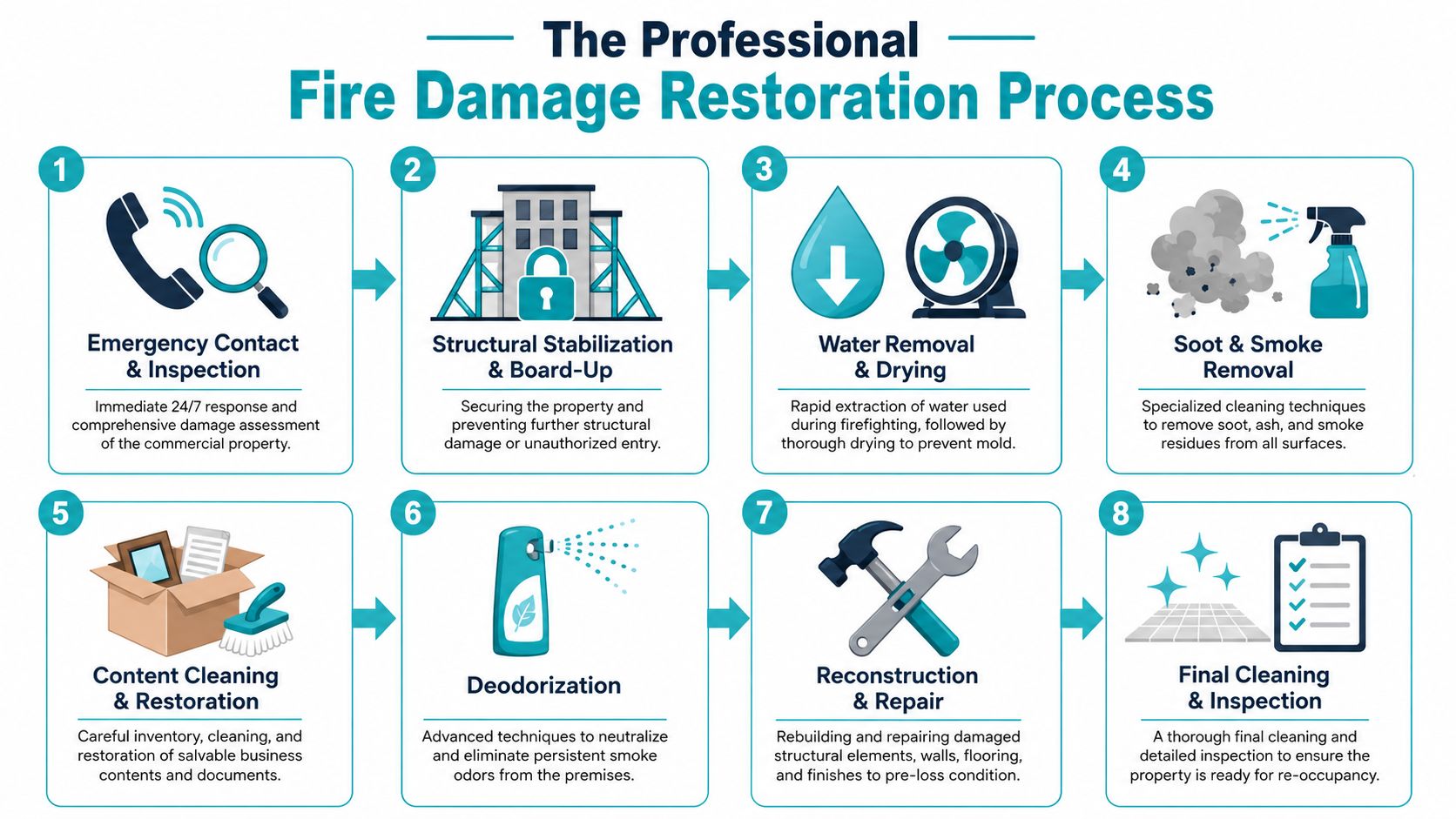
The Professional Fire Damage Restoration Process
Professional commercial fire damage repair services work best when they’re run like a medical case. First comes emergency stabilization. Then targeted treatment. Then controlled recovery and rebuild. If any of those phases are skipped or rushed, the project usually circles back into rework.
The walkthrough that determines everything else
A proper job starts with a documented site walkthrough. That walkthrough should map fire, smoke, and water-affected zones, identify priority spaces like IT rooms or records storage, and produce a Restoration Work Plan that sequences labor, equipment, and safety controls. That matters because smoke and soot can travel beyond visibly burned areas, including through HVAC pathways, and missed scope can lead to lingering odor, corrosion, or expensive rework, as described in these commercial fire damage protocols.
Experienced project management proves its value. A warehouse office may look lightly affected until the return air system and upper wall cavities are checked. A restaurant may need close attention to grease pathways, hood areas, and hidden residues above the finished ceiling. A clinic may need selective containment so unaffected treatment space can be preserved.
What the crew actually does on site
The field process usually includes several overlapping tracks:
- Stabilization work: Board-up, roof tarping, temporary fencing, debris control, and hazard isolation.
- Water removal and drying: Extraction, demolition of unsalvageable wet materials, dehumidification, and moisture monitoring.
- Soot and smoke cleanup: HEPA vacuuming, dry-cleaning methods, wet cleaning where appropriate, and HVAC attention.
- Contents handling: Inventory, pack-out, off-site cleaning, document protection, and separation of salvageable from non-salvageable items.
- Odor treatment: Thermal fogging, air scrubbing, or other deodorization methods chosen for the material and contamination type.
One mistake I see often is treating odor as the main problem because it’s the most noticeable one. Odor is the symptom. The actual work is removing the residue source from structure, contents, and air pathways.
Hidden scope is where jobs go wrong
Some surfaces clean easily. Others don’t. Porous ceiling tile, insulation, unfinished wood, paper goods, soft contents, and certain laminated materials may hold contamination differently than metal, glass, or sealed surfaces. That’s why a reliable work plan separates what can be cleaned, what should be tested or evaluated, and what should be removed.
If your property has rated assemblies, stair enclosures, corridor doors, or separation walls, it also helps to understand commercial fire door standards so post-fire repair decisions don’t accidentally compromise code-required protection.
The cleanest-looking room in the building isn’t always the cleanest room. HVAC movement and pressure differences can carry smoke where flames never reached.
Owners who want a fuller overview of the sequence from mitigation through rebuild can review this fire damage restoration process explained resource before authorizing major work.
Reconstruction That Minimizes Business Interruption
Cleanup doesn’t reopen a business by itself. Reconstruction does, and the order of reconstruction matters just as much as the quality. The smartest projects don’t ask, “How do we rebuild everything at once?” They ask, “What has to come back online first so the business can function?”
A phased strategy is what separates a shutdown from a managed recovery. In a Bradenton office, that might mean restoring the reception area, restrooms, and a limited set of offices first while a rear suite stays under containment. In a Sarasota restaurant, the first milestone may be kitchen infrastructure and life-safety-related repairs, not cosmetic work in the dining area.
How phasing works in practice
A good reconstruction plan prioritizes areas by revenue impact, occupancy requirements, safety, and contamination level.
- Critical operations first: Server rooms, point-of-sale stations, treatment rooms, kitchen lines, or tenant access points.
- Shared systems next: Electrical panels, plumbing branches, HVAC distribution, and code-required assemblies.
- Finishes last where possible: Paint, trim, decorative elements, and nonessential upgrades can often follow once operations resume.
This approach only works if the contractor and owner agree on business priorities early. Otherwise, crews can spend days restoring low-impact spaces while the area that primarily generates income stays offline.
Sample commercial restoration timelines
| Damage Level | Typical Property Type | Estimated Timeline for Restoration & Reconstruction |
|---|---|---|
| Light smoke and localized damage | Small office, boutique retail suite | Often measured in days to a short multi-week window, depending on cleaning scope, inspections, and material availability |
| Moderate fire, smoke, and water damage | Restaurant, medical office, professional suite | Often measured in multiple weeks, especially when selective demolition, drying, and partial rebuild are required |
| Heavy structural and systems damage | Warehouse office, multi-tenant commercial building, large hospitality space | Often measured in a longer multi-phase reconstruction period, particularly when major structural, electrical, HVAC, and code-related work are involved |
No honest contractor should promise an exact timeline on day one. Material lead times, inspection cycles, hidden damage, and code upgrades can all shift the sequence. What they should provide is a realistic phasing plan, clear milestones, and a definition of what “partial reopening” means for your property.
For owners comparing providers, it helps to review what a dedicated commercial restoration company typically handles under one roof. Fewer handoffs usually mean fewer scheduling conflicts and better continuity.
Navigating Insurance Claims for Commercial Fire Damage
The property loss is only half the problem. The claim file is the other half. If the documentation is weak, the project slows down. If the scope is unclear, disagreements start. If items are discarded before they're documented, you may lose support for part of the claim.
That's why the best restoration teams build the claim as they build the job. Photos, room-by-room notes, moisture records, demolition logs, content inventories, cleaning decisions, and repair estimates all need to line up. The adjuster doesn't just need to know that the property was damaged. They need to understand where, how, and what work is required to return it to pre-loss condition.
What your restoration contractor should help organize
A commercial fire claim usually runs smoother when these pieces are in order:
- Site documentation: Before-cleaning photos, videos, annotated damage areas, and emergency mitigation records.
- Content records: Itemized business property lists, model information where available, and salvage or non-salvage decisions.
- Scope support: Clear description of fire, smoke, soot, water, and reconstruction work required.
- Communication trail: Notes from adjuster meetings, approvals, supplements, and change conditions uncovered during work.
Where business owners get stuck
Many owners are busy handling employees, customers, lease issues, and vendors. They don't have time to debate line items all day. That's where a contractor's administrative discipline matters. A vague estimate slows approvals. A detailed estimate with supporting photos and organized scope language gives the adjuster something workable.
It also helps to understand your broader risk posture before a loss happens. For property owners reviewing coverage structure and property risk basics, this guide on protecting your commercial assets offers useful background.
Keep every emergency invoice, after-hours call record, and temporary protection receipt. Those details often matter later in the claim.
One practical note. Don't treat the insurance process as separate from continuity planning. If temporary partitions, phased occupancy, or temporary workspaces can reduce downtime, those decisions should be discussed early, documented clearly, and tied back to the repair strategy.
Why Trust AMPM for Your Florida Business Recovery
Choosing a fire restoration contractor in Florida isn't simple because the field is crowded. In the United States, the number of damage restoration businesses grew at an average of 4.3% per year over the five years from 2020 to 2025, reaching 62,582 businesses in 2025, according to IBISWorld's damage restoration services industry data. For a business owner, that means selection matters. Credentials, process discipline, and commercial experience matter more than broad marketing claims.
What matters on a commercial job
Commercial losses are different from residential losses because the decision tree is bigger. A contractor may need to coordinate occupied areas, tenant communication, after-hours access, inspections, equipment staging, and claim support while keeping a record that holds up under scrutiny.
That's where local response and certification standards help. On a Gulf Coast commercial project, delays can expose the site to weather, theft, vandalism, or additional moisture issues. A team that can handle emergency mitigation, drying, smoke cleanup, and reconstruction under one managed process usually gives owners a cleaner path to reopening.
Why local knowledge changes the job
A Florida business owner needs more than a generic national playbook. They need someone who understands how coastal humidity affects drying, how to secure a site ahead of changing weather, and how local occupancy patterns affect phasing in retail, office, hospitality, and mixed-use buildings around Bradenton, Sarasota, St. Petersburg, and Tampa Bay.
One option in that category is AMPM Restoration Services, which provides commercial fire restoration, emergency response, insurance claim coordination, and reconstruction work across the Suncoast. The practical advantage is straightforward. Owners can keep one project line moving instead of trying to coordinate multiple disconnected vendors after a fire.
Frequently Asked Questions About Commercial Fire Repair
Commercial fire losses create the same urgent questions every time. The answers below are the ones owners usually need before they can make a clear next decision.
FAQs
| Question | Answer |
|---|---|
| How soon should commercial fire damage repair services begin? | As soon as the property is cleared for safe access and emergency mitigation can be performed. The first priority is stabilization, documentation, and preventing secondary damage from weather, unauthorized entry, smoke spread, and lingering moisture. |
| Can my business stay open during fire restoration? | Sometimes, yes. It depends on structural safety, air quality, code requirements, utility status, and whether affected areas can be isolated. Partial operations are often possible when the project is phased correctly. |
| Is smoke damage really a big issue if the fire was small? | Yes. A smaller fire can still push soot and odor through vents, above ceilings, and into adjacent rooms. Visible burn damage is only part of the scope. |
| Should I throw away damaged inventory or materials right away? | Not until they’ve been documented and the restoration team or adjuster has reviewed them. Early disposal can create claim problems and make it harder to prove the full loss. |
| Do I need reconstruction after cleanup? | Often, yes. Cleanup removes contamination and damaged materials. Reconstruction puts the building back into usable condition with repaired walls, ceilings, flooring, systems, and finishes. |
| How do I choose among commercial fire damage repair services? | Look for commercial experience, IICRC-certified processes, clear documentation, emergency response capability, insurance coordination, and a practical plan for reopening, not just cleaning. |
A fire loss can feel chaotic, but the path forward doesn't have to be. The right response protects the structure, supports the insurance claim, and helps you reopen with less disruption.
If your property needs commercial fire damage repair services in Bradenton, Sarasota, Tampa Bay, Saint Petersburg, Lakewood Ranch, or nearby Gulf Coast communities, call AMPM Restoration Services at 941-946-7807 for a free inspection and estimate. The team is available 24/7, provides insurance claim assistance, and offers financing options to help you move from emergency response to full recovery with a clear plan.