

Residential Water Mitigation in Sarasota
You walk into the kitchen, step onto a wet floor, and realize the leak has been running longer than you thought. Or you come home after a Sarasota storm and find baseboards swollen, drywall stained, and a musty smell starting to build. In that moment, most homeowners have the same questions. Is this serious? Can I dry it myself? How fast do I need to act?
With residential water mitigation in Sarasota, the first decision matters more than is commonly appreciated. The Institute of Inspection, Cleaning and Restoration Certification notes that porous materials can begin supporting mold growth within 24 to 48 hours under the right conditions, which is why the response window matters so much in Florida’s warm, humid climate, as explained in this water damage restoration overview. What looks like a small leak on the surface can already be moving into drywall, insulation, cabinets, and subfloor.
The good news is that water damage follows a process, and so does fixing it. If you understand what to do first, what not to do, and how professional drying works, you can protect the structure, reduce avoidable demolition, and make the insurance side much easier.
Your Guide to Residential Water Mitigation in Sarasota
Residential water mitigation in Sarasota is the emergency phase of water damage work. It’s the part where you stop the source, remove standing water, dry the structure, control humidity, and prevent secondary damage from taking over the job. It is not the same thing as repainting a wall or replacing flooring later. It’s the step that protects everything that can still be saved.
In Sarasota homes, that distinction matters. Water doesn’t stay where you first see it. It travels under baseboards, into wall cavities, beneath vinyl plank flooring, and through insulation. A room can look “mostly dry” while the framing behind it is still holding moisture.
Practical rule: If water touched drywall, insulation, engineered wood, cabinetry toe-kicks, or baseboards, treat it like a drying problem, not a surface-cleanup problem.
Why homeowners lose time
Most delays happen for understandable reasons. Homeowners grab towels, set up a few box fans, and wait to see if the area dries out by tomorrow. That can help with a tiny splash or a brief overflow caught immediately. It does not work well when water has soaked porous materials or moved into concealed spaces.
What works is fast source control, fast extraction, and measured drying. What doesn’t work is guessing.
What a calm first response looks like
A controlled response usually follows this order:
- Make the area safe: Watch for electrical hazards, slip risks, and contaminated water.
- Stop active water: Shut off the fixture valve or main line if a plumbing failure is still feeding the loss.
- Protect contents: Move rugs, documents, electronics, and furniture legs out of the wet area if it’s safe to do so.
- Start documentation: Photos and video taken before cleanup help preserve the condition of the loss.
- Bring in proper drying equipment: Structural drying depends on moisture mapping, dehumidification, and monitoring, not just airflow.
That’s the purpose of residential water mitigation in Sarasota. It buys back control before moisture turns a limited problem into a much larger repair.
What to Do Immediately After Discovering Water Damage
The first half hour should be simple and disciplined. Don’t start tearing into walls or dragging in household equipment without a plan. Start with safety, then source control, then documentation.
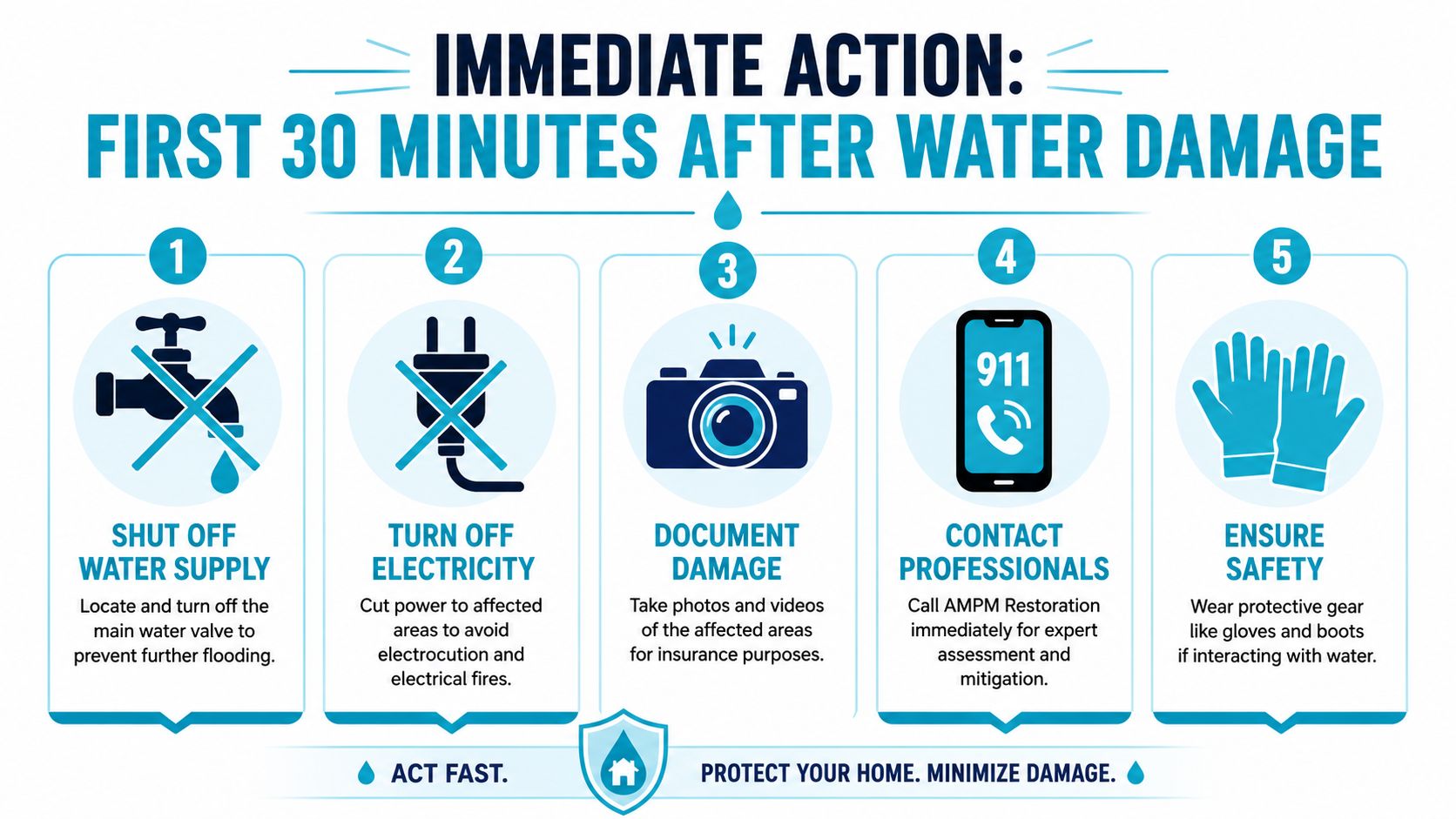
The first 30 minutes
-
Cut the water if the source is inside the home
If a supply line, appliance hose, toilet valve, or water heater is leaking, shut it off immediately. If you can’t isolate the fixture, shut off the main water supply. -
Turn off power to the affected area if it can be done safely
Don’t step into standing water to reach outlets or power strips. If water is near electrical devices, call for help before entering. -
Document before moving too much
Take clear photos of the floor, walls, furniture, source area, and any visible staining or swelling. This helps preserve the timeline and condition for a claim. -
Move what you can without spreading damage
Lift papers, fabric items, electronics, and small furniture out of the wet zone. Put foil, plastic tabs, or blocks under furniture legs if they must stay in place. -
Call a mitigation team for the technical part
Surface drying is not structural drying. Once materials are wet, someone needs to determine where the moisture traveled and what can still be saved.
What homeowners should avoid
A few common choices make the loss worse:
- Don’t use a household vacuum on standing water. It isn’t designed for that hazard.
- Don’t assume clear water is harmless. Hidden moisture still damages materials.
- Don’t close the room and wait. Trapped humidity drives moisture deeper into the assembly.
- Don’t run random fans toward wet walls if the source isn’t controlled and the area hasn’t been evaluated.
If the event involves a drain backup, the hazard profile changes fast.
One outdoor issue many owners miss
Not every water event starts indoors. In this region, exterior drainage often contributes to recurring wetting. Regional guidance recommends extending downspouts at least six feet from the foundation and keeping the grade sloped away from the structure by about 5% for the first 10 feet, as outlined in the Sarasota-area drainage and remediation guide. If runoff keeps feeding the wall or slab edge, indoor drying won’t hold.
For a closer look at the decision window after a loss, AMPM has a useful page on emergency water damage repair in the first 24 hours.
Understanding Water Mitigation Versus Restoration
Homeowners often use the words interchangeably, but they are not the same job.
Mitigation is the emergency response. Restoration is the repair and rebuild that follow. The easiest way to think about it is medical. Mitigation is the emergency room. Restoration is the recovery phase after the patient is stable.
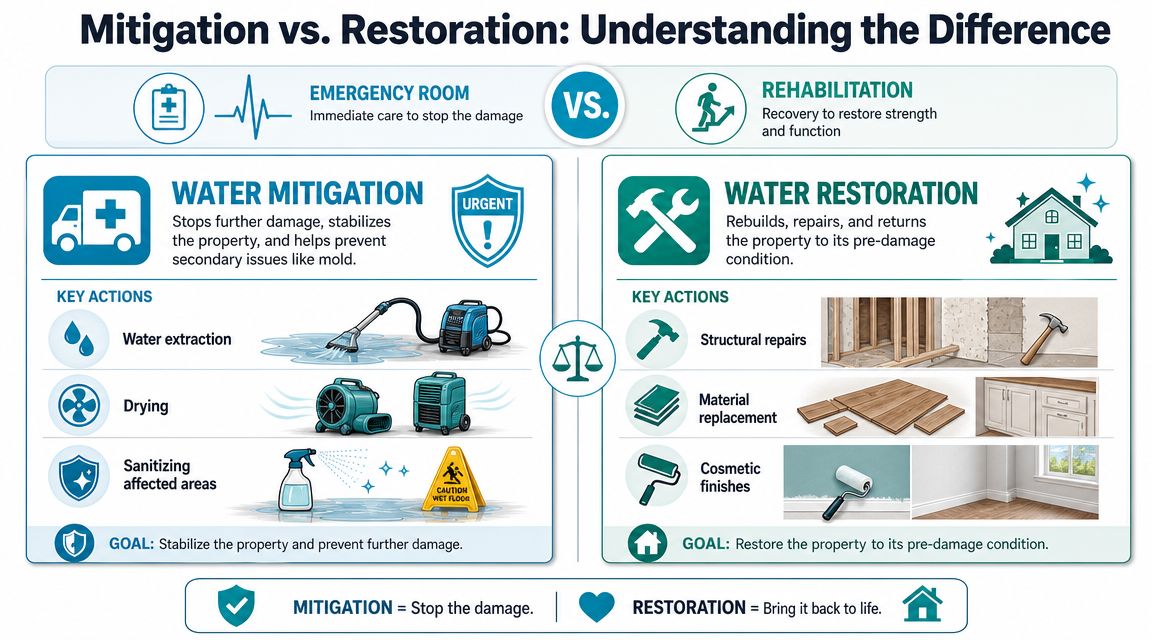
What mitigation actually includes
When a crew handles mitigation properly, they are trying to stop deterioration in real time. Industry guidance defines that phase as stopping the source, extracting standing water, drying affected materials, and monitoring humidity and material moisture until readings return to safe ranges. It also states that the first 24 to 48 hours are critical, and that emergency extraction, selective demolition of unsalvageable materials, and structural drying should begin in that window to reduce mold amplification and concealed structural deterioration, as explained in the water mitigation process guide.
That means mitigation may involve:
- water extraction
- moisture mapping
- removing wet pad or unsalvageable drywall
- setting dehumidifiers and air movers
- daily monitoring of moisture conditions
- documenting the drying path
What restoration includes
Restoration starts after the moisture problem is controlled. That phase may include replacing drywall, reinstalling trim, rebuilding cabinets, resetting flooring, painting, and returning the home to pre-loss condition.
The mistake I see most often is homeowners wanting to jump straight to repairs while materials behind the finish layer are still wet.
That shortcut usually leads to callbacks, odor, recurring staining, warped materials, or mold behind the new work.
Why the distinction matters in Sarasota homes
In a humid climate, the line between “cleanup” and “secondary damage” is thin. Fans alone can make a room feel drier without drying the assembly. Mitigation is the science-based part. Restoration is the finish work after the structure has earned it.
If you want a broader look at how these phases fit together, AMPM outlines the full scope on its water damage restoration services.
The Professional Water Mitigation Process with AMPM
When a mitigation team arrives, the job shouldn’t feel chaotic. A good crew follows a sequence. The goal is to identify what got wet, remove what can’t be saved, dry what can be saved, and document each decision.
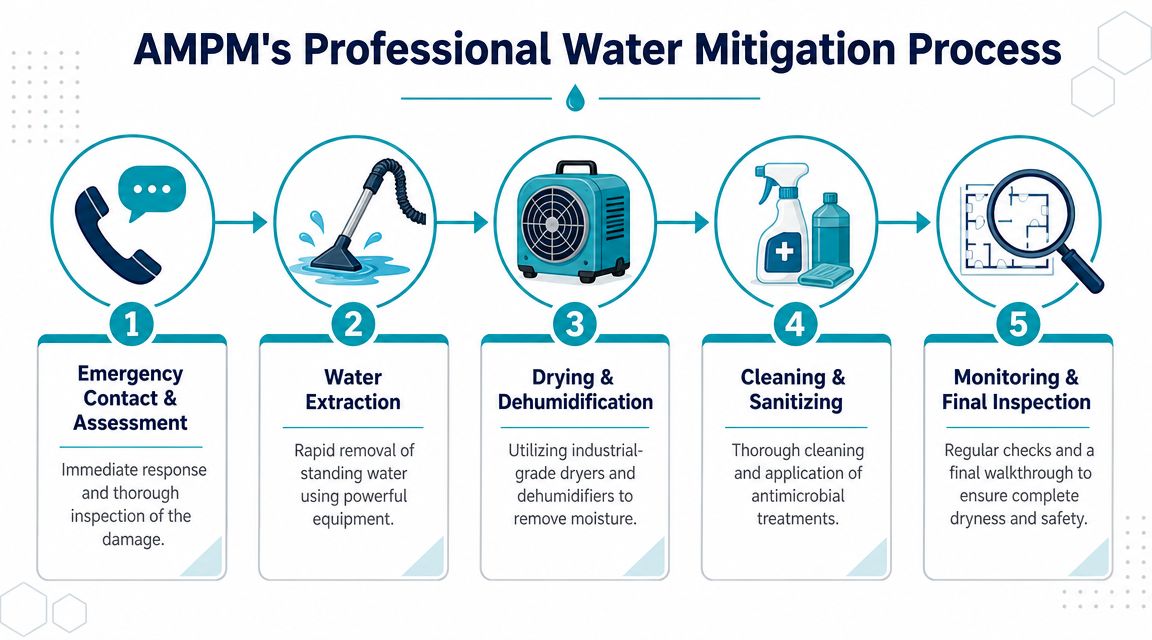
Arrival and inspection
The first step is inspection, not random equipment placement. A project manager or technician checks the source, affected rooms, flooring type, wall construction, and the likely moisture path. Moisture meters help verify what is wet. Infrared cameras can help flag temperature differences that suggest hidden moisture, but they are only useful when confirmed with direct readings.
Water also has to be classified. Clean supply-line water is handled differently than water involving a dishwasher discharge, overflow, or drain backup. That classification changes containment, removal decisions, and cleaning steps.
Extraction and controlled demolition
After inspection, crews remove as much bulk water as possible. Extraction is the fastest way to reduce the load on the structure. If carpet pad, insulation, or drywall is saturated beyond recovery, selective demolition may be necessary to expose framing and let the assembly dry.
Homeowners often hesitate, worrying that removing baseboards or cutting drywall means the damage is getting worse. In reality, controlled opening often prevents a much larger failure later.
Open only what the readings justify. Leave trapped moisture behind, and the wall keeps the problem for you.
Drying and monitoring
Once the area is opened and extracted, drying equipment is placed with a purpose. Air movers support evaporation. Dehumidifiers pull moisture from the air so evaporation can continue instead of stalling. The setup should match the materials, room layout, and moisture load.
Even when the water looks clean, hidden moisture is still the issue. FEMA and EPA guidance stresses that moisture trapped in subfloors, drywall, and insulation can remain long after surfaces look dry, leading to mold growth and structural deterioration, as summarized in the Sarasota water and flood damage guidance page.
Daily monitoring matters because drying isn’t a one-time event. Readings should show that the structure is moving toward dry standards, not just feeling less damp.
Contents, access, and temporary relocation
Sometimes rooms need to be cleared so drying can proceed correctly. If furniture must be moved or stored during a project, homeowners should look for providers that explain liability, valuation coverage, and handling standards clearly. This overview on hiring licensed and insured movers is useful when mitigation overlaps with content handling.
For homeowners comparing practical steps and prevention habits, AMPM also has a page with water damage restoration tips. AMPM Restoration Services handles residential water extraction, structural drying, sanitization, and repair coordination across the Suncoast, which is one option when a Sarasota home needs the mitigation and rebuild phases managed together.
Sarasota’s Unique Water Damage Risks
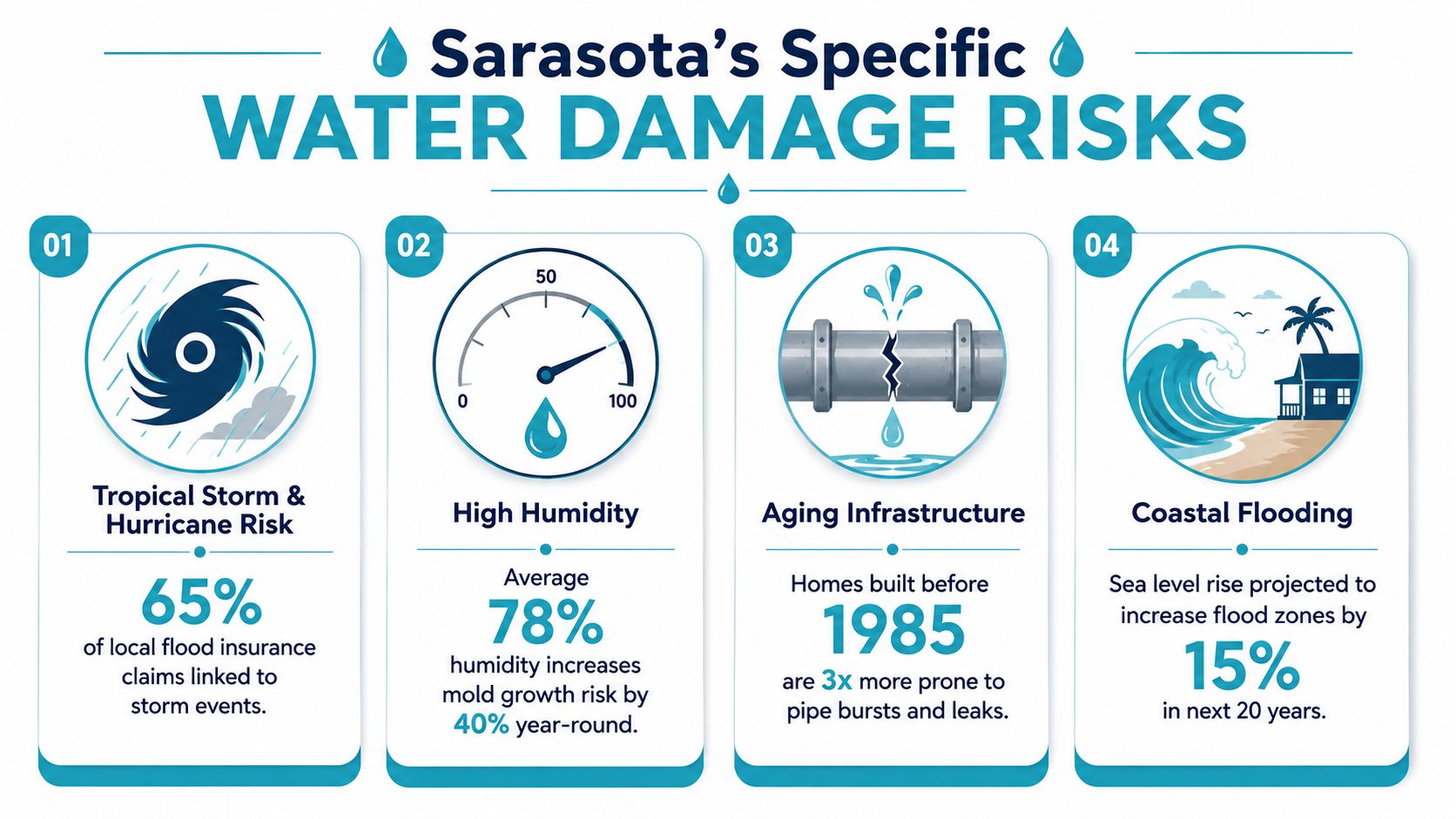
Sarasota doesn’t deal with water damage in a generic way. Local exposure is unusually high, which changes how homeowners should think about response time, prevention, and recurrence.
The flood exposure is broad, not isolated
Independent hazard modeling from ClimateCheck estimates that about 71% of buildings in Sarasota are at risk of flooding, with 63% facing a high risk level. The same source estimates that buildings at risk have about a 65% chance of experiencing a flood about 3.2 feet deep over 30 years, and that 59 of Sarasota’s 75 census tracts have more than half of buildings exposed to storm surge, high-tide flooding, surface flooding, and riverine flooding, according to ClimateCheck’s Sarasota flood risk profile.
For homeowners, that means residential water mitigation in Sarasota isn’t only a hurricane-season issue. It’s a recurring risk tied to geography, drainage, and stormwater behavior.
Public systems matter, but private response still matters too
A local investigation after Tropical Storm Debby reported that county officials downplayed flood risk and failed to maintain parts of the stormwater system, leaving neighborhoods more vulnerable when Debby hit. The same reporting also notes that Sarasota County has stated it made a significant investment in water quality through infrastructure improvements and related initiatives, as covered in this Suncoast Searchlight reporting on Debby flooding and stormwater decisions.
That combination is important. Public infrastructure affects flood behavior, but it doesn’t dry your drywall, cabinet bases, or subfloor after the water gets in.
What that means on-site
In Sarasota homes, I look hard at the full wetting cycle. Did the loss come from storm intrusion, runoff, roof failure, drain backup, or an indoor leak that was made worse by outdoor saturation? That determines whether the job is likely to re-wet after the first dry-out attempt.
A homeowner dealing with storm aftermath may also need broader property recovery beyond interior drying. For storm-specific situations, AMPM provides hurricane cleanup services in Sarasota.
Navigating Costs and Insurance Claims in Florida
The first cost question homeowners usually ask is simple. “How much is this going to be?” The honest answer is that the price depends on scope, water category, how long materials stayed wet, and what has to be removed to dry the structure correctly.
A supply-line leak caught early is a different job than storm intrusion that soaked insulation, cabinetry, and multiple flooring layers. A small clean-water loss may need extraction and equipment. A more involved loss may also require containment, demolition, cleaning, and reconstruction. That’s why a real estimate has to come after inspection and moisture mapping.
What insurance usually needs from you
Insurance carriers want documentation, not just a verbal description. The strongest claim files usually include:
- Photos from the start: Source area, damaged materials, visible staining, and standing water
- Moisture documentation: Readings that show what was wet and how drying progressed
- Scope notes: What materials were affected, what had to be removed, and why
- Cause information: Whether the loss involved plumbing, appliance failure, storm entry, or another source
When the file is organized, the conversation tends to move faster and with less back-and-forth.
The trade-off homeowners should understand
The cheapest-looking option up front isn’t always the least expensive path overall. If someone skips proper drying and goes straight to cosmetic repair, the home can end up needing the same area opened again later. That creates duplicate labor, longer disruption, and more friction in the claim.
A clean claim starts with clean documentation. If the drying record is weak, the repair conversation usually gets harder.
Where a mitigation contractor helps
A mitigation company helps by documenting the job in the language carriers expect: affected materials, moisture conditions, equipment use, and daily progress. That doesn’t mean every claim is simple, but it does mean the homeowner isn’t trying to explain technical drying decisions alone.
If you’re preparing for that process, AMPM has a useful resource on water damage insurance claim tips. Homeowners should also ask about payment options early. Financing can make sense when emergency work needs to start before claim decisions are fully resolved.
Sarasota Water Mitigation FAQs and Your Next Steps
Homeowners usually don’t need more theory at this point. They need direct answers. These are the questions that come up most often on residential jobs.
Frequently Asked Questions
| Question | Answer |
|---|---|
| Can I handle a small water leak myself? | Sometimes, if it was truly minor, caught immediately, and only affected non-porous surfaces. If water reached drywall, baseboards, insulation, cabinets, or flooring seams, it needs a mitigation evaluation because hidden moisture may remain after the surface looks dry. |
| If the water looks clean, do I still need professional help? | Often, yes. Clean-looking water can still soak subfloors, wall cavities, and insulation. The risk is not just contamination. It's trapped moisture that can damage materials if it isn't verified dry. |
| How quickly should mitigation start? | As quickly as possible. The early response window is where you have the best chance of limiting secondary damage and reducing how much material has to be removed. |
| Will I have to tear out all wet drywall and flooring? | Not always. Good mitigation is selective. Some materials can be dried and saved, while others can't. The decision should be based on moisture readings, material type, contamination level, and how long the area stayed wet. |
| Do I have to use the contractor my insurance company suggests? | Homeowners should review their policy and claim instructions carefully, but in many situations you can choose the company performing the work. What matters is proper documentation, communication, and a defensible scope. |
| What should I do while waiting for the crew to arrive? | Stay safe, stop the active source if possible, document the damage, and move vulnerable items out of the wet area if you can do so safely. Avoid unsafe electrical exposure and don't rely on household fans as a substitute for a drying plan. |
The next step that protects the house
If you're dealing with active water damage right now, the priority is simple. Stop the source if you can do it safely. Protect people first. Then get the home evaluated before trapped moisture turns a manageable loss into a larger repair.
Residential water mitigation in Sarasota works best when it starts early, follows moisture data, and treats the problem as structural drying rather than surface cleanup.
If your home has water damage, call AMPM Restoration Services at 941-946-7807 for a free inspection and estimate. We provide 24/7 emergency response across Sarasota and the Gulf Coast, assist with insurance claims, and offer financing options to help you move forward without delay.