

You notice a chalky patch spreading across the back of a closet wall after a long, humid Florida summer. It looks like dust, perhaps residue from a window air-conditioning unit, and wiping it away seems simple. But white mold removal is rarely a cleaning problem first. It's usually evidence that moisture has reached a material, stayed there, and created conditions for growth.
The correct response is to identify the growth, find the water source, protect occupants, remove affected materials when necessary, and verify that the structure is dry. The U.S. Environmental Protection Agency explains that mold cleanup must be paired with correcting the moisture problem, and that wet materials should be dried within 24 to 48 hours to help prevent mold growth (EPA mold and moisture guidance). The CDC gives the same drying window and recommends keeping indoor humidity at or below 50% (CDC mold cleanup guidance).
What White Mold Looks Like and Why It Shows Up in Florida Homes
A Bradenton homeowner may first see a pale bloom on drywall near a closet, window, or air-conditioning area. The patch can look soft and powdery, while another patch may appear almost crystalline. That makes it easy to mistake white mold for efflorescence on concrete block, paint blush, or dust drifting through a window AC unit.
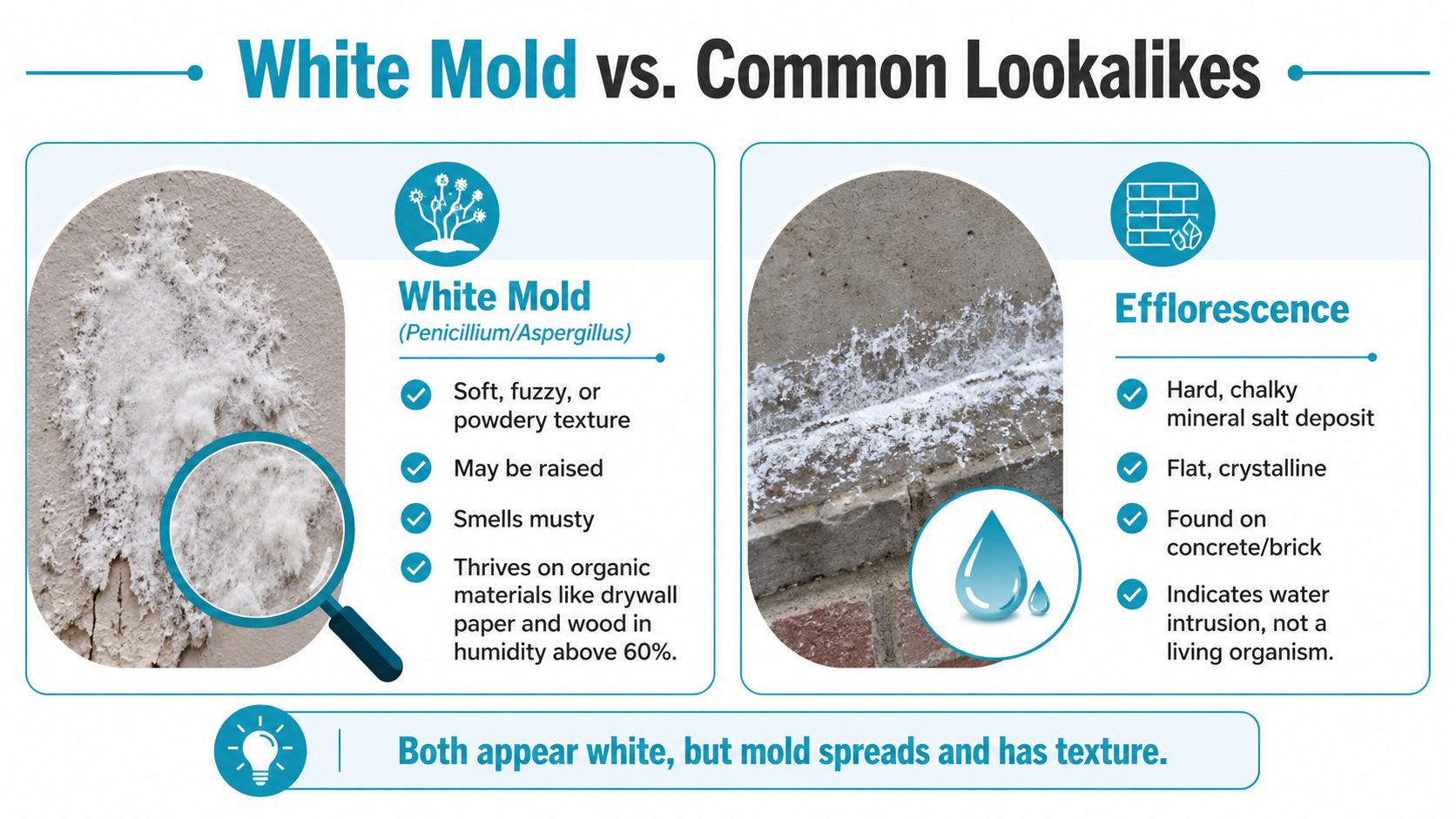
Color alone can't identify mold. White mold is a visual description that may include pale Aspergillus or Penicillium growth, while other molds can also appear light during an early stage. Texture, odor, location, and the material underneath provide better clues. A fuzzy or raised patch on drywall, wood, fabric, or insulation deserves more concern than a hard mineral deposit on masonry.
Efflorescence is a chalky salt deposit created when water moves through concrete, brick, or block and leaves minerals behind as it evaporates. It isn't a living organism, but it still signals water movement. Mold tends to feel soft, fuzzy, or powdery and may carry a musty odor. A homeowner who can't distinguish the two should avoid aggressive scrubbing until the surface and moisture pathway have been assessed.
Florida moisture creates repeat trouble
On the Suncoast, indoor moisture can come from several directions:
- High indoor humidity: Sustained humidity above 60% creates a favorable environment for growth, especially in closets and rooms with limited air movement.
- Air-conditioning failures: A blocked AC condensate line, overflowing drain pan, or poorly insulated duct can wet nearby drywall and framing.
- Storm intrusion: Wind-driven rain, roof damage, and floodwater can leave materials damp after a storm even when the visible surface looks dry.
- Weak ventilation: Bathrooms and kitchens release moisture into the home when exhaust fans are missing, undersized, or vented into an attic.
Common inspection points include AC closets, window sills, the space behind furniture against exterior walls, under kitchen sinks, and attic insulation near soffit vents. White growth on a window frame can be a surface condensation issue, but it can also point toward moisture inside the wall cavity.
Homeowners dealing with stored rugs, carpet, or padding should also review the specific risks of mold in carpets, since porous flooring can retain moisture below the visible surface. For a broader comparison of appearance and response, see white mold versus black mold. Identification should come before opening a bottle of cleaner.
Safety Gear, Containment, and Pre-Cleanup Preparation
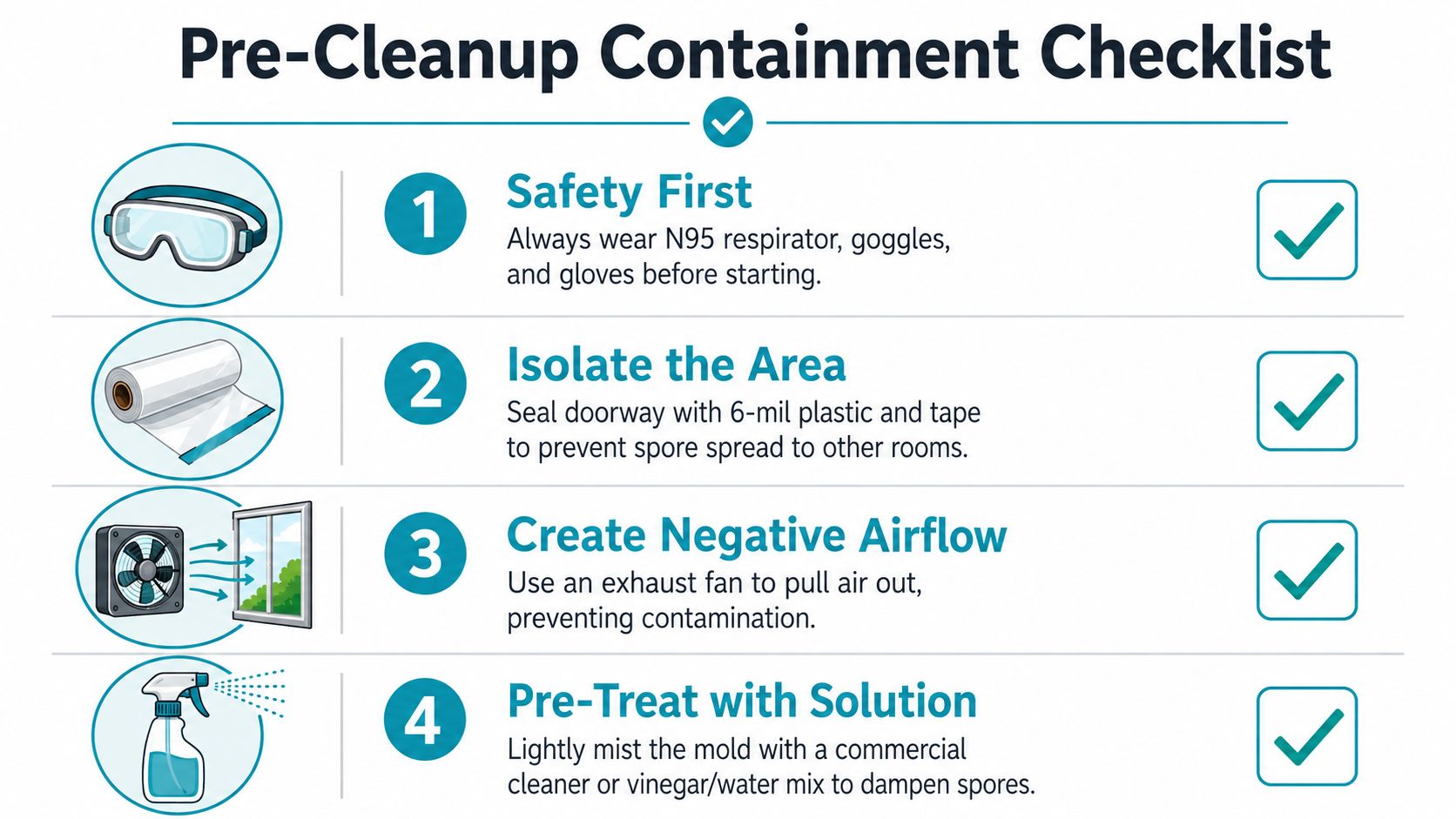
A small patch still deserves a controlled setup. Before touching the growth, remove children, pets, pregnant household members, and immunocompromised people from the work area. Anyone with asthma or significant mold sensitivity should avoid the space during disturbance and cleanup.
Wear a properly sealed N95 respirator at minimum. A P100 respirator is more appropriate for larger contamination or extended work, provided the user knows how to fit and wear it. Add nitrile or chemical-resistant gloves, long sleeves, washable pants, and sealed goggles. Ordinary eyeglasses don't protect the sides of the eyes from splashes or airborne debris.
Keep contamination from following the air
For a contained job, close supply registers in the work area and seal nearby returns with plastic and tape. Larger or more sensitive projects may require 6-mil polyethylene sheeting, sealed seams, and a single entry zipper. The purpose is to control air movement so disturbed spores don't travel into bedrooms, living areas, or the return-air system.
Ventilation requires judgment. During active scrubbing, exhausting air to the outside can help reduce airborne contamination, but running the home's HVAC system may spread particles through the duct network. Shut down the HVAC serving the work zone when appropriate, and don't point a fan from the contaminated area toward clean rooms. If the system itself may be involved, stop work and arrange an inspection rather than trying to compensate with household fans. A separate review of air duct cleaning can be useful when contamination may have entered the air-distribution system.
Never mix chlorine bleach with ammonia, acidic cleaners, or other products. The CDC specifically warns against mixing bleach with ammonia or other cleaners and recommends no more than 1 cup of household bleach per 1 gallon of water when bleach is used (CDC cleanup safety guidance). For many household surfaces, a product such as 3% hydrogen peroxide can be a more practical alternative, but it still requires label compliance, ventilation, and a spot test.
Before cleanup, record the condition with photographs, note odors and affected rooms, and take moisture readings where possible. A homeowner preparing for drywall work can also review safe mold removal from drywall before disturbing the material.
Practical rule: Containment isn't over-preparation. It becomes more important when air movement, porous materials, or HVAC equipment can carry contamination beyond the original patch.
The Cleanup Sequence From Small Patches to Larger Growths
Start with the water source. Check plumbing connections, the AC condensate line and drain pan, roof penetrations, window assemblies, and exterior walls. In Suncoast block construction, also consider failed vapor control, cracks, and water moving through masonry. Cleaning a surface while the leak or condensation continues only resets the clock.
Dry, loose growth should be addressed with a HEPA-filtered vacuum before wet agitation. The vacuum captures settled particulate instead of pushing it across the surface. After that, damp-wipe hard materials with an appropriate cleaner and scrub details such as grout, caulk lines, textured tile, and seams where growth can anchor.
Decide what can stay
Glass, metal, tile, and solid sealed countertops are generally cleanable when their surfaces remain intact. Drywall, carpet, padding, ceiling tile, insulation, and upholstered furniture are different. If those porous materials were wet with floodwater and can't be completely cleaned and dried within 24 to 48 hours, CDC guidance says they should be discarded (CDC mold cleanup tips).
Affected materials that can't be salvaged should be double-bagged in 6-mil or thicker polyethylene, consistent with EPA guidance (EPA containment and disposal guidance). Keep the bags inside containment until removal, wipe their exteriors, and don't carry loose contaminated debris through occupied rooms.
For a growth under 10 square feet, with no HVAC involvement and no hidden moisture concern, a capable homeowner may be able to manage the work with suitable PPE and containment. Larger growth, structural cavities, widespread odor, or duct involvement changes the risk and the required equipment.
| Material Type | Examples | Clean or Discard? | Florida-Specific Note |
|---|---|---|---|
| Non-porous | Glass, metal, tile, sealed countertops | Clean when intact | Check nearby condensation and plumbing before cleaning |
| Semi-porous | Solid wood, sealed masonry | Assess, clean, and dry when salvageable | Masonry deposits may be efflorescence, but moisture still needs attention |
| Porous | Drywall, carpet, padding, ceiling tile | Discard when contaminated or not fully dry | Gulf Coast humidity can leave hidden moisture below the visible surface |
| Fibrous | Insulation, upholstered furniture | Usually discard when extensively affected | Attic and wall-cavity contamination can spread beyond what is visible |
| Contents | Cardboard, clothing, stored fabric | Clean selectively or discard | Move clean items only after the area is dry and contained |
Painting, caulking, or covering the patch isn't removal. The CDC identifies covering mold instead of removing it as a major pitfall because regrowth can continue when moisture persists (CDC prevention tips). Dispose of sealed porous debris with regular trash according to local requirements, not yard waste, where contaminated material could be redistributed.
Knowing When to Stop DIY and Call a Florida Pro
A small white patch on a dry, exposed surface may be manageable. The decision changes when moisture is hidden, the material is porous, or the affected area cannot be isolated. The EPA's small-area benchmark is 10 square feet, but square footage alone does not determine risk. A smaller patch inside a wall, near an air handler, or following floodwater can require professional handling.
Practical stop signs
Call a qualified remediation contractor when:
- The patch exceeds 10 square feet: More affected material increases dust, containment, and disposal demands.
- The odor remains: A musty smell after cleaning often indicates damp insulation, wet padding, hidden moisture, or growth inside a wall cavity.
- HVAC may be involved: Growth near returns, air handlers, or ductwork can distribute particles into occupied rooms.
- Porous materials stayed wet beyond 48 hours: Materials that cannot be cleaned and dried fully may require removal instead of surface treatment.
- The problem follows a storm or roof leak: Water can enter insulation, cavities, and structural components that are not visible from the room.
- Growth returns: Reappearance usually means the moisture failure remains unresolved. Stronger cleaner will not correct a leak, condensation problem, or drainage pathway.
Attics and crawl spaces need extra caution in Florida. Poor ventilation can raise humidity, while heat and limited access make inspection difficult. An AC condensate backup may wet a closet wall behind equipment. White growth around a window frame can point to intrusion through the opening or moisture moving within the wall.
| Scenario | DIY Feasible | Call a Pro |
|---|---|---|
| Small, isolated surface patch | Possibly, if accessible and dryable | If it returns or spreads |
| Growth larger than 10 square feet | No longer a sensible default | Yes, arrange inspection and containment |
| Drywall feels soft or swollen | Usually not | Yes, assess removal and cavity moisture |
| Suspected HVAC involvement | No | Yes, isolate and evaluate the system |
| Post-flood or roof-leak growth | Rarely | Yes, especially with porous materials |
| Musty odor without a visible source | No | Yes, locate hidden moisture |
Professional remediation may involve containment, HEPA air scrubbing, material removal, antimicrobial application, drying, and verification. The trade-off is cost versus control. A contractor can reduce spread and identify concealed damage, but the final price in Bradenton, Sarasota, and Tampa depends on access, affected materials, the moisture source, and reconstruction needs. A responsible company should inspect before offering a firm estimate rather than promise a universal cost band.
Ask whether the company carries appropriate Florida licensing and insurance, whether technicians hold recognized remediation credentials, how containment will be built, how moisture will be documented, and who performs final verification. Photograph existing conditions and preserve invoices. If the damage may result from a covered sudden event, contact your insurance carrier before invasive work. Guidance on when professional mold removal is needed can help organize that discussion.
The health reason for addressing damp buildings is well established. The World Health Organization found sufficient epidemiological evidence linking damp or moldy buildings with increased respiratory symptoms, respiratory infections, and asthma exacerbation (WHO indoor air quality review). A U.S. government review also reported associations with approximately 30% to 50% increases in respiratory and asthma-related outcomes and estimated that 21% of U.S. asthma cases could be attributed to dampness and mold in housing if the association is causal (NCBI government review). These findings do not make every white patch an emergency. They do support stopping when the source, materials, or air-handling system cannot be controlled safely.
Drying, Verification, and Post-Remediation Checks
A wall can look clean while moisture remains beneath baseboards, inside drywall edges, under flooring, or in attic insulation. Florida's heat can dry the surface quickly while a cavity stays damp enough to support another bloom. Treat drying as the closeout of a moisture failure, not as the last wipe-down.
Measure affected materials with a moisture meter, then compare readings with nearby unaffected materials of the same type. Record the readings, locations, and dates. Dehumidifiers, air movers, and controlled exhaust must match the room and moisture load. A small portable unit may help a closet, while substantial wetting can require professional low-grain-refrigerant equipment and a controlled plan. The tradeoff is straightforward: slower drying costs time, but aggressive airflow without containment can move dust and spores into clean areas. A documented structural drying method helps set equipment placement and drying targets.
What complete work looks like
A proper closeout should include:
- Moisture correction: The leak, condensation source, drainage failure, or intrusion pathway has been repaired.
- Material removal: Unsalvageable drywall, insulation, padding, or other porous materials have been removed inside containment.
- Surface cleaning: Hard surfaces have been scrubbed, rinsed or wiped as appropriate, and dried.
- HEPA finishing: Once materials are dry and contaminated contents are removed, final HEPA vacuuming captures settled particulate. For major cleanup, containment may use fire-retardant 6-mil polyethylene with negative pressure, consistent with the IICRC S520 standard history.
- Verification: Moisture readings, photographs, equipment logs, and any agreed testing results are recorded.
The Institute of Inspection, Cleaning and Restoration Certification first published its S520 mold remediation standard in 2003, followed by editions in 2008, 2015, and 2024. That history reflects the profession's move toward defined practices for containment, removal, and verification instead of cosmetic cleaning alone.
Antimicrobial treatment may suit some cleaned hard surfaces, but it cannot replace source removal or drying. Clearance testing or third-party air sampling can be appropriate after a large project, HVAC concern, extensive hidden growth, or a property transfer. Testing should answer a defined question, not replace visual inspection and moisture documentation.
Before signing off, confirm that the original odor is gone, affected materials are dry, containment was removed without spreading debris, and HVAC concerns were addressed. Request photographs, readings, equipment records, and any agreed test results. Keep the file for insurance, real estate, and tenant records.
Stopping White Mold From Coming Back on the Suncoast
White mold returns when moisture remains available. On the Suncoast, air-conditioning, outdoor humidity, storm exposure, and condensation can keep a building damp even after a surface looks clean. Use properly sized air-conditioning, add dehumidification when needed, and place a hygrometer in rooms with a history of condensation. Keep indoor humidity controlled, and correct roof, wall, plumbing, or drainage leaks before they wet the same materials again.
Watch for early warning signs: window condensation, damp closet corners, misting near supply registers, peeling paint, or a musty odor. Treat AC drip pans and condensate lines as recurring maintenance points. A slow drain backup can repeatedly wet one wall, allowing growth to return before anyone sees it.
Room-by-room habits that matter
Bathrooms need exhaust that routes outdoors, not into an attic. Kitchens need effective capture over cooking surfaces, and laundry areas need dryer ventilation that releases warm, wet air outside the building. Older Florida homes may require a carefully evaluated ventilation strategy. Supply-only systems can pressurize a leaky building and push moisture into wall or ceiling assemblies.
Leave space between furniture and exterior walls, avoid tightly packed closets, and store vulnerable fabrics in dry, ventilated areas. Cardboard placed against concrete or block can hold moisture against the wall. Outside, inspect gutters, downspouts, grading, irrigation overspray, and landscaping that keeps soil or mulch against the exterior.
Use a seasonal maintenance rhythm rather than relying on a fixed calendar. Recheck humidity and condensate management as conditions shift from drier winter weather into the wetter season. Inspect attics, crawl spaces, areas beneath sinks, and window assemblies after major storms. These moisture-control practices for stopping mold from coming back work best before another visible failure.
Bradenton-area homeowners should arrange a site assessment when growth recurs, odor has no clear source, or storm moisture remains. Early investigation can help prevent damage from reaching framing, insulation, or HVAC equipment. AMPM Restoration Services provides emergency water damage restoration, mold inspection and removal, fire and smoke restoration, storm and flood cleanup, commercial restoration, and reconstruction across Bradenton, Sarasota, Tampa Bay, Saint Petersburg, Lakewood Ranch, and nearby Gulf Coast communities. Call 941-946-7807 for a free inspection and estimate, and ask about insurance claim assistance and financing options.
AMPM Restoration Services can inspect the moisture source, contain affected areas, dry the structure, remove unsalvageable materials, and coordinate repairs when white mold returns after cleaning. Visit AMPM Restoration Services or call 941-946-7807 for a free inspection and estimate, with insurance claim assistance and financing options available.
Frequently asked questions
Is white mold dangerous?
White mold is not automatically safer because it looks pale. Damp, moldy buildings can contribute to respiratory problems, with greater concern for people who have asthma or weakened immune systems. Address the moisture source and avoid disturbing substantial growth without suitable protection.
How can I tell white mold from efflorescence?
Efflorescence is a hard, crystalline mineral deposit on concrete, brick, or block. White mold is more likely to feel soft, fuzzy, or powdery and can grow on drywall, wood, fabric, or insulation. Color alone cannot confirm the material.
Can I remove a small patch myself?
A small visible patch may be manageable when the source is corrected, the area is isolated, and no HVAC system or hidden cavity is involved. Wear respiratory protection, gloves, and goggles. Stop if the material is soft, the odor persists, or the patch spreads.
Should I use bleach for white mold removal?
Never mix bleach with ammonia, acids, or other cleaners. Bleach does not replace physical removal and drying, especially on porous materials. Follow the product label and choose a cleaner suited to the surface.
When should I discard drywall or carpet?
Discard porous material when it cannot be cleaned and dried completely, especially after floodwater exposure or prolonged wetting. Drywall, padding, insulation, ceiling tile, and upholstered items can retain moisture below the visible surface.
How do I prevent white mold from returning?
Control humidity, repair leaks, maintain AC condensate systems, ventilate bathrooms and kitchens outdoors, keep furniture away from exterior walls, and inspect attics and crawl spaces after storms. Recurring growth calls for a moisture-focused inspection, not repeated surface cleaning.