

A lot of Sarasota homeowners call after the same sequence of events. A storm rolls through, the AC runs hard for days, a closet starts smelling musty, and then a dark stain shows up near a baseboard, bathroom ceiling, or vent. At that point, they aren’t just asking what mold is. They want to know how serious it is, whether it can spread, whether insurance will help, and how fast someone can fix it without tearing the whole house apart.
If you’re searching for mold removal Sarasota FL, that concern is justified. In this climate, mold isn’t rare and it usually isn’t a simple wipe-and-forget problem either. The right response is controlled, technical, and centered on moisture correction first. If you want a practical overview of what proper remediation looks like, this guide on how to remediate mold is a useful starting point before any cleanup begins.
Your Guide to Professional Mold Removal in Sarasota FL
A homeowner in Sarasota often notices mold indirectly before they ever see it. The first clue is usually odor. Then come subtle signs like bubbling paint, an AC smell that doesn’t go away, or allergy symptoms that seem worse in one room than the rest of the house.
That matters because visible growth is only part of the problem. Mold often follows a moisture path. Roof leaks, plumbing failures, floodwater intrusion, shower humidity, and HVAC condensation can all leave hidden contamination inside drywall, cabinetry, insulation, and duct areas.
Professional mold removal Sarasota FL is built around one question: where is the moisture coming from? If that answer is missed, cleanup becomes temporary.
Homeowners also tend to face two bad options at first. One is waiting too long and hoping the smell fades. The other is trying to kill it with household spray, bleach, or a fan. Neither addresses hidden growth, airborne spores, or the reason mold took hold in the first place.
The process that works is straightforward, even if it’s technical:
- Find the source before opening walls or cleaning surfaces.
- Isolate the affected area so spores don’t spread.
- Remove contamination safely with proper filtration and disposal methods.
- Dry the structure fully so regrowth doesn’t start behind the repair.
- Document everything if there’s any chance an insurance claim may apply.
That’s the difference between cosmetic cleaning and remediation. One makes the area look better. The other is meant to return the space to a safe, stable condition.
Why Mold Thrives in Sarasota and The Risks It Poses
Sarasota gives mold exactly what it wants. Moisture, warmth, and long periods of indoor humidity make homes and buildings vulnerable even when there hasn’t been a major leak.
Sarasota’s humid climate, with average indoor humidity levels ranging from 60% to over 80%, peaking during rainy summer months, creates ideal conditions for mold proliferation in hidden areas like bathrooms, kitchens, behind walls, and HVAC systems according to this local overview of common places mold hides in Sarasota.
Where mold usually starts
In this area, mold doesn’t always begin where people expect. Bathrooms and kitchens are common, but hidden wall cavities and HVAC systems are frequent trouble spots because they stay damp and dark.
Look closely at places like these:
- Window areas: Condensation on frames, sills, and nearby drywall can support growth. If you’ve noticed recurring spotting near glass, this guide on black mold on window sills gives helpful context on why those areas keep returning.
- Behind cabinets and vanities: Slow plumbing drips often stay unnoticed until material starts swelling.
- Air handlers and duct runs: Cool surfaces plus humid air create a steady condensation risk.
- Closets on exterior walls: Low airflow traps moisture.
- Behind drywall and baseboards: A past leak can leave active growth long after the visible stain dries.
For homeowners dealing with dark staining specifically, this page on what causes black mold in homes helps connect the visible signs to the underlying moisture conditions.
Why the health concerns are real
Mold exposure doesn’t affect everyone the same way, but the concerns are not theoretical. In occupied homes, common complaints include allergic reactions and respiratory problems, especially when spores are circulating through living spaces or HVAC systems.
Mold in a bathroom corner is one thing. Mold tied to an air return or wet wall cavity is a different level of exposure because the home can keep redistributing particles.
That’s one reason Florida health guidance puts the emphasis on prompt removal of indoor mold and on controlling moisture first. If the source remains active, cleaning surfaces alone won’t solve the indoor air issue.
Why delay usually makes the job harder
A small patch isn’t always a small job. If moisture stays present, mold can move behind finish materials and into porous components that can’t be cleaned in place.
The practical risk isn’t just appearance. It’s damage to drywall, insulation, trim, contents, and indoor air quality. The longer it sits, the more likely the project shifts from surface cleanup to containment, demolition, drying, and reconstruction.
The IICRC-Certified Mold Remediation Process Explained
Proper remediation follows a sequence. That sequence matters because every step protects the next one. If a crew starts tearing out moldy material before containment is established, they can spread contamination into clean rooms.
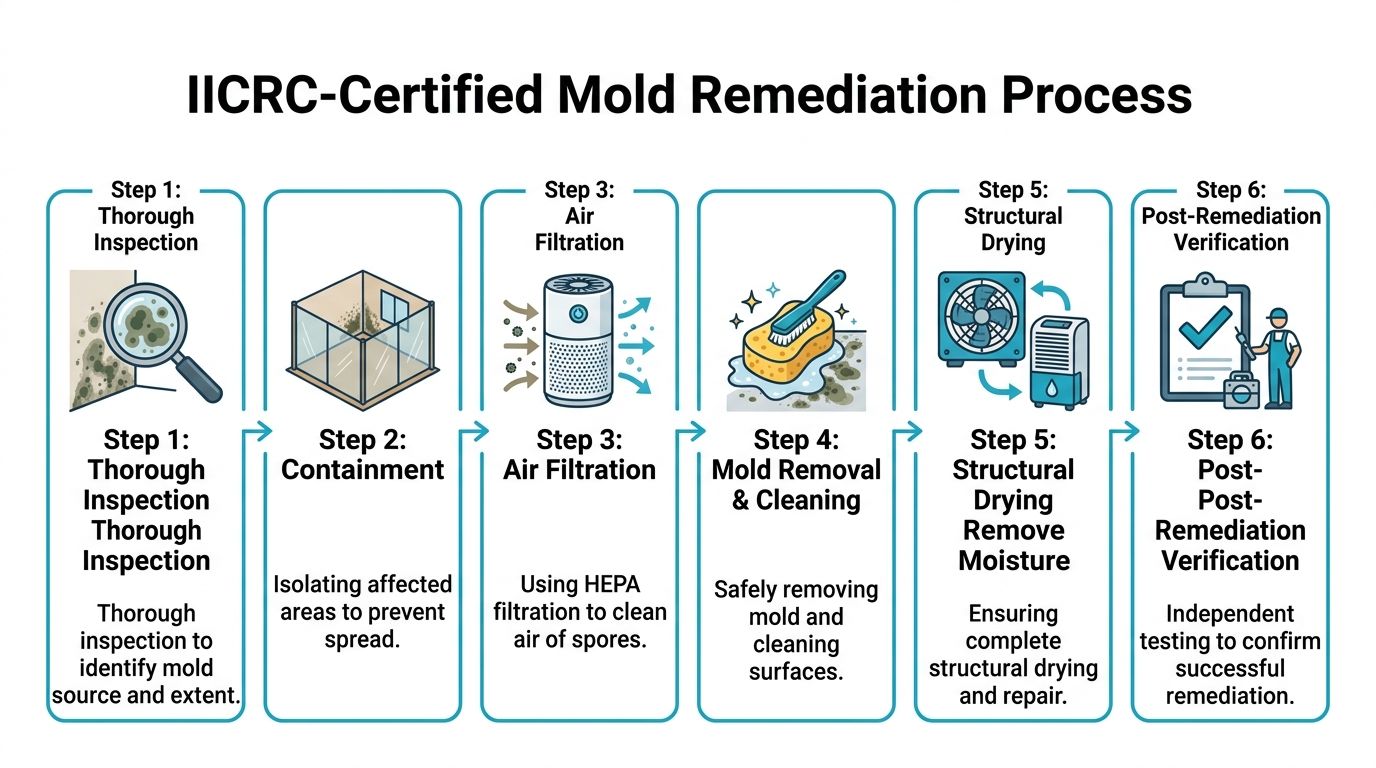
Inspection and moisture mapping
The first task is identifying the active moisture source and the extent of impact. That usually means a visual inspection plus moisture meters, infrared thermal imaging when needed, and targeted opening of suspect areas if evidence supports it.
A good assessment separates three different conditions:
| Condition | What it means | What the crew does |
|---|---|---|
| Visible growth | Mold is present on an exposed surface | Evaluate material condition and contamination pattern |
| Hidden moisture | Material is wet but growth may be concealed | Trace leak, condensation, or humidity source |
| Secondary spread | Spores may have moved beyond the original source | Plan containment and filtration before disturbance |
This is also where the work is scoped. Some materials can be cleaned. Others need removal because they’re porous, soft, deteriorated, or contaminated through the full thickness.
If you’re comparing the initial evaluation phase with the actual cleanup phase, this overview of mold assessment vs. mold remediation lays out that distinction clearly.
Containment before demolition
Containment is not optional. It’s one of the biggest differences between a professional job and an improvised cleanup.
Professional mold remediation requires establishing negative air pressure using HEPA air purifiers within the work area. This creates a directional airflow that pulls mold spores toward collection units rather than allowing them to migrate to unaffected areas, as noted in this Sarasota remediation reference from Thumbtack.
That’s why you’ll see poly barriers, sealed openings, and controlled entry points. Without that setup, opening a wet wall or pulling contaminated insulation can drive spores into bedrooms, hallways, and return ducts.
Practical rule: If the area isn’t isolated first, the cleanup can become the event that spreads mold farther through the home.
Air filtration and controlled removal
Once containment is active, HEPA air scrubbers run continuously in the work area. Technicians then remove unsalvageable materials, HEPA vacuum accessible surfaces, and clean structural elements that can be preserved.
This part of the process is selective. A trained crew doesn’t treat every material the same way.
- Drywall and insulation: Often removed if contamination is established within the material.
- Wood framing: Usually cleaned, detailed, and dried if structurally sound.
- HVAC-adjacent components: Handled carefully because disturbance near returns and ducts can spread spores quickly.
- Contents and furnishings: Evaluated separately based on material type, exposure, and cleanability.
Household vacuums don’t belong in this process. They aren’t designed for mold remediation and can make airborne contamination worse. Professional HEPA filtration is built for fine-particle capture during cleanup.
Cleaning, treatment, and structural drying
After removal, the remaining structure is cleaned in detail. Depending on the surface and conditions, technicians may use HEPA vacuuming, damp wiping, sanding or abrasion where appropriate, and antimicrobial products labeled for the application.
Then comes drying. Many failed jobs fall apart at this stage. If surfaces look clean but moisture remains in framing, sheathing, subfloor, or cavity air, mold can return behind the repair.
Drying usually involves:
- Targeted dehumidification to lower interior moisture load.
- Air movement placed for drying, not for cross-contaminating unaffected space.
- Monitoring so material moisture trends are moving in the right direction.
One factual option in this area is AMPM Restoration Services, which provides mold remediation and related drying and recovery work across Sarasota and surrounding Gulf Coast communities. The key point for any provider is the same. They need to handle both contamination removal and moisture correction, not just surface cleanup.
Clearance and rebuild readiness
The end of remediation is not when the visible mold is gone. It’s when the affected area has been cleaned, dried, and is ready for safe reconstruction or normal occupancy.
That final stage may include visual verification, site documentation, and, when the project calls for it, third-party clearance testing. A careful crew also makes sure the original moisture issue has been addressed, whether that means plumbing repair, drainage correction, HVAC service, or humidity control changes inside the home.
The goal isn’t to bleach a stain. The goal is to remove contamination, control the air, fix the moisture path, and leave a dry structure behind.
Estimating Mold Removal Costs and Timelines in Sarasota
Cost questions usually come early, and they should. Mold work varies because the full scope isn’t just the stain you can see. It’s the material affected, the amount of containment needed, whether HVAC components are involved, and whether reconstruction is part of the job.
In Sarasota, FL, the average cost for mold remediation ranges from $1,222 to $3,751, depending on the severity of the infestation. Nationally, similar costs average around $2,347, according to this local cost reference on mold remediation in Sarasota.
What changes the price
Two jobs with similar-looking mold can price very differently. One may involve a bathroom vanity wall with limited removal. Another may involve multiple rooms, high moisture, HVAC contamination concerns, and finish materials that need replacement.
The main cost drivers are usually:
- Extent of hidden impact: Surface growth is one thing. Wet cavities and concealed spread increase labor and material removal.
- Location of contamination: Tight attics, crawlspaces, and mechanical areas are slower and more complex to remediate.
- Containment requirements: The more isolation and filtration needed, the more setup and monitoring the job requires.
- Drying needs: Some losses need dehumidification and several days of moisture tracking before rebuild can begin.
- Repairs after remediation: Removing damaged drywall, insulation, trim, or cabinets is only part of the total project if reconstruction is also needed.
What affects the timeline
Timelines depend on moisture behavior as much as visible mold. A contained area with limited material removal may move quickly. A property with multiple wet assemblies takes longer because the structure has to dry before closure.
A realistic way to think about timing is:
| Project factor | Effect on schedule |
|---|---|
| Small isolated area | Usually shorter if moisture is already controlled |
| Active leak or humidity issue | Cleanup may pause until the cause is corrected |
| Wet framing or subfloor | Drying and monitoring extend the job |
| Post-remediation repairs | Reconstruction adds time after the remediation phase |
Fast action saves time later. The earlier the moisture source is found and contained, the less demolition and drying the project usually requires.
The right estimate should explain what is included, what may change once materials are opened, and whether insurance documentation is part of the package.
Navigating Florida Insurance Claims for Mold Damage
Insurance is where many Sarasota homeowners get frustrated. They assume mold is covered because water caused it. Carriers often look at it differently.
In Florida, mold coverage commonly turns on cause, not just condition. If mold developed from a covered peril, such as certain storm-related or sudden water events, there may be a path to coverage. If it developed from long-term seepage, deferred maintenance, or a policy exclusion, the claim can become much harder.
Many Florida insurance claims for mold fail due to policy exclusions unless the mold is tied to a covered peril like a storm. Data from Florida insurance disputes in 2025 showed over 20% of water/mold claims were denied in high-humidity coastal areas like Sarasota, according to this local insurance-focused article on mold removal in Sarasota.

What homeowners should do immediately?
The first response after discovering mold can affect the claim. Waiting too long, throwing materials away before documenting them, or failing to connect the mold to the original water event can weaken your file.
Take these steps early:
- Photograph the damage: Include wide shots, close-ups, and the likely water source.
- Document the timeline: Note when you first saw staining, odor, moisture, or active leaking.
- Protect the property: Mitigate further damage if it can be done safely.
- Review your policy language: Focus on mold exclusions, sudden water damage wording, and endorsements.
- Request professional documentation: Carriers respond better to organized records than verbal descriptions.
If the mold followed a water loss, this article on does home insurance cover water damage can help you understand the coverage issue before speaking with the adjuster.
Why professional documentation matters
Often, people find themselves at a disadvantage. A homeowner may know the closet got wet after a storm, but the insurer usually wants evidence that connects the mold to the covered event and shows the mitigation steps taken afterward.
Useful claim support often includes:
| Documentation | Why it matters |
|---|---|
| Site photos | Establishes visible conditions and affected materials |
| Moisture findings | Shows where active or residual water is present |
| Scope notes | Explains what must be removed, cleaned, and dried |
| Cause analysis | Helps tie mold to a covered water event when supported by facts |
| Invoice and communication records | Creates a clean timeline for adjuster review |
A restoration contractor can also help you avoid a common mistake. Some homeowners only report mold, when the stronger claim issue is the underlying water damage event that led to it.
Insurance adjusters don’t approve claims based on smell or suspicion. They approve them based on documented cause, visible impact, and policy language.
For homeowners trying to understand policy distinctions after flooding, this explanation of what flood insurance covers is a useful reference point.
The trade-off of handling the claim alone
You can call the carrier yourself and manage the process solo. Sometimes that works fine on a simple loss. But if the source is disputed, if mold appeared days after a storm, or if the insurer questions whether the damage was long-term, professional documentation becomes much more important.
That doesn’t guarantee coverage. Nothing does. But it gives the carrier a clear, technical file instead of a vague complaint, and that usually puts the homeowner in a better position.
Your Local Partner for 24/7 Mold Remediation
When mold shows up, speed matters. Not rushed work. Controlled work that starts quickly, stops further spread, and keeps the project moving toward dry, repair-ready conditions.
That’s why local response matters in mold removal Sarasota FL. A team familiar with Gulf Coast humidity, storm losses, AC condensation issues, and older Florida building assemblies will usually spot the common failure points faster than someone treating the job like a generic cleanup.
For homeowners who want the process started without delay, a free mold damage inspection is often the most practical first step. It gives you a documented starting point, a scope of work, and a clearer sense of whether the issue appears isolated or more widespread.
What most property owners need from a remediation company is simple:
- 24/7 emergency response when moisture and contamination can’t wait.
- IICRC-certified handling so containment, filtration, and removal follow accepted practice.
- Insurance claim assistance so documentation doesn’t become your second full-time job.
- Repair coordination because many mold projects don’t end at demolition.
- Financing options when out-of-pocket timing matters.
True value isn’t just getting rid of what you can see. It’s having a crew that can inspect, contain, dry, document, and carry the job through the difficult middle stage when the house feels disrupted and decisions need to be made quickly.
Frequently Asked Questions About Mold Removal in Sarasota
| Question | Answer |
|---|---|
| Can I clean mold myself if it looks small? | Sometimes a minor surface issue can appear manageable, but the risk is misjudging hidden moisture or spreading spores during cleanup. If there’s a musty odor, recurring growth, water damage history, or nearby HVAC involvement, professional evaluation is the safer route. |
| How quickly should mold be addressed? | As soon as you find it. Mold problems rarely improve with time in Sarasota’s climate. Fast action helps limit spread, reduces material damage, and can improve the chances of documenting the loss properly for insurance. |
| What does professional mold remediation include? | A proper job usually includes inspection, moisture source identification, containment, HEPA air filtration, controlled removal of contaminated materials, detailed cleaning, drying, and documentation. The exact scope depends on what materials were affected and why the mold developed. |
| Does homeowners insurance cover mold removal in Florida? | It depends on the policy and the cause of loss. Coverage is often stronger when mold is tied to a covered water event rather than long-term moisture or maintenance issues. Documentation matters. |
| Will mold come back after remediation? | It can if the moisture source isn’t fixed. Good remediation is not just cleaning visible growth. It also includes drying, moisture control, and addressing the original cause so the conditions that supported mold are removed. |
| How do I get started with mold removal Sarasota FL? | Start with an inspection. A trained team can identify the moisture source, determine whether the issue is isolated or hidden, explain the containment plan, and help you understand next steps for pricing, timing, and insurance documentation. |
If you need help with mold removal Sarasota FL, contact AMPM Restoration Services for a free inspection and estimate. Call 941-946-7807 any time for 24/7 response. We assist with insurance claims, offer financing options, and help homeowners across Sarasota, Bradenton, Tampa Bay, Saint Petersburg, Lakewood Ranch, and surrounding Gulf Coast communities move from uncertainty to a clear remediation plan.